
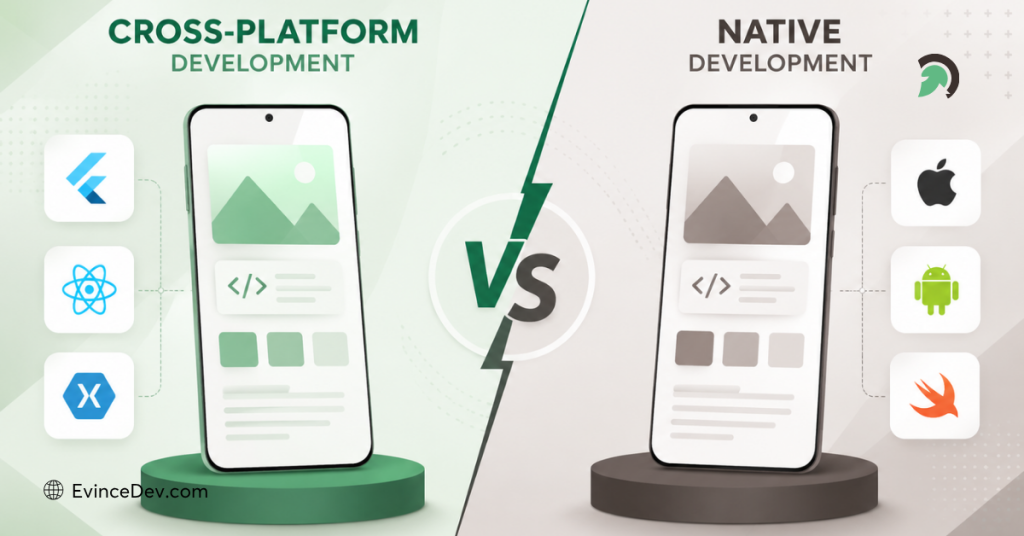
Key Takeaways
- Right Approach Matters: The choice between native and cross-platform development affects cost, speed, performance, scalability, and maintenance.
- Cross-Platform Saves Time: Cross-Platform Mobile Development is ideal for faster launches, MVPs, startups, and apps targeting both Android and iOS.
- Native Offers More Control: Native development works best for apps needing high performance, advanced security, complex animations, or deep device integration.
- Framework Choice Is Important: Flutter, React Native, Kotlin Multiplatform, and other frameworks should be selected based on app goals and team expertise.
- Business Goals Should Lead: The best development approach depends on your app features, budget, timeline, target users, and long-term roadmap.
Choosing between native development and Cross-Platform Mobile Development is one of the first major decisions businesses face when building a mobile app. This choice affects your development cost, timeline, performance, user experience, scalability, maintenance, and even the kind of development team you need.
For a beginner, the difference may seem technical at first. But in reality, it is a business decision too. Native development gives you deeper platform control and high performance. Cross-Platform Mobile Development helps you build apps for both Android and iOS using a shared codebase, which can reduce time and cost.
Both approaches are useful. The better choice depends on what kind of app you are building, how fast you want to launch, how much you want to invest, and how complex your app features are.
In this blog, we will explain what native and cross-platform development mean, how they compare, their pros and cons, popular frameworks, use cases, cost differences, performance considerations, security factors, and how to choose the right approach for your business.
Quick Stat:
According to Sensor Tower’s State of Mobile 2025 report, mobile users spent 4.2 trillion hours on apps in 2024, showing how deeply mobile apps are now part of everyday digital behavior.
What Is Native Mobile App Development?
Native mobile app development means building an app specifically for one operating system, such as iOS or Android. The app is created using the official tools, programming languages, and software development kits provided by that platform.
For iOS apps, developers commonly use Swift or Objective-C with Apple’s development environment, Xcode. For Android apps, developers commonly use Kotlin or Java with Android Studio.
If a business wants to launch an app on both iOS and Android, native development usually requires two separate codebases. One app is built for iPhone users, and another app is built for Android users. Both apps may offer the same features, but they are developed separately using different technologies.
Native apps are built using official platform tools and SDKs, which give developers deeper access to device features such as camera, GPS, Bluetooth, sensors, biometrics, notifications, storage, and operating system-level capabilities.
Because native apps are designed for a specific platform, they often deliver strong performance, smooth user experience, and better control over device-specific functionality.
Quick Stat:
According to Sensor Tower’s State of Mobile 2025 report, global consumer spending on mobile apps reached $150 billion in 2024, growing 13% year over year.
Simple Example of Native App Development
Imagine you are building a banking app.
With native development, your team would create one iOS app using Swift and one Android app using Kotlin or Java. Both apps may allow users to log in, check account balances, transfer money, receive alerts, and manage cards.
To the user, both versions may look similar. But behind the scenes, the iOS app and Android app are built separately. Each version follows the design standards, security practices, and technical requirements of its own platform.
This approach is useful when the app needs strong security, high performance, smooth interactions, and deep access to device features.
Common Native Development Tools
Common native development tools and technologies include:
|
Platform |
Languages and Tools |
|
iOS |
Swift, Objective-C, Xcode, iOS SDK |
|
Android |
Kotlin, Java, Android Studio, Android SDK |
Swift is widely used for modern iOS development. Kotlin is widely used for modern Android development. These technologies help developers build apps that feel natural to users on each platform.
What Is Cross-Platform Mobile Development?
Cross-Platform Mobile Development means building one mobile app that can run on multiple platforms, mainly Android and iOS, using a shared codebase.
Instead of creating two separate apps from scratch, developers write most of the code once and reuse it across both platforms. Some platform-specific adjustments may still be needed, but the overall development effort is usually lower compared to building two separate native apps.
This approach has become very popular in modern mobile application development because businesses often want to reach both Android and iOS users without doubling the development cost or timeline.
Cross-platform mobile app development is commonly used for startups, MVPs, eCommerce apps, marketplaces, booking apps, food delivery apps, fitness apps, EdTech apps, internal business tools, and many other business applications.
Expert Note:
Cross-platform development works best when the Android and iOS versions need mostly the same features, workflows, and user experience. If both platforms require very different behaviors, native development may be easier to manage long term.
Simple Example of Cross-Platform Development
Imagine you are building a food delivery app.
With cross-platform development, your team can create one shared app codebase that works on both Android and iOS. The app can include login, restaurant listings, food categories, cart, payment, order tracking, delivery updates, customer support, and push notifications.
Instead of building the Android and iOS apps separately, developers can reuse much of the same code. This helps launch the app faster and makes future updates easier.
Popular Cross-Platform Frameworks
Some popular frameworks used for Cross-Platform Mobile Development include:
|
Framework |
Common Use |
|
Flutter |
Custom UI, visually rich apps, MVPs |
|
React Native |
Apps using JavaScript and React ecosystem |
|
Kotlin Multiplatform |
Shared business logic with native UI flexibility |
|
.NET MAUI |
Enterprise apps and Microsoft-based environments |
|
Ionic |
Web-based mobile apps and simple prototypes |
|
NativeScript |
Apps using JavaScript or TypeScript with native APIs |
Each framework has its own strengths. The right choice depends on your app features, performance needs, team skills, budget, and long-term roadmap.
Expert Perspective:
A technically strong framework can still fail if the team does not have the right experience with it. Flutter, React Native, and Kotlin Multiplatform should be selected based on both app needs and available engineering expertise.
Cross-Platform vs Native Development: Quick Comparison Table
|
Factor |
Native Development |
Cross-Platform Development |
|
Codebase |
Separate codebase for iOS and Android | Mostly one shared codebase |
| Cost | Usually higher |
Usually lower |
|
Development time |
Longer if building for both platforms | Faster for multi-platform launch |
| Performance | Best possible performance |
Good to near-native performance |
|
User experience |
Highly platform-specific |
Consistent across platforms |
|
Maintenance |
More complex because of two codebases |
Easier in many cases |
|
Device feature access |
Strongest access |
Good access, but may need plugins or bridges |
|
App size |
Usually more optimized |
Can be larger depending on the framework |
|
Scalability |
Strong for complex apps |
Strong for many business apps |
|
Best for |
Gaming, fintech, healthcare, complex apps |
MVPs, startups, eCommerce apps, business apps |
Key Differences Between Native and Cross-Platform Development
1. Development Approach
Native development uses platform-specific technologies. This means developers build separate apps for iOS and Android.
Cross-Platform Mobile Development uses a shared codebase. Developers can write most of the code once and reuse it across platforms. This reduces duplicate work and helps businesses launch faster.
2. Performance
Native development usually delivers the best performance because the app is built directly for the operating system. It can use device resources more efficiently.
Cross-platform apps have improved a lot. Modern frameworks like Flutter and React Native can deliver smooth performance for most business apps. However, native development is still stronger for gaming, AR, heavy animations, real-time processing, and complex device-level features.
3. Cost
Native development is usually more expensive because businesses often need two development tracks: one for iOS and one for Android.
Cross-platform app development can reduce cost because one shared codebase supports both platforms. This makes it a practical option for startups, MVPs, and businesses with limited budgets.
4. Development Timeline
Native development can take longer when both platforms are required because each app is built separately.
Cross-Platform Mobile Development usually helps businesses launch faster. Since most of the code is shared, the team can move more quickly from planning to release.
5. User Experience
Native apps usually feel more natural on each platform. iOS users get an app that follows iOS patterns, and Android users get an app that follows Android patterns.
Cross-platform apps can provide a consistent experience across platforms. This is useful for brand consistency, but the design must be carefully optimized so the app does not feel generic.
6. Access to Device Features
Native apps have the strongest access to device features such as camera, GPS, Bluetooth, biometrics, sensors, and background services.
Cross-platform apps can access many of these features through plugins, packages, or native bridges. For advanced integrations, native expertise may still be required.
7. Maintenance and Updates
Native apps require maintenance across separate codebases. If the same issue appears on both platforms, developers may need to fix it separately.
Cross-platform apps are often easier to maintain because updates can be made in one shared codebase. However, businesses also need to manage framework updates, plugin compatibility, and operating system changes.
8. Security
Native development provides strong access to platform-specific security features. This is why it is often preferred for banking, fintech, healthcare, and enterprise apps with strict security needs.
Cross-platform apps can also be secure if they are built properly. Security depends on architecture, authentication, encrypted storage, API protection, testing, and regular updates.
9. App Size
Native apps are usually more optimized for their platform.
Cross-platform apps may have larger app sizes depending on the framework, libraries, and plugins used. This may matter in markets where users have limited storage or slower internet.
10. Long-Term Scalability
Native development is a strong choice for complex apps with heavy platform-specific requirements.
Cross-Platform Mobile Development can also scale well for many business apps if the architecture is planned properly from the beginning.
Also Read: Mobile Application Design Guide for Building User-Friendly AppsPros and Cons of Native App Development
Advantages of Native Development
Native development offers the highest level of platform control. Since the app is built specifically for one operating system, it can use device resources more efficiently and deliver strong performance.
Key advantages include:
- Best performance for demanding apps
- Better platform-specific user experience
- Full access to device features
- Strong security capabilities
- Better support for complex animations and graphics
- Easier adoption of new iOS and Android features
- Strong reliability for large-scale and complex applications
Native development is a strong choice when quality, performance, security, and platform-specific experience are more important than speed or cost savings.
Disadvantages of Native Development
The biggest drawback of native development is cost and time. Since Android and iOS apps are often built separately, businesses may need more developers, more testing, and more maintenance effort.
Common disadvantages include:
- Higher development cost
- Longer development timeline
- Separate teams may be needed
- More maintenance effort
- Limited code reuse
- Slower MVP launch if both platforms are required
For simple apps or early-stage products, native development may be more than what the project actually needs.
Pros and Cons of Cross-Platform Mobile Development
Advantages of Cross-Platform Development
Cross-Platform Mobile Development is popular because it helps businesses build apps for Android and iOS faster with a shared codebase.
Key advantages include:
- Faster time to market
- Lower development cost
- Shared codebase
- Easier maintenance
- Consistent user experience
- Wider market reach
- Good option for MVPs and startups
- Useful for businesses targeting both Android and iOS from day one
For many companies, cross-platform mobile app development offers the right balance between speed, cost, and quality.
Disadvantages of Cross-Platform Development
Cross-platform development is not the best fit for every app. Some complex apps may still need native development.
Common disadvantages include:
- May not match native performance in complex apps
- Some device-specific features may require native bridges
- Dependency on framework updates
- App size can be larger
- UI may need extra customization
- Third-party plugin quality can vary
- Testing is still needed on both iOS and Android
A cross-platform app can perform very well, but it must be planned, developed, and tested properly.
Also Read: Mobile App Development Process: Step-by-Step GuidePopular Cross-Platform Mobile Development Frameworks
Flutter
Flutter app development is widely used for building visually rich apps with smooth performance and consistent UI. Flutter is developed by Google and uses the Dart programming language.
It is known for hot reload, fast development, custom widgets, and strong design flexibility. Businesses often choose Flutter app development for apps that need a polished look and a consistent experience across platforms.
Flutter is a good fit for:
- Startups
- eCommerce apps
- On-demand apps
- Apps needing custom UI
- MVPs with polished design
Quick Stat:
According to Statista’s 2023 developer survey, Flutter was the most popular cross-platform mobile framework among global developers.
React Native
React Native is backed by Meta and uses JavaScript with React. It is a strong option for companies that already have JavaScript or React teams.
React Native development allows teams to build apps with a native-like experience while reusing a large part of the codebase.
React Native development is often used for:
- Marketplace apps
- Social apps
- Content-driven apps
- Startup products
- Apps that need faster development
Kotlin Multiplatform
Kotlin Multiplatform allows developers to share business logic across platforms while still keeping native UI where needed. This gives businesses a balance between code reuse and native platform control.
Kotlin Multiplatform is useful for teams already using Kotlin and for apps where shared logic is important, but the business still wants a strong native user experience.
It is a good fit for:
- Kotlin-based teams
- Apps needing shared business logic
- Products that still need native UI control
- Complex apps that need flexibility
.NET MAUI
.NET MAUI is a Microsoft framework used to build apps across mobile and desktop platforms using C# and XAML. It is useful for businesses already working in the Microsoft ecosystem.
It is a good fit for:
- Enterprise apps
- Internal tools
- Microsoft-based organizations
- Teams with .NET expertise
Ionic
Ionic uses web technologies such as HTML, CSS, and JavaScript. It is often used for simple apps, prototypes, content apps, and web-first products.
It is a good fit for:
- Simple apps
- MVPs
- Content apps
- Web-first teams
However, Ionic may not be ideal for apps that need very high performance or deep native functionality.
Xamarin
Xamarin is a Microsoft-backed framework that uses C#. It has been widely used for cross-platform development, though many teams are now moving toward .NET MAUI for new projects.
Xamarin may still be relevant for existing applications that need support, modernization, or migration planning.
When Should You Choose Native Development?
Native development is usually the better choice when your app needs maximum performance, advanced security, and deep platform integration.
Choose native development when:
- Your app needs top-level performance
- You are building a gaming app
- Your app uses complex animations or graphics
- You need advanced AR, VR, camera, Bluetooth, or sensor features
- You are building a banking, fintech, healthcare, or enterprise app with strict security needs
- You want the best possible platform-specific user experience
- You have a bigger budget and longer timeline
- Your app depends heavily on new iOS or Android features
- You want deep OS-level integration
Best Examples of Native App Use Cases
Native development is a strong choice for:
- Banking apps
- Trading apps
- Healthcare apps
- Gaming apps
- AR and VR apps
- High-performance video apps
- Apps with advanced hardware integrations
These apps often need deeper control, stronger security, and higher performance than a standard business app.
When Should You Choose Cross-Platform Development?
Cross-platform development is usually better when the goal is to launch faster, reach both Android and iOS users, and control development costs.
Choose cross-platform development when:
- You need to launch faster
- You have a limited budget
- You want both Android and iOS apps
- You are building an MVP
- Your app has standard business features
- You want easier maintenance
- You need consistent branding across platforms
- Your team already has experience with Flutter, React Native, Kotlin, JavaScript, or .NET
- Your app does not require heavy native integrations
Best Examples of Cross-Platform App Use Cases
Cross-platform development works well for:
- eCommerce apps
- Food delivery apps
- Booking apps
- Marketplace apps
- Fitness apps
- EdTech apps
- Internal business apps
- CRM apps
- Event apps
- MVPs and startup products
For these use cases, Cross-Platform Mobile Development can provide a strong balance between cost, speed, and performance.
Native vs Cross-Platform for Different Business Scenarios
| Business Scenario | Better Choice | Why |
| MVP launch | Cross-platform | Faster and more cost-effective |
| High-performance game | Native | Better graphics and speed |
| eCommerce app | Cross-platform | Standard features and faster launch |
| Banking app | Native or hybrid-native strategy | Strong security and platform control |
| Internal enterprise app | Cross-platform | Easier maintenance and lower cost |
| AR-based app | Native | Better device-level access |
| Social media app | Depends | Cross-platform for speed, native for complex media features |
| Healthcare app | Depends | Native for strict security, cross-platform for standard patient apps |
| On-demand service app | Cross-platform | Faster development across platforms |
Key Factors to Compare Before Choosing Native or Cross-Platform Development
Choosing between native and cross-platform development becomes easier when you compare both approaches across the factors that matter most to your app. Performance, cost, timeline, maintenance, security, user experience, and advanced feature needs can all influence the final decision.
1. Performance
Native apps usually offer the best raw performance because they are built directly for the operating system. They can use platform resources more efficiently and are better suited for demanding use cases such as gaming, AR, complex animations, real-time processing, and media-heavy apps.
However, this does not mean cross-platform apps are slow. Modern cross-platform frameworks can deliver strong performance for most business applications. For example, users may not notice a major performance difference in apps with features like login, dashboards, payments, booking, chat, push notifications, product listings, and user profiles.
Performance depends on several factors, including:
- App architecture
- Framework choice
- Code quality
- Backend performance
- Testing process
- Device optimization
- Image and media handling
- API response time
A poorly built native app can perform worse than a well-optimized cross-platform app. So, the development approach matters, but execution matters just as much.
2. Cost
Cross-Platform Mobile Development is usually more budget-friendly because developers can use one shared codebase for both Android and iOS. This reduces duplicate work and can lower development, testing, and maintenance costs.
Native development usually costs more because separate apps are built for each platform. Businesses may need different developers, separate testing efforts, and separate maintenance work for Android and iOS.
Cost depends on factors such as:
- App complexity
- Number of features
- UI and UX design requirements
- Third-party integrations
- Security needs
- Backend development
- Testing requirements
- Post-launch support
Cross-platform is often better for MVPs and standard business apps. Native may be worth the investment for complex, performance-heavy, or security-sensitive products.
3. Time to Market
Cross-platform development usually helps businesses launch faster. Since the same codebase can support both Android and iOS, development teams can reduce repeated effort and release the app sooner.
This is especially useful for startups and businesses that need to validate an idea quickly. A faster launch allows companies to collect user feedback, test features, and improve the product based on real market response.
Native development may take longer because Android and iOS apps are usually built separately. However, it can still be the better choice when platform quality, performance, and advanced functionality matter more than launch speed.
Quick Stat:
Kotlin’s official documentation notes that cross-platform solutions can improve development efficiency and speed up time to market by reducing the need to maintain separate Android and iOS codebases.
4. Maintenance and Updates
Cross-platform apps are often easier to maintain because updates can be applied through one shared codebase. This helps reduce repeated work and keeps both Android and iOS versions more consistent.
Native apps require separate maintenance for each platform. This can increase effort, especially when the same feature, bug fix, or design update needs to be implemented twice.
However, cross-platform apps also need regular framework updates, plugin checks, dependency management, and compatibility testing after operating system updates.
Long-term maintainability depends on:
- Clean architecture
- Documentation
- Testing coverage
- Code quality
- Dependency management
- Development team expertise
- Post-launch support
5. Security
Native development gives stronger access to platform-level security tools. This can be useful for apps that handle sensitive data, financial transactions, healthcare records, or enterprise workflows.
However, cross-platform apps can also be secure when they are built correctly. Security is not only about the framework. It depends on how the app is designed, developed, tested, and maintained.
Important security practices include:
- Secure authentication
- Encrypted data storage
- API security
- Secure payment integration
- Regular dependency updates
- Code reviews
- Penetration testing
- Compliance-ready architecture
For high-risk industries like banking, healthcare, insurance, and fintech, native development or a native-heavy architecture may be more suitable. For standard business apps, cross-platform development can be secure with proper engineering.
This is where Custom software development services can help businesses plan security from the beginning instead of treating it as an afterthought.
Quick Stat:
Zscaler’s 2025 Mobile, IoT, and OT Threat Report found a 67% year-over-year increase in Android malware transactions, and hundreds of malicious apps on Google Play had been downloaded over 40 million times.
6. User Experience
Native apps usually provide the best platform-specific user experience because they naturally follow iOS and Android design guidelines. This helps the app feel familiar to users on each platform.
Cross-platform apps provide a consistent experience across platforms. This can be useful for businesses that want the same brand experience for all users.
Frameworks like Flutter are strong for custom design and visual consistency. React Native can provide a native-like feel, especially when built carefully.
The quality of user experience depends on:
- UI design
- UX research
- Platform testing
- Navigation flow
- Loading speed
- Accessibility
- Device compatibility
- Real-user feedback
A good cross-platform app can feel smooth and professional. A poorly designed native app can still deliver a weak experience. So, user experience depends heavily on execution.
7. AI, IoT, AR, and Advanced Features
Both native and cross-platform approaches can support modern features like AI, IoT, automation, chatbots, recommendation engines, and connected devices. The right choice depends on how advanced the feature is and how deeply it needs to work with the device.
If your app uses cloud-based AI through APIs, cross-platform development can work well. For example, AI chatbots, product recommendations, smart search, and automated customer support can be integrated into many cross-platform apps.
Project Reference: Cross-Platform in Action
In the careless™ AI Insurance App project, EvinceDev refined a React Native app to support a consistent iOS and Android experience while connecting it with secure payments, automated claims processing, real-time analytics, and AI chatbot support. This shows that cross-platform success depends not only on the mobile framework but also on backend architecture, API performance, security, and integration planning.
If your app needs on-device AI, real-time image recognition, advanced camera processing, AR, VR, or complex IoT device communication, native development may offer better performance and control.
Businesses investing in AI-powered software development should first understand where AI will run. If AI runs through the cloud or backend, cross-platform may work well. If AI needs to run deeply on the device, native may be better.
AI-powered software development is not only about adding smart features. It also needs secure data flow, scalable architecture, model integration, user privacy, and reliable performance.
Expert Note
If your app will use AI, decide early whether the AI logic will run on the device, in the backend, or through cloud APIs. This decision affects performance, data privacy, infrastructure cost, and whether native or cross-platform is more suitable.
How to Choose the Right Approach for Your App
1. What Type of App Are You Building?
A simple eCommerce app, booking app, marketplace, or internal tool may work well with cross-platform development.
A gaming app, AR app, fintech platform, or complex healthcare product may need native development.
2. What Is Your Budget?
If your budget is limited and you need both Android and iOS, Cross-Platform Mobile Development may be more practical.
If you have a larger budget and need top-quality platform-specific performance, native development may be worth the investment.
3. How Fast Do You Need to Launch?
If you need to launch quickly, cross-platform development is usually better.
If the timeline is flexible and performance matters more, native development may be a better fit.
4. How Important Is Performance?
If your app has standard business features, cross-platform performance is usually enough.
If your app needs heavy graphics, gaming, advanced processing, or real-time performance, native development may be better.
5. How Complex Is the UI?
A highly custom-branded UI can work well with Flutter.
A platform-specific UI that must feel different on iOS and Android may be better with native development.
6. Do You Need Advanced Device Features?
If the app depends heavily on sensors, Bluetooth, AR, camera processing, or background services, native development may be safer.
If the app uses standard features like login, payment, notifications, chat, and dashboard, cross-platform development can work well.
7. What Skills Does Your Team Have?
Technology should match your team’s expertise. A React team may prefer React Native. A Kotlin team may explore Kotlin Multiplatform. A Microsoft-based team may consider .NET MAUI.
8. What Are Your Long-Term Plans?
Think beyond the first version. Consider future integrations, performance needs, scaling, user growth, security, and maintenance.
9. How Mature Is the Framework?
Before choosing a framework, check documentation, community support, available libraries, update frequency, performance, and long-term reliability.
10. What Level of Security and Compliance Do You Need?
If your app handles sensitive data, security planning is essential. Compliance-heavy apps need careful architecture, secure storage, testing, and audit readiness.
A reliable partner offering mobile application development services can help evaluate these factors before development starts.
Native or Cross-Platform: Which One Fits Your App Better?
Use cross-platform if most of these answers are yes:
- Do you need to launch on both iOS and Android quickly?
- Do you have a limited budget?
- Are your features mostly standard?
- Do you need an MVP?
- Do you want easier maintenance?
- Is consistent branding more important than platform-specific UI?
Use native if most of these answers are yes:
- Is performance a top priority?
- Does your app use advanced device features?
- Is your app security-critical?
- Do you need complex animations, AR, VR, or gaming features?
- Do you want the best possible iOS and Android experience?
- Do you have enough budget and time for separate development?
This simple decision matrix can help you shortlist the right direction before discussing details with a development team.
Common Mistakes Businesses Make When Choosing Between Native and Cross-Platform
Many businesses choose based only on cost. This can create problems later if the app needs features that the selected approach does not support well.
Another common mistake is assuming cross-platform always means poor performance. Modern cross-platform frameworks have improved significantly and can work well for most business apps.
Some businesses also assume native development automatically guarantees a better app. That is not always true. A poorly built native app can still have performance issues, poor UX, and high maintenance costs.
Common mistakes include:
- Choosing only based on cost
- Ignoring long-term maintenance
- Assuming cross-platform always means poor performance
- Assuming native always guarantees a better app
- Not checking team expertise
- Not planning for future integrations
- Ignoring testing on real devices
- Choosing a framework without checking the community and support
- Not considering app store requirements
- Forgetting post-launch support
The best decision comes from understanding both business and technical needs.
Expert Perspective:
As Gabriel Peal shared in Airbnb Engineering’s React Native experience, cross-platform development can bring speed and code reuse, but scaling it successfully requires strong tooling, infrastructure, and native platform expertise.
Expert View: The Best Choice Is Often Strategic, Not Technical
Many businesses ask whether native or cross-platform is better. But the better question is: which approach supports your product roadmap with the least technical risk?
A simple MVP, a customer-facing eCommerce app, a healthcare platform, and a security-heavy fintech product should not follow the same development strategy.
For early-stage products, cross-platform development can help validate an idea faster. For large-scale or complex apps, native development may provide stronger control. In some cases, a hybrid strategy also works well, such as sharing business logic while keeping native UI.
Architecture matters more than the label “native” or “cross-platform.” Businesses should also think about documentation, testing, scalability, ownership, integrations, and post-launch support from the beginning.
Working with a custom software development company can help you make this decision more confidently. The right partner will not push one technology for every project. They will evaluate your goals, users, features, budget, timeline, security needs, and long-term roadmap.
So, Which Is Better: Cross-Platform or Native Development?
There is no single winner in the native vs cross-platform development debate.
Cross-platform development is better for businesses that need faster launch, lower cost, easier maintenance, and apps for both Android and iOS. It is a strong fit for MVPs, startups, eCommerce apps, marketplaces, booking platforms, on-demand apps, and many standard business applications.
Native development is better for apps that need maximum performance, advanced security, complex device integrations, and highly polished platform-specific experiences. It is often the better choice for gaming, fintech, healthcare, AR, IoT-heavy apps, and complex enterprise platforms.
So, the simple answer is this:
Choose Cross-Platform Mobile Development if speed, cost-efficiency, and wider reach matter most.
Choose native development if performance, platform control, security, and advanced app experience matter most.
How a Mobile App Development Partner Can Help You Choose the Right Approach
A reliable development partner can help you choose the right approach before development begins. This is important because the wrong decision can lead to higher costs, delays, performance issues, or rebuilding the app later.
A good partner can support:
- Requirement analysis
- Feature complexity assessment
- Technology consulting
- UI and UX planning
- Architecture planning
- Cost and timeline estimation
- Framework selection
- Security and scalability planning
- MVP development
- Native and cross-platform development support
- Post-launch maintenance
A strong development team does not recommend the same technology for every project. They first understand your business goals, target users, technical complexity, budget, and future roadmap.
This helps you build an app that is not only functional at launch but also scalable, secure, and easier to maintain over time.
Conclusion
Native development and Cross-Platform Mobile Development both have strong use cases. The right choice depends on your app type, budget, timeline, performance expectations, security needs, and long-term product roadmap.
Cross-Platform Mobile Development is usually better for speed, cost-efficiency, easier maintenance, and wider reach across Android and iOS. It works well for MVPs, startups, eCommerce apps, booking apps, marketplace apps, and internal business tools.
Native development is better for apps that need high performance, strong platform control, advanced security, complex animations, AR, gaming features, or deep device integrations.
Before choosing, define your app’s must-have features, target users, budget, launch timeline, and future growth plan. This clarity helps you avoid choosing a development approach based only on cost or popularity. With experience in both native and cross-platform app development, EvinceDev helps businesses assess the right technology direction and build mobile apps that are scalable, secure, and aligned with their growth goals.