Key Takeaways
- Learns Language Patterns: Trained on large amounts of text and code to understand context and language relationships.
- Uses Transformer Architecture: Applies attention mechanisms to process context and identify important connections.
- Generates Responses: Predicts one token at a time instead of retrieving fixed answers.
- Connects to External Data: Uses RAG, search, APIs, and business systems to access current or private information.
- Requires Strong Governance: Depends on secure data, testing, monitoring, and human oversight for reliable results.
A few years ago, asking software to write code, summarize a 50-page report, draft a campaign, or answer a complex question in seconds would have sounded unrealistic. Today, it is becoming routine, and large language models are the reason why.
These models power AI assistants, coding copilots, intelligent search tools, customer support systems, and many of the generative AI applications businesses now use every day. They can understand natural-language instructions, generate detailed responses, and work across tasks that once required separate tools or specialist knowledge.
But what exactly is a large language model, and how does it produce answers that can feel remarkably human? More importantly, why can those answers sometimes be incomplete, outdated, or simply wrong?
This guide breaks down how LLMs work, how they are trained, the role of transformer architecture, the main Types of LLMs, popular LLM examples, real-world business applications, benefits, limitations, and the ways organizations connect these models with current and private data.
Quick Stat:
According to McKinsey, 88% of organizations reported using AI in at least one business function in 2025, up from 78% the previous year.
What Is a Large Language Model?
A large language model, or LLM, is an AI system trained on large amounts of text and code to understand prompts and generate useful responses. It can help with tasks such as writing, summarising, translating, answering questions, analyzing documents, and generating code.
During training, an LLM learns patterns in words, phrases, concepts, and sentence structures. When it receives a prompt, it uses those patterns and the surrounding context to predict which words should come next and build a response.
Unlike a database, an LLM does not simply look up a fixed answer. It generates a new response based on what it learned during training and any additional information provided in the prompt or through connected data sources.
Expert Insight:
Large language models are functions that map text to text. Given an input string of text, a large language model predicts the text that should come next.
A large language model AI system can support many tasks, including:
- Answering questions
- Writing and summarizing content
- Translating languages
- Generating and explaining code
- Extracting and classifying information
- Supporting enterprise search and workflows
Why Are Large Language Models Called “Large”?
The term “large” refers to the scale of the model rather than the length of the responses it generates. Large language models are typically trained on substantial volumes of text and contain a high number of parameters, which are numerical values learned during training.
Their development and operation can also require significant computing resources. This scale allows them to recognize complex language patterns and support a broad range of tasks, including writing, summarization, coding, translation, and question answering.
However, a larger model is not automatically the best option for every use case. Smaller or specialized models may offer faster responses, lower operating costs, stronger privacy, and better performance for narrowly defined tasks.
Expert Perspective:
In real-world applications, model size matters less than task fit. A smaller or specialized model can outperform a larger general-purpose model when the task, data, latency requirements, and evaluation criteria are clearly defined.
-
- Hiren Daraji, Department Head – Microsoft, EvinceDev
Why Are Large Language Models Important?
Large language models allow people to interact with technology through everyday language rather than rigid commands, menus, or programming instructions.
They can help users access information, interpret documents, generate content, and complete complex tasks through conversational requests. This makes sophisticated software capabilities available to a wider range of users.
For businesses, LLMs are particularly valuable because much organizational information is unstructured. Important knowledge may be stored in emails, support conversations, policy documents, contracts, reports, manuals, and meeting notes.
An AI language model can help organizations search, summarize, classify, and use this information more efficiently. It can also support customer service, employee assistance, software development, marketing, operations, research, and decision-support workflows.
Expert Insight:
Large language models have moved from research laboratories into the infrastructure of everyday life. They power everything from developer tools to educational tutors, healthcare assistants to enterprise agents.
Quick Stat:
According to Stanford’s 2025 AI Index, the share of organizations using generative AI in at least one business function rose from 33% in 2023 to 71% in 2024.
Core Features of Large Language Models
Large language models share several capabilities that allow them to support a wide range of language-based applications.
- Natural-language processing: LLMs interpret questions, instructions, intent, and surrounding context.
- Generative capability: They create text, summaries, translations, code, and structured responses one token at a time.
- Multi-task learning: One model can support several tasks without requiring separate systems for each one.
- Few-shot and zero-shot performance: Many LLMs can perform a task from instructions or a small number of examples.
- Adaptability: LLM applications can be extended through prompts, RAG, fine-tuning, tools, APIs, and business data.
How Do Large Language Models Work?
Large language models work by breaking a prompt into smaller units, converting those units into numerical form, analyzing the relationships between them, and predicting one token at a time to create a response.
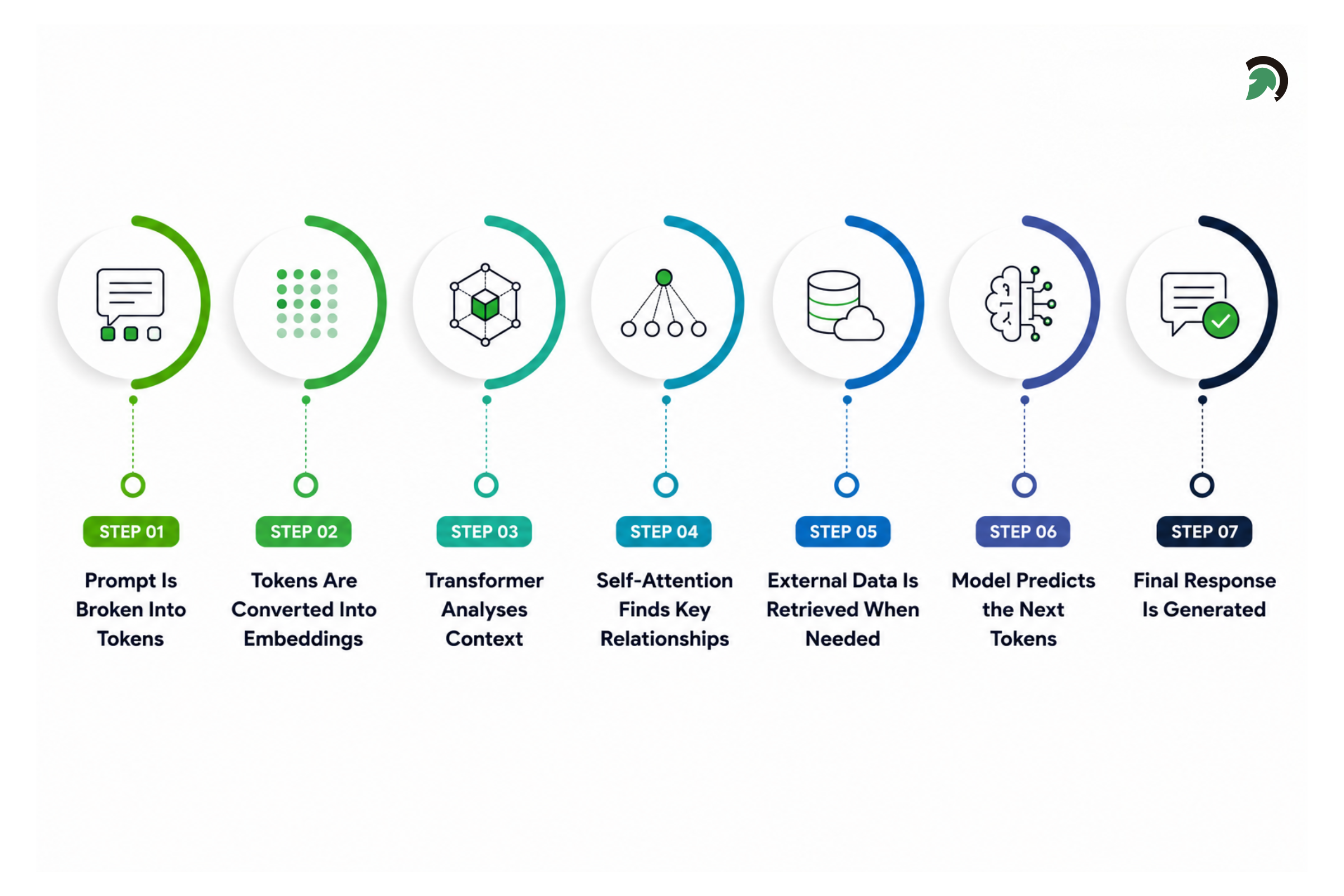
How an LLM Works From Prompt to Final Response
Most modern LLMs are built using transformer architecture. Transformers help the model process context, understand how different words relate to one another, and generate responses more efficiently than many earlier language-processing methods.
Step 1: The Prompt Is Broken Into Tokens
The process begins when the model divides the prompt into smaller units called tokens. A token may be a complete word, part of a word, a number, a punctuation mark, a symbol, or a piece of programming code.
For example, the word “development” may be treated as one token or split into smaller parts, depending on the tokenizer used by the model.
Tokenization gives the model a consistent way to process text. It also affects how much information can fit within the model’s context window and how usage may be measured in API-based applications.
Step 2: Tokens Are Converted Into Embeddings
After tokenization, each token is converted into a numerical representation called an embedding.
Embeddings allow the model to represent words and concepts mathematically. Terms used in similar contexts may receive related representations, helping the model recognize connections between them.
For example, words such as “doctor,” “patient,” and “hospital” may be closely associated because they often appear in related contexts.
Step 3: The Model Considers Word Order and Context
The model must understand not only which words are present, but also where they appear and how they relate to the surrounding text.
Consider these sentences:
The dog chased the cat.
The cat chased the dog.
The same main words appear in both sentences, but their order changes the meaning.
Context also helps the model interpret words with more than one meaning. For example, “bank” may refer to a financial institution or the side of a river. The surrounding words help the model determine which meaning is more likely.
Step 4: The Transformer Processes the Input
The token representations then pass through multiple layers of the transformer network.
These layers help the model analyze grammar, meaning, user intent, word relationships, important details, and connections between different parts of the prompt.
As the information moves through the layers, the model builds a richer representation of the input before generating a response.
Step 5: Self-Attention Identifies Important Relationships
A key part of the transformer is the self-attention mechanism. It helps the model determine which words or tokens are most relevant to one another.
Consider the sentence:
Maria placed the book on the table because it was heavy.
The model must determine whether “it” refers to the book or the table. Self-attention allows it to compare these words with the surrounding context and identify the most likely relationship.
Transformers also use multi-head attention, which allows the model to analyze several types of relationships at once, including grammar, meaning, references, and broader context.
Step 6: The Model Predicts the Next Token
Once the prompt has been processed, the model calculates which token is most likely to appear next.
For example, if the prompt is:
The capital of France is…
The model will usually assign a high probability to “Paris.”
After selecting a token, the model adds it to the existing context and predicts the next one. This process continues one token at a time until the response is complete.
Step 7: The Final Response Is Generated
The final response is shaped by the prompt, system instructions, conversation history, retrieved information, connected business data, application rules, safety controls, and model settings.
Settings such as temperature can also influence the result. A lower temperature generally produces more predictable responses, while a higher temperature can create greater variation.
Because LLMs generate responses from learned patterns and probabilities, fluent wording does not always mean the answer is accurate. Important information should still be checked against reliable sources.
What Is Transformer Architecture?
Transformer architecture is the neural network design behind most modern LLMs. Its defining feature is attention, which helps the model determine how different tokens relate to one another across a prompt.
Unlike many earlier sequence models, transformers can process multiple parts of the input in parallel during training. This makes them more efficient at learning from large datasets and better at identifying relationships across longer passages.
A transformer generally combines token embeddings, positional information, attention layers, feed-forward networks, normalization, and an output layer. Different models may use encoder-only, decoder-only, or encoder-decoder designs. Many generative LLMs use decoder-based architectures to predict the next token repeatedly.
Note: The exact structure varies across model families, but attention is the central feature that allows transformers to process context and support modern language understanding and generation.
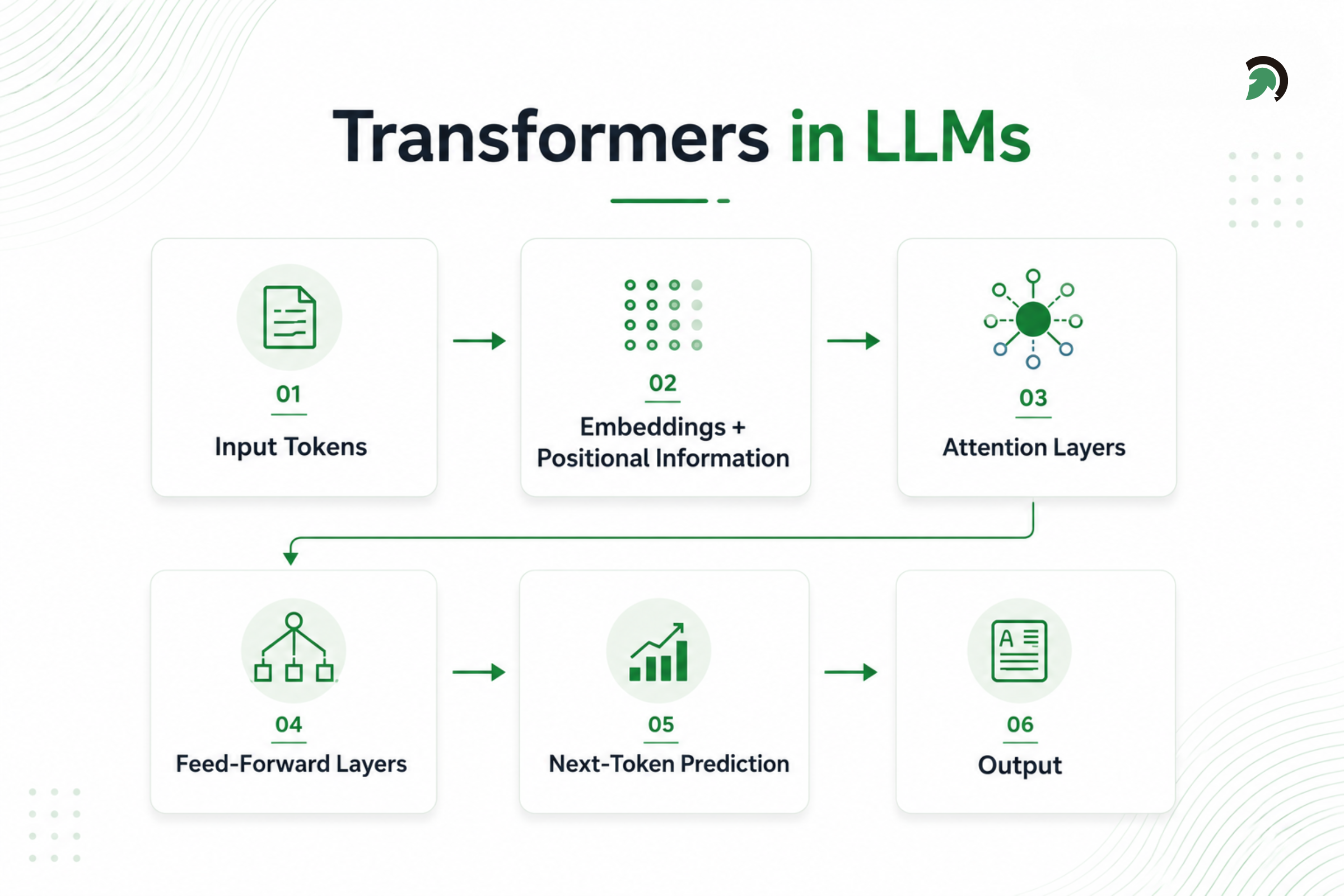
Transformer Architecture in LLMs Explained
How Are Large Language Models Trained?
Training a large language model involves preparing large amounts of data, teaching the model to recognize language patterns, refining how it responds to instructions, and testing its performance before release.
Data Collection and Preparation
LLMs are trained on large collections of text and code. This may include websites, books, articles, research papers, technical documentation, licensed datasets, public records, and specialized industry content.
Before training begins, the data is cleaned, filtered, normalized, and deduplicated. Low-quality, repetitive, harmful, or sensitive material may also be removed. The quality and diversity of this data strongly influence the model’s performance.
Tokenization
The prepared data is divided into smaller units called tokens. These may represent full words, parts of words, numbers, punctuation marks, symbols, or pieces of code.
Different models use different tokenization methods, so the same sentence may be split into a different number of tokens.
Pretraining
During pretraining, the model learns broad language patterns, including grammar, sentence structure, word relationships, facts, writing styles, and coding conventions.
A common method is next-token prediction. The model predicts the next token, compares it with the correct one, and adjusts its internal parameters. Repeating this process across many examples gradually improves its ability to generate coherent responses.
Instruction Tuning
A pretrained model may be able to continue text but may not follow user instructions reliably.
Instruction tuning uses examples of prompts and suitable responses to teach the model how to answer questions, summarize documents, follow directions, and respond in requested formats.
Alignment and Feedback
Additional training helps make the model more useful, safe, and consistent with human expectations.
This can include human feedback, AI-generated feedback, preference testing, safety evaluation, and refusal training. These methods can reduce unwanted behavior, but they do not remove every risk.
Evaluation and Testing
Before release, the model is tested for language quality, factual accuracy, reasoning, coding ability, instruction following, safety, bias, multilingual performance, and domain-specific tasks.
Deployment and Improvement
After release, developers monitor response quality, speed, cost, safety, and user feedback.
Models may be improved through additional training, better datasets, stronger alignment methods, architectural updates, or external tools such as RAG, web search, and APIs.
Key Components and Terms Used in Large Language Models
Understanding a few common terms makes LLM technology easier to evaluate.
Tokens
Tokens are the text units processed by the model. Model usage, context capacity, and API pricing are often measured in tokens.
Parameters and Model Weights
Parameters are adjustable numerical values inside the neural network. Model weights are the parameter values learned during training.
Embeddings
Embeddings are numerical representations of language or other data. They are commonly used for semantic search, recommendation, clustering, and RAG.
Prompts
A prompt is the instruction or information supplied to the model. Prompt quality can significantly affect output relevance and accuracy.
Context Window
A context window is the total amount of information a model can consider at once, typically measured in tokens. It can include system instructions, conversation history, retrieved documents, user input, and generated output.
Expert Perspective:
A large context window allows an LLM to process more information, but adding more content does not always improve the answer. Irrelevant, repetitive, or poorly structured context can reduce accuracy and make important information harder for the model to identify.
- Hiren Daraji, Department Head – Microsoft, EvinceDev
Temperature
Temperature influences output variation. It should be configured according to the task rather than treated as a measure of intelligence.
Inference
Inference is the process of applying a trained model to new input.
Note: Training vs inference
Training is the resource-intensive process in which an LLM learns patterns and adjusts its parameters. Inference happens after training, whenever the model receives a prompt and generates a response. Although inference generally requires less computing power than training, its ongoing cost can still become significant in applications that handle large numbers of requests.
Hallucination
A hallucination is an inaccurate, fabricated, or unsupported output presented as though it were correct. Hallucinations remain a recognized limitation because language models may guess rather than express uncertainty.
Types of Large Language Models
Several Types of LLMs are available, each serving different requirements.
- General-Purpose LLMs: General-purpose models handle broad tasks such as writing, summarization, coding, conversation, and analysis.
- Domain-Specific LLMs: Domain-specific models are trained or adapted for areas such as healthcare, finance, legal services, cybersecurity, or software engineering.
- Proprietary LLMs: Proprietary models are controlled by a commercial provider and usually accessed through an application or API.
- Open-Weight and Open-Source Models: An open-weight model makes trained weights available under a specified license. An open-source large language model may provide broader access to code, architecture, weights, or training details, although “open source” and “open weight” are not always interchangeable.
- Multilingual LLMs: Multilingual models understand and generate content in multiple languages.
- Multimodal Models: Multimodal models can process combinations of text, images, audio, video, or documents. Google’s current Gemini documentation, for example, describes models designed for multimodal and agentic tasks.
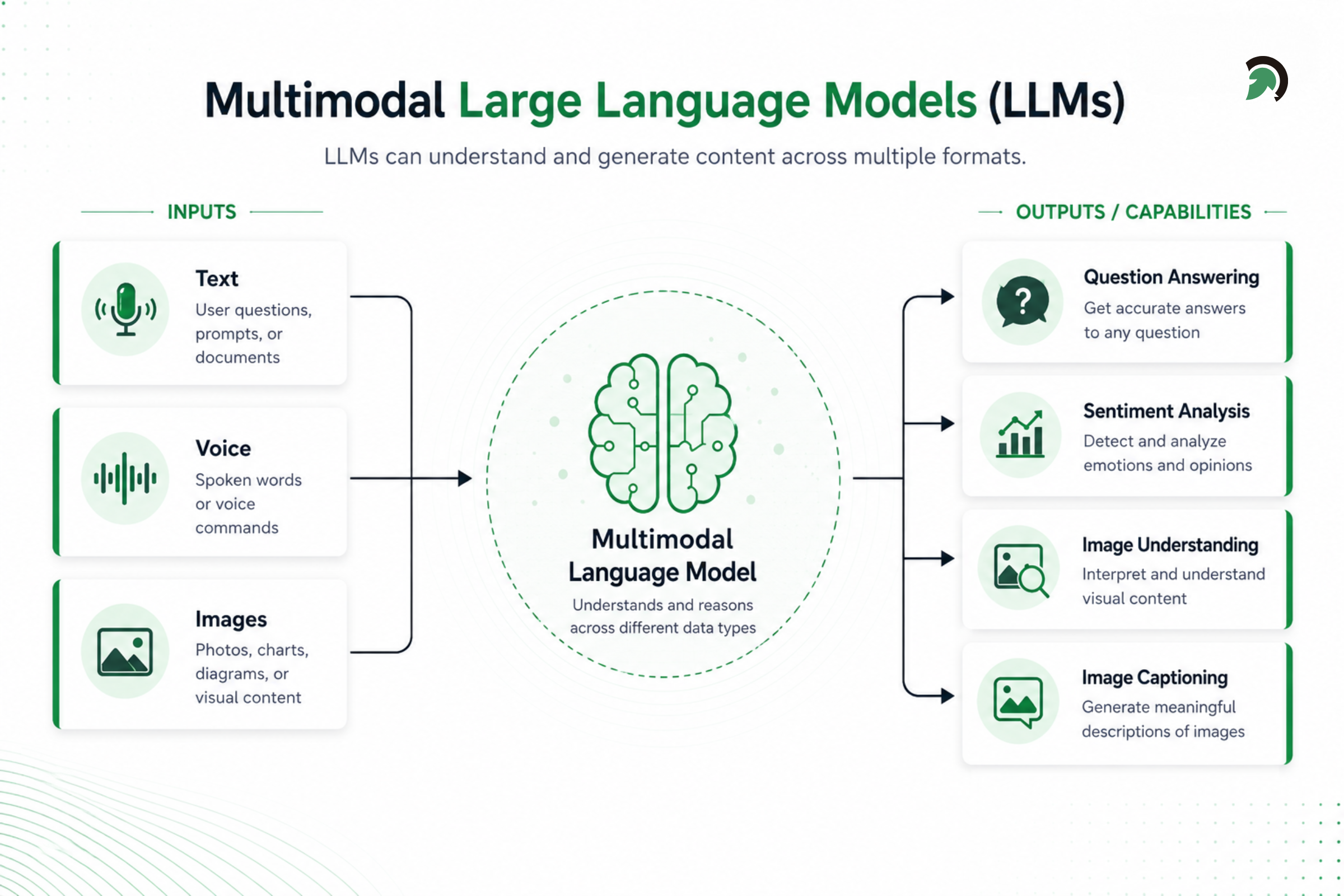
How Multimodal LLMs Process Text Voice and Images
- Reasoning Models: Reasoning-focused models are designed for multi-step analysis, planning, mathematics, coding, and complex problem-solving.
Examples of Popular Large Language Models
A List of large language models may include these widely recognized families:
| Model family | Developer | Access approach | Typical applications |
| GPT | OpenAI | Products and API | Writing, coding, reasoning, assistants |
| Claude | Anthropic | Products and API | Document analysis, writing, reasoning |
| Gemini | Products and API | Multimodal applications and agents | |
| Llama | Meta | Open-weight releases | Custom and private deployments |
| Mistral | Mistral AI | API and open-weight options | Enterprise and developer applications |
| Command | Cohere | API | Enterprise retrieval and search |
| Qwen | Alibaba | API and open-weight options | Multilingual and general tasks |
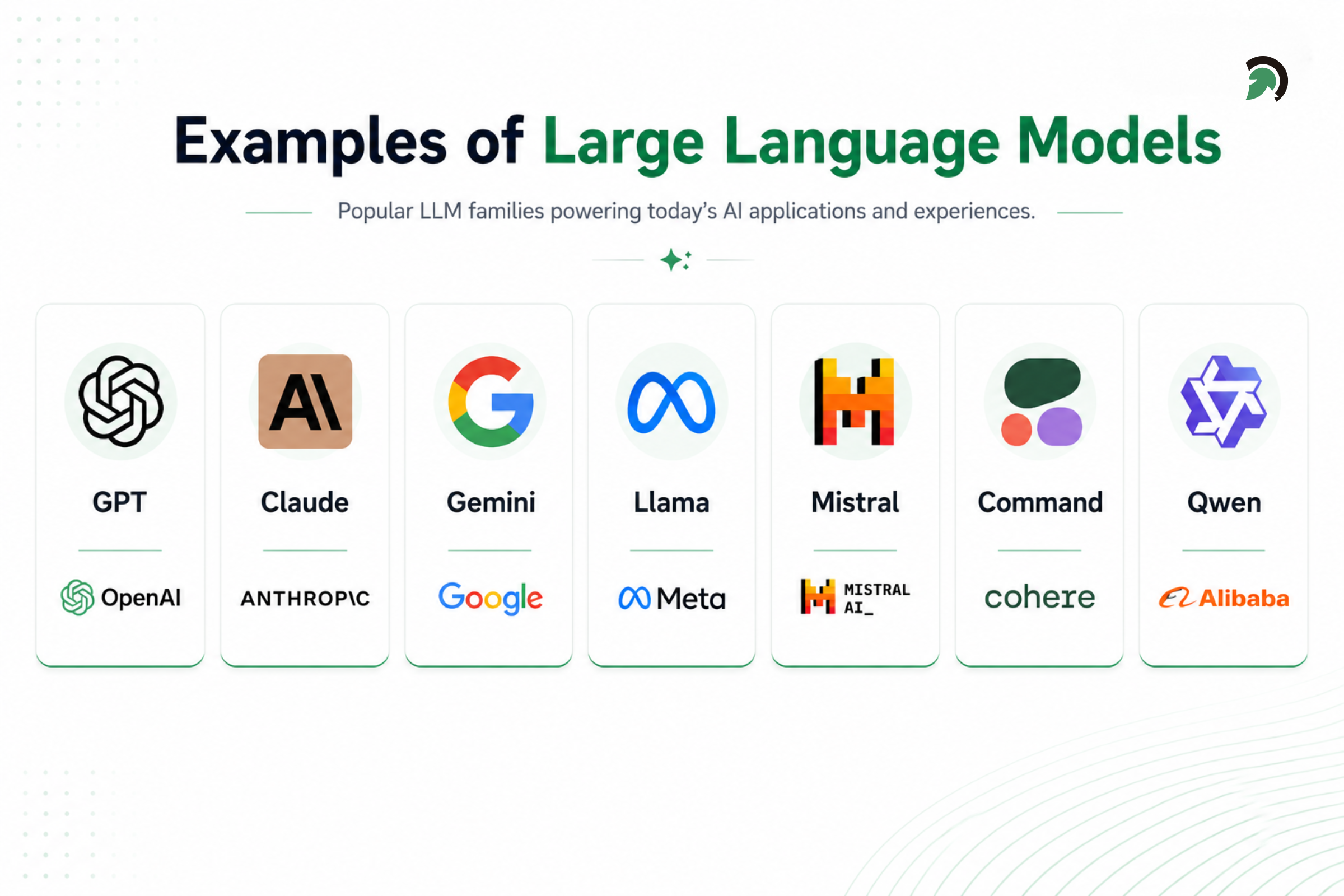
Top Large Language Models Used in AI Applications
Note: Searches such as “Best large language models LLM” often produce ranked lists, but no model is best for every application. Organizations should test candidate models against their own tasks, data, risk requirements, latency targets, and budget.
What Are Large Language Models Used For?
- Conversational AI and Chatbots: An LLM chatbot can understand natural-language questions and generate contextual responses. It may support customers, employees, patients, students, or platform users.
- Content Generation: LLMs can help create articles, emails, product descriptions, reports, social posts, and marketing drafts. Human review remains important for accuracy and brand quality.
- Document Summarization: Models can summarize contracts, policies, research papers, reports, meeting notes, and manuals.
- Enterprise Search and Knowledge Retrieval: LLMs can provide conversational access to internal knowledge when connected to approved documents through RAG.
- Software Development: They can generate code, explain existing applications, create tests, identify possible errors, and assist with documentation.
- Translation and Multilingual Support: Multilingual models can translate text, localize content, and support international customer communication.
- Data Extraction and Classification: LLMs can identify names, dates, products, values, topics, sentiments, and other information in unstructured text.
- AI Copilots: Copilots assist users inside business applications. Examples include sales, developer, healthcare, financial, and operations copilots.
- Research and Analysis: Models can compare documents, summarize evidence, identify themes, and organize information for further human analysis.
- Workflow Automation: When connected to tools and APIs, LLMs can help classify requests, prepare reports, update systems, and initiate controlled actions.
Key Industries Utilizing LLMs
Large language models are being adopted across industries to improve access to information, automate repetitive tasks, support employees, and create more responsive digital experiences.
| Industry | Common LLM applications |
| Healthcare | Documentation, research summaries, patient communication, internal knowledge |
| Financial services | Document analysis, support, compliance assistance, fraud investigation |
| Retail and ecommerce | Product discovery, support, personalization, content generation |
| Software and technology | Coding, testing, documentation, troubleshooting |
| Legal services | Contract review, clause comparison, research, knowledge search |
| Education | Tutoring, lesson planning, content creation, learning support |
| Manufacturing and logistics | Manual search, reporting, field support, operational documentation |
| Government | Citizen assistance, policy summaries, internal knowledge and workflows |
Benefits of Large Language Models
Large language models can help organizations work faster, improve access to information, and create more intuitive digital experiences.
- Natural-language interaction: Users can search, ask questions, and work with software using everyday language.
- Faster information processing: LLMs can summarize, classify, and analyze large volumes of unstructured content.
- Task automation: They can reduce manual effort in areas such as customer support, email handling, reporting, and content creation.
- Scalable assistance: LLM-powered tools can support large numbers of customers or employees across multiple channels.
- Multilingual support: They can help businesses communicate, translate, and serve users across different languages.
- Improved productivity: LLMs can assist with writing, research, coding, documentation, and knowledge retrieval.
- Better knowledge access: When connected to trusted data, they can make internal documents and business information easier to find and use.
- More personalized experiences: Responses can be adapted using user context, preferences, and application data.
- Reusable capabilities: A single model can support several tasks across different teams and workflows.
The real value of an LLM depends on the complete application around it. Reliable data, thoughtful integrations, rigorous evaluation, a good user experience, and proper governance are essential to producing consistent business outcomes.
Limitations and Risks of Large Language Models
- Hallucinations: LLMs can generate plausible but incorrect statements. Important claims should be checked against authoritative sources.
- Bias: Models may reproduce or amplify biases present in their training data or application context.
- Outdated Knowledge: A standalone model may not know about recent events, policies, prices, or organizational changes.
- Privacy Risks: Sending confidential information to an improperly configured service can expose sensitive data.
- Prompt Injection: Attackers may insert instructions designed to bypass controls, reveal information, or manipulate tool usage.
- Lack of Human Understanding: LLMs model statistical relationships. They do not possess human experience, intention, accountability, or judgment.
- Cost and Infrastructure: High-volume inference, long prompts, retrieval systems, and large models can create substantial operational costs.
- Inconsistent Outputs: Small prompt changes may produce different answers. Structured evaluation is needed for production use.
- Legal and Copyright Concerns: Organizations must consider training-data policies, generated-content rights, attribution, privacy, and regulatory obligations.
- Human Oversight: High-impact decisions should not depend solely on unverified model output.
Expert Insight:
When an LLM application produces poor results, the model is not always the main problem. Weak prompts, incomplete context, poor-quality retrieval, missing access controls, and unclear workflows often have a greater impact on performance than the underlying model itself.
- Hiren Daraji, Department Head – Microsoft, EvinceDev
How LLMs Differ From Search Engines
| Aspect | Large language model | Search engine |
| Main function | Generates a response | Retrieves and ranks existing content |
| Output | Conversational answer | Links, snippets, and media |
| Information source | Training data and connected tools | Indexed web content |
| Current information | Limited without retrieval tools | Commonly accesses indexed updates |
| Source visibility | May not show sources automatically | Usually links to sources |
| Main risk | Fluent but incorrect output | Low-quality or misleading sources |
| Best suited for | Explanation, synthesis, and creation | Discovery and source finding |
Search engines primarily help users locate existing information. LLMs generate a response by synthesizing patterns and context.
The technologies can work together. Search-connected language applications retrieve current webpages and provide relevant material to the model. The model can then summarize the information and present a conversational answer.
Neither approach eliminates the need for verification. Search results may contain unreliable sources, while LLM answers may contain unsupported claims.
How Do LLMs Access Current or Business-Specific Information?
A standalone LLM mainly relies on what it learned during training and the information provided in the current prompt. To access recent or private data, it must connect to external sources.
Training Data
An LLM’s built-in knowledge may have a cutoff date. It may not know about recent events, updated policies, live inventory, customer records, or internal company information.
Web Search
Search tools allow an LLM application to retrieve recent public information and use it to generate a more current response.
Retrieval-Augmented Generation
Retrieval-augmented generation, or RAG, finds relevant information from approved documents, databases, or knowledge bases and adds it to the model’s context.
This helps ground responses in trusted, current, or organization-specific information without retraining the model.
Expert Perspective:
Adding RAG does not automatically make an LLM accurate. The response quality depends on whether the system retrieves the right information, removes irrelevant content, preserves document context, and provides the model with enough evidence to answer confidently.
- Hiren Daraji, Department Head – Microsoft, EvinceDev
APIs and Business Systems
APIs can connect an LLM with CRM, ERP, ecommerce, inventory, payment, analytics, support, and internal database systems.
These connections allow the application to retrieve live information or perform approved actions.
Access Controls and Security
Private data connections should use authentication, role-based permissions, encryption, audit logs, secure APIs, and input and output controls.
The LLM does not replace application security. The surrounding system must control which data and actions each user is allowed to access.
How Are LLMs Different From Other AI Technologies?
Large language models are often confused with generative AI, natural language processing, small language models, and chatbots. The table below explains how these terms differ.
| Comparison | Large Language Model | Other Technology | Key Difference |
| LLM vs Generative AI | An LLM mainly understands and generates language, including text and code. | Generative AI is a broader category that can create text, images, audio, video, and other content. | An LLM is one type of generative AI. |
| LLM vs NLP | An LLM is a model that can perform several language tasks using learned patterns. | Natural language processing is the wider field of technologies used to analyze, understand, and generate human language. | LLMs are one technology used within NLP. |
| LLM vs Small Language Model | An LLM usually offers broader capabilities but requires more computing power and higher operating costs. | A small language model is lighter, faster, and often designed for more focused tasks or private deployment. | The choice depends on capability, cost, privacy, speed, and infrastructure needs. |
| LLM vs Chatbot | An LLM is the underlying AI model that processes language and generates responses. | A chatbot is the user-facing application through which people interact with an AI system. | A chatbot may use an LLM, but it can also include memory, search, APIs, business rules, safety controls, and human escalation. |
How Can Businesses Customize Large Language Models?
- Prompt Engineering: Prompt engineering improves instructions, context, tone, and output structure without changing the model’s weights.
- Retrieval-Augmented Generation: RAG connects the model with current or private information. It is suitable for knowledge assistants, document search, and support applications.
- Fine-Tuning: Fine-tuning adjusts model behavior using task-specific examples. It can improve output format, terminology, tone, or performance on a specialized task.
- Training From Scratch: Training a foundation model requires extensive data, computing resources, expertise, and investment. Most businesses do not need this approach.
| Method | Main purpose | Effort | Suitable for |
| Prompt engineering | Improve instructions | Low | Prototypes and general applications |
| RAG | Add trusted knowledge | Moderate | Enterprise knowledge systems |
| Fine-tuning | Adapt behavior | Moderate to high | Specialized tasks |
| Training from scratch | Create a new foundation model | Very high | Exceptional large-scale requirements |
An organization may engage AI consulting services to assess which approach aligns with its data, risks, and business goals. A capable AI development company should validate whether an LLM is necessary before recommending complex architecture.
How to Choose the Right Large Language Model
Choosing the right LLM depends on how well it fits the application, data, users, and operating environment. The largest or most popular model is not always the best choice.
Consider the following factors:
- Use case: Define what the model needs to do, such as summarization, coding, customer support, document analysis, or workflow automation.
- Accuracy and domain performance: Test how reliably the model handles real tasks and industry-specific language.
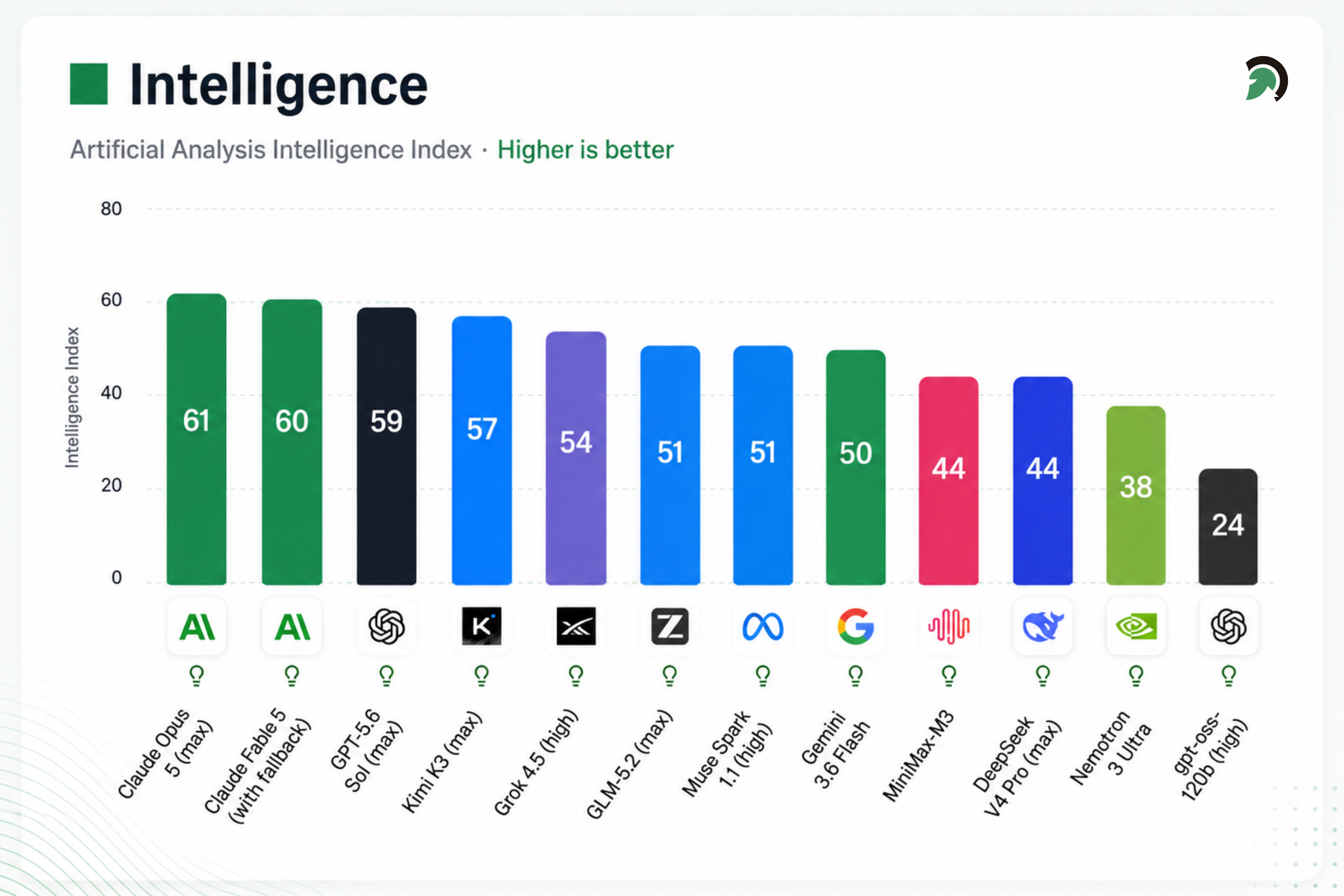
Top Large Language Models Ranked by Intelligence
- Context capacity: Check whether it can process the required prompt length, conversation history, or document volume.
- Speed and cost: Compare response time, token usage, infrastructure needs, and expected operating expenses.
- Privacy and deployment: Determine whether the model can be used through a managed API, private cloud, on-premises environment, or self-hosted setup.
- Language and modality support: Confirm whether it supports the required languages and inputs, such as text, images, audio, or documents.
- Integration capabilities: Review support for tool calling, APIs, retrieval-augmented generation, fine-tuning, and existing business systems.
- Security and governance: Assess access controls, logging, monitoring, data retention, compliance requirements, and provider policies.
- Licensing and vendor dependency: Understand usage rights, commercial restrictions, support options, portability, and the risk of relying on one provider.
The best model is the one that delivers consistent results in real-world applications while meeting the required standards for accuracy, cost, speed, privacy, security, as well as, scalability.
How to Build an LLM-Powered Application
Building an LLM-powered application requires a clear use case, reliable data, secure architecture, testing, and ongoing monitoring.
Quick Stat:
McKinsey found that nearly two-thirds of organizations had not yet begun scaling AI across the enterprise, despite widespread adoption.
Step 1: Define the Business Problem
Identify the users, expected outcome, required accuracy, risks, and business value.
Expert Insight:
When building applications with LLMs, we recommend finding the simplest solution possible, and only increasing complexity when needed.
Step 2: Select the Right Model
Compare models based on accuracy, speed, cost, privacy, context capacity, and integration support.
Step 3: Prepare the Data
Clean, organize, classify, and secure the information the application will use.
Step 4: Choose the Customization Approach
Decide whether the application needs prompt engineering, RAG, fine-tuning, or a combination.
Step 5: Design the Architecture
Plan the interface, backend, databases, vector store, APIs, authentication, and monitoring.
Step 6: Integrate the Model
Connect the LLM to authorized documents, applications, databases, APIs, and workflows.
Step 7: Add Guardrails
Apply access controls, validation, filtering, grounding, logging, and human review.
Step 8: Test the Application
Measure accuracy, relevance, safety, response time, cost, and user experience.
Step 9: Deploy and Monitor
Track model performance, user feedback, security events, response quality, and operating costs.
Expert View:
“I think AI agent workflows will drive massive AI progress this year, perhaps even more than the next generation of foundation models.”
- Andrew Ng, Founder of DeepLearning.AI
How Are Large Language Models Evaluated?
LLMs can be evaluated using:
- Accuracy
- Factual consistency
- Relevance
- Instruction following
- Reasoning quality
- Safety
- Bias
- Latency
- Cost per request
- User satisfaction
- Domain-specific performance
Benchmark scores should not be the only selection criterion, in fact, real-world evaluation should use representative users, data, workflows, edge cases, as well as, risk scenarios.
Conclusion
Large language models can support chatbots, enterprise search, coding assistants, document analysis, AI copilots, as well as the workflow automation by interpreting context and also generating the relevant responses.
However, the value of an LLM depends on how well it is connected to reliable data, secure systems, clear business goals, and appropriate governance. This is where EvinceDev helps businesses move from early experimentation to practical implementation by combining AI consulting, RAG development, model integration, custom chatbots, and AI copilot development within a secure and scalable solution.
With the right model, architecture, and controls in place, organizations can use LLMs to improve access to information, automate complex tasks, and create more intelligent digital experiences.