
Key Takeaways
- Full Funnel CRO: CRO improves every stage of the ecommerce journey from browsing to checkout.
- Product & Checkout Impact: Product pages and checkout experience have the highest impact on conversions.
- UX Drives Revenue: Better speed, navigation, and clarity directly improve sales performance.
- Data-Led Decisions: CRO works best when driven by analytics, testing, and user behavior.
- Continuous Optimization: Ongoing improvements are needed to sustain conversion growth over time.
Getting visitors to your online store is only half the battle. The real challenge begins after they land on your website.
A shopper may click your ad, explore a product, compare options, add something to the cart, and still leave without buying. This happens every day across ecommerce stores. The problem is not always traffic. Sometimes, the real issue is friction in the shopping journey.
This is where Ecommerce conversion optimization becomes important.
Ecommerce conversion optimization focuses on improving your online store so more visitors take meaningful actions, such as viewing products, adding items to cart, starting checkout, signing up for offers, or completing a purchase. Instead of spending more only to attract new visitors, it helps you get better results from the visitors you already have.
Think of it this way. If your ecommerce store gets 50,000 visitors per month and converts 2% of them, you get 1,000 orders. But if you improve the conversion rate to 3%, you get 1,500 orders from the same traffic. That means 500 extra orders without increasing your advertising spend.
In this blog, we will explain what Ecommerce Conversion Optimization means, why it matters, how it works, and the best strategies to improve speed, product pages, checkout, trust, personalization, and overall sales performance.
Quick Stat:
As per eMarketer, retail ecommerce sales worldwide were expected to reach $6.419 trillion in 2025, accounting for 20.5% of total global retail sales. This shows how competitive online selling has become, and why ecommerce brands need to focus not just on traffic, but also on converting more visitors into customers.
What Is Ecommerce Conversion Optimization?
Ecommerce Conversion Optimization is the process of improving an online store so that more visitors complete desired actions.
For most ecommerce businesses, the main conversion is a purchase. But conversions are not limited to sales only. A conversion can be any action that moves a visitor closer to becoming a customer.
Common ecommerce conversions include:
- Buying a product
- Adding a product to cart
- Starting checkout
- Creating an account
- Signing up for a newsletter
- Adding a product to the wishlist
- Using a discount code
- Contacting support
- Subscribing to a product
- Making a repeat purchase
In simple words, Ecommerce Conversion Optimization helps make your store easier to use, easier to trust, and easier to buy from.
A visitor may leave your store for many reasons. The website may be slow, the product page may not answer their questions, the checkout may feel complicated, or the shipping cost may appear too late. Conversion optimization helps identify these problems and fix them.
Why Is Ecommerce Conversion Optimization Important for Online Stores?
Online stores often focus heavily on traffic. But if the website does not convert well, more traffic may only increase wasted opportunities.
Ecommerce conversion optimization is important because it helps you increase revenue without always spending more on marketing.
Here are the main benefits.
1. It Increases Sales From Existing Traffic
If your store already receives visitors, improving conversions can directly increase sales. You do not always need more visitors to grow revenue. Sometimes, you need to remove the friction that stops existing visitors from buying.
2. It Reduces Customer Acquisition Cost
Customer acquisition cost is the amount you spend to get one customer. When more visitors convert, the cost per customer becomes lower. This is especially useful for ecommerce brands that depend on paid ads.
3. It Improves Marketing ROI
Your ads, SEO, email campaigns, and social media efforts perform better when the website is optimized. A well-designed product page, faster checkout, and better trust signals can help turn campaign traffic into actual revenue.
This is where ecommerce brands often combine CRO with Digital marketing Services to improve the full customer journey, from attracting visitors to converting them into buyers.
4. It Improves Customer Experience
A high-converting ecommerce website is usually also a better website for users. It loads faster, explains products clearly, makes navigation easier, and helps customers complete checkout without confusion.
5. It Reduces Cart Abandonment
Many shoppers end up adding items to their cart without making the purchase. The reasons for such problems include high checkout costs, payment problems, trust issues, and others. The process of conversion optimization comes to assist in that.
Quick Stat:
Baymard Institute’s long-running research shows that the average ecommerce cart abandonment rate is around 70%, meaning roughly 2 out of 3 shoppers leave after adding items to the cart.
6. It Builds Trust
Online shoppers need confidence before they buy. Reviews, ratings, secure payment badges, clear return policies, product images, and customer support details all help reduce hesitation.
Also Read: What Is Visual AI in eCommerce? Virtual Try-Ons, 3D Models, and Image RecognitionWhat Are the Best Ecommerce Conversion Rate Optimization Strategies?
The best ecommerce conversion rate optimization strategies focus on improving the complete shopping journey, from the first website visit to the final purchase. The goal is to remove friction, build trust, make product discovery easier, and help shoppers complete checkout with confidence.
Below are the most important strategies every ecommerce business should consider.
1. Improve Website Speed
Website speed plays a major role in ecommerce conversions. If your store loads slowly, visitors may leave before they even view your products. Slow speed can also affect product browsing, cart updates, and checkout completion, especially for mobile users.
What to improve:
- Compress product images
- Use modern image formats
- Remove unnecessary plugins and scripts
- Enable caching
- Use a content delivery network
- Lazy load images and videos
- Improve mobile page speed
- Monitor Core Web Vitals
- Limit heavy third-party apps
Why it matters:
A faster website creates a smoother shopping experience. It helps users explore products quickly, move through checkout easily, and complete purchases with less frustration.
Quick Stat:
A Deloitte study found that just a 0.1-second improvement in mobile site speed led to an 8.4% increase in conversions for retail consumers and a 9.2% increase in average order value
2. Optimize for Mobile Shoppers
Mobile optimization has become a necessity for online shops. It is because many customers compare and purchase using their mobile devices. In case your website is poorly designed for mobile usage, your potential customers might leave your site, even if they like your goods.
What to improve:
- Use responsive design
- Keep buttons large and easy to tap
- Add sticky Add to Cart buttons
- Make product images easy to view
- Keep checkout forms short
- Enable autofill
- Support mobile wallets
- Avoid intrusive popups
- Make text easy to read
- Test checkout on real mobile devices
Why it matters:
A mobile shopper should be able to browse products, compare details, add items to the cart, and complete payment without unnecessary effort.
Quick Stat:
Google research found that 53% of mobile visits are likely to be abandoned if pages take longer than 3 seconds to load, making mobile speed a key part of ecommerce CRO.
3. Make Navigation and Search Simple
If visitors cannot find what they need, they are unlikely to buy. A high-converting ecommerce website should make product discovery quick and simple.
What to improve:
- Use clear category names
- Keep the main menu simple
- Add a visible search bar
- Use autocomplete suggestions
- Add filters for size, price, color, brand, rating, and availability
- Add sorting options like price, newest, bestsellers, and ratings
- Use breadcrumb navigation
- Show relevant products when search returns no results
Example:
A fashion store should allow users to filter products by size, color, fit, price, fabric, and occasion. This helps shoppers reach the right product faster.
4. Optimize Product Pages
Product pages are one of the most important parts of conversion optimization for ecommerce website performance. A strong product page should answer customer questions, build trust, and make the buying decision easier.
What to improve:
- Clear product title
- High-quality images
- Product videos
- Benefit-focused description
- Price and discount details
- Size, color, and variant options
- Stock availability
- Delivery estimate
- Return policy
- Customer reviews
- FAQs
- Strong CTA button
- Related product suggestions
Example:
Instead of writing:
“Cotton T-shirt, 180 GSM.”
Write:
“Soft cotton T-shirt designed for daily comfort, breathable wear, and easy styling.”
Why it matters:
Online shoppers cannot touch or try the product. Clear descriptions, strong visuals, reviews, and delivery details help reduce doubt and increase buying confidence.
Real-World Project Reference:
A relevant example is EvinceDev’s work on the STAG Provisions Shopify apparel project. For an apparel ecommerce brand, product discovery, visual presentation, responsive browsing, and brand experience directly influence how easily shoppers move from browsing to buying. EvinceDev helped build a Shopify storefront that reflected STAG Provisions’ premium identity while supporting faster performance, smoother navigation, and a more consistent shopping journey. This shows how ecommerce conversion optimization is not limited to adding more product content. It also depends on how well the overall store experience supports customer confidence and purchase intent.
5. Use Clear Call-to-Action Buttons
A call-to-action button tells users what to do next. If your CTA is unclear, hidden, or surrounded by too many distractions, users may not move forward.
What to improve:
- Use simple CTA text
- Place the main CTA above the fold
- Repeat the CTA after key product details
- Use sticky CTA buttons on mobile
- Make the button visually clear
- Avoid too many competing buttons
- Keep distractions away from the CTA area
Good CTA examples:
- Add to Cart
- Buy Now
- Start Checkout
- Subscribe and Save
- Claim Offer
- Get Free Shipping
Why it matters:
A clear CTA reduces confusion and helps shoppers take the next step in the buying journey.
6. Simplify Checkout
Checkout is where the final conversion happens. Even if users like the product, they may abandon the cart if the checkout process feels long, confusing, or risky.
What to improve:
- Offer guest checkout
- Reduce the number of steps
- Keep forms short
- Enable address autofill
- Show the total cost early
- Display shipping, taxes, and fees clearly
- Offer multiple payment options
- Let users edit the cart easily
- Show security badges
- Add clear error messages
- Avoid forcing account creation
Why it matters:
Checkout optimization can reduce cart abandonment by making payment faster, clearer, and easier. Unexpected costs should not appear at the final step. If shipping, tax, or additional fees apply, show them as early as possible.
Expert Note
Checkout should feel like the final confirmation, not another decision-making stage. Keep it short, transparent, and free from last-minute surprises.
7. Build Trust With Reviews and Social Proof
Customers are more likely to buy when they see proof from other shoppers. Reviews, ratings, and real customer experiences help reduce hesitation.
What to improve:
- Star ratings
- Customer reviews
- Photo reviews
- Video reviews
- Testimonials
- User-generated content
- Bestseller labels
- Recently purchased messages, only when true
- Press mentions
- Number of customers served
Example:
A skincare brand can show reviews by skin type, usage duration, and before-and-after photos. This helps new customers understand whether the product is right for them.
Why it matters:
Trust signals should appear near important decision points, such as product pages, cart pages, and checkout pages.
8. Show Shipping, Returns, and Payment Information Clearly
Customers want clarity before they buy. If delivery timelines, return options, or payment security are unclear, they may leave without completing the purchase.
What to improve:
- Delivery estimate
- Shipping cost
- Free shipping threshold
- Return window
- Refund process
- Warranty or guarantee
- Secure payment information
- Customer support contact
- Accepted payment options
Example:
“Free delivery above ₹999. Easy 7-day returns. Secure payment.”
Why it matters:
A small information block near the product price or CTA can reduce hesitation and make customers feel more confident.
9. Use Offers, Urgency, and Personalization Carefully
Offers can improve conversions, but they should be used strategically. Urgency and personalization can also encourage action when they are relevant and honest.
What to improve:
- First-order discounts
- Free shipping offers
- Bundle discounts
- Buy one, get one offers
- Loyalty points
- Referral rewards
- Subscribe and save options
- Limited-time sales
- Personalized product recommendations
- Recently viewed products
- Frequently bought together sections
- Cart add-ons
Example:
If a customer is buying a camera, the store can recommend a memory card, tripod, camera bag, or lens cleaner. This can improve both conversion rate and average order value.
Important note:
Use urgency honestly. Fake countdown timers or false low-stock messages may create short-term clicks, but they can damage trust.
10. Reduce Cart Abandonment
Cart abandonment happens when users add products to their cart but do not complete the purchase. This is one of the biggest conversion challenges for ecommerce stores.
Common reasons for cart abandonment:
- Unexpected shipping cost
- Long checkout process
- Payment failure
- No preferred payment method
- Forced account creation
- Delivery concerns
- Lack of trust
- Website errors
What to improve:
- Send abandoned cart emails
- Use SMS or WhatsApp reminders
- Run retargeting ads
- Offer exit-intent discounts
- Show free shipping reminders
- Use checkout recovery links
- Make checkout easier to resume
Example message:
“You left something in your cart. Complete your order today and get free shipping.”
Why it matters:
Cart recovery helps bring back shoppers who already showed buying intent.
11. Use A/B Testing, Heatmaps, and Customer Feedback
CRO should not be based on guesswork. Data helps you understand what users are doing, where they are dropping off, and what might be stopping them from buying.
What to use:
- A/B testing to compare different page versions
- Heatmaps to see where users click and scroll
- Session recordings to identify friction points
- Surveys to collect customer feedback
- Analytics to track drop-offs and conversions
What to test:
- CTA text
- Product images
- Product descriptions
- Page layout
- Checkout steps
- Review placement
- Free shipping threshold
- Offer timing
- Popup placement
Why it matters:
The best ecommerce conversion rate optimization strategies are built on testing and user behavior, not assumptions.
How Does Ecommerce Conversion Rate Optimization Work?
Ecommerce conversion rate optimization works by identifying where users drop off, understanding why they leave, and improving those areas through data, design, content, and testing.
The basic process includes:
- Tracking how users behave on the website
- Finding pages with high drop-off rates
- Understanding what may be causing friction
- Making improvements to those pages
- Testing different versions
- Measuring results
- Repeating the process regularly
For example, if many users visit a product page but very few add the product to cart, the issue may be weak product content, unclear pricing, poor images, missing reviews, or an unclear CTA. If many users add products to their carts but do not complete payment, the issue may be hidden shipping costs, limited payment options, forced account creation, or a long checkout form.
How to Calculate Ecommerce Conversion Rate
The ecommerce conversion rate shows the percentage of visitors who complete a desired action.
The formula is:
Conversion Rate = Number of Conversions ÷ Total Visitors × 100
Example:
If 10,000 people visit your ecommerce website and 300 people complete a purchase:
300 ÷ 10,000 × 100 = 3%
Your conversion rate is 3%.
Conversion rates vary according to the industry, pricing, traffic, credibility of the company, intention of users, and website. Rather than trying to match up to a particular standard conversion rate that may not apply to your specific circumstances, measure how well you’re doing compared to your own previous performances.
Common Reasons Ecommerce Websites Have Low Conversion Rates
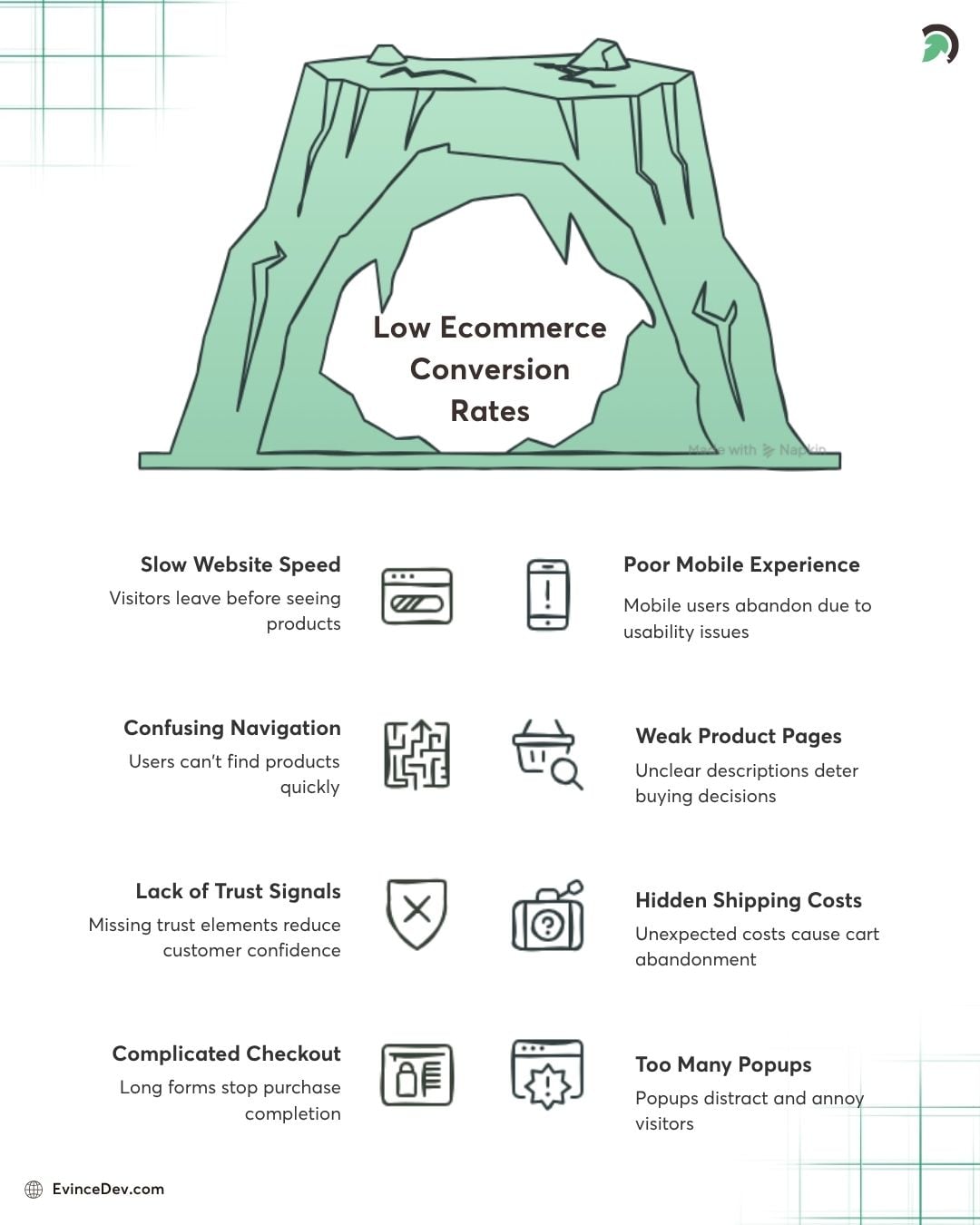
Common reasons ecommerce websites struggle with low conversion rates, including slow loading speed, poor mobile experience, weak product pages, hidden costs, and complicated checkout processes.
Before improving conversions, you need to understand what may be stopping users from buying.
Here are some common reasons ecommerce websites have low conversion rates.
Slow Website Speed
If your website takes too long to load, visitors may leave before they even see your products. Slow speed is especially harmful on mobile devices.
Poor Mobile Experience
Many shoppers browse and buy from their mobile phones. If buttons are hard to tap, images do not load properly, text is difficult to read, or checkout forms are too long, users may leave.
Confusing Navigation
Customers should be able to find products quickly. If categories, filters, search, or menus are confusing, users may not reach the right product.
Weak Product Pages
A product page should answer all important buying questions. If the description is unclear, images are low quality, reviews are missing, or delivery details are hidden, customers may hesitate.
Lack of Trust Signals
New customers may not trust your store immediately. Missing reviews, unclear return policies, no secure payment badges, or a lack of contact information can reduce confidence.
Hidden Shipping Costs
Unexpected costs at checkout are one of the biggest reasons users abandon carts. Customers want pricing clarity before they reach the final payment step.
Complicated Checkout
Long forms, forced account creation, limited payment methods, and unclear error messages can stop users from completing purchases.
Too Many Popups
Pop-ups can be useful, but too many of them can distract or annoy visitors. They should support the buying journey, not interrupt it.
What Role Does AI Play in Ecommerce Conversion Optimization?
AI is becoming useful in Ecommerce conversion optimization because it can help brands understand user behavior, personalize experiences, and automate important parts of the shopping journey.
AI can support ecommerce CRO in several ways:
- Product recommendations
- Personalized offers
- Dynamic search results
- Chatbots for customer support
- Predictive analytics
- Customer segmentation
- Automated email flows
- Fraud detection
- Smart pricing suggestions
- Product description optimization
For example, an AI-powered recommendation engine can show different products to different users based on browsing history, cart behavior, and past purchases.
AI should not replace human strategy, but it can help ecommerce teams make faster and more informed decisions.
How Can Ecommerce Conversion Optimization Improve Sales?
Ecommerce conversion optimization improves sales by removing friction from the buying journey.
It helps users:
- Find products faster
- Understand product value clearly
- Trust the brand
- Compare options easily
- Complete checkout smoothly
- Return for future purchases
The impact can be simple to understand.
Suppose your store gets 100,000 visitors per month.
Current conversion rate: 2%
Orders: 2,000
Average order value: $75
Revenue: $150,000
After improving the conversion rate to 3%:
Orders: 3,000
Average order value: $75
Revenue: $225,000
That is $75,000 in extra monthly revenue from the same traffic.
This is why many growing brands invest in ecommerce conversion optimization services when they want expert support in auditing, testing, and improving their store performance.
How Do You Measure Ecommerce Conversion Rate Optimization Success?
Measuring the success of ecommerce conversion rate optimization requires that one should take note of the entire customer buying process rather than the total sales made. This helps us know where our customers are progressing and where they drop off.
Key Metrics to Track
| Metric | What It Shows |
| Conversion rate | How many visitors complete a desired action |
| Add-to-cart rate | How many visitors add products to cart |
| Cart abandonment rate | How many users leave after adding products to cart |
| Checkout completion rate | How many users finish checkout after starting it |
| Average order value | How much customers spend per order |
| Revenue per visitor | How much revenue each visitor brings on average |
| Bounce rate | How many visitors leave without taking action |
| Mobile conversion rate | How well the store converts mobile users |
| Returning customer rate | How many customers come back and buy again |
| Email signup rate | How many visitors join your email list |
Expert Perspective
Do not measure CRO only by total sales. Track where users drop off, such as product pages, cart, checkout, or mobile journeys, to understand what needs fixing.
Match Metrics With Your Goal
Different metrics should be used based on which areas need improvement. If the product pages receive visitors but there are no additions to the shopping cart, the metric that will come in handy is the add to the cart rate. In case the visitors make additions to the shopping cart but do not complete the purchase, the checkout rate should be checked.
Compare Before and After Changes
Good CRO measurements involve comparing the performance before and after each significant change. After simplifying the checkout process, you should see whether the conversion rate has been improved. Similarly, after updating the pictures or descriptions of products, see whether the add-to-cart rate has improved.
Segment the Results
Do not just consider numbers in general. Segment your performance by mobile versus desktop, new versus returning visitors, paid versus organic visits, product type, and landing pages. That way, you can identify how effective something is, and if there are opportunities for further optimization.
When Should Businesses Use Ecommerce Conversion Optimization Services?
Businesses should consider ecommerce conversion optimization services when they have traffic but are not getting enough sales, or when they are spending heavily on ads but revenue is not growing as expected.
You may need expert help if:
- Your conversion rate is lower than expected
- Your cart abandonment rate is high
- Your checkout has too many drop-offs
- Your mobile conversion rate is poor
- Product pages are not generating add-to-cart actions
- Your website is slow
- You are redesigning your ecommerce store
- You need data-backed testing and a CRO strategy
CRO often works best when combined with strong design, development, analytics, and ecommerce website development services. A technically strong website gives your optimization efforts a better foundation.
What Are Common Ecommerce Conversion Optimization Mistakes?
Many ecommerce stores try to improve conversions, but small mistakes can reduce the impact of their efforts. Common mistakes include:
- Making changes without using data or customer behavior insights
- Copying competitors blindly without understanding your own audience
- Ignoring mobile users and focusing only on the desktop experience
- Overlooking website speed and page loading performance
- Hiding shipping costs until the final checkout step
- Using fake urgency, false countdown timers, or misleading stock alerts
- Adding too many pop-ups that interrupt the shopping experience
- Forcing users to create an account before checkout
- Testing too many changes at once makes results difficult to measure
- Not tracking micro conversions like add-to-cart, wishlist, or checkout start
- Ending A/B tests too early, before collecting enough data
- Focusing only on design changes instead of user intent, trust, and buying friction
Ecommerce conversion optimization is not about making random changes. It is about understanding user behavior, removing friction, and improving the customer journey with a clear purpose.
Ecommerce Conversion Optimization Checklist
Use this quick checklist to review your ecommerce store.
Website Speed
- Are product pages loading quickly?
- Are images compressed?
- Are unnecessary scripts removed?
- Is mobile speed optimized?
Mobile Experience
- Are buttons easy to tap?
- Is text readable?
- Is checkout simple on mobile?
- Are popups mobile-friendly?
Product Pages
- Are product images clear?
- Is the description benefit-focused?
- Are reviews visible?
- Is delivery information clear?
- Is the CTA easy to find?
Checkout
- Is guest checkout available?
- Are forms short?
- Are shipping and taxes visible early?
- Are multiple payment options available?
- Are error messages clear?
Trust
- Are reviews and ratings visible?
- Is the return policy clear?
- Are secure payment badges shown?
- Is customer support easy to find?
Testing
- Are you tracking user behavior?
- Are you testing important changes?
- Are you measuring results by device and channel?
- Are you documenting CRO learnings?
Conclusion
Ecommerce conversion optimization helps online stores increase sales by improving the way visitors browse, trust, and buy from a website. Instead of depending only on more traffic, it focuses on making the existing shopping journey faster, clearer, and easier to complete.
From website speed and mobile experience to product pages, checkout, trust signals, personalization, and cart recovery, every improvement can help reduce friction and turn more visitors into customers.
For growing ecommerce businesses, CRO should be an ongoing process of tracking user behavior, testing improvements, and making data-backed decisions.
At EvinceDev, we help businesses create ecommerce experiences that are not just fast, but also scalable, user-friendly, and support better conversions. The goal is simple, build stores that help customers find what they are looking for and streamline the path to complete their purchase with confidence and without any roadblock.
FAQs
1. What is Ecommerce Conversion Optimization?
Ecommerce Conversion Optimization is the process of improving an online store so more visitors complete important actions, such as buying a product, adding to cart, signing up for emails, or starting checkout.
2. What is a good ecommerce conversion rate?
A good conversion rate depends on your industry, product type, traffic quality, pricing, device type, and customer intent. Instead of only relying on generic benchmarks, compare your current performance with your own previous results.
3. How to calculate ecommerce conversion rate?
Use this formula:
Conversion Rate = Number of Conversions ÷ Total Visitors × 100
For example, if 500 out of 20,000 visitors buy, your conversion rate is 2.5%.
4. Why is my ecommerce conversion rate low?
Your conversion rate may be low because of slow speed, poor mobile experience, weak product pages, lack of reviews, hidden costs, limited payment options, complicated checkout, or low-quality traffic.
5. What is the quickest way to increase ecommerce conversion rates?
First, you need to look at the largest barriers to conversion. Make your website faster, mobile-friendly, easy to checkout from, include trust signals, better product pages, and abandoned cart recovery.
6. Is conversion optimization only about increasing purchases?
No, the conversion is not just about increasing purchases also includes actions such as add-to-cart, wishlist addition, email signup, checkout start, review submission, and repeat purchases.
7. How frequently should ecommerce sites engage in CRO?
CRO is an activity that needs to be undertaken all the time since the behavior of customers, traffic sources, product demand, and technology continue to evolve.