Risk Management Software Development Company
Strengthen governance, reduce compliance gaps, and improve risk accuracy with FinTech risk management software tailored to modern financial workflows.
Talk to Our FinTech Expert






As fintech products grow, managing risk across transactions, users, operations, and compliance workflows becomes more complex. Manual oversight, fragmented systems, and evolving regulations make it harder to maintain control and respond quickly.
Track transactions and user activity in real time to detect anomalies and trigger timely risk alerts.
Evaluate and predict risk using dynamic scoring and forecasting models based on behavior, transaction data, income patterns, and financial signals.
Automate compliance checks and policy enforcement while aligning workflows with predictive risk insights to improve decision accuracy and reduce manual effort.
Identify suspicious patterns and predict potential fraud risks using rule-based and data-driven detection models to prevent financial losses proactively.
Manage risk cases with centralized tracking, audit trails, and data-driven insights that support faster investigation and informed decision-making.
Access dashboards and reports to monitor risk trends, forecast exposure, and track repayment behavior, and overall financial risk performance.
Connect with banking systems, payment platforms, and data sources to support unified risk visibility, including risk management software use cases.
Support broader finance software development needs by building risk-aware modules, workflows, and system components that align with financial operations.
Use advanced models to forecast repayment behavior, default risk, income trends, and future loan demand for proactive financial decision-making.

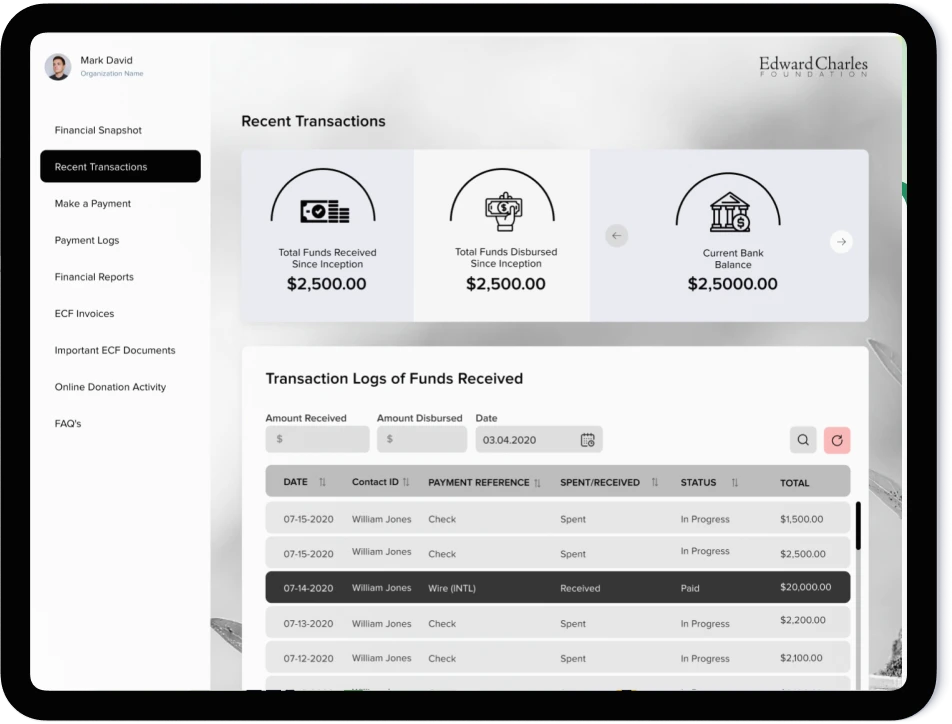
Disbursed and Managed through ECF Fiscal
Sponsorship Platform
Faster Reporting with Xero API

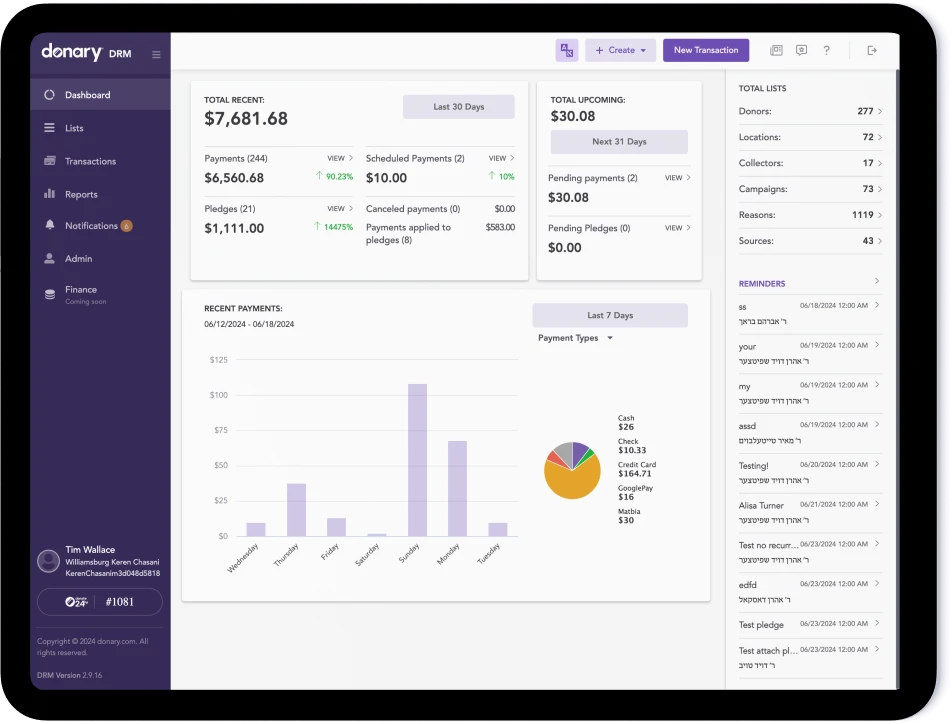
Increased in donor engagement and participation
More accurate donor insights for better targeting

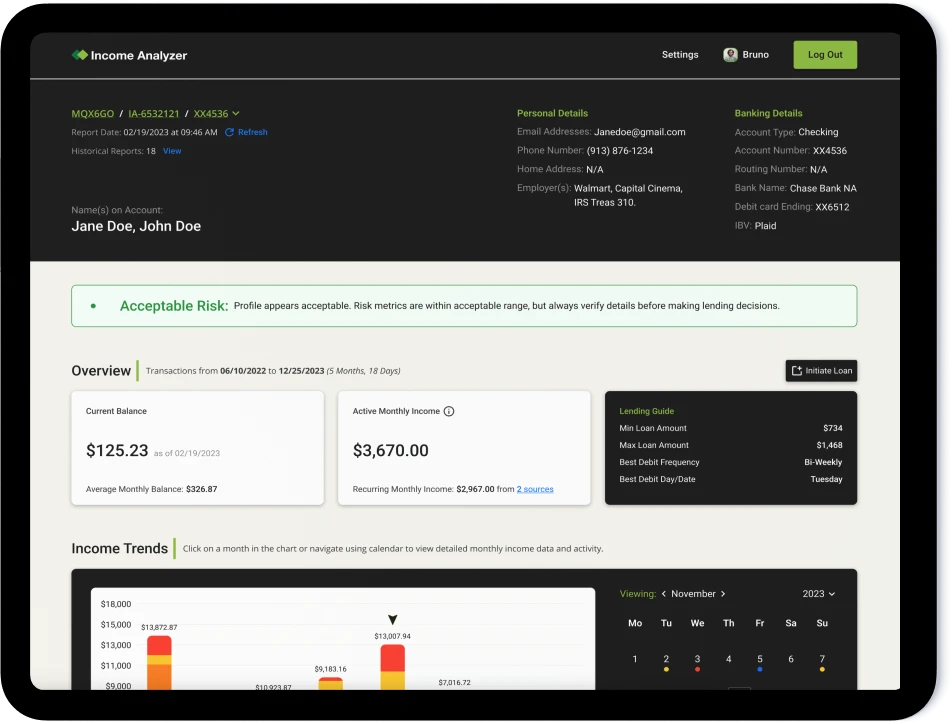
Improvement in Risk Assessment
Faster income verification process

Success rate in global payment acceptance
Reduction in fraudulent transactions

FinTech risk management software development requires clarity across risk strategy, compliance, and system execution as platforms scale. Our approach protects delivery timelines and long-term trust while ensuring consistent risk control, accuracy, and performance.
Dedicated ownership ensures risk policies, compliance requirements, and system decisions remain aligned across workflows and business priorities.
Risk models, scoring logic, compliance checks, and system dependencies are defined early to reduce gaps, improve accuracy, and maintain delivery momentum.
Systems are built for scalability, performance, and reliability, supporting real-time monitoring and high-volume financial operations from launch onward.
Progress, system performance, and risk exposure are communicated clearly to maintain confidence, control, and alignment throughout the development lifecycle.


CEO, Donary

Operations & Donor/Client Relations, Edward Charles Foundation


Owner, DMA Associates LLC


Director & Founder, Careless
CEO, Donary
Operations & Donor/Client Relations, Edward Charles Foundation
Owner, DMA Associates LLC
Director & Founder, Careless

Chief Executive Officer, NumaraPay
















Our FinTech risk management software integrates seamlessly with financial systems and compliance tools to enable unified risk visibility and accurate decision-making.
Connect with Payment gateway integration services to monitor transaction flows, detect anomalies, and apply risk controls across real-time payment activities.
Leverage Open banking api integration and Financial data integration to access account-level data, improve risk assessment accuracy, and strengthen decision-making.
Integrate with core banking platforms and financial systems to align risk monitoring with account activity, lending operations, and transaction processing.
Enable fraud monitoring workflow integration to strengthen fraud detection capabilities and ensure faster response to suspicious activities.
Connect with KYC AML automation software to align risk management workflows with identity verification, screening, and regulatory compliance processes.
Incorporate AI in FinTech Solutions to enhance risk modelling, automate anomaly detection, and improve predictive risk insights.
Explore frequently asked questions about building FinTech risk management software for monitoring, compliance, reporting, and operational control.
FinTech risk management software helps financial platforms identify, assess, monitor, and control risks across transactions, users, compliance workflows, and internal operations. It supports better visibility, faster response, and stronger decision-making.
Fintech businesses need risk management software to reduce financial exposure, improve compliance readiness, detect unusual activity faster, and maintain control as transaction volumes, customer data, and regulatory requirements grow.
Core features often include real-time monitoring, risk scoring, alert management, compliance workflows, reporting dashboards, audit trails, case management, and integrations with financial systems and third-party tools.
Yes, custom risk management software development allows fintech businesses to tailor workflows, risk models, dashboards, and integrations based on their products and compliance requirements.
It is used to monitor transactions, assess risk exposure, support compliance checks, manage alerts, and improve reporting. Many platforms rely on financial risk management software development to align solutions with specific financial workflows.
Yes, compliance and risk management software can help automate controls, improve audit readiness, support policy enforcement, and maintain more consistent oversight across regulated financial processes.
Yes, it can integrate with payment systems, core banking platforms, compliance tools, CRMs, and external data providers. It can also connect with open banking API integration workflows and broader financial data sources to improve risk visibility.
Yes, AI can help strengthen risk analysis by identifying patterns, improving anomaly detection, and supporting faster decision-making. Many businesses also explore AI in FinTech solutions to enhance monitoring and predictive risk insights.
The timeline depends on the scope, features, integrations, compliance needs, and level of customization. A basic solution may take less time, while more advanced risk analytics software development or enterprise-scale platforms usually require a broader implementation cycle.
Look for a team with fintech domain expertise, strong engineering capability, experience with secure integrations, and a clear understanding of compliance-focused product delivery. This is especially important for risk management software development in regulated environments.