
Key Takeaways
- Mobile-First Banking Is Now Essential: Customers expect fast, secure, and convenient banking services directly from their smartphones
- Security Must Be Built In: Strong authentication, encryption, secure APIs, and fraud detection are critical for protecting users.
- Features Define User Experience: Digital onboarding, transfers, bill payments, card management, alerts, and support make the app useful.
- Compliance Cannot Be Ignored: KYC, AML, PCI DSS, GDPR, and regional banking regulations must be considered from the start.
- Architecture Impacts Scalability: A strong backend, API-first approach, and cloud-ready infrastructure help support long-term growth.
- AI Is Shaping the Future: Chatbots, fraud detection, personalization, credit scoring, and predictive banking are becoming key differentiators.
Banking is no longer limited to branches, paperwork, or fixed working hours. For most customers, the banking experience now begins and ends on a smartphone.
From checking balances and transferring funds to paying bills, applying for loans, and receiving real-time alerts, users expect banking services to be fast, secure, and available anytime. This shift has made mobile banking app development a major priority for banks, credit unions, fintech companies, and financial institutions.
But building a successful banking app takes more than a clean interface. It requires secure architecture, regulatory compliance, seamless integrations, reliable performance, and a user experience customers can trust.
This guide covers the key features, development process, technology stack, security considerations, compliance requirements, cost factors, challenges, and future trends involved in building a modern mobile banking application.
What Is Mobile Banking App Development?
Mobile banking app development refers to the process of designing, building, testing, deploying, and maintaining mobile applications that enable customers to access banking and financial services through smartphones and tablets.
These applications are used for accessing banking services digitally through online connections between the user and the financial institution without visiting the physical branch. The new generation of bank applications is more advanced and intuitive when compared to the first-generation mobile banking applications. These applications have been developed in such a way that they offer a whole platform for managing one’s finances.
Typical services offered through mobile banking applications include:
- Account management
- Balance inquiries
- Transaction history
- Fund transfers
- Bill payments
- Loan applications
- Credit card management
- Mobile check deposits
- Investment tracking
- Budgeting tools
- Customer support
The goal of mobile banking app development is not simply to digitize banking services but to create seamless, secure, and engaging experiences that improve customer convenience while supporting operational efficiency and business growth.
Modern banking applications nowadays can easily integrate with multiple backend systems, including core banking platforms, payment gate-ways, fraud-detection systems, customer relationship management platforms, as well as analytics solutions.
These integrations allow financial institutions to deliver real-time services while maintaining high levels of security and compliance.
Why Mobile Banking Apps Matter
Mobile banking applications have evolved from optional customer convenience tools into critical business assets. For many financial institutions, mobile applications now represent the primary point of interaction between customers and the bank.
There has been an enormous shift in consumer behavior, with mobile devices now being the preferred method. Consumers now demand access to financial services in an immediate manner without having to wait in queue in branches or even call customer service for simple transactions.
The first benefit that can be associated with developing a mobile bank application is better customer experience. Through using mobile applications for banking needs, customers have an opportunity to use the service whenever and wherever they want. This factor makes direct contribution to greater customer satisfaction.
In terms of business benefits, mobile banking applications can also help reduce costs incurred by firms. For instance, through such applications, banks will reduce the number of people who visit their branches to carry out regular activities.
Customer engagement is another important avenue for banks through the use of mobile apps. By making use of push notifications, product recommendations, expense analysis, and targeted promotions, banks will be able to have consistent contact with their customers, encouraging usage of their products and services.
Given the growing competition within the financial sector, banks with superior digital experiences have an advantage.
Quick Stat:
Also Read: How to Choose a Fintech Software Development Company: A Practical Guide for BusinessesA McKinsey survey found that digital channels now account for the majority of banking interactions, with customers increasingly preferring mobile and online banking over branch visits.
Types of Mobile Banking Applications
Different financial institutions require different types of banking applications based on their customer base, services, and business objectives.
Retail Banking Applications
These retail banking apps are designed for individual customers, and they constitute the most common type of banking applications. They provide several functionalities like account management, money transfers, payment processing, monitoring of transactions, and other financial services using mobile phones.
Retail banking applications focus heavily on usability, convenience, and customer engagement.
Corporate Banking Applications
Corporate banking apps are designed specifically for businesses and commercial clients. These applications often support more complex financial activities such as treasury management, payroll processing, cash flow monitoring, invoice approvals, and multi-user authorization workflows.
Corporate banking applications typically require advanced security controls and role-based access management.
Digital-Only Banking Applications
Digital-only banks, often referred to as neobanks, operate entirely through digital channels without maintaining physical branch networks.
These institutions rely heavily on mobile banking app development to deliver customer experiences, manage accounts, facilitate payments, and provide financial services.
Examples include mobile-first banking platforms that offer account opening, card management, savings tools, and budgeting features through a single application.
Credit Union Applications
Credit unions often develop mobile applications tailored to their member communities. These apps typically include many of the same capabilities as retail banking apps while emphasizing member services and relationship-focused experiences.
Investment and Wealth Management Applications
Investment-focused banking apps provide tools to manage portfolios, monitor investments, execute trades, as well as, accessing market insights.
As financial institutions is diversifying their offerings, investment capabilities are becoming common additions to modern banking applications.
Essential Features of Modern Banking Apps
The success of any banking application depends largely on its ability to provide meaningful functionality while maintaining security and usability.
Expert Perspective
“Many organizations focus mostly on adding new features, but adoption often depends more on usability than the feature volume. In fact, the most successful banking apps prioritize intuitive navigation, fast transaction flows, as well as, friction-less user experiences along with the robust functionality.”
Digital Onboarding
The customer onboarding experience often determines whether a user completes account registration or abandons the process.
Modern onboarding capabilities typically include:
- Digital identity verification
- Document scanning
- Facial recognition
- Electronic signatures
- Automated KYC checks
Reducing onboarding friction can significantly improve customer acquisition rates.
Secure Authentication
Security remains one of the most important aspects of banking application development.
Modern authentication methods include:
- Password-based login
- Biometric authentication
- Multi-factor authentication
- One-time passwords
- Device verification
Combining multiple authentication methods helps strengthen account security while maintaining convenience.
Account Dashboard
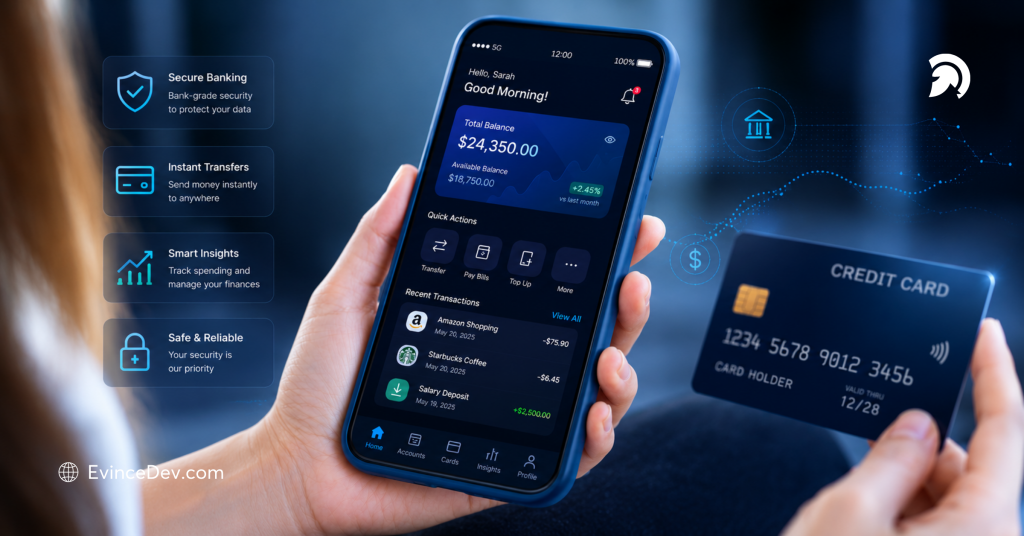
The dashboard serves as the central hub of the application and provides users with quick access to important information.
A well-designed dashboard may include:
- Account balances
- Recent transactions
- Spending summaries
- Savings goals
- Personalized insights
Clear and intuitive dashboards improve overall user experience.
Real-World Application
In the Income Analyzer fintech project, EvinceDev developed an AI-powered solution that transforms bank transaction data into actionable financial insights, helping organizations evaluate income patterns, income stability, and financial risk more efficiently. The platform was able to achieve a 90% reduction in manual analysis as well as 98% data processing accuracy, demonstrating the value of AI in financial decision-making.
Fund Transfers
Customers increasingly expect instant and flexible transfer capabilities.
Transfer features commonly include:
- Internal transfers
- External bank transfers
- Peer-to-peer payments
- International transfers
- Scheduled payments
Real-time payment capabilities are becoming particularly important in modern banking environments.
Bill Payments
Bill payment functionality allows users to manage recurring expenses directly within the application.
Capabilities often include:
- Utility payments
- Credit card payments
- Subscription management
- Automatic payments
- Payment reminders
Card Management
Self-service card management features continue to gain popularity.
Customers increasingly expect to:
- Activate cards
- Freeze cards
- Replace cards
- Manage PINs
- Configure spending limits
These features improve convenience while reducing support requests.
Push Notifications
Real-time notifications help keep users informed about account activity.
Common notifications include:
- Transaction alerts
- Security warnings
- Payment reminders
- Low-balance alerts
- Promotional offers
Customer Support
Customer support features may include:
- Live chat
- AI-powered chatbots
- Video banking
- Knowledge bases
- Support ticket systems
Effective support capabilities improve customer satisfaction and retention.
Mobile Banking App Development Process
A structured mobile application development process helps financial institutions build secure, scalable, and user-friendly banking applications while reducing development risks.
- Step 1: Discovery and Requirements Analysis
This stage focuses on understanding business goals, customer needs, compliance requirements, technical expectations, and project scope. Clear discovery helps define the right features, integrations, risks, and roadmap before development begins. - Step 2: UI/UX Design
The design team designs user journeys, wireframes, and prototypes for easy banking transactions. They seek to eliminate any difficulty that would occur during critical transactions such as sign-ups, money transfer, bill payments, and account management. - Step 3: Architecture Planning
This stage determines the architecture, API approach, infrastructure approach, database design, and security approach of the system. Well-thought-out architecture design can help guarantee that your application will be scalable and integrable into the future. - Step 4: Frontend Development
The main focus of frontend development is the design of the user interface that appears on the mobile application for users to interact with. Some common languages utilized in frontend include Flutter, React Native, Swift, and Kotlin. - Step 5: Backend Development
The backend powers authentication, transaction processing, business logic, data handling, and API services. A reliable backend is essential for secure operations, fast response times, and smooth banking experiences. - Step 6: Integration Development
Integration with various components like core banking system, payment gateway, KYC services provider, CRM, and anti-fraud systems is required for most of the mobile banking applications. Early planning will help in seamless communication between different systems. - Step 7: Testing and Quality Assurance
Banking applications require functional, security, performance, compatibility, and usability testing before launch. Thorough QA helps identify bugs, vulnerabilities, and performance issues before they affect customers. - Step 8: Deployment and Ongoing Maintenance
Once the deployment is over, the QA teams start their work of monitoring performance, releasing updates, fixing bugs if any, enhancing security, and ensuring that the app adapts to changing requirements of compliance. Continuous maintenance is necessary to keep banking application reliable as well as secure.
Technology Stack for Mobile Banking Applications
Technology choices significantly influence application performance, scalability, and future flexibility.
Frontend Technologies
Many organizations choose Flutter or React Native to expedite development across multiple platforms. On the other hand, Native technologies such as Swift and Kotlin may be preferred choices, when maximum performance and platform-specific functionality are top priorities.
Backend Technologies
Popular backend technologies include:
- Java Spring Boot
- Microsoft .NET
- Node.js
- Python
These frameworks support enterprise-grade scalability and security.
Databases
Common database options include:
- PostgreSQL
- MySQL
- Oracle Database
- MongoDB
Database selection depends on transaction volume, data structures, and regulatory requirements.
Cloud Infrastructure
Cloud platforms continue to play an important role in digital banking app development.
Popular options include:
- Amazon Web Services (AWS)
- Microsoft Azure
- Google Cloud Platform
Cloud environments provide scalability, resilience, disaster recovery capabilities, and operational flexibility.
Also Read: How FinTech Software Is Built: Key Architecture ExplainedSecurity Considerations in Mobile Banking App Development
Security is one of the most critical aspects of mobile banking app development. Financial institutions manage highly sensitive customer information and are frequent targets for cybercriminals.
Expert perspective
“Security cannot be an end-game checklist activity. Security in banking applications needs to permeate the entire software development life cycle, from architectural design to coding to testing and rollout.”
Data Encryption
Encryption protects sensitive information from unauthorized access.
Organizations should encrypt:
- Data at rest
- Data in transit
- Sensitive credentials
- Financial information
Multi-Factor Authentication
MFA significantly reduces the risk of unauthorized account access.
Additional verification layers make it more difficult for attackers to compromise user accounts.
Secure APIs
API security should include:
- OAuth authentication
- Token management
- Input validation
- Rate limiting
Fraud Detection
AI-powered fraud detection systems can identify suspicious behavior in real time.
These systems often analyze:
- Transaction patterns
- User behavior
- Device information
- Geographic anomalies
Security Testing
Regular penetration testing and vulnerability assessments help identify weaknesses before they can be exploited.
Quick Stat:
IBM’s Cost of a Data Breach Report found that the average cost of a data breach in the financial industry reached $6.08 million, making security a top priority for banking applications.
Compliance Requirements for Banking Applications
Compliance is a major consideration in banking and finance app development.
Financial institutions operate within highly regulated environments and must satisfy multiple regulatory requirements.
- KYC Compliance: Know Your Customer procedures help verify identities and reduce fraud risks.
- AML Compliance: Anti-Money Laundering regulations help detect and prevent illicit financial activities.
- PCI DSS: Applications handling payment card data may need to comply with PCI DSS requirements.
- GDPR and Data Privacy: Organizations serving customers in the European Union must address GDPR requirements related to data protection and privacy.
- Open Banking Regulations: Open banking initiatives encourage secure data sharing and API-based financial ecosystems.
Compliance considerations should be paid heed from the starting phase and throughout the development lifecycle instead of treating it as post-development activities.
Also Read: PCI DSS Compliance in Software Development: A Complete GuideAI and Emerging Technologies in Banking Apps
AI-powered capabilities are becoming increasingly common in fintech app development initiatives.
Quick Stat:
According to NVIDIA’s State of AI in Financial Services report, 91% of financial institutions are either assessing or already using AI in their operations and customer-facing services.
AI Chatbots
Virtual assistants can provide:
- Customer support
- Account information
- Product recommendations
- Transaction assistance
Personalized Financial Insights
AI can analyze customer behavior and provide recommendations related to spending, saving, and budgeting.
Fraud Detection
Machine learning algorithms can identify unusual activity faster than traditional rule-based systems.
Credit Risk Assessment
AI helps financial institutions evaluate lending risk and improve decision-making processes.
Predictive Banking
Future banking applications may proactively recommend actions based on customer financial behavior and goals.
Expert Insight:
“While AI can improve customer experiences and operational efficiency, successful implementation depends on balancing automation with transparency, regulatory compliance, and human oversight, particularly for financial decision-making processes.”
Challenges in Mobile Banking App Development
Developing banking applications involves numerous technical and operational challenges.
- Legacy System Integration: Many banks continue to operate legacy systems that were not designed for modern mobile experiences. Integrating these systems with contemporary applications can be complex and time-consuming.
- Security Threats: Cybersecurity threats continue to evolve, requiring continuous investment in protection and monitoring.
- Regulatory Complexity: Compliance requirements differ across regions and frequently change over time.
- Scalability: Applications must support growing user bases and increasing transaction volumes without compromising performance.
- User Expectations: Customers increasingly expect friction-less digital experiences which is comparable to leading consumer applications. Meeting these expectations requires ongoing maintenance and optimization.
How Much Does Mobile Banking App Development Cost?
The cost of mobile banking app development depends on numerous factors.
Major cost drivers include:
- Feature complexity
- Platform selection
- Security requirements
- Third-party integrations
- Compliance obligations
- Team composition
- Infrastructure requirements
Estimated development costs typically include:
| Application Type | Estimated Cost |
| Basic Banking App | $30,000 – $80,000 |
| Mid-Level Banking Platform | $80,000 – $200,000 |
| Enterprise Banking Ecosystem | $200,000 – $500,000+ |
Organizations should also account for ongoing expenses related to maintenance, security monitoring, cloud infrastructure, and feature enhancements.
Future Trends in Mobile Banking
The future of mobile banking app development will be shaped by evolving technologies and changing customer expectations.
Key trends include:
- Open Banking: Expanding financial ecosystems through secure API integrations.
- Embedded Finance: Integrating financial services directly into non-banking applications.
- Agentic AI: AI systems capable of performing approved financial actions on behalf of customers.
- Hyper-Personalization: Delivering highly tailored financial experiences using advanced analytics and AI.
- Real-Time Payments: Instant payment systems becoming increasingly common worldwide.
- Digital Identity Solutions: Advanced identity verification technologies improving security and user experience.
- Voice Banking: Voice-enabled financial services offering additional convenience as well as accessibility.
Financial institutions that are adopting these innovations will have competitive edge in the growing digital marketplace.
Expert View
“Financial institutions planning mobile banking initiatives should view digital transformation as an ongoing journey rather than a one-time technology project. Long-term success depends on continuous innovation, security enhancements, regulatory readiness, and responsiveness to evolving customer expectations.”
How EvinceDev Helps Build Mobile Banking Applications
EvinceDev assists financial institutions such as banks, fintech firms, credit unions, and financial service organizations in creating safe, scalable, and easy-to-use digital banking applications. Leveraging their knowledge of mobile app development, fintech software development, custom software development, API integration, cloud computing, AI implementation, application reengineering, and quality assurance, EvinceDev caters to the needs of businesses in any phase of their mobile banking app development process.
From designing a new banking app to improving an existing one, incorporating innovative elements like chatbots, fraud prevention systems, digital payments, or even real-time analytics in your mobile banking app, EvinceDev can be your ideal tech partner for all these needs.
Conclusion
The financial service sector is fast moving into a mobile-first world. For this reason, mobile banking apps have become very important to banks, credit unions, and other financial service institutions globally. Modern customers demand a secure, convenient, and personalized experience through which they can access their finances at any time and from anywhere.
Banking software applications need not only be visually appealing but also well structured, secure, compliant, integrated, scalable, and innovative. Those who adopt digital banking can benefit through better customer experience, efficient processes, better security, and a competitive advantage due to the increasing competition within the market.
With the advent of technologies, the need for mobile banking app development is only going to increase in the coming years. Banks adopting these technologies will find themselves better equipped to address customer needs in the future.