Key Takeaways
- PPC Drives Quick Visibility: It helps businesses appear in front of high-intent users faster than organic methods.
- You Pay Only for Clicks: Advertisers are charged when users actually click on their ads.
- Targeting Matters Most: The right keywords, audience, location, and intent improve campaign performance.
- Landing Pages Impact Results: A relevant and optimized landing page can increase conversions and reduce wasted spend.
- Tracking Is Essential: Conversion tracking helps measure leads, sales, ROI, and campaign effectiveness.
- PPC Works Best with Optimization: Regular testing, bid adjustments, and keyword refinement improve long-term results.
Digital advertising is evolving rapidly. Artificial intelligence is transforming campaign management, automation is reshaping bidding strategies, privacy regulations are changing audience targeting, and competition for online visibility continues to intensify. In this environment, businesses need marketing channels that can deliver measurable results, adapt quickly, and connect with customers at the right moment.
This is one of the reasons pay per click advertising continues to be a core growth strategy for businesses in 2026. Unlike many marketing channels that take time to build momentum, PPC allows brands to appear in front of potential customers almost immediately. Whether the goal is generating leads, increasing sales, promoting a new product, or expanding market reach, PPC provides a highly targeted and measurable way to drive results.
However, modern PPC is no longer just about bidding on keywords and creating ads. Success today depends on audience targeting, automation, landing page experience, conversion tracking, AI-powered optimization, and continuous performance improvement. Businesses that understand how these elements work together are often able to generate stronger returns while making more efficient use of their advertising budgets.
In this ultimate guide, we will explore what pay per click advertising is, how it works, the platforms that matter most, campaign creation strategies, costs, optimization techniques, emerging trends, and the best practices businesses can use to succeed in 2026 and beyond.
Quick Stat:
According to HubSpot, 74% of brands say PPC is a major driver of their business, highlighting the continued importance of paid advertising in modern digital marketing strategies.
What Is Pay Per Click Advertising?
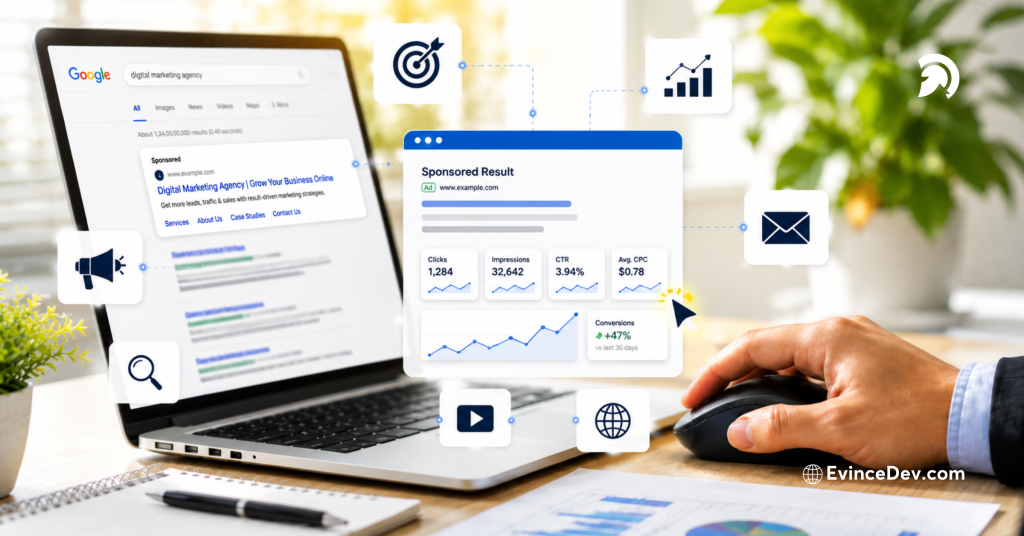
Pay-per-click advertising is an online advertising model where advertisers pay a fee each time someone clicks on their advertisement.
Instead of earning website visitors through organic search rankings alone, businesses can essentially purchase targeted traffic by placing ads on search engines, websites, and social media platforms.
A simple example can help explain the concept.
Imagine you own a local bakery and want more people to visit your website. You create an advertisement targeting the keyword “best bakery near me.” When someone searches for that term, your ad may appear at the top of the search results. If a user clicks the ad and visits your website, you pay a small fee for that click.
The key advantage is that you only pay when someone actively engages with your advertisement.
Because PPC allows businesses to reach users who are already searching for products or services, it often delivers highly qualified traffic and faster results than many other marketing channels.
How Does Pay Per Click Advertising Work?
One of the most common questions businesses ask is how does pay per click advertising work.
Although the process happens within seconds behind the scenes, several important steps take place before an ad appears.
First, advertisers select keywords relevant to their products or services. These keywords determine when their ads may appear in search results.
For example, a software development company might target terms such as:
- Custom software development
- Mobile app development services
- Enterprise software solutions
Next, advertisers create ad campaigns that include headlines, descriptions, target audiences, budgets, and landing pages.
When users perform a search, advertising platforms conduct an automated auction to determine which ads will appear. The winning ads are not always those with the highest bids. Search engines also evaluate factors such as ad quality, relevance, and expected user experience.
The selected ads then appear in search results, on websites, or across social media platforms. If users click the advertisement, they are directed to the advertiser’s landing page, and the advertiser pays the associated click cost.
This process happens millions of times every day across various advertising networks.
The PPC Conversion Funnel
A PPC funnel shows how ads can guide users from first discovering a brand to becoming repeat customers. Since every user has a different level of intent, each stage needs a different message, campaign type, and goal.
We can add an infographic like this here –
| Funnel Stage | PPC Goal | Example Campaigns |
| Awareness | Build visibility and brand awareness | Display ads, YouTube ads, broad search ads |
| Consideration | Educate and engage potential customers | Search ads, remarketing ads, comparison keywords |
| Decision | Drive high-intent traffic and leads | High-intent search ads, shopping ads, brand campaigns |
| Conversion | Generate sales, inquiries, or sign-ups | Conversion-focused ads, offer-based ads, landing pages |
| Retention | Encourage repeat business | Remarketing, cross-sell ads, upsell ads |
Simply put, a strong PPC strategy does not tend to treat every user the same, instead it delivers the right message at the right stage to improve clicks, conversions, and long-term customer value.
Why Businesses Are Investing More in PPC Advertising in 2026?
The popularity of pay-per-click advertising continues to grow because it solves one of the biggest challenges businesses face: visibility.
A newly launched website may take months to rank organically in search engines. PPC, however, can place that business in front of potential customers almost immediately.
Businesses use PPC for several reasons:
- Generating leads
- Increasing online sales
- Promoting new products
- Building brand awareness
- Driving website traffic
- Supporting local marketing campaigns
Perhaps the biggest advantage is control. Advertisers can define exactly who sees their ads based on factors such as location, demographics, interests, device type, and search intent.
This precision makes pay-per-click advertising highly efficient when managed correctly.
Types of Pay-Per-Click Advertising
Although search ads are the most recognized PPC format, they represent only one part of the broader PPC landscape.
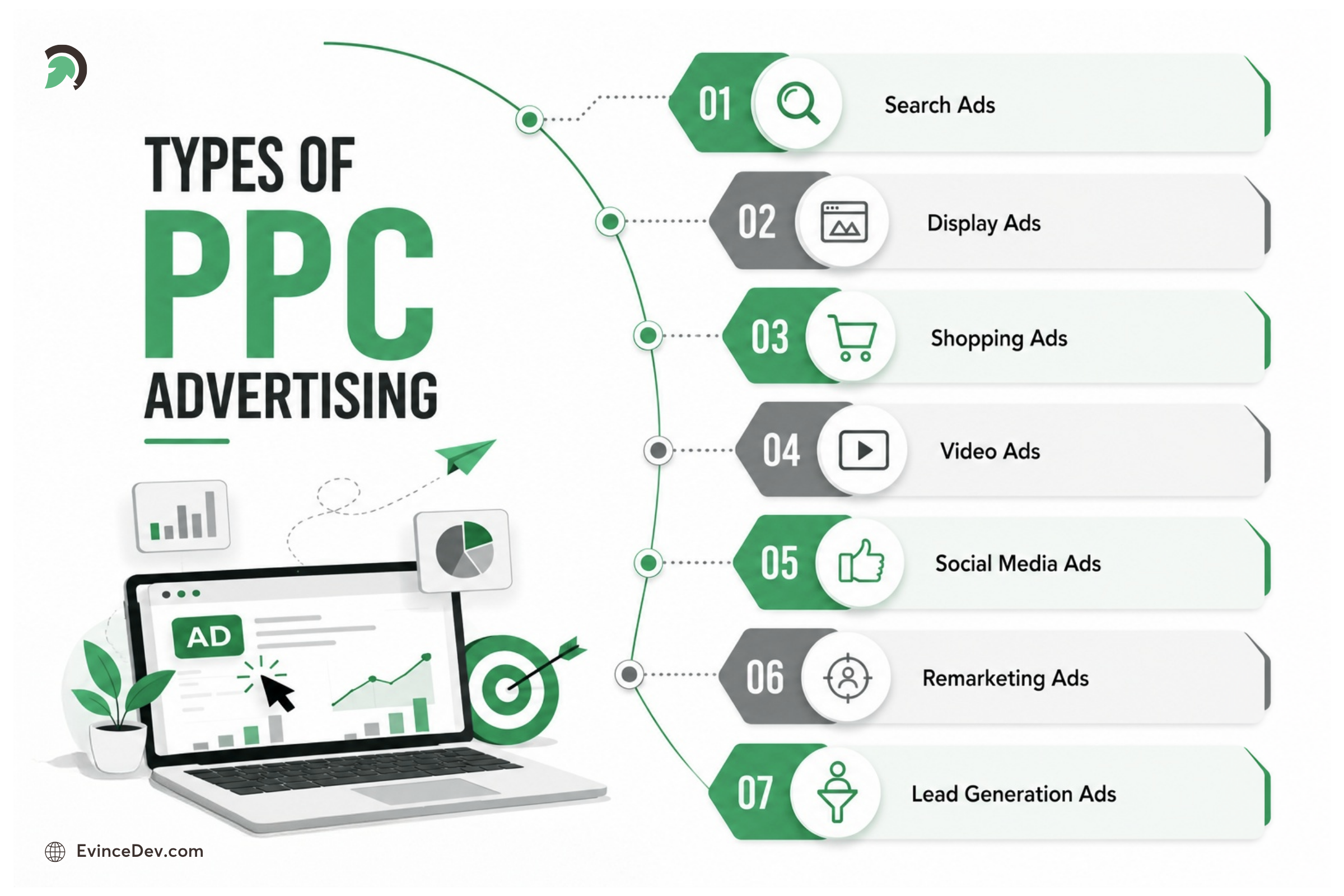
Different Types of PPC Advertising Explained
Search Advertising
Search advertising displays ads directly within search engine results pages.
This form of pay per click search engine advertising allows businesses to appear when users actively search for products, services, or information.
Search ads are particularly effective because they target users with high purchase intent. Someone searching for “CRM software pricing” is often much closer to making a decision than someone casually browsing social media.
Display Advertising
Display advertising uses visual banner ads that appear across websites, blogs, and mobile applications.
Rather than targeting search behavior, display campaigns focus on audience interests, demographics, and browsing habits.
Display ads are commonly used for brand awareness campaigns and remarketing efforts.
Shopping Ads
Shopping ads showcase product images, prices, ratings, and store information directly within search results.
These advertisements are particularly valuable for eCommerce businesses because users can evaluate products before clicking.
Video Advertising
Video advertisements appear before, during, or after online video content.
Platforms such as YouTube have made video advertising a highly effective channel for increasing engagement and brand recognition.
Social Media Advertising
Social platforms such as Facebook, Instagram, LinkedIn, TikTok, and X offer PPC advertising opportunities based on audience targeting rather than search intent.
These campaigns often focus on awareness, engagement, lead generation, and customer acquisition.
Also Read: Best Display Ad Networks for Advertisers and PublishersPopular PPC Platforms
Businesses have numerous options when selecting PPC advertising platforms.
Google Ads
Google remains the largest PPC platform globally. Through google pay per click advertising, businesses can place ads across Google’s search results, display network, YouTube, Gmail, and partner websites.
Because of Google’s massive market share, many organizations consider it the primary PPC channel.
Many marketers simply refer to these campaigns as google ppc ads, which continue to dominate search advertising spend worldwide.
Microsoft Advertising
Previously known as Bing Ads, Microsoft Advertising allows businesses to target users across Bing, Yahoo, and other partner networks.
Although search volume is smaller than Google, competition is often lower, which can lead to reduced advertising costs.
Facebook and Instagram Ads
Meta’s advertising ecosystem provides highly advanced audience targeting capabilities.
Businesses can reach users based on demographics, interests, behaviors, and previous interactions with their brand.
LinkedIn Ads
LinkedIn offers specialized targeting for B2B marketers.
Companies can target users based on job title, industry, company size, skills, and professional interests.
YouTube Ads
As one of the world’s largest video platforms, YouTube provides powerful opportunities for video-based PPC campaigns.
Ad Extensions: Improving PPC Ad Visibility
Ad extensions are additional pieces of information that can appear alongside PPC ads, such as phone numbers, website links, business locations, pricing details, and promotional offers. They help make ads more informative and can improve visibility, click-through rates, and overall campaign performance.
| Ad Extension | Purpose |
| Sitelink Extensions | Direct users to specific pages on a website |
| Call Extensions | Allow users to call directly from the ad |
| Location Extensions | Display business addresses and directions |
| Callout Extensions | Highlight key benefits or offers |
| Structured Snippets | Showcase products, services, or features |
Key PPC Terms Every Beginner Should Know
Understanding PPC terminology makes campaign management significantly easier.
- Keywords are the search terms advertisers target.
- Cost Per Click (CPC) refers to the amount paid when someone clicks an ad.
- Impressions represent the number of times an advertisement appears.
- Click-Through Rate (CTR) measures how often users click an ad after seeing it.
- Conversion occurs when a visitor completes a desired action, such as making a purchase or submitting a form.
- Quality Score is Google’s measure of ad relevance, expected performance, and landing page quality.
- Return on Ad Spend (ROAS) evaluates revenue generated compared to advertising costs.
These metrics help advertisers assess campaign performance and identify opportunities for improvement.
Also Read: Impact of Keyword Quality Score on Search Ads PerformanceUnderstanding PPC Keyword Match Types
Selecting the right keywords is only part of the equation. Advertisers also need to choose the appropriate keyword match type, which determines how closely a user’s search query must match the selected keyword before an ad can appear.
Using the right match type helps improve targeting, reduce wasted spend, and attract more qualified traffic.
| Match Type | Example | How It Works |
| Broad Match | CRM software | Ads may appear for related searches like customer management tools, sales software, or business CRM platforms. |
| Phrase Match | “CRM software” | Ads may appear for searches that include the phrase or close variations, such as best CRM software or CRM software for small business. |
| Exact Match | [CRM software] | Ads appear for searches that closely match the keyword or show the same intent, offering tighter targeting. |
For many businesses, phrase match provides a good balance between reach and relevance. As campaigns mature, advertisers often combine different match types and use negative keywords to improve targeting and campaign efficiency.
What Is Quality Score?
Quality Score is Google’s rating of the relevance and quality of your PPC ads. It helps determine how well your ads, keywords, and landing pages align with what users are searching for.
A higher Quality Score can improve your ad position and potentially lower your cost per click (CPC), making it one of the most important factors in PPC performance.
Google primarily evaluates Quality Score based on three key factors:
| Quality Score Factor | Why It Matters |
| Expected Click-Through Rate (CTR) | Measures how likely users are to click your ad when it appears. |
| Ad Relevance | Evaluates how closely your ad matches the user’s search intent and selected keywords. |
| Landing Page Experience | Assesses the usefulness, relevance, and overall user experience of the landing page. |
Benefits of Pay-Per-Click Advertising
One reason pay-per-click advertising remains so popular is its ability to deliver measurable business outcomes.
- Immediate Visibility: Unlike SEO, which can take months to generate rankings, PPC allows businesses to appear in search results almost immediately after launching campaigns.
- Highly Targeted Reach: Advertisers can target audiences based on location, age, interests, device usage, search intent, and numerous other factors.
- Measurable Results: Every click, impression, conversion, and cost can be tracked, making performance evaluation straightforward.
Expert View:
One of the most misleading PPC metrics is traffic volume. A campaign generating 500 highly qualified visitors can often outperform another generating 5,000 low-intent visitors. Successful advertisers focus on conversions, customer quality, and return on investment rather than clicks alone.
- Budget Flexibility: Businesses can start with modest budgets and gradually increase spending as campaigns prove successful.
- Faster Lead Generation: Because PPC targets users actively searching for solutions, it often generates qualified leads more quickly than many traditional marketing methods.
- Scalability: Successful campaigns can often be expanded by increasing budgets, targeting additional keywords, or entering new geographic markets.
For these reasons, many businesses consider pay per click advertising a core component of their growth strategy.
Quick Stat:
Also Read: Guide to Maximizing Your PPC Campaign PerformanceHubspot reports that search ads can increase brand awareness by up to 80%, showing that PPC can support visibility even when users do not immediately click on an ad.
PPC vs SEO: Understanding the Difference
PPC and SEO are two of the most effective digital marketing strategies for driving website traffic and increasing online visibility. While both help businesses appear in search engine results, they achieve this goal in different ways.
PPC relies on paid advertisements that can generate traffic almost immediately after a campaign is launched. SEO, on the other hand, focuses on improving a website’s organic rankings through content creation, technical optimization, and authority building, which typically takes longer to produce results.
Neither strategy is inherently better than the other. The right approach depends on your business goals, budget, timeline, and competitive landscape. In many cases, businesses achieve the best results by combining both PPC and SEO as part of a comprehensive marketing strategy.
| Factor | PPC | SEO |
| Traffic Speed | Can generate traffic almost immediately after launch | Usually takes several months to build rankings and traffic |
| Cost Structure | Pay for each click or interaction | No direct cost per click, but requires ongoing investment in content and optimization |
| Visibility | Appears in sponsored search results | Appears in organic search results |
| Results Timeline | Short-term and immediate | Long-term and gradual |
| Targeting Options | Advanced targeting by keywords, location, demographics, interests, and devices | Primarily based on search intent and content relevance |
| Control | Full control over budget, targeting, and ad placement | Limited control over rankings due to search engine algorithms |
| Sustainability | Traffic stops when ad spend stops | Traffic can continue long after content is published |
| Click-Through Rates | Often effective for high-intent commercial searches | Often receives higher trust from users for informational searches |
| Testing and Optimization | Results can be tested and adjusted quickly | Changes may take weeks or months to show impact |
| Best For | Quick leads, sales, promotions, and product launches | Long-term brand visibility, authority, and organic growth |
When to Choose PPC
PPC is often a good choice when businesses need immediate visibility, want to promote a time-sensitive offer, launch a new product, or generate leads quickly.
When to Choose SEO
SEO is typically better suited for businesses focused on long-term growth, organic traffic, brand authority, and sustainable customer acquisition.
Why Many Businesses Use Both
Rather than choosing one over the other, many businesses combine PPC and SEO. PPC helps generate immediate traffic and valuable keyword insights, while SEO builds lasting visibility and reduces dependence on paid advertising over time. Together, they create a balanced strategy that supports both short-term performance and long-term growth.
Quick Stat:
According to HubSpot, 61% of marketers say improving SEO and growing their organic presence is a top inbound marketing priority, while PPC is commonly used alongside SEO to drive immediate traffic and leads.
How Much Does PPC Cost?
PPC costs vary based on industry, location, competition, campaign goals, bidding strategy, ad quality, and landing page experience. Highly competitive industries such as legal, insurance, finance, and software often have higher click costs, while niche campaigns may cost less.
The good thing about PPC is budget control. Businesses can set daily or monthly limits, pause campaigns, and increase spending once they start seeing results.
PPC Budget Planning for Beginners
For new campaigns, it is better to start with a budget that allows testing and data collection. Instead of spending everything on one campaign, businesses can divide their budget like this:
| Budget Allocation | Purpose |
| 60% | High-intent keywords and core campaigns |
| 20% | Remarketing and retargeting |
| 20% | Testing new keywords, ads, audiences, and offers |
How to Create a Successful PPC Campaign in 2026
Launching a PPC campaign is not just about choosing a few keywords and writing ads. A successful campaign needs proper planning, targeting, tracking, and continuous optimization. Here is a step-by-step process to build a PPC campaign that drives meaningful results.
Step 1: Define Your Campaign Goal
Before creating any ad, start by identifying what you want to achieve. Your goal will shape your campaign structure, keywords, ad copy, budget, and landing page.
For example, your goal may be to generate leads, increase online sales, promote a new service, drive website traffic, or improve brand awareness. A clear goal makes it easier to measure success and avoid spending money on clicks that do not support your business objective.
Step 2: Understand Your Target Audience
Once the goal is clear, define who you want to reach. This includes understanding your audience’s location, age group, interests, search behavior, pain points, and buying intent.
For example, a business selling enterprise software may want to target decision-makers, managers, or business owners. The more clearly you understand your audience, the better you can create ads that speak directly to their needs.
Step 3: Conduct Keyword Research
Keyword research is one of the most important parts of a PPC campaign. It helps you identify the search terms your potential customers are using.
Focus on keywords that show strong intent. For example, someone searching “best CRM software for small business” is likely closer to making a decision than someone searching “what is CRM.” Along with primary keywords, include long-tail keywords because they are often more specific, less competitive, and more likely to convert.
Step 4: Organize Keywords into Ad Groups
After selecting your keywords, group them based on similar themes. This helps you create more relevant ads for each search intent.
For instance, in case your ads are for digital marketing solutions, there will be different ad groups that focus on SEO services, PPC services, social media marketing, and content marketing solutions.
Step 5: Write Compelling Ad Copy
Your ad copy needs to give users information on what you are offering and why they should visit your landing page. In most cases, successful pay-per-click ads have a great headline, messages showing benefits, keywords that are important, and a compelling call to action.
It is not advisable to just say that you offer certain services. For instance, you can consider saying something like, “Get quality leads from our result-oriented PPC campaigns.”
Step 6: Create a Relevant Landing Page
The landing page plays a major role in campaign success. When users click your ad, they should land on a page that matches the promise made in the advertisement.
For instance, if you advertise about providing PPC services, then your visitors must not be directed to your home page. Instead, they should be directed to a dedicated page for the services with adequate details about the product, its benefits, the credibility of the company, and a convincing call to action.
Expert Perspective:
One of the most frequent mistakes that a PPC campaign makes is paying too much attention to advertisement creation without taking into account the quality of the landing page. No matter how successful the ad was, the results will still suffer from having to land on a slow loading, confusing, or user-unfriendly landing page.
Step 7: Set Your Budget and Bidding Strategy
Secondly, determine the amount you wish to allocate each day or month. The PPC model enables businesses to have control over their budget, which makes it ideal for either small or large scale advertising campaigns.
The type of bid that you make should depend on the goal of your campaign. For instance, if the aim of your campaign is traffic, you may consider clicking. However, for lead generation or sales, conversion bids can be considered.
Step 8: Add Negative Keywords
Negative keywords prevent your ads from showing for irrelevant searches. This helps reduce wasted clicks and improves campaign efficiency.
For example, if you offer premium software development services, you may want to exclude terms like “free,” “cheap,” or “jobs” if they do not match your target audience. Adding negative keywords regularly helps keep your traffic more relevant.
Step 9: Set Up Conversion Tracking
Conversion tracking must be implemented prior to the start of the campaign. With conversion tracking, one knows the number of clicks on his/her advertisements; however, he/she does not know the number of people who have been converted into leads or customers.
Conversion types involve submitting an online form, making calls, buying something, booking a demo, signing up for newsletters, and downloading stuff.
Step 10: Launch the Campaign and Monitor Performance
Once everything is ready, launch the campaign and monitor it closely. In the beginning, focus on key metrics such as impressions, clicks, click-through rate, cost per click, conversions, cost per conversion, and return on ad spend.
Do not judge the campaign too quickly. PPC campaigns often need some time and data before you can make strong optimization decisions.
Step 11: Test Different Ad Variations
Testing is essential for improving PPC performance. Create multiple versions of your ads with different headlines, descriptions, offers, or calls-to-action.
Over time, you can identify which messages attract more clicks and conversions. Even small improvements in ad copy can make a noticeable difference in campaign results.
Step 12: Optimize and Improve Continuously
Managing PPC campaigns is a dynamic activity. You must constantly analyze the results of your keywords, delete those that are not effective, change bids, enhance landing pages, try out fresh ad copies, and add negative keywords.
A good PPC campaign is never set and forgotten. It can only improve through constant optimization, analysis, and testing. The more you optimize, the higher the chances of cutting down wastage and maximizing ROI.
Expert View:
PPC campaigns generate valuable insights about customer behavior, search intent, and buying patterns. Businesses can use this data to improve SEO strategies, content marketing efforts, product messaging, and even sales conversations. PPC is not just a traffic channel; it is also a powerful market research tool.
PPC Trends Shaping 2026 and Beyond
As PPC continues to evolve, businesses must adapt to new technologies, changing user behavior, and increasingly automated advertising platforms. Understanding these trends can help advertisers stay competitive and maximize campaign performance.
- AI-powered campaign optimization: Artificial intelligence is becoming central to bidding, targeting, audience discovery, and campaign optimization. Businesses that effectively combine AI with human strategy can gain a significant competitive advantage.
- Personalization at scale: Modern PPC platforms make it easier to deliver personalized ads based on user behavior, interests, location, and stage in the buying journey.
- AI search and conversational search: As AI-generated search experiences and voice search continue to grow, advertisers need to optimize for user intent and natural language queries rather than relying solely on traditional keyword targeting.
- First-party data is becoming more valuable: With privacy regulations evolving and third-party tracking becoming less reliable, businesses are increasingly relying on customer data from websites, CRM systems, email subscribers, and previous interactions.
- Predictive targeting beyond keywords: PPC platforms are using machine learning and behavioral signals to identify users who are most likely to convert, making audience intent just as important as keyword selection.
- Video advertising continues to grow: Platforms such as YouTube, LinkedIn, Instagram, and TikTok are creating new opportunities for businesses to engage audiences through video-first advertising.
- Omnichannel advertising is becoming the norm: Successful PPC strategies increasingly combine search, display, video, social media, and remarketing campaigns to create a consistent customer journey across multiple touchpoints.
- Regular PPC audits remain essential: As campaigns become more automated, ongoing audits help ensure budgets, targeting, tracking, and optimization strategies remain aligned with business goals.
Common PPC Mistakes Businesses Should Avoid
- Targeting broad keywords: This can bring irrelevant traffic and waste ad spend.
- Ignoring negative keywords: Your ads may appear for searches that are not useful for your business.
- Using weak ad copy: Generic ads often fail to attract clicks or conversions.
- Sending users to poor landing pages: Slow, confusing, or unrelated pages can reduce results.
- Not tracking conversions: Without tracking, you cannot measure which ads are actually working.
- Not optimizing regularly: PPC campaigns need ongoing review, testing, and improvement.
- Skipping A/B testing: Testing different headlines and CTAs helps improve ad performance.
- Ignoring mobile users: A poor mobile experience can lead to lost leads and sales.
PPC Management: Should You Do It Yourself or Hire Experts?
While some businesses successfully manage campaigns internally, others prefer professional support.
Experienced providers offering pay per click advertising services can help businesses develop strategies, conduct keyword research, optimize bids, improve ad performance, and track conversions.
Professional pay per click advertising management becomes particularly valuable when campaigns involve large budgets, multiple markets, or complex targeting requirements.
Many organizations work with a specialized pay per click advertising agency or a broader Digital marketing agency that provides PPC as part of a comprehensive marketing strategy.
Choosing the best pay per click advertising company depends on factors such as industry experience, transparency, reporting capabilities, and proven results.
Conclusion
Pay per click advertising remains one of the most effective digital marketing strategies for businesses seeking immediate visibility, targeted traffic, and measurable results. By helping brands reach potential customers at the right time and in the right place, PPC provides a powerful way to generate leads, drive sales, and support business growth.
However, for a PPC campaign to succeed, there are additional factors that come into play, such as planning, research, creative writing, landing page optimization, tracking results, and making improvements. That’s where partnering with a professional can really help out.
EvinceDev helps businesses strengthen their digital presence through result-driven digital marketing services, including PPC strategy, campaign planning, landing page optimization, SEO, and performance-focused marketing support. Whether you are a small business, startup, eCommerce brand, or enterprise organization, leveraging pay per click advertising with the right strategy can help you compete more effectively in today’s digital marketplace and achieve your marketing objectives faster.