Key Takeaways
- Personalization Is Now Expected: Customers expect ecommerce brands to understand their intent, preferences, and buying journey.
- AI Improves Product Discovery: AI-powered recommendations, search, and visual discovery help shoppers find relevant products faster.
- Customer Journeys Become Smarter: AI personalizes offers, emails, chatbots, loyalty rewards, and post-purchase support across touchpoints.
- Data Quality Matters: Clean product data, connected systems, and privacy-first practices are essential for accurate AI personalization.
- AI Supports Business Growth: AI in ecommerce can improve engagement, conversions, retention, marketing performance, and customer satisfaction.
Think about the last time you shopped online. You may have searched for a product, opened a few options, compared reviews, added something to the cart, left the website, and returned later from an email or ad. For the customer, this feels like one journey. But for an ecommerce brand, every action creates a signal.
“McKinsey found that 71% of consumers expect companies to deliver personalized interactions, and 76% get frustrated when this does not happen.”
This is where AI in ecommerce is changing personalization. It helps brands read those signals and understand what a shopper may need next. A visitor browsing running shoes may need size guidance. A repeat buyer may need a reorder reminder. A cart abandoner may need a better offer or more product confidence. A confused shopper may need instant support from an AI assistant.
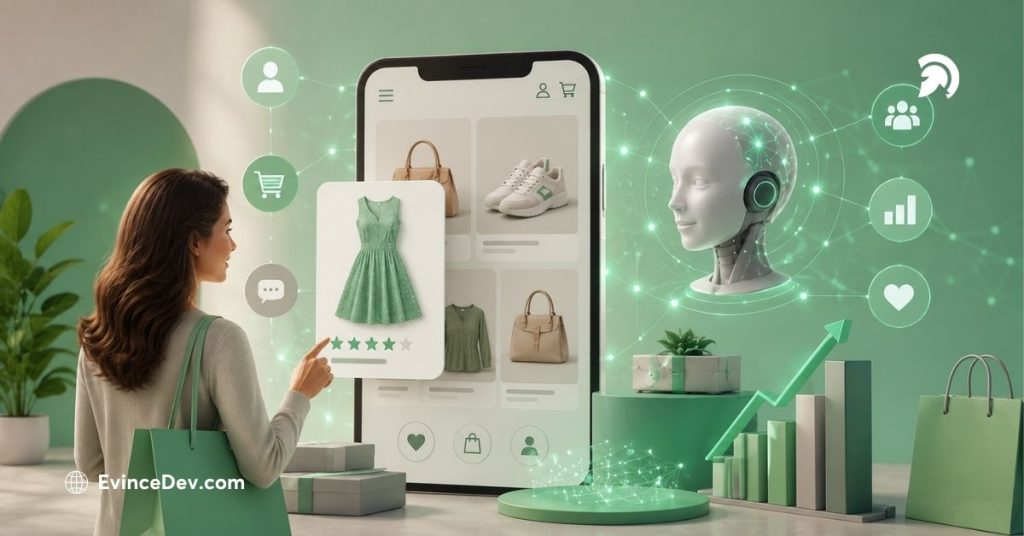
Modern personalization is no longer just about adding a customer’s name to an email or showing “similar products.” It is about creating a shopping experience that adapts to customer intent in real time. AI helps ecommerce brands personalize recommendations, search results, offers, website content, chatbot conversations, loyalty rewards, and post-purchase support.
The result is a journey that feels easier for the customer and more profitable for the brand. Shoppers find relevant products faster, receive timely guidance, and feel understood across different touchpoints.
In this blog, we will explore how brands are using AI to personalize ecommerce customer experiences, along with key use cases, real-world examples, benefits, challenges, best practices, and practical ways to get started.
What Is AI-Powered Personalization in Ecommerce?
AI-powered personalization in ecommerce means using artificial intelligence, machine learning, customer data, and predictive analytics to customize the shopping experience for each customer.
Earlier, personalization was often limited to simple rules. For example, a brand could show one offer to users from a specific location or send a birthday discount to registered customers. That kind of personalization still has value, but it is limited.
With AI in ecommerce, personalization becomes more dynamic. AI can study multiple customer signals together and understand what a shopper may need next.
For example, two shoppers may search for “running shoes,” but their intent may be different. One may want affordable shoes for daily walking, while another may need premium shoes for marathon training. AI can analyze their behavior, budget range, browsing history, and past purchases to show more relevant options.
AI-powered personalization can be used across:
- Product recommendations
- Website and app content
- Search results
- Emails and push notifications
- Chatbot conversations
- Offers and discounts
- Loyalty rewards
- Post-purchase support
In simple terms, AI in ecommerce helps brands move from broad customer segments to more individual, intent-based customer journeys.
To understand how AI personalization works in ecommerce, it helps to look at the customer journey. AI does not personalize only one touchpoint. It can support discovery, decision-making, conversion, support, retention, and trust.
| Customer Journey Stage | How AI Personalizes It | Example Use Case |
| Product discovery | Understands search intent and browsing behavior | Personalized search, visual search, product ranking |
| Product evaluation | Helps customers compare and choose faster | AI chatbots, buying guides, reviews, recommendations |
| Conversion | Shows relevant offers and reduces checkout friction | Personalized bundles, dynamic pricing, cart recovery |
| Post-purchase | Keeps customers informed after checkout | Predictive support, delivery updates, reorder reminders |
| Retention | Encourages repeat purchases with relevant engagement | Loyalty personalization, email campaigns, product suggestions |
| Trust and security | Protects genuine buyers and reduces risk | Fraud detection, secure transactions, human review |
Expert Perspective:
AI personalization should not start with the algorithm. It should start with the customer journey. If brands do not know where shoppers feel confused, delayed, or unsupported, even the best AI model will only automate a weak experience.
– Rahul Patidar, Dept. Head of eCommerce and CMS, EvinceDev
Why Brands Are Investing in AI Personalization
Brands are investing in AI personalization because customer expectations have changed. Shoppers want faster product discovery, smoother checkout, relevant offers, and support that understands their context.
At the same time, ecommerce competition is increasing. Many brands sell similar products, offer similar discounts, and use similar marketing channels. In such a market, personalization helps brands stand out by making the shopping journey easier and more relevant.
AI personalization also helps brands respond in real time. If a shopper views a product, reads reviews, checks shipping details, and adds the product to the cart, AI can recognize high purchase intent and trigger the right next step. This could be a product comparison, a limited-time offer, a chatbot prompt, or a cart reminder.
The key reasons brands invest in AI in ecommerce personalization include:
- Customers expect more relevant digital experiences
- Generic campaigns often lead to lower engagement
- AI can analyze behavior faster than manual teams
- Personalized journeys can improve conversions and loyalty
- AI helps brands connect marketing, sales, service, and retention
The real value is not only in showing personalized content. It is in reducing customer effort across the complete buying journey.
Also Read: How AI Is Transforming the Entertainment Industry: Tools, Trends & Case Studies“If your customer experiences aren’t planning to leverage these intelligent models, you will not be competitive.”
– Andy Jassy, CEO of Amazon
How Brands Are Using AI in Ecommerce to Personalize Customer Experience
AI in ecommerce is helping brands personalize the complete shopping journey, from the first product search to post-purchase support. Instead of showing the same experience to every shopper, AI helps brands understand customer intent, recommend relevant products, improve support, and create smoother buying journeys.
1. AI-Powered Product Recommendations
AI-powered product recommendations help ecommerce brands suggest products based on browsing history, purchase behavior, cart activity, wishlist items, and similar customer patterns. Instead of showing random products, AI guides shoppers toward items that match their needs or buying intent.
Example: If a customer buys a camera, AI can recommend lenses, memory cards, tripods, and camera bags. If someone views formal shirts, it can suggest trousers, belts, shoes, or accessories.
Business impact: This improves product discovery and supports cross-selling, upselling, repeat purchases, and higher average order value.
Quick Stat:
According to ResearchGate, AI enables ecommerce platforms to analyze large volumes of customer data in real time and identify behavior patterns that help predict customer needs more accurately.
2. Dynamic Website and App Personalization
Dynamic personalization allows ecommerce websites and apps to change content based on each shopper’s behavior, preferences, and buying stage. AI can personalize homepage banners, product sections, CTAs, landing pages, pop-ups, and loyalty messages in real time.
Example: A first-time visitor may see best-selling products and buying guides, while a returning customer may see recently viewed items, personalized offers, or a “continue shopping” section.
Business impact: This reduces friction and helps customers move faster from browsing to buying.
3. Personalized Search and Product Discovery
AI improves ecommerce search by understanding natural language, customer intent, product context, and buying preferences. Instead of matching only exact keywords, AI can understand what the shopper is actually trying to find.
Example: A customer searching for “comfortable office shoes” or “best laptop for video editing under $1,500” can see products that match the intent behind the query, not just the words used.
Business impact: This helps customers find relevant products faster and reduces search abandonment, especially for stores with large catalogs.
4. AI Chatbots and Virtual Shopping Assistants
AI chatbots and virtual shopping assistants guide customers through product discovery, comparison, checkout, order tracking, returns, and support. They can ask follow-up questions and recommend products based on customer needs.
Example: A customer looking for a washing machine can ask which model is best for a family of four. The AI assistant can ask about budget, space, capacity, energy rating, and delivery location before suggesting suitable options.
Business impact: This is how AI helps ecommerce businesses offer guided shopping support at scale while reducing pressure on customer service teams.
5. Personalized Emails, SMS, and Push Notifications
AI helps ecommerce brands personalize customer communication based on browsing behavior, purchase history, cart activity, and engagement patterns. It can decide what message to send, when to send it, and which product or offer to include.
Example: A customer who viewed winter jackets may receive an email with similar jackets, available sizes, matching accessories, and a limited-time offer. A regular pet food buyer may receive a reorder reminder before the product runs out.
Business impact: Personalized communication improves engagement, cart recovery, repeat purchases, and campaign performance.
6. Personalized Offers, Discounts, and Bundles
AI helps brands understand which offer, discount, bundle, or reward is most relevant for each customer. This allows ecommerce businesses to move beyond one-size-fits-all promotions and create more meaningful offers.
Example: A customer buying a phone may see a bundle with a case, charger, screen protector, and warranty. A loyal customer may receive early access instead of a discount.
Business impact: This improves promotion effectiveness while helping brands avoid unnecessary blanket discounts.
7. Predictive Customer Support
Predictive customer support uses AI to identify possible issues before customers raise complaints. It helps brands send timely updates, reminders, and support messages based on order status, payment activity, stock levels, or customer behavior.
Example: If an order is delayed, AI can send a revised delivery update. If a payment fails, it can trigger a reminder. If a product is running low, it can notify customers who may want to reorder.
Business impact: This builds trust, reduces support tickets, and improves the post-purchase customer experience.
8. AI-Based Customer Segmentation
AI-based segmentation helps ecommerce brands group customers by real-time behavior, purchase intent, engagement level, buying frequency, and churn risk. Unlike traditional segmentation, these groups keep changing as customer behavior changes.
Example: A brand can identify customers who are likely to buy soon, customers who may need a discount, customers ready to reorder, and customers at risk of becoming inactive.
Business impact: This helps brands run more accurate campaigns and make better marketing, sales, and retention decisions.
9. Visual Search and Image-Based Personalization
Visual search allows shoppers to search using images instead of text. AI analyzes colors, patterns, shapes, materials, and styles to help customers find similar or related products.
Example: A shopper can upload a photo of a sofa to find similar designs or use an image of a dress to discover similar styles on an ecommerce website.
Business impact: This shortens the journey from inspiration to purchase, especially in fashion, beauty, furniture, home decor, and lifestyle ecommerce.
10. Personalized Loyalty Programs
AI helps ecommerce brands personalize loyalty rewards based on customer value, purchase frequency, product interest, and reward preferences. This makes loyalty programs feel more relevant to each customer.
Example: A fashion brand may offer early access to frequent buyers. A grocery app may suggest weekly deals based on regular purchases. A beauty brand may recommend rewards based on past orders or skin preferences.
Business impact: Personalized loyalty programs encourage repeat purchases and strengthen long-term customer relationships.
11. Generative AI for Personalized Content
Generative AI helps ecommerce brands create personalized content at scale, including product descriptions, email copy, ad variations, chatbot responses, buying guides, landing pages, and support replies.
Example: The same product description can be adapted for a technical buyer, a first-time shopper, or a budget-conscious customer.
Business impact: This helps brands deliver more relevant content across the customer journey, while human review ensures accuracy, tone, and brand consistency.
12. Omnichannel Personalization
Omnichannel personalization uses AI to connect customer interactions across websites, mobile apps, emails, social media, marketplaces, chatbots, and support channels. This helps brands maintain context across different touchpoints.
Example: A customer may browse a product on mobile, receive a relevant email later, ask a chatbot about sizing, and complete the purchase on desktop.
Business impact: This creates a smoother journey and makes customers feel as if they are interacting with a single, connected brand rather than separate tools or departments.
Quick Stat:
Adobe reported that in July 2025, 26% of traffic from generative AI sources came through mobile, up from 18% in January 2025. This shows why ecommerce brands need to make AI-personalized journeys work smoothly across mobile, desktop, email, chatbots, and other touchpoints.
13. AI-Based Product Ranking and Predictive Sorting
AI helps ecommerce brands personalize the order in which products appear on search and category pages. Instead of showing the same product ranking to every shopper, AI can adjust results based on browsing behavior, purchase history, preferred price range, product interest, and buying intent.
Example: A customer who often buys premium products may see higher-end options first, while a budget-conscious shopper may see affordable or discounted products ranked higher.
Business impact: This improves product discovery, reduces browsing effort, and helps customers find relevant products faster.
14. Dynamic Pricing and Revenue Optimization
AI helps brands adjust pricing, markdowns, and promotional strategies based on demand, inventory levels, competitor pricing, seasonality, and customer behavior. This allows ecommerce businesses to make pricing decisions faster and more accurately.
Example: If demand for a product increases during a seasonal trend, AI can suggest holding the price or reducing discounts. If a product is slow-moving, AI can recommend a controlled markdown to clear inventory.
Business impact: This helps brands protect profit margins, reduce unnecessary discounting, and respond quickly to market changes.
15. Predictive Inventory and Demand Forecasting
AI helps ecommerce brands predict product demand by analyzing sales history, seasonal patterns, customer behavior, promotions, and real-time buying signals. This helps brands plan inventory more accurately and avoid stock-related issues.
Example: If AI detects rising demand for a product category, the brand can increase stock, promote available products, or recommend alternatives before items go out of stock.
Business impact: This reduces stockouts, overstocking, delivery delays, and missed sales opportunities.
16. Order Intelligence and Fulfillment Optimization
The use of AI technology allows ecommerce brands to optimize their processes related to order processing, routing, fulfillment, and delivery. This technology is capable of evaluating several factors, including inventory availability, warehouse location, shipping costs, preferred mode of delivery, and order priority.
Example: If the same product is available in multiple warehouses, AI can help route the order from the location that offers faster delivery at a lower cost.
Business impact: This improves delivery reliability, reduces fulfillment costs, and creates a better post-purchase experience.
17. Fraud Detection and Secure Transactions
AI can enable ecommerce merchants to identify any suspicious transactions, strange payment behaviors, account takeovers, and refunds scams instantly. Therefore, it makes the whole transaction process much safer for the legitimate customer and minimizes risks for the merchant.
Example: If a high-value order is placed from an unusual location or device, AI can flag it for additional verification before processing.
Business impact: This helps reduce chargebacks, prevent revenue loss, and build customer trust during checkout.
Also Read: AI in Warehouse Management: Automation, Robotics, and Real-Time Inventory TrackingReal-World Examples of AI in Ecommerce Personalization
Several leading brands show how AI can make digital shopping experiences more relevant, guided, and customer-focused.
Amazon is one of the most recognized examples of AI in ecommerce. It uses browsing history, purchase behavior, search activity, and product relationships to recommend items customers are more likely to buy. From “frequently bought together” suggestions to personalized product feeds, Amazon shows how AI can make product discovery faster and more relevant.
Sephora uses AI-supported personalization to improve beauty shopping experiences. Customers often need guidance based on skin type, shade, beauty concerns, and preferences. AI helps Sephora offer more relevant product suggestions, virtual assistance, and personalized beauty recommendations.
Fashion ecommerce brands use AI to recommend sizes, styles, outfits, and accessories based on browsing behavior, purchase history, body preferences, and trend patterns. This helps customers make better choices and reduces the chances of returns caused by poor fit or irrelevant suggestions.
Grocery and daily essentials brands use AI to personalize repeat purchases, weekly shopping lists, product bundles, and personalized deals. For example, if a customer regularly buys certain household items, AI can suggest them again at the right time or recommend related products.
Netflix and Spotify are examples of personalization that aren’t classic ecommerce companies. The recommender systems employed by both companies help illustrate the power of data and how it can make things easier for users while keeping them engaged at the same time. Classic ecommerce companies can apply the same concept of finding what their users need.
These examples show that AI in ecommerce works best when it reduces effort for the customer. The goal is not just to show more products, but to make every interaction more useful, timely, and relevant.
Also Read: Top AI Use Cases Across Industries: How to Choose and Implement the Right OneBenefits of AI in Ecommerce Personalization
The benefits of AI in ecommerce go beyond product recommendations. AI helps brands personalize the full customer journey, from product discovery to post-purchase support.
Key Benefits
- Better engagement: Customers interact more with relevant products, offers, and messages.
- Higher conversions: Personalized search, recommendations, and chatbot support help shoppers decide faster.
- Increased average order value: Smart bundles and AI-powered product recommendations encourage natural cross-selling.
- Improved retention: Loyalty rewards, reorder reminders, and proactive support bring customers back.
- Reduced support workload: AI handles common queries like order tracking, returns, and product questions.
- Better marketing ROI: Brands can target customers based on behavior, intent, and buying stage.
- Stronger insights: AI helps brands understand customer preferences, purchase patterns, and engagement trends.
Quick Stat:
McKinsey found that companies that excel at personalization generate 40% more revenue from personalization activities than average players. This shows why AI-powered personalization is not just a customer experience improvement, but also a growth driver for ecommerce brands.
Challenges Brands Face with AI Personalization
AI personalization can create strong results, but it also comes with challenges.
The first challenge is data quality. AI depends on accurate customer data, product data, inventory data, and order data. If the data is incomplete or outdated, recommendations may become irrelevant.
The second challenge is fragmented systems. Many ecommerce brands use separate tools for CRM, email, analytics, support, loyalty, and inventory. If these systems are not connected, AI cannot create a complete customer view.
Privacy is another important concern. Brands must use customer data responsibly and clearly explain how data is collected and used. Personalization should feel helpful, not invasive.
There is also the risk of over-personalization. If a brand uses too much personal data too visibly, customers may feel uncomfortable.
AI can also misread intent. For example, if a customer buys a gift once, the system should not assume they personally prefer that product category forever.
That is why human oversight remains important, especially for AI-generated content, chatbot responses, product recommendations, complaints, refunds, and sensitive customer interactions.
Expert Perspective:
Personalization should be helpful, not intrusive. Ecommerce brands need to balance customer data, consent, and timing carefully so that AI-driven experiences build trust instead of making shoppers uncomfortable.
– Vishal Dubey, Dept. Head of CMS and eCommerce, EvinceDev
Best Practices for Using AI in Ecommerce Personalization
AI personalization works best when it is focused, useful, and built on reliable data. Instead of personalizing every touchpoint at once, ecommerce brands should start with areas where AI can make the shopping journey easier and more relevant.
1. Start with One Clear Use Case
Begin with a high-impact area, such as, product recommendations, personalized search, chatbot support, cart recovery, or reorder reminders. This makes implementation much easier as well as help brands measure results in a clear way.
2. Connect Customer and Product Data
AI needs the right data to personalize accurately and appropriately. Brands should connect customer behavior, purchase history, product details, inventory, support records, and marketing data to create a better customer context.
3. Keep Personalization Helpful
The goal should not be to push more products at every step. AI should help customers find the right products, compare options, get answers faster, and complete purchases with less effort.
4. Use Human Review
AI-generated recommendations, chatbot replies, offers, and content should be reviewed regularly to ensure they are accurate, relevant, and aligned with the brand’s tone.
5. Respect Privacy
Customers should feel that personalization is useful, not intrusive. Brands should use customer data responsibly and follow consent-based data practices.
6. Measure and Improve
Track metrics like conversion rate, average order value, repeat purchases, cart abandonment, customer satisfaction, and support resolution time. These insights help brands improve personalization over time.
Quick Stat:
Salesforce reported that 68% of customers say advances in AI make trust in companies more important.
Future of AI in Ecommerce Personalization
The future of AI in ecommerce will move beyond basic product recommendations. Shopping will become more predictive, conversational, visual, and assisted by AI agents.
AI-driven shopping bots can aid consumers in comparing products, reading reviews, analyzing pricing, knowing the features, and deciding to make purchases. Predictive journeys will enable brands to know what their customers require even before they search, reorder, complain, or defect.
Multimodal personalization will also become more common. Brands will personalize experiences across text, image, voice, video, and visual search.
At the same time, privacy-first personalization will become more important. Customers will expect relevant experiences, but they will also expect transparency, consent, and control over their data.
As AI tools become more involved in product discovery, ecommerce brands will need better product data, stronger descriptions, clear attributes, and trustworthy content so AI systems can understand and recommend their products accurately.
How Ecommerce Businesses Can Get Started with AI Personalization
Businesses do not need to begin with a complex AI transformation. A practical roadmap works better.
Start by auditing customer data across ecommerce platforms, CRM, analytics, support tools, email platforms, and loyalty systems. This helps identify what data is available, what is missing, and where systems are disconnected.
Next, choose one or two high-impact areas. For many ecommerce brands, this could be AI-powered product recommendations, personalized search, cart recovery, chatbot support, loyalty personalization, or reorder reminders. Businesses that need help identifying the right use cases, assessing data readiness, and planning implementation can also use AI consulting services to build a practical personalization roadmap.
Product data also needs attention. AI personalization works better when product titles, descriptions, categories, images, prices, inventory, attributes, and compatibility details are accurate.
Finally, measure performance continuously. Track conversion rate, click-through rate, average order value, repeat purchase rate, customer satisfaction, support resolution time, and churn.
This approach helps brands understand how AI helps ecommerce businesses create more relevant, scalable, and conversion-focused customer experiences.
Conclusion
AI is changing ecommerce in a very practical way. It is helping brands understand what customers need, where they get stuck, and what kind of support or recommendation can make their journey easier. Whether it is personalized search, smarter product recommendations, dynamic pricing, predictive support, loyalty offers, or omnichannel engagement, AI is making ecommerce experiences more relevant and less generic.
But the key to the usefulness of AI in ecommerce is in proper utilization of automation. The real value of utilizing AI technology lies in smart utilization of customer signals. When companies know their customers’ needs, the timing of the purchases and the areas that require assistance, personalized services become more helpful and beneficial for both parties involved. Customers receive better recommendations, companies achieve higher engagement levels, greater conversion rates and increased purchases.
However, at the same time, efficient AI-based personalization requires proper groundwork to be laid down. The right formatting of product information, integration of customer databases, secure use of data and human intervention are needed for effective use of AI technology. Otherwise, no matter how sophisticated the technology is, it can produce irrelevant recommendations.
It is no longer enough for an e-commerce business to integrate AI capabilities; it has to create more intelligent experiences for the customers based on their real needs. All this can be achieved with a proper strategy and the right technology partner. EvinceDev is an ecommerce development company that helps businesses create innovative and intelligent digital commerce solutions leveraging AI and providing personalized experiences along customer journeys.