Key Takeaways
- Smarter Warehouse Visibility: AI helps warehouses track inventory, order flow, and stock movement with better accuracy.
- Automation Beyond Manual Tasks: AI improves receiving, picking, packing, sorting, dispatch, and task prioritization.
- Robotics with Intelligence: Robots become more useful when AI helps them navigate, prioritize work, and respond to warehouse conditions.
- Real-Time Inventory Control: AI-powered tracking helps reduce stock mismatches, stockouts, overstocking, and fulfillment delays.
- Phased AI Implementation: The best approach is to start with one clear warehouse problem, test the solution, measure results, and scale gradually.
Warehouses look organized from the outside, but inside, even a small delay can create a chain reaction. One misplaced product, one wrong stock update, or one slow picking route can affect orders, delivery timelines, and customer experience.
For ecommerce brands, retailers, manufacturers, and logistics companies, warehouse efficiency is no longer just an operational concern. It has become a direct business advantage.
This is where AI in warehouse management is starting to change the way warehouses work. Instead of depending only on manual checks and fixed processes, businesses are now using smarter systems to improve visibility, reduce errors, and make warehouse operations more responsive.
Quick Stat:
According to Global Market Insights, the global warehouse automation market was valued at USD 26.5 billion in 2024 and is expected to grow at a 15.9% CAGR from 2025 to 2034, showing strong investment in AI, robotics, and automation-led warehouse modernization.
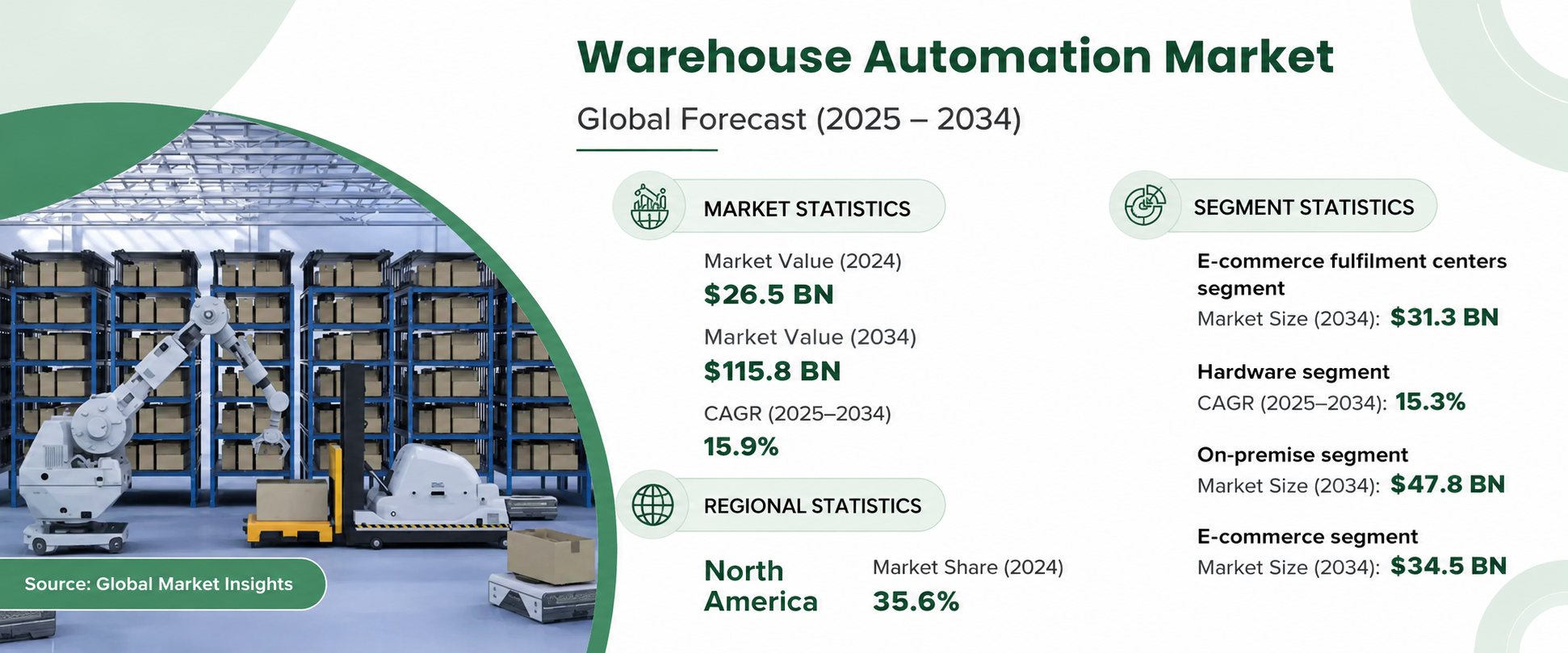
Warehouse Automation Market Trends and Growth Opportunities 2025–2034
But how does AI actually help inside a warehouse? And where do automation, robotics, and real-time inventory tracking fit into the bigger picture?
Let’s break it down.
What Is AI in Warehouse Management?
AI in warehouse management means using smart technologies to improve how products are received, stored, picked, packed, tracked, and shipped.
It combines software, data, automation, sensors, robotics, and analytics to help warehouses operate more efficiently. Instead of depending only on manual checks or fixed rules, AI systems can learn from warehouse data and recommend better actions.
For example, an AI-powered warehouse system can identify which products are selling fast, where those products should be placed, which picking route is faster, which stock may run out soon, and which orders need urgent attention.
AI in warehouse management can include:
- Machine learning for demand forecasting and inventory planning
- Computer vision for product scanning, quality checks, and shelf monitoring
- Robotics for moving, picking, sorting, and packing goods
- IoT sensors for tracking product movement and storage conditions
- RFID and barcode systems for real-time stock updates
- Predictive analytics for stock replenishment and labor planning
- Digital twins for warehouse simulation and layout optimization
- AI-powered warehouse management systems for better decision-making
In short, AI helps warehouses work with better speed, accuracy, and visibility.
Why Traditional Warehouse Management Is No Longer Enough
Traditional warehouse management often depends on manual processes, spreadsheets, barcode scans, fixed workflows, and human decision-making. These methods can work for smaller operations, but they become difficult to manage as order volume, SKU count, customer expectations, and delivery pressure increase.
A traditional warehouse may face problems such as:
- Slow inventory checks
- Inaccurate stock records
- Products stored in the wrong location
- Long picking routes
- Manual data entry errors
- Delayed stock updates
- Poor demand planning
- Labor shortages
- High return rates due to wrong shipments
- Difficulty handling seasonal demand spikes
Imagine an ecommerce warehouse with 50,000 SKUs. The system may show that 200 units of a product are available, but in reality, some units may already be picked, damaged, misplaced, or returned but not updated. The warehouse team may only discover the issue when an order is already delayed. This creates frustration for customers and extra pressure for the operations team.
AI helps reduce these problems by connecting warehouse data with real-time actions. It does not just record what happened. It helps predict what may happen next and suggests what the warehouse team should do.
How AI Is Used in Warehouse Automation
Warehouse automation is not just about replacing manual work with machines. It is about making warehouse processes faster, more accurate, and easier to manage. AI adds intelligence to automation by helping systems understand real-time warehouse conditions and make better decisions.
Instead of following the same fixed process every time, AI-powered systems can adjust based on inventory levels, order priority, product demand, worker availability, and warehouse capacity.
Here is how AI supports different stages of warehouse automation:
1. Receiving: Checking Goods Faster and More Accurately
Receiving is where warehouse operations begin. Products arrive from suppliers, manufacturers, or return channels, and the warehouse team needs to verify quantities, check item details, inspect product condition, and update inventory records.
In a traditional setup, this process depends heavily on manual checks and scanning. With AI, receiving becomes faster and more accurate.
AI can help match incoming goods with purchase orders, detect damaged items using computer vision, identify missing or incorrect products, and update stock records automatically.
For example, if 500 units of a product arrive, the system can verify the shipment, flag any mismatch, and update inventory without waiting for multiple manual checks.
2. Putaway: Placing Products in the Right Location
Once goods are received, they need to be stored in the right place. This step may look simple, but poor putaway decisions can create problems later during picking and dispatch.
AI can recommend the best storage location based on product size, demand level, expiry date, picking frequency, available space, and order patterns.
For example, if a product is ordered frequently, AI may suggest placing it closer to the packing area. If an item moves slowly, it can be stored in a less active zone. This reduces walking time and improves warehouse space utilization.
3. Picking: Helping Teams Find Products Faster
Picking is one of the most time-consuming warehouse activities. Workers often spend a large part of their shift walking through aisles to find products. If the route is not planned well, order fulfillment becomes slower.
AI can create smarter picking paths, group similar orders, prioritize urgent orders, and guide workers through handheld devices or wearable systems.
For example, instead of picking one order at a time, AI may group orders that include products stored near each other. This reduces travel time, improves productivity, and helps teams process more orders in less time.
4. Packing: Choosing the Right Packaging and Reducing Errors
After picking, products need to be packed correctly. The wrong package size, missing item, or poor handling can increase shipping costs, returns, and customer complaints.
AI can support packing by recommending the right box size, packaging material, and shipping method based on product dimensions, fragility, destination, carrier rules, and delivery timeline.
It can also help verify that the right items are being packed before the order leaves the warehouse.
5. Sorting and Dispatch: Moving Orders Without Bottlenecks
Once orders are packed, they need to be sorted and dispatched. Sorting may depend on destination, delivery priority, carrier, route, order type, or shipping deadline.
AI-powered sorting systems can automatically direct packages to the right dispatch area. This reduces manual sorting errors and helps warehouses handle high order volumes during peak periods.
For example, during a festive sale or holiday rush, thousands of orders may need to leave the warehouse quickly. AI can help prioritize express orders, group shipments by route, and prevent dispatch delays.
6. Task Prioritization: Deciding What Should Happen First
A warehouse may have hundreds of tasks happening at the same time. Same-day delivery may be required for some orders, while certain products need urgent replenishment. In busy zones, workers or robots can be reassigned when they are idle.
AI can analyze these conditions and decide which task should be handled first.
This is one of the biggest advantages of AI for warehouse management. It helps managers move from reactive decision-making to proactive task planning. Instead of waiting for problems to appear, warehouse teams can act earlier and keep operations moving smoothly.
Role of Robotics in AI-Powered Warehouses
Robotics is one of the most visible parts of AI-powered warehouse automation. Robots help move goods, scan shelves, support picking, sort packages, and reduce repetitive physical work.
But robots become more useful when they are guided by AI. AI helps them understand their surroundings, choose better routes, avoid obstacles, prioritize tasks, and work safely around people.
“CSCOs must develop an organizational structure to support the management of growing fleets of robots by creating a warehouse automation strategy.”
- Abdil Tunca, Senior Principal Analyst, Gartner Supply Chain Practice
Here are the main types of robots used in modern warehouses:
1. Autonomous Mobile Robots
Autonomous mobile robots, or AMRs, move goods across the warehouse without fixed tracks. They use sensors, cameras, maps, and AI-based navigation to move safely from one place to another.
AMRs can carry bins, move products between zones, support picking, and reduce worker travel time.
Example:
Instead of a worker walking across the warehouse to collect products, an AMR can bring the shelf or bin closer to the worker. This improves productivity and reduces physical strain.
2. Robotic Picking Systems
Robotic picking systems use robotic arms, grippers, sensors, and computer vision to identify and pick products.
They are useful for repetitive tasks such as picking, sorting, packing, and item handling. Computer vision helps the robot recognize products, understand item position, and avoid picking the wrong object.
Example:
In a high-volume warehouse, a robotic arm can pick repeated items quickly and consistently, while workers handle exceptions, damaged products, or special orders.
3. Warehouse Drones
Warehouse drones are used mainly for inventory checks. Instead of workers manually scanning shelves, pallets, or high storage racks, drones can move through warehouse aisles and scan inventory locations.
They help teams find missing stock, update inventory records, and check hard-to-reach areas faster.
Example:
In a large warehouse, drones can scan thousands of pallet locations and help teams identify stock gaps without stopping regular operations.
4. Collaborative Robots
Collaborative robots, also called cobots, work alongside human workers. They are designed to support tasks such as lifting, moving, sorting, and repetitive handling.
Cobots are useful because they combine human judgment with robotic consistency. Humans can manage quality checks, exceptions, and complex decisions, while robots handle repetitive or physically demanding work.
Example:
A cobot can help move heavy boxes to a packing station, while the worker focuses on checking the order and preparing it for shipment.
Quick Stat:
Gartner predicts that by 2030, one in 20 supply chain managers will manage robots rather than humans. This shows how robotics is becoming a core part of warehouse operations, not just a supporting technology.
Real-Time Inventory Tracking with AI
Real-time inventory tracking means the warehouse system updates stock movement as soon as a product is received, moved, picked, packed, returned, or shipped.
This is one of the most important uses of AI in warehouse management because inventory accuracy affects almost every decision inside a warehouse. If the stock data is wrong, teams may face stockouts, overstocking, delayed orders, wrong shipments, and poor customer experience.
AI improves inventory tracking by connecting data from barcode scanners, RFID tags, IoT sensors, cameras, warehouse robots, ecommerce platforms, and ERP systems. Instead of only showing what is recorded in the system, AI helps identify what is actually happening on the warehouse floor.
1. Barcode and RFID-Based Tracking
Barcode scanning is commonly used to track products when they arrive, move, or leave the warehouse. RFID takes this further by allowing products to be identified without direct scanning.
AI can analyze barcode and RFID data to find missing stock, repeated errors, unusual movement, or products that are often placed in the wrong location.
Example:
If a product is frequently scanned in the wrong zone, AI can flag it as a process issue and suggest better storage, labeling, or staff instructions.
2. IoT Sensors and Smart Shelves
IoT sensors help track product movement, location, temperature, humidity, weight, and storage conditions. Smart shelves can detect when stock is removed, misplaced, or running low.
This is especially useful for food, pharmaceuticals, electronics, cold chain logistics, and high-value products.
Example:
In a pharmaceutical warehouse, some products must stay within a fixed temperature range. IoT sensors can track storage conditions in real time, and AI can alert the team if the temperature becomes unsafe.
3. Computer Vision for Inventory Visibility
Computer vision uses cameras and AI to monitor shelves, pallets, packages, labels, damages, and product placement.
It can detect empty shelves, misplaced products, damaged packages, incorrect labels, or items placed in the wrong area. This reduces the need for manual inspection and improves quality control.
Example:
If a camera detects that a high-demand product shelf is empty but the system still shows stock available, AI can alert the team to check for a stock mismatch.
4. Stockout and Overstock Prevention
AI can compare real-time inventory data with sales trends, seasonal demand, supplier timelines, and order history. This helps businesses predict when stock may run out or when too much inventory is being held.
Example:
If demand for a product suddenly increases, AI can alert the warehouse team to reorder earlier, move available stock closer to the packing area, or prioritize replenishment.
Quick Stat:
McKinsey notes that AI can reduce inventory levels by 20% to 30% by improving demand forecasting, dynamic segmentation, and inventory optimization. This shows how real-time inventory visibility can help warehouses avoid excess stock while reducing the risk of stockouts.
Key Use Cases of AI in Warehouse Management
AI is helping warehouses improve inventory accuracy, optimize picking routes, forecast demand, coordinate robots, reduce fulfillment errors, and make faster operational decisions. These are some of the most practical AI use cases every business should know in warehouse management, especially for ecommerce brands, retailers, manufacturers, logistics companies, and fulfillment centers.
AI can support many warehouse workflows. The table below shows some of the most important use cases and their business impact.
| Use Case | How AI Helps | Business Impact |
| Real-time inventory tracking | Tracks stock movement across receiving, storage, picking, packing, and shipping | Reduces stock mismatches and improves inventory accuracy |
| Demand forecasting | Predicts future demand using sales history, seasonality, and market trends | Helps prevent stockouts and overstocking |
| Picking optimization | Suggests the fastest picking route and order grouping | Improves fulfillment speed and worker productivity |
| Slotting optimization | Recommends the best storage location for each product | Reduces walking time and improves space usage |
| Robotics coordination | Guides robots, assigns tasks, and prevents traffic conflicts | Improves automation efficiency |
| Quality inspection | Uses computer vision to detect damaged goods or wrong items | Reduces returns and customer complaints |
| Labor planning | Predicts workload and staffing needs | Improves workforce utilization |
| Predictive maintenance | Detects equipment failure risks before breakdowns happen | Reduces downtime |
| Returns management | Sorts and processes returned items faster | Improves resale, restocking, and refund speed |
| Warehouse analytics | Converts warehouse activity into useful insights | Helps managers make better operational decisions |
Benefits of AI in Warehouse Management
AI offers both operational and business benefits. It helps warehouses improve speed, accuracy, visibility, and scalability.
Better Inventory Accuracy
AI helps detect stock mismatches, missing items, duplicate entries, and incorrect product locations. This helps businesses avoid overselling and promise more reliable delivery timelines.
Quick Stat:
McKinsey reports that AI-driven forecasting can reduce supply chain forecasting errors by 20% to 50% and reduce lost sales and product unavailability by up to 65%. For warehouses, this means better stock planning, fewer availability issues, and more reliable fulfillment.
Faster Order Fulfillment
AI improves picking routes, packing decisions, sorting, dispatch, and task priority. This helps warehouses process more orders in less time and improve customer satisfaction.
Lower Operational Costs
AI reduces unnecessary movement, manual checks, rework, picking errors, and downtime. Over time, this can lower labor, return handling, and fulfillment costs.
Improved Labor Productivity
AI helps workers spend less time searching, walking, or manually checking stock. Teams can focus more on quality checks, exceptions, and urgent orders.
Better Space Utilization
AI recommends better product placement based on demand, size, storage needs, and picking patterns. This helps warehouses use space more efficiently.
Fewer Fulfillment Errors
AI improves inventory visibility, picking accuracy, and order verification. This helps reduce wrong shipments, missing items, delayed orders, and customer complaints.
More Scalable Operations
AI helps warehouses handle higher order volumes, seasonal demand, and growing SKU counts without depending only on manual expansion.
How an AI Warehouse Management System Works
An AI-powered warehouse management system does not work as a separate tool. It works like a connected decision layer that brings together warehouse data, business systems, workers, and automation tools.
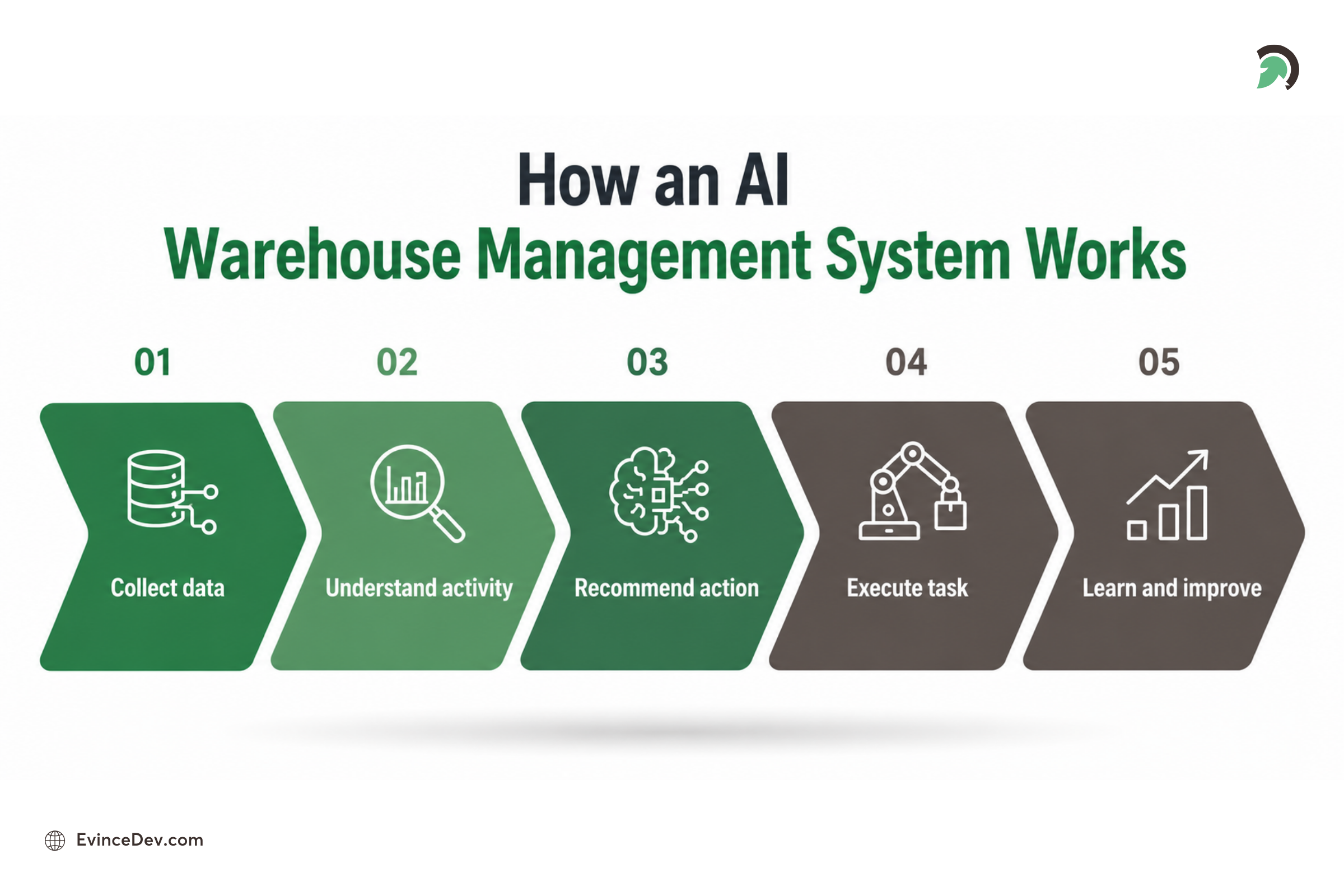
AI Warehouse Management System Explained: From Inventory Tracking to Automation
A simple way to understand it is:
Collect data → Understand activity → Recommend action → Execute task → Learn and improve
1. Collects Warehouse Data
The system first gathers data from different sources, such as barcode scanners, RFID tags, IoT sensors, cameras, robots, drones, ERP systems, ecommerce platforms, order management systems, transportation systems, and worker devices.
This gives AI a live view of what is happening across the warehouse.
2. Understands Warehouse Activity
AI then processes this data to understand inventory movement, order volume, product demand, worker activity, robot movement, storage space, and fulfillment speed.
Instead of only showing raw data, it identifies patterns, delays, gaps, and risks.
3. Recommends the Next Best Action
Based on this analysis, AI suggests what should happen next.
For example, it may recommend where to store a product, which order to pick first, which picking route to follow, which stock needs replenishment, or which equipment may need maintenance.
4. Executes Through Connected Systems
These recommendations are then carried out through the WMS, workers, robots, conveyors, scanners, dashboards, or automated alerts.
This is where AI turns insights into real warehouse action.
5. Learns from Daily Operations
The system keeps learning from warehouse activity. When a picking route causes delays, AI can improve it. Misplaced products can also be flagged automatically, while sudden demand changes can help adjust stock planning.
This feedback loop makes the system smarter over time.
How AI, WMS, ERP, IoT, and Robotics Work Together
AI becomes truly useful when it connects with existing warehouse and business systems.
A warehouse may already use a WMS for inventory and fulfillment, an ERP for business operations, an ecommerce platform for orders, a TMS for shipping, and barcode or RFID tools for stock tracking.
AI connects these systems and helps them work together.
For example, if ecommerce demand increases for a product, AI can identify the trend, alert the warehouse team, suggest replenishment, recommend moving the product closer to the packing area, and help adjust labor planning.
This is where custom AI development becomes important. Every warehouse has different workflows, systems, product categories, order patterns, and operational challenges. A ready-made tool may not solve every problem. Custom AI development can help businesses build solutions that match their exact warehouse process.
Businesses can also use AI development services to build dashboards, predictive models, inventory tracking systems, robotics integrations, and warehouse analytics platforms that connect with their existing WMS or ERP.
Project Reference:
In the retail fulfillment environment, the challenge is not always physical automation. Sometimes, the bigger issue is scattered operational data. Store visits, field activities, fulfillment updates, inventory-related workflows, and reporting may exist across different systems.
EvinceDev solved a similar challenge for The InStore Group by building InStore Reporter, a web-based retail analytics and reporting dashboard. The platform automated data collection through API integration, centralized reporting, enabled role-based dashboards, and provided map-based visibility for faster operational decisions. This shows how connected data systems can improve visibility across retail, fulfillment, and inventory-related operations.
Real-World Examples of AI and Warehouse Automation
Real-world adoption shows how AI and robotics are changing warehouse operations.
- Amazon has deployed more than 1 million robots across its operations network since 2012. These robots support tasks such as sorting, lifting, carrying packages, moving inventory, assisting with picking, and improving fulfillment center productivity. Amazon also mentions systems like Sequoia, Hercules, Titan, Vulcan, Sparrow, Robin, Cardinal, and Proteus, which support different parts of the fulfillment workflow.
- Gartner has predicted that by 2030, 50% of new warehouses in developed markets will be designed as robot-centric facilities, with humans becoming optional for many routine warehouse tasks.
- Decathlon has also reported productivity gains after using warehouse robots in European facilities. At one site, order preparation reportedly doubled from 57,000 to 114,000, while worker walking distance reduced significantly.
- GNC used AI-powered drones at its 250,000-square-foot warehouse in Whitestown, Indiana, to improve inventory checks. The drones scan more than 2,000 pallets and help the team find missing, misplaced, or damaged stock. This helped GNC reduce daily backorders from several hundred units to about 98, while allowing employees to focus on inventory problem-solving.
These examples show that AI and warehouse automation are not only future concepts. They are already being used to solve practical problems such as slow picking, poor inventory visibility, backorders, and labor-intensive warehouse tasks.
Challenges of Implementing AI in Warehouse Management
AI can create strong results, but implementation is not always simple. Businesses need to prepare their systems, processes, and teams before expecting major impact.
Common challenges include:
- Poor inventory data quality
- Outdated warehouse management systems
- Disconnected ERP, ecommerce, and logistics platforms
- High initial investment in hardware or robotics
- Lack of skilled AI and automation experts
- Worker resistance to new technology
- Safety concerns around robots and automated equipment
- Cybersecurity risks
- Unreliable network connectivity
- Difficulty measuring ROI
One important point is that AI warehouse projects often fail because of weak data and poor integration, not because the AI model itself is weak.
For example, if product locations are not properly mapped, inventory records are outdated, and order data is inconsistent, AI cannot make reliable recommendations.
Before investing in advanced robotics or predictive analytics, businesses should first clean their warehouse data, map their workflows, and identify the highest-impact problem to solve.
How to Implement AI in Warehouse Management
AI implementation should feel like a planned rollout, not a sudden technology shift. The best approach is to begin with one warehouse problem, test the solution in a controlled area, and then scale it once the results are clear.
Stage 1: Find the Right Starting Point
Every warehouse has a few areas where time, cost, or accuracy is being lost. It could be stock mismatches, slow picking, delayed dispatch, misplaced products, or too many manual inventory checks.
This first stage is about finding the problem that needs AI the most. A warehouse with poor stock accuracy may start with real-time inventory tracking. A warehouse with slow fulfillment may begin with picking route optimization.
Stage 2: Build the Data Foundation
Once the starting point is clear, the next step is to prepare the data. AI needs reliable information about SKUs, product locations, inventory records, order history, supplier timelines, and warehouse movement.
If the warehouse data is incomplete or outdated, AI will not give useful recommendations. Clean data helps the system understand what is actually happening inside the warehouse.
Stage 3: Connect the Core Systems
AI should not work separately from the rest of the warehouse. It needs to connect with the WMS, ERP, ecommerce platform, barcode tools, RFID systems, IoT sensors, logistics software, and worker devices.
This gives AI a complete view of inventory, orders, workers, robots, and dispatch activity. Once systems are connected, AI can make more practical decisions.
Stage 4: Test One Use Case First
The first AI use case should be focused and easy to measure. Instead of trying to automate everything, businesses should choose one area where improvement can be clearly tracked.
For example, real-time inventory tracking can be tested in one product category. Picking optimization can be tested in one warehouse zone. Demand forecasting can be tested for a specific product group.
Stage 5: Train the People Who Will Use It
AI adoption depends heavily on the warehouse team. Workers need to know how to read alerts, follow recommendations, use dashboards, operate scanners, and work with robots or automation tools.
When teams understand how AI supports their daily work, adoption becomes easier. It also reduces resistance because workers can see how AI helps reduce repetitive tasks and daily confusion.
Stage 6: Measure Results and Expand
After the pilot, businesses should measure results through KPIs such as inventory accuracy, picking speed, order cycle time, stockout rate, return rate, labor productivity, and on-time dispatch.
If the pilot delivers clear improvement, AI can be expanded to more zones, workflows, product lines, or warehouse locations.
A simple way to remember the rollout:
Find the problem → Prepare the data → Connect the systems → Test one use case → Train the team → Scale what works.
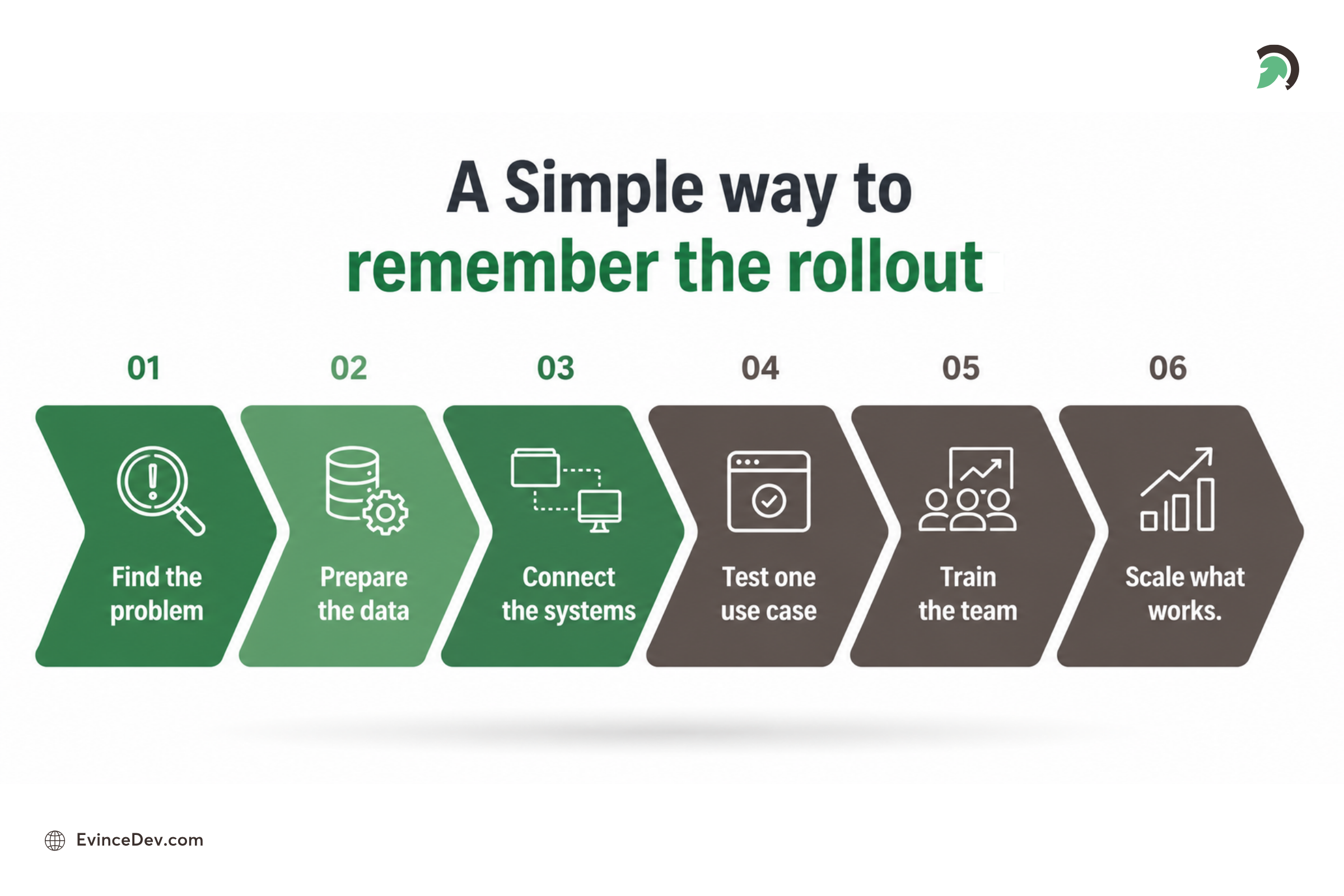
A Simple Rollout Plan Businesses Can Follow
Expert Perspective:
Warehouse AI projects usually fail because the process foundation is weak, not because the AI model is weak. Clean SKU data, mapped storage locations, accurate movement logs, and reliable integrations matter more than choosing the most advanced algorithm.
- Hiren Daraji, Department Head, EvinceDev
KPIs to Measure AI Warehouse Success
To understand whether AI is working, businesses should track clear warehouse KPIs.
| KPI | What It Measures |
| Inventory accuracy rate | How closely system records match actual stock |
| Order picking accuracy | How often the correct item is picked |
| Order cycle time | Time taken from order receipt to shipment |
| Dock-to-stock time | Time taken to make received goods available for sale |
| Picking productivity | Number of items picked per worker or hour |
| Labor cost per order | Labor cost involved in fulfilling each order |
| Stockout rate | Frequency of products being unavailable |
| Backorder rate | Orders delayed due to missing inventory |
| Return rate due to wrong shipment | Returns caused by fulfillment errors |
| Space utilization | How efficiently warehouse space is used |
| Equipment downtime | Time lost due to machine or equipment failure |
| On-time dispatch rate | Orders shipped within the promised time |
Tracking these KPIs helps businesses prove ROI and identify where AI should be improved.
Cost Factors of AI in Warehouse Management
The cost of AI in warehouse management depends on the size and complexity of the warehouse.
Key cost factors include:
- Warehouse size
- Number of SKUs
- Order volume
- Existing WMS and ERP maturity
- Hardware requirements
- Robotics requirements
- IoT and sensor requirements
- Barcode or RFID setup
- Computer vision needs
- Integration complexity
- Custom AI model development
- Number of warehouse locations
- Training and support requirements
A basic AI solution may include inventory analytics, demand forecasting, automated dashboards, and stock alerts. A more advanced solution may include robotics, computer vision, digital twins, IoT sensors, and full WMS integration.
The right approach is to start with the use case that can deliver measurable value quickly.
For example, a warehouse with frequent stock mismatches may start with real-time inventory tracking. A warehouse with slow fulfillment may start with picking route optimization. A warehouse with high labor dependency may start with AMRs or task automation.
Future of AI in Warehouse Management
The future of AI in warehouse management will be more connected, automated, and intelligent. Warehouses will increasingly use autonomous mobile robots, AI-powered orchestration systems, computer vision-based inventory monitoring, predictive analytics, voice-guided operations, and cloud-based warehouse platforms to manage daily workflows with greater speed and accuracy.
Digital twins will also play a bigger role in warehouse planning. McKinsey explains that digital twins can help companies design, simulate, and test warehouse operations virtually before making real-world changes. This means businesses may be able to test layout changes, robot movements, product placement, and fulfillment strategies in a virtual environment before applying them inside the actual warehouse.
AI will also change how warehouse teams work. Workers may spend less time on repetitive manual tasks and more time managing exceptions, monitoring systems, improving processes, and coordinating automated workflows. As AI becomes more integrated with WMS, ERP, TMS, ecommerce platforms, and robotics systems, warehouses will become smarter, more responsive, and better prepared for changing demand.
Quick Stat:
Gartner predicts that by 2030, 50% of new warehouses in developed markets will be designed as robot-centric facilities where humans are optional for many routine tasks. This highlights how AI and robotics may reshape warehouse design, workforce roles, and fulfillment operations.
Is AI Right for Every Warehouse?
AI can help many warehouses, but not every business needs the same level of automation.
AI is especially useful for warehouses with:
- High order volume
- Many SKUs
- Frequent stock errors
- Multiple warehouse locations
- Seasonal demand spikes
- Slow picking or packing processes
- Labor shortages
- Poor inventory visibility
- High return rates due to wrong shipments
- Growing ecommerce or retail fulfillment needs
For smaller warehouses, the best starting point may not be robotics. It may be AI-powered inventory tracking, demand forecasting, stock alerts, or simple workflow automation.
For larger warehouses, robotics, computer vision, IoT sensors, and advanced AI systems may create stronger value.
The right AI strategy depends on business goals, warehouse maturity, operational pain points, and available data.
How EvinceDev Can Help Businesses Build AI-Powered Warehouse Solutions
Businesses planning to modernize warehouse operations need more than one AI tool. They need connected systems that bring together inventory data, warehouse workflows, order platforms, robotics, ERP systems, and real-time analytics.
EvinceDev can help businesses design and develop AI-powered warehouse management solutions tailored to their operational needs. This can include real-time inventory tracking systems, WMS and ERP integrations, warehouse automation dashboards, predictive analytics, robotics integration, computer vision solutions, and custom AI development for logistics and supply chain workflows.
With the right AI development services, businesses can start small, solve a high-impact warehouse problem, measure results, and then scale automation across more workflows.
Conclusion
AI in warehouse management is changing how warehouses operate. It helps businesses improve inventory accuracy, automate repetitive tasks, guide robots, optimize picking routes, forecast demand, and track stock in real time.
The biggest value of AI is not only automation. It is better decision-making.
When AI connects warehouse data, workers, robots, WMS, ERP, ecommerce platforms, and IoT devices, the warehouse becomes more visible, responsive, and efficient.
However, successful implementation requires the right strategy. Businesses should begin by identifying their biggest warehouse problems, cleaning their data, selecting one high-impact use case, integrating AI with existing systems, and measuring performance through clear KPIs.
AI and warehouse automation are no longer limited to large enterprises. With the right approach, even growing businesses can use AI to reduce errors, speed up fulfillment, improve inventory control, and build a smarter warehouse operation.