

Key Takeaways
- Offshore Development Is More Than Cost Saving: It gives businesses access to skilled global teams, faster delivery, and the flexibility to grow without depending only on local hiring.
- One Model Does Not Fit Every Project: Some projects need fixed pricing, some need flexible time-and-materials support, and long-term products often work better with dedicated teams.
- Clear Processes Make Offshore Work Smoother: Good requirements, proper onboarding, regular updates, testing, and handover help avoid confusion and keep the project moving.
- True Ownership Means More Than Having the Code: Businesses should also have documentation, deployment access, API details, testing records, and knowledge transfer to stay in control.
- The Right Partner Makes the Biggest Difference: A strong offshore partner brings technical skill, security awareness, and accountability beyond just completing tasks.
Hiring a developer next door used to be the default. It’s no longer the only option, and for many businesses, it’s not even the best one. Offshore software development has moved from a cost-cutting tactic to a genuine strategic lever, giving companies access to deep technical talent, faster delivery timelines, and the flexibility to scale without the overhead of expanding a local headcount.
But it only works when you go in with clear expectations and the right partner. This guide covers everything: what offshore software development actually involves, how to structure the engagement, where the real risks sit, and what separates a successful offshore project from a frustrating one.
Quick Stat:
According to Gartner, Global IT spending is projected to reach $6.08 trillion in 2026, showing how strongly businesses continue to invest in software, infrastructure, and digital transformation.
What Is Offshore Software Development and Why Do Companies Choose It?
Offshore software development is the practice of contracting software work to a team based in a different country, typically one with lower labor costs, a strong technical education system, or a specific concentration of relevant expertise. The client company retains ownership of the product and direction; the offshore team handles execution.
The appeal is practical, not ideological. A senior full-stack developer in Eastern Europe or South Asia costs a fraction of the cost of an equivalent hire in the US, UK, or Western Europe, with no meaningful drop in technical capability when the right team is selected. That cost differential allows companies to stretch their development budget, run parallel workstreams, or fund projects that wouldn’t otherwise be viable.
Beyond cost, offshore software development opens access to a global talent pool. Some of the strongest expertise in AI software development, cloud infrastructure, and mobile engineering sits outside traditional tech hubs. Companies that limit hiring to their local geography artificially constrain their options.
Offshore vs. Nearshore vs. Onshore: Knowing the Difference
Before committing to a model, it’s worth being precise about what each term means:
- Onshore: Development team in the same country as the client. Highest cost, easiest collaboration, minimal time zone friction.
- Nearshore: Team in a neighboring or nearby country. Moderate cost advantage, overlapping working hours, cultural familiarity.
- Offshore: Team in a geographically distant country. Largest cost differential, wider talent pool, requires deliberate communication planning.
Each model has legitimate use cases. Offshore software development makes the most sense for companies with well-defined project scopes, the internal bandwidth to manage a remote relationship, and a priority on cost efficiency and access to talent over geographic proximity.
Core Benefits of Offshore Software Development
The reasons companies choose offshore software development consistently come down to the same practical advantages:
1. Cost Efficiency Without Quality Compromise
Offshore development rates in regions like Eastern Europe, India, Southeast Asia, and Latin America are typically 40–70% lower than equivalent US or UK rates. For custom software development, this means delivering the same product at significantly lower cost or delivering more product within the same budget.
2. Access to Specialized Talent
Certain technical capabilities are concentrated offshore. If your project requires expertise in a specific framework, legacy system, or emerging technology, including AI software development, offshore teams often have practitioners with deep, current experience.
3. Faster Time to Market
Engaging an established offshore team means bypassing the months-long process of local recruitment, onboarding, and ramp-up. An experienced offshore partner can place a vetted team on your project within weeks.
4. Scalability
Custom software development needs to shift over a product’s lifecycle. Offshore models allow companies to scale team size up or down without the legal and financial complexity of local hiring and redundancy.
5. Round-the-Clock Development
When managed well, time zone differences become an asset. Work completed by an offshore team during their business hours can be reviewed and built upon during the client’s business hours, effectively extending the productive development day.
Quick Stat:
ISG reported that global managed services and cloud-based services reached a record $32.7 billion in annual contract value in Q3 2025, up 18% year over year.
Offshore Software Development Trends to Watch in 2026
In 2026, offshore software development does not mean only cutting down costs anymore. Companies search for offshore development providers that will help them achieve fast development, improve their security and ensure the future success of their products.
Artificial intelligence in offshore development becomes increasingly popular as offshore developers use artificial intelligence tools for coding, testing, documentation creation, and code reviewing while having qualified engineers to make decisions.
Quick Stat:
GitHub’s Octoverse 2025 reported that a new developer joins GitHub every second, while AI and agents are reshaping how modern software teams build and collaborate
Cloud-native and DevOps-driven delivery is also becoming important, as companies need faster releases, scalable infrastructure, and smoother deployment processes.
Cybersecurity-first vendor selection is now essential. Businesses should evaluate offshore partners based on secure coding practices, data protection, access controls, IP ownership, and compliance readiness.
Hybrid offshore teams are becoming more valuable because companies need more than developers. Teams with QA engineers, DevOps specialists, designers, product managers, and AI experts can take stronger ownership of delivery.
Dedicated offshore teams are also gaining preference over task-based outsourcing, especially for long-term custom software development where product knowledge, consistency, and accountability matter.
Quick Stat:
Deloitte’s global outsourcing research, based on insights from more than 500 executives, shows that companies are rethinking outsourcing around talent access, AI, and modern workforce models
Understanding the Offshore Software Development Lifecycle
Successful offshore engagements follow a structured software development lifecycle, not because process documents are inherently valuable, but because clarity at each stage prevents the ambiguity that causes offshore projects to fail.
The Six Phases of an Offshore Software Development Project
Phase 1: Discovery and Requirements: The scope needs to be defined prior to coding. This would include writing out the functional requirements, technical limitations, integrations, and success criteria. Loose requirements result in loose software.
Phase 2: Offshore Partner Selection and Contract Management: Choosing an offshore partner is more than a technical process. Look at communication methods, project management methodologies, security measures, and IP protection procedures. The contract should specify deliverables, schedule, IP ownership, confidentiality, and dispute resolution mechanisms.
Phase 3: Onboarding Phase: Even seasoned offshore developers will benefit from understanding your product, customers, and goals. By properly documenting and sharing an onboarding phase, friction can be substantially reduced in subsequent phases.
Phase 4: Software Development and Iteration: The basic development process is done in sprints or through milestone phases, where there are periodic code reviews, presentations, and evaluations. It is during this phase that the quality of your communication skills will be as important as your programming skills.
Phase 5: Testing and Quality Assurance: A dedicated QA phase covering functional testing, performance testing, security audits, and user acceptance testing should be built into the project plan, not treated as an afterthought. Offshore custom software development projects that skip structured QA pay for it in post-launch patches.
Phase 6: Deployment and Handover: Final deployment, documentation handover, and knowledge transfer to the client’s internal team or support function. This phase is frequently underplanned; budget time for it properly.
Engagement Models: Choosing the Right Structure
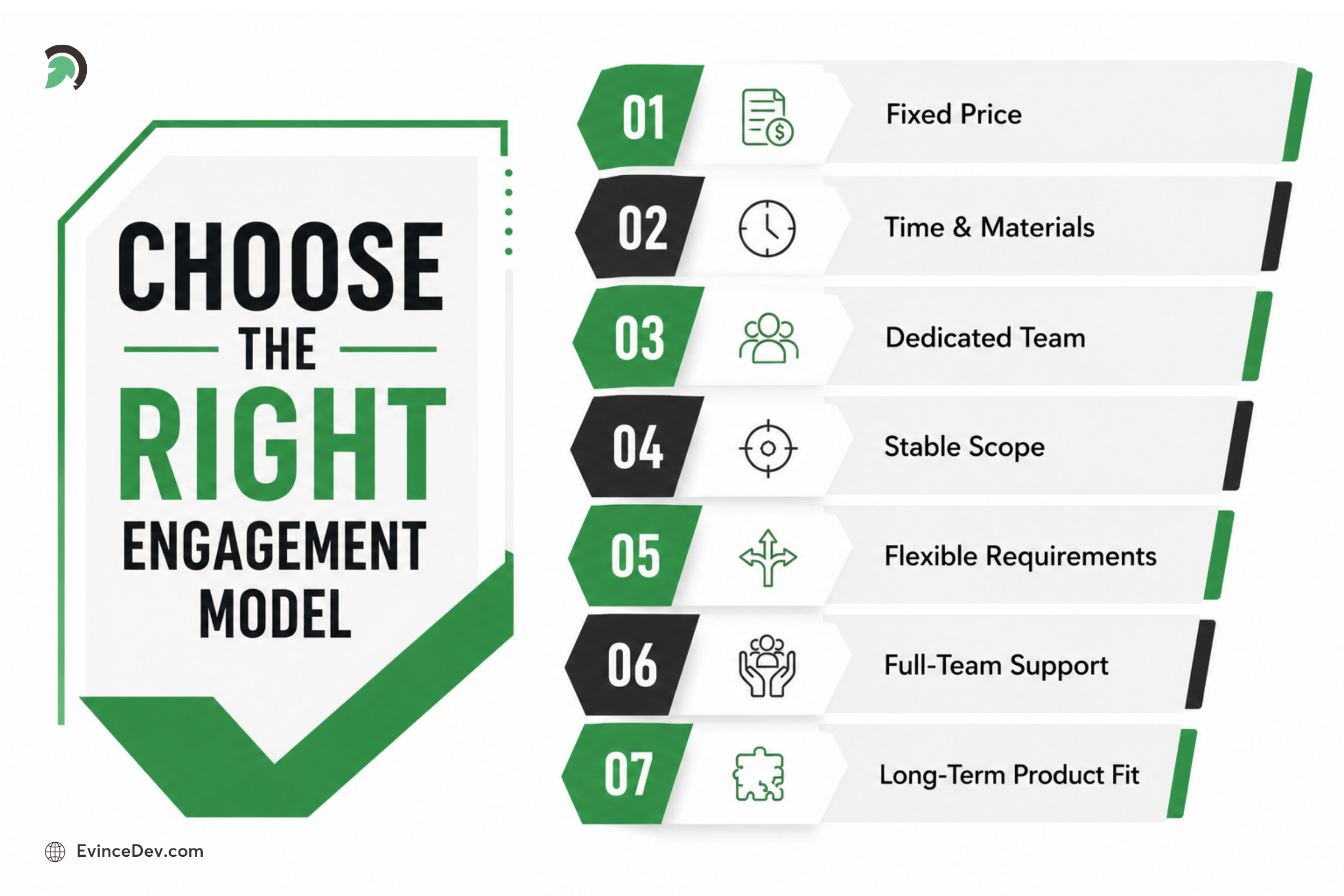
Offshore software development isn’t one-size-fits-all in how the commercial relationship is structured. The three primary models each suit different project types:
- Fixed Price: Best for well-scoped projects with stable requirements. The scope, timeline, and cost are agreed upon up front. Changes are managed through a formal change request process. Lower financial risk for the client, but less flexibility during execution.
- Time and Materials: The team logs hours at agreed-upon rates; billing reflects the actual work performed. This model suits projects where requirements are likely to evolve, which accurately describes most real-world custom software development engagements. It requires stronger client-side project oversight to manage cost.
- Dedicated Team: The client engages a full offshore team exclusively of developers, QA engineers, and a project manager, integrated into their own delivery structure. This model works well for long-running product development where continuity, cultural alignment, and deep product knowledge matter.
A Practical Guide to Choosing the Right Engagement Model
Expert Note:
The working hours for dedicated offshore teams should not be the measure of their success. More reliable measures include the predictability of sprints, the number of defects, the quality of release, the reaction time, the documentation quality, and risk management skills.
How Much Does Offshore Software Development Cost?
The cost of offshore software development depends on the project scope, technology stack, team size, developer experience, engagement model, and delivery timeline. A small software project with a limited scope will cost much less than a complex enterprise platform, AI solution, SaaS product, or cloud-native application.
Also, the hourly pay rate differs from location to location and skill sets. Although offshore software development is often less expensive than local development within the US, UK, and Western Europe, lower pricing does not necessarily mean better. The lower-priced group of developers may prove costly in the long run due to lack of effective communication, skilled technical management, or adequate security measures.
In considering the cost of offshore software development, it would be best to consider the value of the deliverables they will produce compared to their hourly rate. As an instance, it would be essential to consider aspects such as technical skills, coding, communication control, intellectual property rights, and after-delivery maintenance services.
What Actually Goes Wrong and How to Prevent It
Offshore software development gets a complicated reputation because failures are visible and memorable. Most of them trace back to the same preventable mistakes:
- Choosing based on price alone: Choosing based on price alone: The cheapest offshore rate usually is the sign of either junior talent, poor management infrastructure, or even both. So, its advised to evaluate vendors on communication quality, technical depth, and delivery track record, not just the rate cards.
- Insufficient requirements documentation: Remote teams can’t read minds or pick up context from overheard office conversations. What seems obvious to you needs to be written down.
- Underestimating communication overhead: It’s important to manage the communication gap caused by differences in time zones, language subtleties, and ways in which issues are communicated. Introduce regular communication patterns: daily standups, weekly demonstrations, and asynchronous communication.
Expert View:
Time zones are not usually the main issue when it comes to software development in other countries. The bigger issue is slow decision-making. It may be difficult to communicate due to the 10-hour difference, but the biggest bottleneck is slow approval processes and vague feedback.
- No internal project owner: Someone on the client side needs to own the offshore relationship, such as, reviewing the deliverables, unblocking decisions, and maintaining the momentum. Offshore software development without an engaged client-side counterpart drifts away.
Expert View:
Owning the source code is important, but true ownership goes further. Businesses should also secure architectural documentation, deployment access, API notes, test coverage, and knowledge transfer sessions so they are not dependent on a single developer or vendor.
- Skipping security and IP due diligence: Confirm that your offshore partner operates under appropriate data protection standards, signs NDAs as standard practice, and has internal controls around code access and confidentiality.
Selecting the Right Offshore Software Development Partner
The vendor selection process deserves more rigor than most companies apply. Beyond technical skills, evaluate:
- Industry experience: Has the team built software in your sector? Domain context reduces ramp-up time and produces better-fit solutions.
- Communication practices: How do they handle blockers? How quickly do they escalate issues? Ask for specifics, not descriptions.
- Technical stack alignment: Does their core expertise match your project’s technology requirements? A team that needs to learn your stack on your project budget is not a cost-saving.
- Portfolio and references: Ask for case studies with measurable outcomes, and speak directly with past clients, not just the references the vendor selects.
- Scalability: Can they scale the team up or down as your custom software development needs shift throughout the engagement?
Expert Perspective:
A strong offshore partner should reduce client dependency over time. As the team learns the product, they should be able to anticipate risks, suggest improvements, identify gaps, and make better technical recommendations instead of waiting for every instruction.
The best offshore software development partnerships function less like vendor-client relationships and more like extended-team arrangements, where the offshore team understands the product vision and takes genuine ownership of delivery quality.
Conclusion
Offshore software development, done with the right partner and the right structure, delivers more than cost savings; it delivers speed, depth of expertise, and the flexibility to build at a pace that local hiring simply can’t match. The companies achieving the best results aren’t just outsourcing tasks; they’re building genuine delivery partnerships that function as an extension of their internal team.
The difference between a frustrating offshore experience and a productive one almost always comes down to vendor selection and communication discipline. If you’re evaluating offshore options, EvinceDev works with businesses to build offshore custom software development engagements that are structured for real delivery, not just low day rates. That distinction matters more than most companies realize until it’s too late.