

Software projects rarely fail because teams cannot write code. They fail when requirements are unclear, risks are identified too late, testing is rushed, or post-launch support is treated as an afterthought. A well-structured Software Development Life Cycle helps prevent these issues by giving teams a clear framework for planning, building, testing, deploying, and improving software.
Understanding the phases of software development life cycle is essential for businesses that want better control over project scope, quality, timelines, security, and costs. Each phase has a specific purpose, from gathering requirements and designing the architecture to development, testing, deployment, and ongoing maintenance.
In this guide, we explain what is SDLC, the seven key SDLC phases, the main development models, the tools used across the lifecycle, and the best practices teams can follow to deliver reliable and scalable software in 2026.
Why SDLC Matters in 2026?
According to PR Newswire, the global business software and services market is projected to surpass $900 billion by 2026, driven by rising digital transformation and enterprise automation.
As software becomes increasingly complex and incorporates automation, multi-cloud environments, and advanced AI development solutions, businesses can no longer rely on ad hoc development. The SDLC provides a disciplined, repeatable framework that ensures every phase of software creation is strategic, cost-efficient, and quality-driven.
Expert Perspective:
“Processes and tools can enhance a team’s effectiveness, but they are always second-order influences.”
According to Martin Fowler, successful software delivery depends first on capable teams, strong collaboration, and sound technical judgment, with the SDLC providing the structure that supports them.
Phases of Software Development Life Cycle
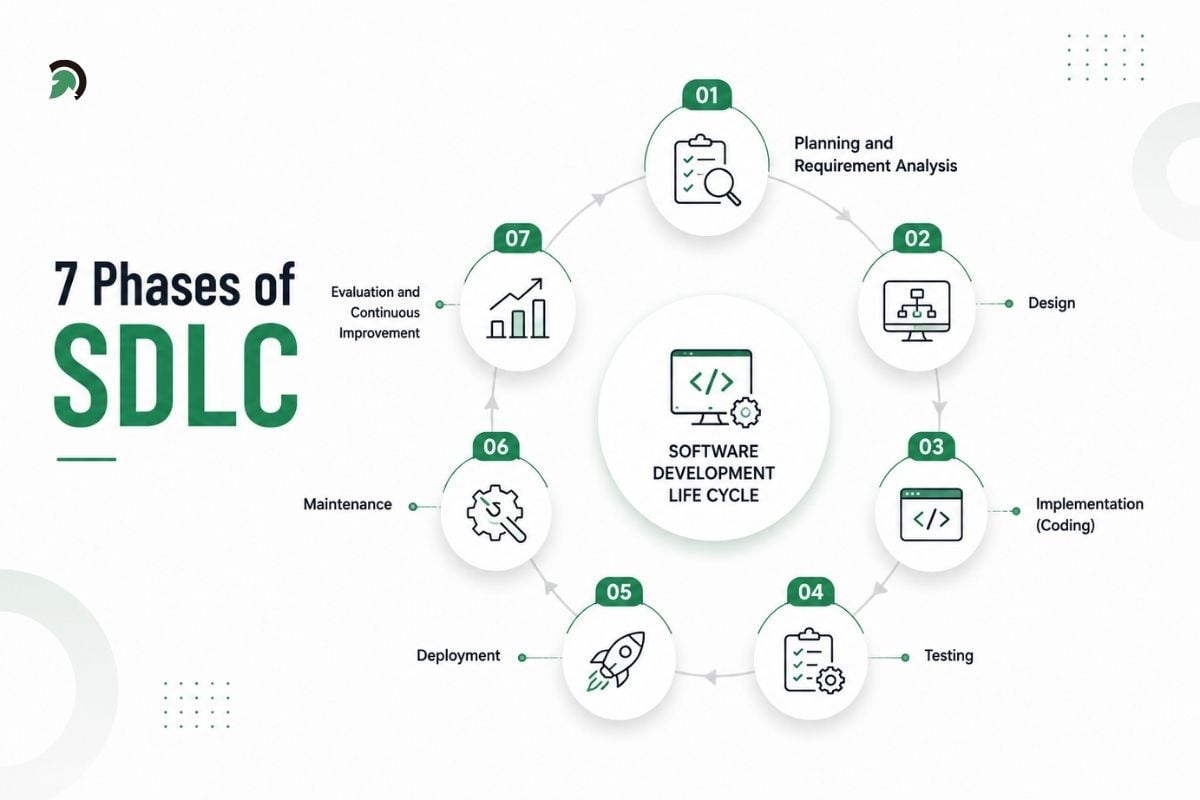
7 phases of software development life cycle, understand what SDLC is, its key components, deliverables, models, and best practices.
Phase 1: Planning and Requirement Analysis
The first phase of the SDLC involves defining the problem and identifying the requirements needed to create the software. This step is crucial as it lays the foundation for the development process. In this phase, stakeholders, including project managers, software developers, and clients, work together to gather information, determine the project scope, set objectives, and establish constraints like timeframes and budgets.
At this stage, the development team must analyze the needs of the client and the users of the system. This is also the phase where risk analysis and feasibility studies are conducted. All of this information helps in creating a detailed project roadmap. For custom software development services, the planning phase is essential for aligning business needs with technological capabilities.

Phase 2: Design
Once the planning phase is complete, the next step is design. During this phase, the development team translates the gathered requirements into a blueprint or architecture for the system. This design phase can be further broken down into two parts:
- High-Level Design (HLD): This involves creating system architecture and database design and defining the system’s structure and major components. Mobile app development includes the user interface (UI) and user experience (UX) design and how different app components will interact.
- Low-Level Design (LLD): Here, the focus shifts to more detailed designs, such as algorithms, data structures, and component diagrams.
The design phase is critical for ensuring the software meets the specified requirements while being scalable and maintainable. The design also guides the development team in building the software correctly the first time, minimizing rework and potential issues later.
Phase 3: Implementation (Coding)
The coding or implementation phase is where the software’s actual development occurs. The development team converts the design into a functional software product by writing the necessary code. Depending on the project, different programming languages, tools, and platforms may be used to develop the software.
For a software development company, this phase requires close collaboration between developers, ensuring everyone is aligned on coding standards, practices, and guidelines. Writing clean, efficient, and well-documented code is essential, reducing the chance of bugs and issues later in the cycle.
In mobile app development, this phase includes coding for both the front end (the user interface) and the back end (server-side logic, database operations). Development teams may work iteratively, especially if they are following Agile or other modern software development practices.
Quick Stat:
DORA’s 2024 research found that AI adoption can improve individual productivity and workflow, but it may also affect software delivery stability when teams lack strong testing and development practices. This shows why structured SDLC controls remain important even as development becomes more automated.
Phase 4: Testing
Once the coding phase is complete, the software enters the testing phase. Testing is critical to ensure the software performs as expected, is free of bugs, and meets quality standards. In this phase, the development team carries out a variety of tests, such as:
- Unit Testing: Focuses on individual components of the software to ensure they function correctly in isolation.
- Integration Testing: Ensures that different components work together as intended.
- System Testing: Evaluate the entire system for compliance with the specified requirements.
- User Acceptance Testing (UAT): Involves real users verifying that the software functions as expected in real-world scenarios.
Testing often takes up a significant amount of time, as thorough testing helps prevent costly and time-consuming fixes later. Automated testing tools may speed up the process and improve accuracy.
Quick Stat:
GitHub’s 2024 US Developer Survey found that 92% of respondents used AI coding tools to generate test cases at least some of the time, showing how automation is becoming an important part of modern software testing.

Phase 5: Deployment
The software is ready for deployment after testing and fixing any necessary issues. In this phase, the software is delivered to the user or client. Depending on the project, deployment may involve releasing the software to a live production environment, such as launching a mobile app on app stores or installing an enterprise solution on client systems.
There are typically two types of deployment:
- Full Deployment: Where the entire software product is released to users.
- Staged Deployment: In cases where the software is released in phases, the development team can monitor the rollout and fix any issues.
The deployment phase also includes tasks like user training, setting up user support, and configuring the software in a production environment. Working with an experienced software development company during deployment can help ensure a smooth transition from development to live operation.
Phase 6: Maintenance
After the software is deployed, the final phase of the SDLC involves ongoing maintenance. This phase ensures the software remains operational and relevant to users. During maintenance, the development team addresses bugs or performance issues not identified during testing and provides updates to improve functionality or security.
Maintenance can be broken down into:
- Corrective Maintenance: Fixes errors discovered after deployment.
- Adaptive Maintenance: Modifies the software to work in a changing environment (e.g., new hardware or operating system updates).
- Perfective Maintenance: Enhances the software’s performance or adds new features.
Quick Stat:
IBM found that organizations extensively using security AI and automation reduced average breach costs by USD 1.9 million and identified and contained breaches 80 days faster than organizations that did not use these technologies.
Phase 7: Evaluation and Continuous Improvement
After deployment and maintenance, continuous evaluation ensures the software remains efficient and relevant. Regular performance reviews, user feedback, and analytics help identify areas for optimization and future upgrades.
Different tools support planning, collaboration, development, testing, deployment, and maintenance throughout the phases of software development life cycle.
| SDLC Phase |
Common Tool Categories |
|
Planning |
Product roadmapping, project management, documentation |
|
Requirements |
User story management, prototyping, requirements tracking |
|
Design |
UI/UX design, architecture modelling, database design |
|
Development |
IDEs, version control, code review, AI coding assistants |
|
Testing |
Test automation, API testing, performance and security testing |
|
Deployment |
CI/CD, containerization, infrastructure as code |
| Maintenance |
Monitoring, logging, analytics, incident management |
What Are the Main SDLC Models?
SDLC models define how teams move through the different stages of software development. Some follow a fixed sequence, while others use repeated iterations, continuous delivery, or risk-based planning. The right model depends on the project scope, complexity, flexibility, security needs, and stakeholder involvement.
|
SDLC Model |
How It Works | Best Suited For |
Primary Limitation |
|
Waterfall |
Each phase is completed in a fixed sequence | Projects with stable and clearly defined requirements |
Changes are difficult to manage later |
|
Agile |
Work is delivered through short, iterative cycles | Products with evolving requirements |
Requires regular stakeholder involvement |
|
Iterative |
The product is improved through repeated development cycles | Complex products that need gradual refinement |
Scope may expand over time |
|
Incremental |
The software is delivered in smaller functional parts | Projects that need early and phased releases |
Requires careful integration planning |
|
Spiral |
Development progresses through risk-focused cycles | Large, complex, or high-risk projects |
Can be costly and difficult to manage |
|
V-Model |
Testing activities are planned alongside each development stage | Regulated or quality-critical software |
Less flexible when requirements change |
|
DevOps |
Development and operations collaborate through continuous delivery | Cloud, SaaS, and frequently updated products |
Requires automation and process maturity |
|
DevSecOps |
Security is integrated throughout development and deployment | Security-sensitive and regulated applications |
Requires strong security expertise and governance |
Many organizations also use hybrid approaches that combine elements of Agile, Waterfall, DevOps, or other models. The best choice is the one that aligns with the project’s requirements, risk level, team structure, and delivery goals.
What Are the Components of a Software Development Life Cycle (SDLC)?
The Software Development Life Cycle is built around more than a sequence of development phases. It also depends on several supporting components that help teams manage quality, collaboration, security, and delivery throughout the project.
The key components that support an SDLC include:
- People and responsibilities: Product owners, project managers, designers, developers, testers, architects, and operations teams contribute at different stages of the lifecycle.
- Processes and workflows: Defined procedures guide requirement approvals, task management, code reviews, testing, change requests, and releases.
- Tools and technologies: Project management platforms, design tools, development environments, version control systems, testing tools, and deployment technologies support efficient delivery.
- Documentation: Requirements, architecture decisions, test plans, technical specifications, and release records help maintain clarity and continuity.
- Quality and security controls: Coding standards, testing practices, security reviews, compliance requirements, and performance benchmarks help ensure reliable software.
- Communication and feedback: Stakeholder reviews, user feedback, analytics, and team collaboration help identify issues and improve the product throughout its lifecycle.
These supporting components work across all SDLC phases. Their structure and level of detail may vary depending on the project size, development methodology, industry requirements, and technical complexity.
Best Practices for the Software Development Life Cycle
While the SDLC provides a structured approach to software development, following best practices can further improve the quality and efficiency of the process.
Some key software development practices include:
- Adopt Agile and DevOps: Combine flexibility with automation for faster delivery cycles and improved collaboration.
-
Automate Testing: Speed up QA processes and minimize human error using modern automation frameworks.
-
Leverage CI/CD Pipelines: Ensure continuous delivery and seamless deployment with integrated version control and automation.
-
Prioritize User-Centered Design: Focus on intuitive UI/UX to enhance engagement and adoption rates.
-
Document Everything: Maintain transparency and accountability throughout the SDLC with versioned, well-organized documentation.
Quick Stat:
According to IBM’s 2025 Cost of a Data Breach Report, the global average cost of a data breach reached USD 4.44 million. This reinforces the importance of integrating security requirements, secure coding, vulnerability testing, and monitoring throughout the SDLC.
Choosing the Right Software Development Company
Success of software project depends on following the correct processes and partnering with the right software development company. A reputable software development partner will guide you through every phase of the SDLC, from planning and design to testing and maintenance, ensuring your custom software meets your business objectives.

Whether you’re building a complex enterprise solution or developing a new mobile app, working with experienced developers who understand the nuances of the SDLC can greatly improve your chances of success.
Conclusion
The software development lifecycle provides the structure teams need to move through every stage of a project with greater clarity, control, and consistency. From planning and design to testing, deployment, and maintenance, each phase plays an important role in building software that supports business goals and user expectations.
By following proven practices and using the right tools, businesses can reduce risks, improve collaboration, and maintain quality throughout development. Partnering with EvinceDev for custom software development services can also help organizations turn requirements into secure, scalable, and reliable software solutions with a well-defined delivery approach.