
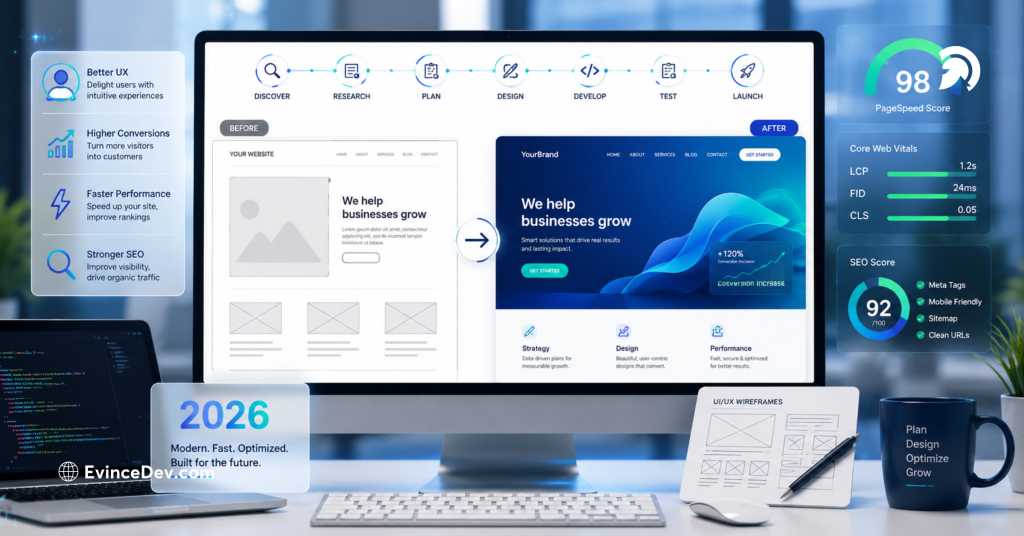
Your website may be attracting visitors, but is it convincing them to stay, explore, and take action?
For many businesses, the website is the first real interaction a potential customer, partner, or investor has with the brand. If it looks outdated, loads slowly, feels difficult to navigate, or fails to communicate value clearly, visitors may leave before learning what the business can offer.
A website redesign can help address these issues by improving usability, performance, visual appeal, and conversion paths. However, redesigning a website is not only about giving it a fresh look. It requires careful planning to ensure the new website supports business goals without disrupting SEO, traffic, or user experience.
This website redesign guide explains when a redesign may be necessary, what the process involves, and how to approach it effectively.
What is Website Redesign?
A website redesign entails revamping your website’s front and back elements. The elements of your website that affect the look, feel, and user experience are front-end elements.
The code that runs the frontend functionality and experience is referred to as the backend elements. You could entirely change the appearance and feel of your website during a site redesign. You can also add new features to improve user experience and increase lead generation.
Businesses can take advantage of the following benefits of a website redesign:
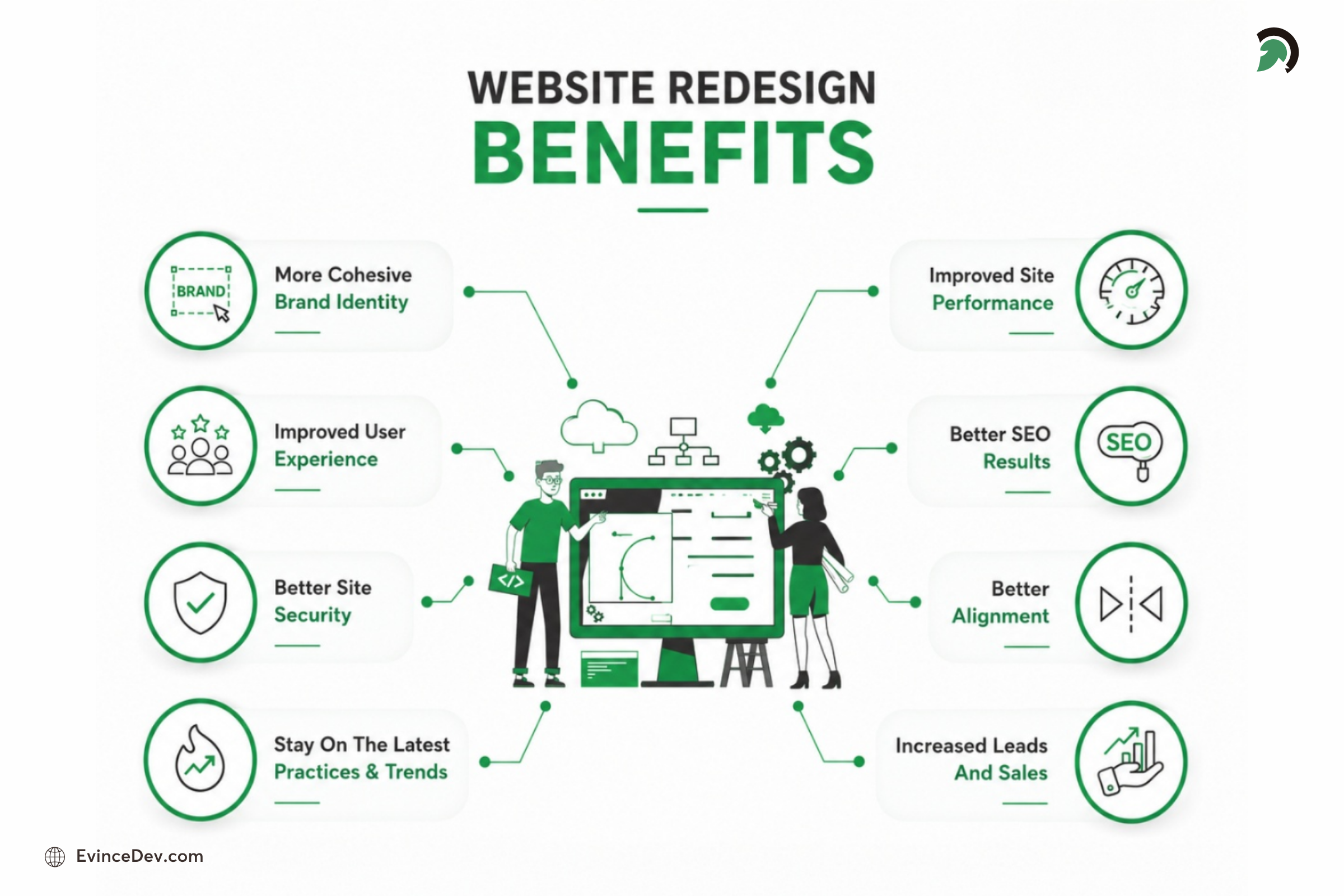
Key Benefits of Redesigning Your Website
- More cohesive brand identity
- Improved site performance
- Stay on the latest web design best practices and trends
- Better SEO results
- Improved user experience
- Better alignment with the current needs and goals of your business
- Increased leads and sales
- Better site security
Quick Stat:
A Google-commissioned study across 37 brand websites found that improving mobile site speed by just 0.1 seconds was associated with an 8.4% increase in retail conversions and a 9.2% rise in average order value.
Website Redesign vs Website Refresh
A website refresh focuses on improving selected elements, while a website redesign involves broader changes to the site’s structure, design, functionality, or user experience.
| Website Refresh | Website Redesign |
| Updates colors, fonts, images, or content | Reworks design, structure, and functionality |
| Usually keeps the existing layout | May introduce a new sitemap and navigation |
| Suitable for minor improvements | Suitable for larger performance or usability issues |
| Requires less time and investment | Requires more planning, testing, and development |
A refresh may be enough when the website foundation is still strong. A full redesign is more suitable when the site feels outdated, performs poorly, no longer supports business goals, or needs major technical changes.
Quick Stat:
In a Stanford study involving 2,684 participants, the visual design of a website was mentioned in 46.1% of comments about credibility, more frequently than any other factor evaluated.
Why Should You Consider Website Revamp?
Although it sounds like a no-brainer, it’s surprising how frequently website rebuilds fail or function poorly because the previous reasons were wrong. The most crucial thing to do before beginning is to analyze your existing website carefully:
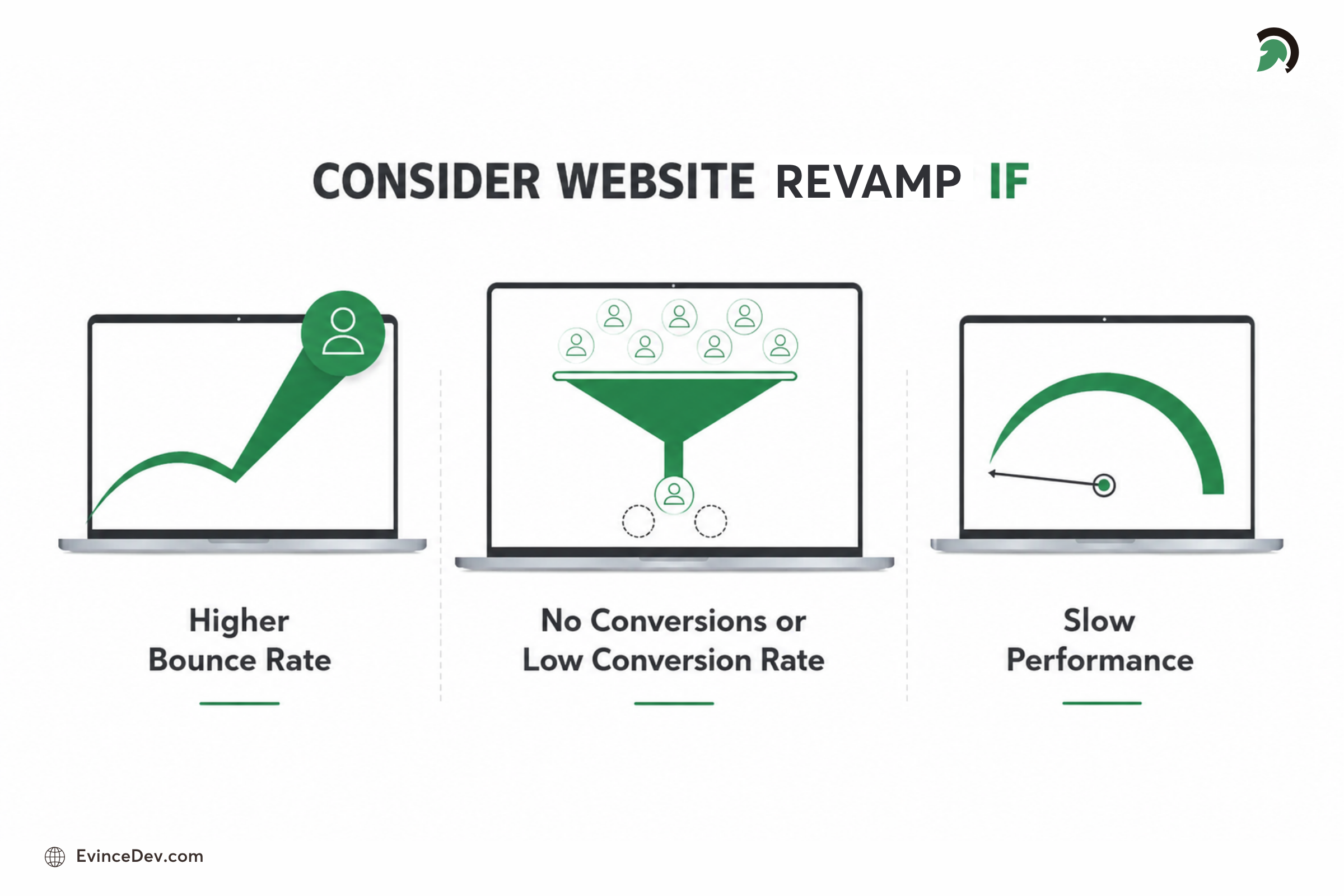
When and Why Your Website Needs a Revamp
Higher Bounce Rate
You should pay attention if your website’s bounce rate is high. The number of visitors to your website that left without visiting any other pages determines your bounce rate (Your Google Analytics report’s audience overview section is where you can quickly determine your bounce rate).
Bounce rates will vary for different kinds of web pages. For example, your home page should have a high bounce rate than a page with a contact form. High bounce rates can result from issues such as slower page load times, poor or unclear content, poor UX design, and other factors.
No Conversions or Low Conversion Rate
It’s excellent that potential customers can locate and use your website, but something needs to be fixed if those visits don’t convert. Most often, crucial on-page features that aid the conversion process must be improved in websites that drive leads and conversions.
Social proof, simple calls-to-action (CTAs), content that appeals to your target audience, and several other components should be included. The likelihood is that they are with competition if they are not converting, and low conversion rates are thus an obvious indication that something has to change.
Slow Performance
Your business may be considerably affected by how fast your website loads. According to recent studies, websites that take longer than three seconds to load would lose roughly 40% of web visitors. It may impact website conversion rates and user experience. Additionally, poor load speeds will hurt a website’s position in search results.
Test your website’s load times at least once a year to ensure everything runs smoothly for mobile device users. To check the speed of your website, we advise using Google’s Lighthouse Tool.
Real-World Project Reference: Urban Air Adventure Park
Urban Air Adventure Park needed a website that could support more than 350 franchise locations without creating a fragmented experience for visitors or local teams. Users needed quicker access to location-specific attractions, pricing, memberships, and booking information, while franchise owners needed a simpler way to manage local content. This is where Evincdedev’s website redesign and web development services came into picture.
EvinceDev redesigned the website around location-based experiences, clearer navigation, responsive layouts, and centralized WordPress multisite management. This reduced content management complexity and made it easier for visitors to find relevant information for their preferred location.
When Should You Consider Website Redesign?
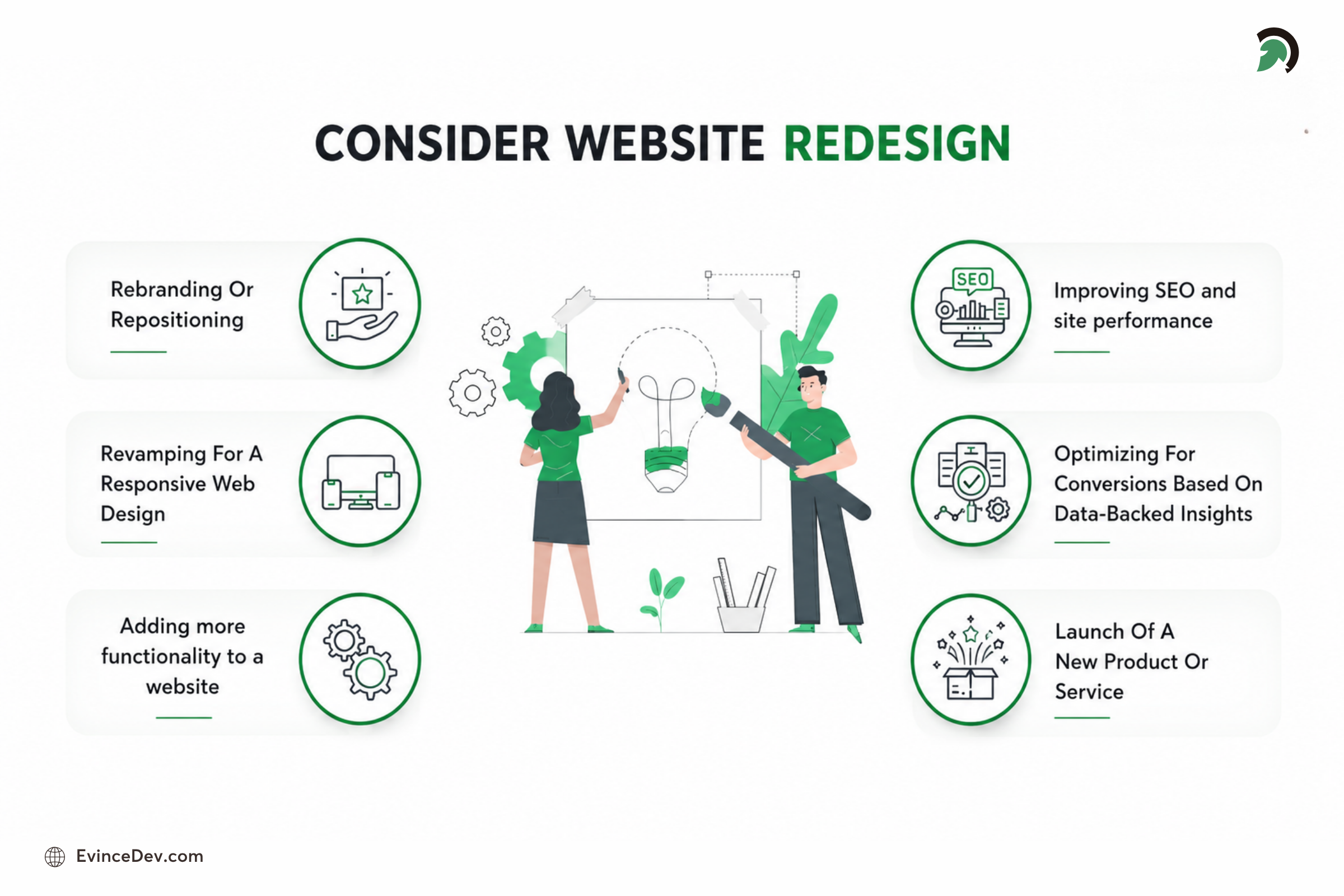
Top Signs Your Business Website Needs a Redesign
There are various reasons why businesses redesign their websites. Consider redesigning your website if you want the following features:
Rebranding or repositioning
Rebranding is a marketing approach used to change how people view a company for commercial purposes. It aids the business in standing out from a crowd of competitors. In some situations, like mergers, rebranding becomes necessary.
Launch of a new product or service
A website redesign is always necessary once a product or service line has launched to include new features and functions.
Adding more functionality to a website
Changing the existing style of your website is necessary when you add new features. You must be sure that the feature you wish to add to your website satisfies your intended business goals because website functionality can directly impact your business.
Optimizing for conversions based on data-backed insights
Conversion Rate Optimization focuses on achieving conversions from the existing user base rather than attracting additional site users. In this way, you may avoid increasing website traffic. Therefore, it’s vital to have statistics to support your views.
Revamping for a responsive web design
With time and user behavior, website designs will undoubtedly improve. Your website may need a significant redesign because it may be using outdated software, a disregarded backend system needs to be mobile-friendly, and so on. With mobile searches on the rise, you must pay attention to your website.
Improving SEO and site performance
SEO affects how quickly and easily a customer can reach your website. When your website includes visuals without alternative text, poorly used HTML elements, and irrelevant keywords, these factors make it difficult for Google crawlers to find it.
Quick Stat:
After improving page performance and Core Web Vitals, real estate platform QuintoAndar reported a 5% increase in conversions and an 87% increase in pages viewed per session.
Website Redesign SEO Checklist
To protect search rankings and organic traffic during a website redesign, make sure you:
- Crawl and export all existing URLs
- Identify high-traffic and high-ranking pages
- Preserve valuable content
- Keep existing URLs unchanged where possible
- Create one-to-one 301 redirects
- Avoid redirect chains
- Retain page titles, meta descriptions, and heading structure
- Update all internal links
- Regenerate and submit the XML sitemap
- Check canonical tags
- Review robots.txt and noindex settings
- Preserve structured data and schema markup
- Test analytics and conversion tracking
- Monitor Google Search Console after launch
- Resolve 404 errors and indexing issues
Key Stages of a Successful Website Redesign
A website redesign should improve how the site looks, works, and supports business goals. Rather than treating it as a simple design update, businesses should follow a structured process that reduces risk and keeps the project focused.
- Goal and Audience Planning: Identify what the new website should achieve, who it needs to serve, and which performance indicators will define success.
- Current Website Evaluation: Review the existing website’s design, content, navigation, SEO performance, speed, functionality, and conversion paths to identify what should be improved or retained.
- Sitemap and User Journey Planning: Organize pages into a clear structure and map how visitors will move from entry pages to key actions such as enquiries, purchases, or bookings.
- Wireframing and Visual Design: Create page layouts before developing the final design. This stage defines content placement, navigation, branding, responsiveness, and overall usability.
- Development and System Integration: Convert the approved design into a functional website, connect it with the selected CMS, and integrate forms, APIs, payment tools, analytics, or other required systems.
- Content and SEO Transition: Move important content carefully, retain high-performing SEO elements, update internal links, and create redirects for URLs that have changed.
- Testing and Launch Preparation: Test the website across browsers, devices, screen sizes, forms, links, and integrations. Any performance, usability, or technical issues should be resolved before launch.
- Post-Launch Monitoring: Review traffic, rankings, conversions, errors, and user behaviour after launch to identify any issues and make further improvements.
How Long Does a Website Redesign Take?
A website redesign can take a few weeks or several months, depending on the website’s size, features, content requirements, integrations, and approval process.
| Website Type | Estimated Timeline |
| Small business website | 4 to 6 weeks |
| Medium-sized website | 6 to 12 weeks |
| Large or eCommerce website | 3 to 6 months |
| Complex custom website | 6 months or more |
These timelines are general estimates. Content rewriting, custom functionality, platform migration, SEO migration, third-party integrations, and delayed approvals may extend the project schedule. Defining the scope and responsibilities early can help keep the redesign on track.
How Often Do You Consider Web Redesign?
There is no fixed timeline for redesigning a website. While some businesses may need a redesign every two to three years, others can continue using the same website for longer with regular content, design, performance, and security updates.
Consider a website redesign when the current site no longer supports your business goals, delivers a poor user experience, performs slowly, looks outdated, or struggles to generate leads and conversions. Changes in customer expectations, branding, technology, products, or services may also indicate that it is time to review the website.
Instead of redesigning based only on age, assess your website regularly and make the decision based on measurable performance issues and evolving business needs.
Conclusion: Hire A Website Redesign Agency
A website redesign and development is more than just a visual update. It is an opportunity to improve the user experience, strengthen the performance, support SEO, and align the website more closely with the current business goals as well as objectives.
The best results of website redesign before and after the implementation come from careful planning, clear priorities, and ongoing optimization after launch. Regular performance reviews, content updates, security checks, and user experience improvements help the redesigned website continue delivering value over time.
As a trusted web development company, EvinceDev helps businesses with website redesign and web development services to improve outdated websites through user-focused design, custom development, performance optimization, integrations, and SEO-conscious migration. Whether the goal is to modernize the design, improve conversions, or support future growth, the team can help build a website that is easier to use, manage, and scale.