
Key Takeaways
- Risk-Based Governance: Apply controls according to each AI system’s potential impact.
- Clear AI Accountability: Assign defined ownership for every AI system and decision.
- Reliable Data and Models: Govern data quality, model testing, documentation, and transparency together.
- Meaningful Human Oversight: Ensure people can review, challenge, override, or stop AI decisions.
- Continuous Governance: Monitor AI systems, address incidents, and improve policies throughout their lifecycle.
AI can make decisions faster than people, process more data than any team, and automate tasks at a scale that was impossible a few years ago. But the same speed and autonomy that make AI valuable can also make it risky. A biased model, exposed customer data, an inaccurate recommendation, or an unexplained automated decision can quickly become a legal, financial, and reputational problem.
This is why organizations need more than powerful AI tools. They need clear rules for how those tools are selected, developed, approved, used, and monitored. An AI governance framework provides that structure by defining who is responsible, what controls must be followed, how risks are assessed, and when human intervention is required.
Effective governance is not about restricting innovation. It is about helping businesses adopt AI with greater confidence, consistency, and control. This guide explains the essential AI governance framework components and how organizations can apply them throughout the AI lifecycle.
Quick Stat:
Deloitte found that only 25% of surveyed leaders considered their organizations highly or very highly prepared to manage generative AI governance and risk.
What Is an AI Governance Framework?
An AI governance framework is a formal structure that helps an organization control how artificial intelligence is used across the business. It combines policies, responsibilities, technical controls, risk reviews, monitoring processes, and documentation requirements.
In simple terms, it answers questions such as:
- What AI systems are we using?
- Who owns and approves them?
- What data do they use?
- What risks could they create?
- How are they tested and monitored?
- Who can intervene when something goes wrong?
An AI governance framework covers more than model performance. It also addresses AI ethics and governance, legal obligations, privacy, security, fairness, accountability, and business impact.
This is different from data governance, which mainly focuses on how data is collected, stored, protected, and used. It is also broader than AI model governance, which focuses specifically on model development, validation, deployment, and monitoring. A complete framework brings these areas together under one enterprise-wide approach.
Why Is an AI Governance Framework Important?
As AI adoption grows, informal guidelines are no longer enough. Without a clear governance structure, different teams may use different tools, follow inconsistent approval processes, or deploy AI systems without fully understanding their risks. This can lead to privacy issues, biased outcomes, security vulnerabilities, regulatory exposure, and uncertainty over who is responsible when something goes wrong.
An effective AI governance framework helps organizations reduce legal, operational, security, and reputational risks while creating clear ownership and AI accountability. It also improves the reliability and fairness of AI-supported decisions, protects sensitive data and intellectual property, supports responsible AI governance across teams, and helps businesses prepare for changing regulatory requirements. At the same time, it builds trust among customers, employees, partners, and other stakeholders.
For larger organizations, enterprise AI governance is especially important because multiple departments may build, purchase, or use AI systems at the same time. A shared framework prevents duplicated efforts, inconsistent controls, and unapproved AI use while allowing the organization to scale AI adoption without losing visibility or control.
Expert Perspective
Organizations should evaluate the unintended consequences of AI alongside its potential benefits, integrating risk assessment, human oversight, and responsible safeguards from the beginning.
– Satya Nadella, Chairman and CEO, Microsoft
Quick Stat:
IBM found that 63% of breached organizations either lacked an AI governance policy or were still developing one, while 61% had no dedicated AI governance technologies.
What Should an AI Governance Framework Include?
A complete AI governance framework should combine organizational accountability, technical safeguards, risk controls, and ongoing oversight. The following 12 elements provide a practical structure that organizations can adapt according to their size, industry, AI maturity, and risk exposure.
1. AI Principles and Policies
AI principles define how the organization expects artificial intelligence to be used. They should establish clear standards for responsible, ethical, and acceptable AI adoption.
Key controls: Fairness, transparency, privacy, security, reliability, accountability, human control, and acceptable or prohibited use cases.
These policies should also explain how each principle will be applied, reviewed, and enforced in practice.
Expert Perspective:
Effective AI governance requires both clear regulation and internal accountability, with ethical review, safety testing, and risk controls built into how AI systems are developed and used.
– Brad Smith, Vice Chair and President, Microsoft
2. Roles, Responsibilities, and Accountability
Every AI system should have clearly assigned owners, reviewers, and approval authorities. This ensures that responsibility remains clear throughout development, deployment, and ongoing use.
Key controls: Business ownership, technical ownership, data responsibility, risk review, legal and security approval, monitoring responsibility, and shutdown authority.
The framework should clearly identify who can approve changes, respond to incidents, override outputs, or stop the system.
Quick Stat:
A 2026 IBM study found that two-thirds of surveyed CIOs and CTOs were accountable for AI systems they did not fully control, while only 11% felt completely prepared for AI agent deployment at scale.
3. AI System Inventory
Organizations should maintain a centralized record of all AI models, applications, vendor platforms, experimental tools, and third-party systems.
Key controls: System purpose, owner, model or provider, data sources, users affected, risk level, approval status, deployment status, and review history.
A current inventory improves visibility and helps identify unmanaged tools, duplicated systems, and shadow AI.
4. Risk Classification and Impact Assessment
AI systems should be governed according to the level of risk they create. A basic chatbot should not follow the same approval process as a system used for lending, hiring, healthcare, or insurance decisions.
Key controls: Impact on individuals, sensitive data use, level of automation, legal or financial consequences, safety risks, reversibility, misuse potential, and scale.
High-risk systems should receive stronger testing, documentation, approval, monitoring, and human oversight.
Expert Insights:
AI governance should not apply identical controls to every system. Organizations should assess how an AI system could affect individuals, operations, and society, then apply oversight in proportion to the severity and likelihood of those risks.
5. Data Governance, Quality, and Lineage
AI systems depend on accurate, relevant, and well-managed data. The framework should govern how data is collected, validated, protected, transformed, retained, and deleted.
Key controls: Data quality, accuracy, completeness, representativeness, privacy, access, retention, provenance, lineage, and bias checks.
Data lineage should allow teams to trace information from its original source through model processing and into the final output.
Also Read: How Is AI Governance Different From Data Privacy Compliance?6. Model Testing and Validation
AI systems should be tested before deployment and after significant changes. Validation should confirm that the system performs reliably across expected conditions, edge cases, and possible failure scenarios.
Key controls: Accuracy, reliability, fairness, robustness, explainability, privacy, security, harmful outputs, manipulation resistance, and performance across user groups.
Clear acceptance criteria should be established before a model is approved for production use.
7. Transparency and Documentation
Every AI system should have clear documentation explaining its purpose, design, data sources, performance, limitations, risks, and approved use.
Key controls: Intended use, unsupported use, model versions, training methods, performance results, known limitations, risk assessments, approvals, monitoring thresholds, and change history.
Users should also be informed when they are interacting with AI or when AI meaningfully influences an important decision.
Expert Perspective:
AI documentation should do more than satisfy audits. Clear records of intended use, limitations, test results, and approval decisions help teams understand whether a system is still suitable when its data, users, or business purpose changes.
8. Human Oversight and Escalation
Human oversight is essential when AI systems influence high-impact decisions or operate in situations where errors could cause harm.
Key controls: Mandatory review points, reviewer authority, override rights, escalation paths, shutdown procedures, confidence thresholds, and intervention records.
Human reviewers should have enough context, authority, and time to challenge AI-generated outcomes meaningfully.
9. Security, Privacy, and Access Controls
AI systems should be protected against unauthorized access, manipulation, data exposure, and misuse from the beginning of development.
Key controls: Authentication, encryption, role-based access, secure APIs, data masking, logging, prompt protection, credential security, vendor access, and sensitive-data restrictions.
The framework should also address threats such as prompt injection, data poisoning, model theft, and data leakage.
Quick Stat:
IBM reported that 13% of surveyed organizations had experienced a breach involving an AI model or application, and 97% of those organizations lacked proper AI access controls.
10. Continuous Monitoring and Audit Trails
AI systems may behave differently over time as data, users, and operating conditions change. Continuous monitoring helps identify declining performance and emerging risks.
Key controls: Model drift, data drift, bias, abnormal outputs, low-confidence responses, security events, complaints, human overrides, failures, and usage changes.
Audit trails should record model updates, approvals, prompts, outputs, configuration changes, and human interventions where appropriate.
11. Incident, Vendor, and Compliance Management
The framework should establish how the organization handles AI failures, manages third-party tools, and meets legal or regulatory obligations.
Key controls: Incident reporting, containment, root-cause analysis, corrective action, vendor assessment, contractual responsibility, regulatory mapping, and stakeholder notification.
Third-party AI systems should be reviewed for privacy, security, performance, transparency, intellectual property, and data-handling risks.
12. Lifecycle Management and Continuous Improvement
AI governance should continue throughout the full system lifecycle, from initial planning to retirement.
Key controls: Use-case review, design, development, testing, approval, deployment, monitoring, retraining, modification, reapproval, and retirement.
The framework should improve over time based on audits, incidents, monitoring results, user feedback, business changes, and regulatory developments.
How to Implement an AI Governance Framework
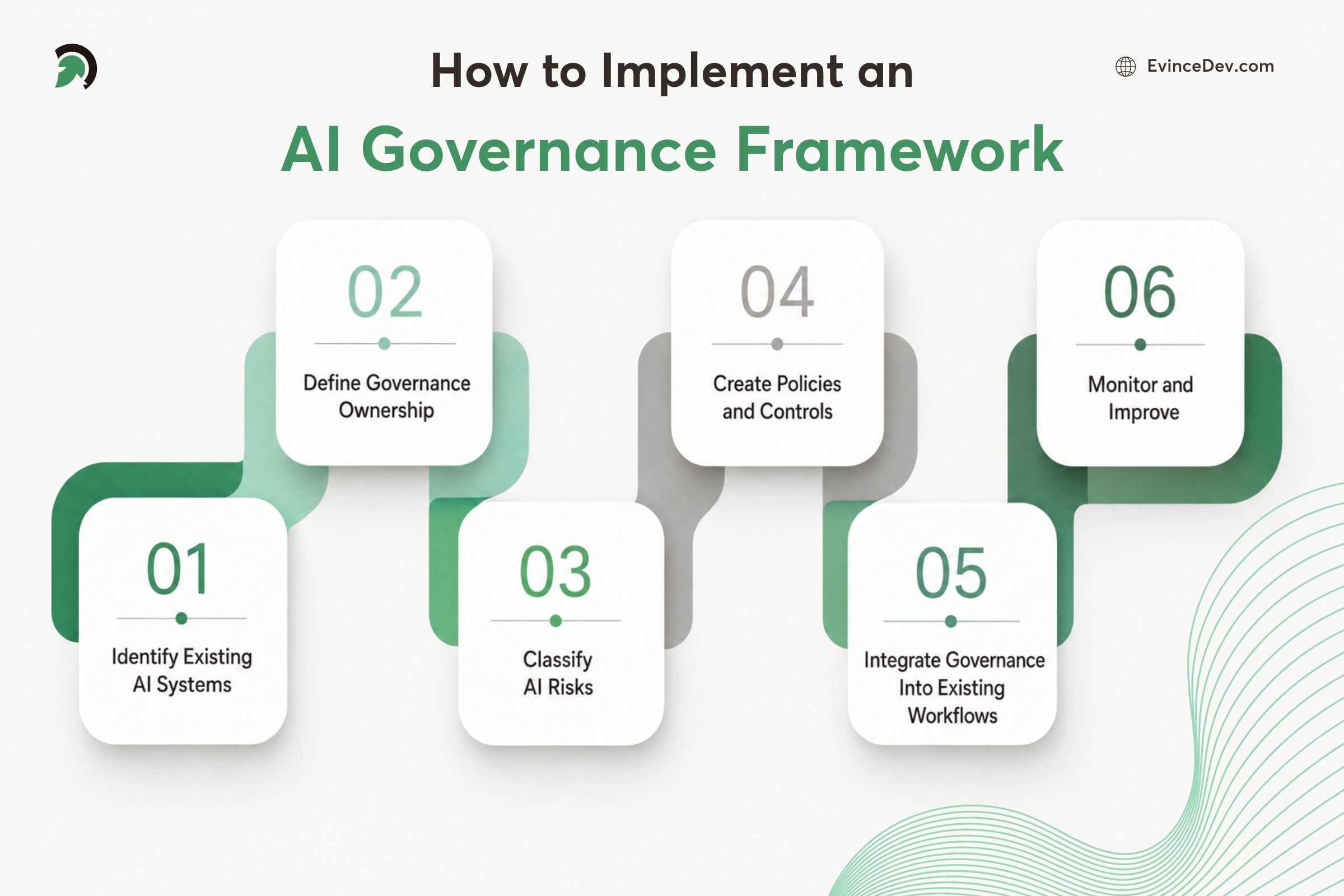
A six-step infographic explaining how to implement an AI governance framework, from identifying existing AI systems and assigning ownership to managing risks, integrating controls, and continuously improving governance.
Creating policies is only the beginning. Organizations also need a practical implementation plan.
Step 1: Identify Existing AI Systems
Start by finding all AI systems currently used or planned across the organization. Include approved tools, experimental projects, vendor products, and employee-used generative AI applications.
Step 2: Define Governance Ownership
Assign a cross-functional group to oversee governance. This may include business leaders, technical teams, legal, privacy, cybersecurity, compliance, and risk specialists.
Organizations without internal expertise may use AI consulting services to design governance responsibilities, control structures, and implementation priorities.
Step 3: Classify AI Risks
Create clear risk categories and define the controls required for each level. Focus first on systems involving sensitive data, automated decisions, financial impact, safety, or legal rights.
This classification process should be connected to an AI risk management framework so that risks are identified, assessed, prioritized, and addressed consistently.
Step 4: Create Policies and Controls
Develop practical AI governance policies covering data, testing, approvals, transparency, access, monitoring, human review, third-party tools, and incidents.
Step 5: Integrate Governance Into Existing Workflows
Governance should become part of procurement, software development, cybersecurity reviews, product approval, and deployment processes.
Organizations planning AI development solutions should introduce risk and governance reviews at the beginning of the project rather than waiting until launch.
Step 6: Monitor and Improve
Track how well the controls work. Review incidents, unresolved risks, monitoring alerts, audit findings, approval delays, and user complaints.
A strong AI governance strategy should evolve as the organization adopts new technologies, enters new markets, and gains experience.
AI Governance Best Practices
Effective AI governance depends on how well the framework is applied in everyday operations. Organizations should follow these practices:
- Match controls to the level of risk.
High-impact AI systems should undergo stricter testing, approval, documentation, and monitoring than low-risk tools. - Keep a complete AI inventory.
Maintain an updated record of all internal models, third-party tools, experimental systems, and employee-used AI applications. - Give every AI system a clear owner.
Assign responsibility for performance, risk management, approvals, monitoring, and incident response. - Record important decisions.
Document risk assessments, approvals, exceptions, model updates, human interventions, and corrective actions. - Embed governance into existing processes.
Include governance checks in procurement, development, testing, deployment, and change management. - Test AI in realistic conditions.
Use diverse datasets, real-world scenarios, edge cases, and different user groups to identify bias and performance issues. - Assess external AI tools before adoption.
Review third-party models, APIs, platforms, and generative AI tools for data privacy, security, reliability, and contractual risks. - Ensure meaningful human oversight.
Human reviewers should have enough information, authority, and time to question, override, or stop AI-driven decisions. - Monitor systems after deployment.
Track model drift, declining accuracy, biased outcomes, unusual behavior, security events, and user complaints. - Review governance policies regularly.
Update policies and controls as technologies, regulations, business needs, and risk conditions change. - Keep the framework easy to understand.
Use plain language, practical examples, and role-specific guidance so employees can apply the rules correctly.
These AI governance best practices turn broad principles into practical actions and help organizations maintain responsible AI governance across the AI lifecycle.
Also Read: Custom AI Workflows: When to Build vs. BuyAI Governance Framework Checklist
Before approving or deploying an AI system, confirm that the organization has:
- Defined clear AI principles, policies, and acceptable-use rules
- Assigned ownership, responsibilities, and accountability
- Added the system to a centralized AI inventory
- Classified its risk level and completed an impact assessment
- Verified data quality, privacy, consent, and lineage
- Completed model testing and validation
- Documented the system’s purpose, limitations, and approved use
- Established human oversight and escalation procedures
- Applied appropriate security and access controls
- Set up continuous AI monitoring and auditing
- Created incident response and third-party vendor controls
- Reviewed applicable legal and regulatory requirements
- Defined lifecycle controls for updates, retraining, and retirement
- Established a process for ongoing review and improvement
Organizations that need support can use AI governance consulting services to identify governance gaps, define practical policies, and build a roadmap aligned with their AI risks and business priorities.
Conclusion
AI governance is not a single policy, checklist, or approval meeting. It is an operating structure that connects people, processes, data, technology, risk controls, and ongoing oversight.
The most effective frameworks combine responsible AI governance with clear ownership, strong data controls, model testing, transparency, human intervention, security, monitoring, and lifecycle management.
The goal is not to eliminate every possible AI risk. That would be unrealistic. The goal is to understand risks, apply controls according to their potential impact, and make informed decisions about where and how AI should be used.
By following AI governance best practices and maintaining clear risk controls, organizations can scale AI adoption while protecting customers, employees, data, and business interests. This is where EvinceDev can support businesses by helping them translate governance principles into practical policies, review processes, technical safeguards, and implementation roadmaps that fit their AI goals and operational needs.