
Key Takeaways
- Data Protection: Privacy compliance protects how personal data is collected, used, stored, and shared.
- AI Control: AI governance manages how AI systems behave, decide, respond, and improve.
- Risk Beyond Privacy: AI can still create bias, errors, unsafe outputs, or unclear decisions even when data is protected.
- Trusted AI Data: AI data governance ensures AI systems use accurate, secure, approved, and relevant data.
- Governance Readiness: AI governance consulting helps businesses reduce risk, improve accountability, and prepare for AI compliance.
Protecting data is no longer enough to make AI trustworthy.
A business can collect data lawfully, store it securely, and follow privacy requirements, yet still have an AI system that gives biased recommendations, produces inaccurate answers, or makes decisions no one can explain.
That is where the conversation shifts from data privacy compliance to AI governance.
AI is now part of customer support, product recommendations, document review, fraud detection, workflow automation, predictive analytics, and decision support. As AI becomes more involved in real business outcomes, companies need controls not only for the data AI uses, but also for the way AI behaves.
Data privacy compliance focuses on how personal data is collected, processed, stored, shared, and protected. AI governance focuses on how AI systems are designed, trained, tested, deployed, monitored, and controlled responsibly.
This blog explains the Difference Between AI Governance and Data Protection, where they overlap, why businesses need both, and how AI governance consulting helps organizations build responsible AI systems with stronger risk management, transparency, and compliance readiness.
What Is Data Privacy Compliance?
Data privacy compliance refers to the policies, controls, and processes that help organizations manage personal data according to applicable laws, industry rules, contractual obligations, and internal security standards.
It focuses on how personal information is collected, used, stored, accessed, shared, retained, and deleted.
In simple terms, data privacy compliance answers one main question:
Are we handling personal data properly?
For example, if a company collects customer names, email addresses, payment details, patient records, employee data, or user behavior data, it must ensure that the information is collected for a clear purpose, protected from unauthorized access, and used only in approved ways.
Data privacy compliance applies to many types of digital systems, including CRM platforms, eCommerce websites, healthcare portals, mobile apps, HR systems, SaaS products, and enterprise applications. It applies whether the system uses AI or not.
Common areas covered under data privacy compliance include consent, privacy notices, lawful data processing, access control, data retention, deletion requests, breach response, third-party data sharing, and cross-border transfers.
What Is AI Governance?
AI governance is the structured approach businesses use to manage AI systems responsibly throughout their lifecycle. It includes policies, technical controls, risk assessments, documentation, human oversight, monitoring, and accountability.
In simple terms, AI governance answers a different question:
Is the AI system safe, fair, explainable, reliable, secure, and accountable?
This goes beyond data protection. AI governance looks at how an AI system behaves, what data it uses, how it produces outputs, how decisions are reviewed, and what happens if the system makes a mistake.
For example, an AI customer support chatbot may need privacy controls because it collects user data. But it also needs governance controls to ensure it does not provide misleading answers, expose sensitive information, or fail to escalate complex issues.
This is where AI governance consulting helps. It gives businesses a practical way to define AI policies, classify risks, review data usage, test AI behavior, assign accountability, and monitor systems after launch.
Also Read: AI in Banking: The Future of Smarter, Safer, and More Personalized Financial TechnologyDifference Between AI Governance and Data Protection
The Difference Between AI Governance and Data Protection comes down to scope.
Data protection focuses on personal data. AI governance focuses on the entire AI system, including data, models, outputs, decisions, risks, users, workflows, and business impact.
A privacy-compliant system is not automatically a responsible AI system. It may protect personal data correctly but still produce biased, inaccurate, unsafe, or unexplained results.
| Area | Data Privacy Compliance | AI Governance |
| Main focus | Protecting personal data | Managing responsible AI development and use |
| Core question | Is personal data handled lawfully and securely? | Is the AI system safe, fair, explainable, and accountable? |
| Scope | Data lifecycle | AI lifecycle |
| Applies to | Any system processing personal data | AI models, chatbots, copilots, AI agents, ML systems, and generative AI tools |
| Main risks | Data misuse, privacy violations, unauthorized access, poor consent management | Bias, hallucination, model drift, unsafe automation, lack of explainability |
| Common controls | Consent, access control, encryption, privacy notices, retention policies | Risk classification, model testing, human oversight, monitoring, documentation |
| Example | Managing customer consent before collecting data | Testing whether an AI loan model gives unfair recommendations |
This distinction matters because many businesses treat AI risk as a privacy issue only. In reality, AI creates broader risks around decisions, automation, fairness, safety, transparency, and accountability.
Where AI Governance and Data Privacy Compliance Overlap
AI governance and data privacy compliance overlap because AI systems often depend on personal, sensitive, behavioral, financial, healthcare, employee, or customer data.
For example, an AI-powered recommendation engine may process user preferences, purchase history, search behavior, and location data. Privacy controls are needed to manage how that data is collected and stored. AI governance controls are needed to ensure the recommendation logic is fair, explainable, and aligned with the intended use case.
The overlap usually appears in areas such as:
- Data quality and accuracy
- Access control and user permissions
- Security and encryption
- Data minimization
- Vendor review
- Documentation
- Transparency
- Risk assessment
- Accountability
- Audit readiness
This is where AI data governance becomes important. Businesses need to understand what data their AI systems use, where it comes from, who can access it, whether it contains sensitive information, and whether it is suitable for the intended AI use case.
Privacy compliance protects the data. AI governance protects how the AI system uses that data and influences outcomes.
Expert Perspective:
AI data governance is the bridge between data privacy compliance and responsible AI. Privacy controls help protect data, but AI data governance ensures that the data used by AI systems is accurate, relevant, approved, traceable, and appropriate for the intended use case. Without strong AI data governance, even well-designed AI systems can produce unreliable or risky outputs.
Why Data Privacy Compliance Alone Is Not Enough for AI
Data privacy compliance is essential, but it does not fully manage AI-related risks.
A company may collect and store personal data correctly, but its AI system may still make poor decisions. It may produce biased recommendations, generate inaccurate responses, rely on weak data, or automate actions without enough human control.
For example, a financial AI tool may protect customer data but unfairly reject loan applicants. A healthcare chatbot may store patient information securely but provide unsafe suggestions. An AI hiring tool may process candidate data lawfully but still create biased shortlists.
These are not only privacy issues. They are AI risk management, AI ethics and compliance, responsible AI, and accountability issues.
Privacy controls may not fully address AI-specific risks such as:
- Biased or unfair decisions
- Hallucinated AI responses
- Inaccurate predictions
- Lack of explainability
- Poor human oversight
- Model drift after deployment
- Prompt injection risks
- Sensitive data leakage through AI outputs
- Uncontrolled AI agents
- Third-party model risks
This is why businesses need AI governance along with data privacy compliance. Privacy tells businesses how to handle data. Governance tells businesses how to control AI behavior, decisions, and outcomes.
Quick Stat:
IBM’s 2025 Cost of a Data Breach Report found that 13% of organizations reported breaches of AI models or applications, and 8% did not know whether they had been compromised in this way. IBM also noted that AI adoption is outpacing AI security and governance.
Why AI Governance Still Depends on Data Privacy Compliance
AI governance does not replace data privacy compliance. It depends on it.
AI systems are only as reliable as the data and controls behind them. If data is collected without a clear purpose, stored insecurely, accessed by the wrong users, or used without proper approval, the AI system becomes risky before it even reaches production.
Strong privacy practices support responsible AI by helping businesses define what data is allowed, why it is needed, how it should be protected, who can access it, and how long it should be retained.
Through AI governance consulting, businesses can connect privacy controls with AI-specific controls. This helps ensure that AI systems are not only data-aware but also risk-aware, secure, explainable, and monitored.
Also Read: AI in Risk Management – Transforming Banking and FinTechPractical Examples: AI Governance vs Data Privacy Compliance
AI Chatbot
An AI chatbot may collect names, email addresses, account details, support queries, and conversation history.
From a privacy perspective, the business needs to manage consent, storage, access, retention, and user notice. From an AI governance perspective, the business needs to make sure the chatbot gives accurate responses, avoids unsafe advice, protects sensitive data, and escalates complex cases to a human.
AI Hiring Tool
An AI hiring system may process resumes, candidate profiles, interview notes, and assessment data.
Data privacy compliance focuses on how candidate data is collected, stored, accessed, and deleted. AI governance focuses on whether the system creates biased recommendations, whether its outputs can be explained, and whether humans review decisions before action is taken.
Healthcare AI Platform
A healthcare AI platform may process patient records, symptoms, appointment data, or clinical notes.
Privacy compliance focuses on protecting sensitive health-related data. AI governance focuses on whether AI-generated suggestions are safe, limited in scope, reviewed where needed, and presented responsibly.
AI Agent for Workflow Automation
An AI agent may update records, assign tasks, send messages, summarize documents, or trigger actions across business tools.
Privacy compliance focuses on what data the AI agent can access. AI governance focuses on what actions the agent can take, what approval limits exist, whether logs are maintained, and whether humans can stop or reverse an action.
These examples show why AI governance consulting is useful for companies building AI-enabled products, platforms, and workflows.
Why Businesses Need AI Governance Consulting
Expert View
AI governance should scale with risk, not slow down every AI use case. A low-risk internal productivity tool does not need the same level of control as an AI system used in lending, healthcare, hiring, insurance, or legal workflows. A practical AI governance framework classifies AI use cases by risk level and applies stronger controls where the business impact is higher.
AI adoption often starts with a simple business goal: automate support, improve productivity, personalize experiences, summarize documents, detect patterns, or speed up decisions.
But once AI becomes part of daily operations, the risks become more complex. Businesses need to understand where AI is used, what data it accesses, what outputs it generates, what decisions it influences, and who is accountable if something goes wrong.
AI governance consulting helps businesses create structure around these questions. It supports AI compliance by helping teams define ownership, review risk, document systems, set controls, and monitor AI after deployment.
A practical AI governance consulting approach can help businesses:
- Identify and classify AI use cases
- Review data sources and privacy risks
- Define an AI governance framework
- Build AI risk management processes
- Add human oversight for high-impact decisions
- Improve AI ethics and compliance readiness
- Support AI regulatory compliance planning
- Review third-party AI tools and vendors
- Create documentation for internal and external review
This is especially important for businesses using generative AI, AI agents, AI copilots, predictive analytics, or AI systems that affect customer, employee, financial, healthcare, or operational decisions.
Quick Stat:
AI adoption is growing quickly, but McKinsey’s 2025 State of AI survey shows that many organizations are still in the early stages of scaling AI and capturing enterprise-level value, making governance a key priority for responsible growth.
Key Components of an AI Governance Framework
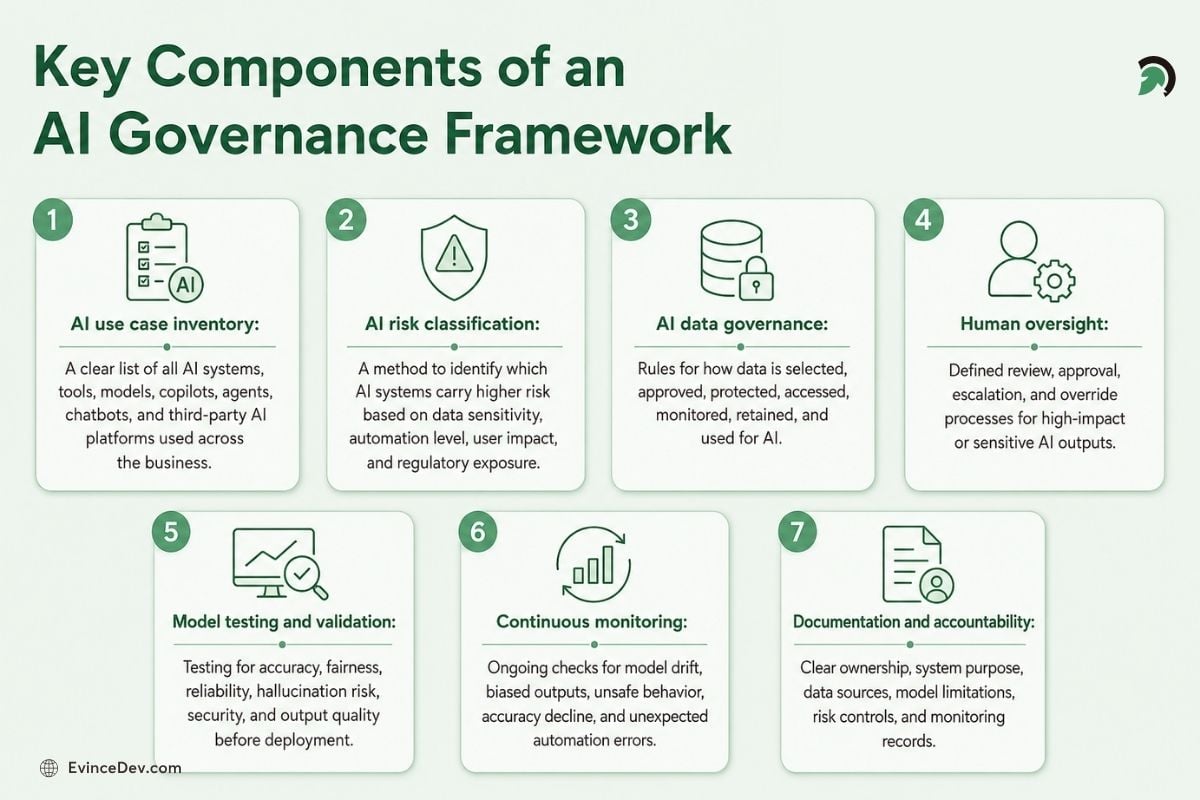
An AI governance framework helps businesses define how AI systems should be planned, developed, deployed, monitored, and improved.
Key Components of an AI Governance Framework
It does not need to start as a complex enterprise program. It can begin with practical controls that match the organization’s AI maturity, risk level, industry, and business goals.
A strong framework usually includes:
- AI use case inventory: A clear list of all AI systems, tools, models, copilots, agents, chatbots, and third-party AI platforms used across the business.
- AI risk classification: A method to identify which AI systems carry higher risk based on data sensitivity, automation level, user impact, and regulatory exposure.
- AI data governance: Rules for how data is selected, approved, protected, accessed, monitored, retained, and used for AI.
- Human oversight: Defined review, approval, escalation, and override processes for high-impact or sensitive AI outputs.
- Model testing and validation: Testing for accuracy, fairness, reliability, hallucination risk, security, and output quality before deployment.
- Continuous monitoring: Ongoing checks for model drift, biased outputs, unsafe behavior, accuracy decline, and unexpected automation errors.
- Documentation and accountability: Clear ownership, system purpose, data sources, model limitations, risk controls, and monitoring records.
This structure helps businesses move from informal AI usage to responsible AI adoption with stronger control and visibility.
How AI Governance Supports AI Ethics and Compliance
AI ethics and compliance are closely related, but they are not the same.
AI ethics focuses on whether AI is fair, transparent, safe, and responsible. Compliance focuses on whether the business meets legal, regulatory, contractual, and industry requirements.
A business may need both. For example, an AI recommendation system may meet technical requirements but still raise concerns about fairness or transparency. An AI chatbot may follow privacy expectations but still need controls around misinformation, user disclosure, and safe response boundaries.
AI governance consulting helps connect AI ethics and compliance with real implementation. It helps teams turn broad principles into practical controls such as bias reviews, human oversight, vendor evaluation, output monitoring, documentation, and escalation processes.
This also supports AI regulatory compliance because businesses can show how AI systems are reviewed, controlled, monitored, and improved over time.
Quick Stat:
PwC’s 2025 Responsible AI Survey found that 78% of strategic-stage respondents were very effective at defining and communicating responsible AI priorities, compared with only 35% in the training stage.
How Businesses Can Align AI Governance With Data Privacy Compliance
AI governance and privacy compliance should not work in separate silos. Legal, compliance, engineering, product, data, cybersecurity, and business teams need to work together.
A practical alignment process can follow five steps:
- Map AI use cases across internal tools, customer-facing platforms, chatbots, copilots, analytics models, AI agents, and third-party AI services.
- Identify the data used by each AI system, including personal, sensitive, confidential, regulated, and third-party data.
- Classify privacy and AI risks based on data access, decision impact, automation level, security exposure, and regulatory requirements.
- Define governance controls for data access, output review, model testing, human oversight, logging, vendor review, incident response, and documentation.
- Monitor continuously as models, prompts, data sources, workflows, integrations, and regulations change.
With the right structure, businesses can connect data privacy compliance, AI compliance, responsible AI practices, and product development into one practical governance model.
Quick Stat:
Deloitte notes that AI regulation often intersects with broader technology and sector-specific rules, meaning firms cannot solve AI-specific regulation in isolation. Scaling global AI regulatory compliance requires strong governance, risk management, and controls.
Common Mistakes Businesses Make
One common mistake is treating AI governance as only a legal task. In reality, it requires input from leadership, engineering, product, data, cybersecurity, compliance, operations, and business teams.
Another mistake is assuming privacy compliance covers all AI risks. Privacy compliance protects data, but it does not automatically prevent biased outputs, hallucinations, unsafe recommendations, or poor AI decision-making.
Businesses also make the mistake of governing only the AI model. AI governance should cover the full system, including data pipelines, prompts, APIs, integrations, user interfaces, workflows, monitoring, and human review.
Post-deployment monitoring is another common gap. An AI system that works well at launch may become less accurate or more risky over time. Continuous monitoring is essential for long-term reliability.
Finally, many teams use third-party AI tools without fully understanding data handling, model limitations, vendor controls, or output risks. Vendor review is important for both privacy and AI governance.
Also Read: Top AI Use Cases Across Industries: How to Choose and Implement the Right One in 2026AI Governance and Data Privacy Compliance Checklist
Data Privacy Compliance Checklist
- Is personal data collected for a clear and approved purpose?
- Are privacy notices clear and accessible?
- Are access controls in place?
- Is sensitive data protected?
- Are retention and deletion rules defined?
- Are third-party processors reviewed?
- Is breach response planning in place?
AI Governance Checklist
- Is every AI use case documented?
- Has the AI system been risk-classified?
- Are data sources reviewed and approved?
- Has the model been tested for accuracy and bias?
- Is human oversight defined?
- Are AI outputs monitored?
- Are system limitations documented?
- Are third-party AI vendors assessed?
- Is there a clear owner accountable for the AI system?
How EvinceDev Helps Businesses Build Responsible AI Systems
Building AI responsibly requires more than model integration. It requires secure architecture, governed data workflows, controlled automation, human oversight, documentation, and scalable engineering practices.
EvinceDev helps businesses design and develop AI solutions with responsible architecture, secure data handling, and governance-aware development practices built into the product lifecycle. From AI chatbots and copilots to generative AI platforms and agentic AI systems, EvinceDev supports businesses in building AI products that are practical, secure, scalable, and aligned with long-term business goals.
Businesses can also explore related AI consulting services and AI Governance Consulting Services to plan responsible AI adoption, improve governance readiness, and build AI solutions with stronger security, transparency, and operational control.
Bottom Line
AI governance and data privacy compliance are not competing priorities. They support each other. Data privacy compliance protects the information AI systems rely on, while AI governance controls how those systems use data, make decisions, and affect users.
For businesses adopting AI, the path forward is clear: build strong privacy foundations and pair them with responsible AI controls. That is how organizations can reduce risk, improve trust, and scale AI with confidence.