AI has moved beyond experimentation. Businesses are now using it to automate operations, improve decision-making, and deliver better customer experiences.
However, simply adopting an AI tool does not guarantee business value. The real challenge is integrating AI with existing workflows, systems, and data so it can solve specific operational problems.
This is where custom AI workflows become valuable. Designed around a company’s processes, data, integrations, and long-term goals, they can automate complex tasks, connect multiple systems, and scale with evolving business needs.
This blog explains when to build a custom AI workflow or buy a ready-made solution, while comparing their costs, benefits, integration requirements, scalability, security, and long-term business value.
Quick Stat:
Based on the “State of AI” survey conducted by McKinsey, almost 65% of companies use generative AI on an ongoing basis in one or more functions within their organizations in 2024, which is almost double the figure reported in the previous year. Clearly, companies have moved from experimenting with AI to making it work.
What Is a Custom AI Workflow?
A custom AI workflow is a business process enhanced with AI to automate tasks, analyze information, support decisions, and coordinate actions across different systems. It is designed around an organization’s specific processes, data, tools, and operational requirements.
Traditional automation usually follows predefined rules. Custom AI workflows can combine those rules with machine learning, natural language processing, predictive analytics, APIs, business data, and human approvals to manage more complex or variable tasks.
For example, an AI-powered customer service workflow can analyze incoming requests, identify customer intent, generate relevant responses, update CRM records, and escalate high-priority issues to the appropriate team.
Businesses can use custom AI workflows for:
- Intelligent document processing
- Sales and demand forecasting
- Personalized customer engagement
- Fraud detection
- Business data analysis
- Internal process automation
- Employee productivity support
Custom AI workflows do more than reduce manual effort. They help teams access relevant information faster, make informed decisions, and complete processes more efficiently.
Why Are Businesses Investing in Custom AI Workflows?
Many organizations begin with off-the-shelf AI tools because they are quick to adopt and easy to use. However, as AI usage expands, these tools can become difficult to customize, integrate with existing systems, and scale across business operations.
An effective AI solution requires more than a capable model. It also depends on:
- High-quality business data
- Reliable system integration
- Clearly defined workflows
- Strong security controls
- Effective AI governance
This is why businesses are increasingly investing in custom AI workflows designed around their specific processes, data, systems, and long-term goals.
Industry Perspective
“The enterprises pulling ahead are not deploying more AI, they’re redesigning how their business operates. Running AI in the enterprise requires a new operating model, and IBM is enabling organizations to manage AI-driven systems with the same rigor, governance, and scale as their most critical infrastructure.”
– Arvind Krishna, Chairman and CEO, IBM
Quick Stat:
According to Deloitte’s State of Generative AI in the Enterprise report, 67% of organizations are increasing their investment in generative AI after seeing measurable benefits. However, many still struggle to move beyond isolated use cases and embed AI into day-to-day operations.
Should You Build or Buy an AI Solution?
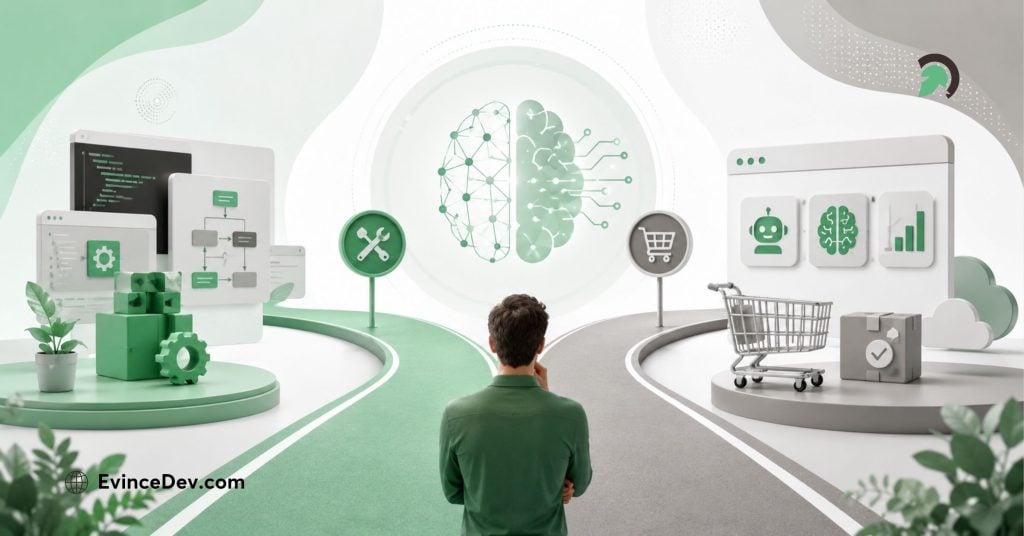
The decision to build or buy an AI solution depends on the complexity of the business problem, the level of customization required, and how closely the technology must integrate with existing operations.
Ready-made AI tools are often suitable for common use cases such as content generation, basic chatbots, meeting assistance, and straightforward task automation. They are usually faster to deploy, require a lower initial investment, and demand less technical maintenance.
However, a custom solution may be more appropriate when AI must work with proprietary data, connect deeply with internal systems, support complex workflows, or meet specific security and regulatory requirements.
Before making a decision, businesses should consider:
- Does the solution fit existing workflows?
- Can it integrate with current systems and data sources?
- Does it provide sufficient customization and control?
- Can it meet security and governance requirements?
- Will it scale as usage and business needs grow?
- What are the long-term licensing, maintenance, and development costs?
Businesses should also consider a hybrid approach. This may involve using an existing AI model or platform while developing custom integrations, workflow logic, security controls, and user experiences around it.
A solution that addresses an immediate need may become restrictive as the business grows. The right choice should therefore support both current requirements and long-term operational goals.
Also Read: How AI Is Transforming the Entertainment Industry: Tools, Trends & Case StudiesExpert Perspective:
“AI delivers limited value when it operates as a standalone tool. Its real impact appears when it connects with business data, existing systems, and the actions teams perform every day.”
– Hiren Daraji, Department Head – Microsoft, EvinceDev
When Should You Build a Custom AI Workflow?
A custom AI workflow is worth considering when ready-made tools cannot support your processes, integrations, security requirements, or long-term goals.
When Your Workflow Is Unique?
Every business has its own processes, approval stages, customer journeys, and operational rules. A generic AI tool may not fit these requirements or provide enough flexibility.
A custom workflow can be designed around how your teams already work, rather than forcing them to adapt to a standardized system.
When Deep System Integration Is Required?
Most organizations rely on multiple platforms, including CRMs, ERPs, databases, analytics tools, and internal applications.
A custom AI workflow can connect these systems, move data between them, and trigger actions across the wider business process. Without proper integration, AI tools may remain isolated and deliver limited operational value.
When Security and Compliance Are Important?
Industries such as healthcare, financial services, and enterprise technology often handle sensitive or regulated data.
Custom development can provide greater control over data access, storage, audit trails, deployment architecture, and compliance-related safeguards.
When AI Is Part of a Long-Term Strategy?
Businesses planning to embed AI across multiple teams or processes need a solution that can evolve over time.
A custom AI workflow can be expanded with new integrations, models, rules, and capabilities as business requirements change, making it more suitable than a one-time or narrowly focused tool.
When Should You Buy an AI Solution?
Not every business needs a custom-built AI workflow. Ready-made AI tools can be a practical choice when the use case is straightforward, customization needs are limited, and faster deployment is a priority.
An off-the-shelf solution may be suitable when:
- The business problem is simple and well defined
- Limited customization is required
- The tool can integrate with existing systems
- Rapid implementation is important
- The available features already meet current needs
- The business prefers vendor-managed updates and maintenance
For example, a company that needs basic writing support, meeting transcription, content assistance, or simple customer service automation may be able to use an existing AI product without investing in custom development.
However, businesses should also consider future requirements. A tool that works well for a small team may become restrictive as user numbers, integration needs, data volumes, security expectations, or workflow complexity increase.
How Much Does a Custom AI Workflow Cost?
The AI workflow cost is determined by many factors, such as complexity, the number of integrations, and the need for data and security.
Factors affecting cost include the following:
- Choice of AI model
- Data preparation
- Number of integrations
- Complexity of development
- Need for maintenance
- Security needs
The costs of basic workflow automation will be lower than those of an enterprise-level AI workflow with complex systems and analysis.
While Custom AI Workflows may require higher upfront investment, they can deliver stronger long-term value by reducing inefficiencies and improving operational scalability.
Quick Stat:
According to Deloitte, organizations investing in generative AI are also increasing investments in supporting areas such as data infrastructure, cloud platforms, and cybersecurity because these foundations directly impact AI success.
What Are the Benefits of Custom AI Workflows?
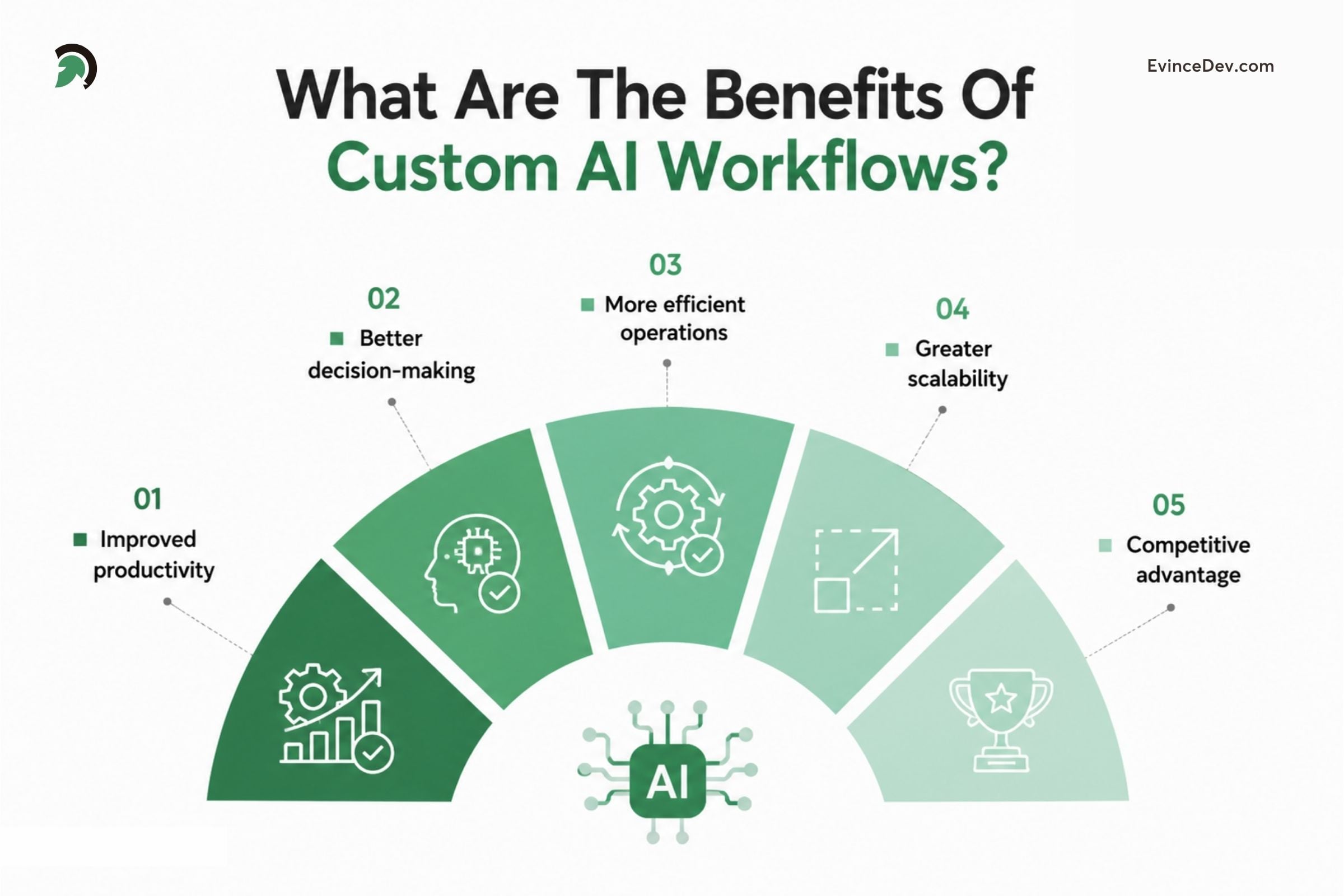
Key benefits of custom AI workflows, including improved productivity, smarter decision-making, operational efficiency, scalability, and competitive advantage.
Businesses investing in Custom AI Workflows gain several advantages.
Improved productivity
AI can automate repetitive activities and allow teams to focus on strategic work.
Better decision-making
AI workflows can analyze large amounts of information and provide actionable insights faster.
More efficient operations
Connected workflows reduce manual processes and eliminate unnecessary delays.
Greater scalability
Custom AI solutions can evolve as business requirements change.
Competitive advantage
Businesses using AI strategically can improve customer experiences and operate more efficiently.
Are Off-the-Shelf AI Tools Enough for Businesses?
Off-the-shelf AI tools have made artificial intelligence more accessible and can be a practical starting point for businesses exploring common use cases.
However, these tools often come with limitations, such as:
- Limited flexibility and customization
- Restricted integration options
- Less control over business data
- Difficulty supporting complex workflows
- Dependence on vendor features and pricing
For straightforward tasks, ready-made tools may be sufficient. However, as operational needs become more complex, businesses may require AI workflows designed around their own systems, data, security requirements, and processes.
This is why many organizations move from standalone AI tools to enterprise AI workflows that offer greater control, deeper integration, and better long-term scalability.
What Should Businesses Consider Before Building AI Workflows?
Before investing in custom AI workflows, businesses should evaluate:
- Business objectives: Identify the specific problem the AI workflow should solve and the measurable outcome it should support.
- Data readiness: Ensure the required data is accurate, organized, accessible, and suitable for AI use.
- Technology infrastructure: Confirm that existing systems can support AI integration, automation, security, and future scalability.
- Integration requirements: Determine which platforms, applications, databases, and APIs the workflow must connect with.
- Security and governance: Define how data access, privacy, monitoring, human oversight, and compliance-related controls will be managed.
- Long-term strategy: Consider how the workflow may expand as business needs, user numbers, data volumes, and AI capabilities evolve.
Working with AI consulting services experts can help businesses identify suitable use cases, assess readiness, and create a practical implementation roadmap.
Expert Perspective:
The right AI model matters, but it should not be the starting point. Businesses should first map the workflow, identify bottlenecks, and define the outcome they want AI to improve.
– Hiren Daraji, Department Head – Microsoft, EvinceDev
Common Mistakes to Avoid When Building AI Workflows
Businesses should avoid these common mistakes:
- Starting without a clearly defined business problem
- Automating an inefficient process without improving it first
- Using poor-quality or inaccessible data
- Ignoring system integration requirements
- Overlooking security, governance, and human oversight
- Building a large solution before testing a smaller use case
- Failing to define clear success metrics
Avoiding these issues can help businesses create AI workflows that are more practical, secure, and scalable.
How Do Custom AI Workflows Improve Productivity?
Custom AI workflows improve productivity by automating repetitive tasks, reducing manual effort, and helping teams complete work more efficiently.
For example, AI workflows can:
- Analyze customer interactions
- Generate reports automatically
- Identify patterns and business trends
- Process documents and extract key information
- Recommend appropriate next steps
- Route tasks to the right teams
By handling time-consuming operational work, AI allows employees to focus on strategic decisions, customer needs, and other higher-value activities.
When integrated effectively, custom AI workflows can create faster, more accurate, and more consistent business operations.
Also Read: AI Copilot vs AI Agent: Key Differences, Use Cases, and When to Use EachWhat Is the Difference Between Custom AI and Ready-Made AI Tools?
The biggest difference is flexibility.
Ready-made AI tools provide general functionality for multiple users and industries.
Custom AI Workflows are created specifically for a company’s processes, data, and objectives.
| Factor | Build a Custom AI Workflow | Buy a Ready-Made AI Tool |
| Business need | Unique or complex processes | Standard or common use cases |
| Deployment time | Longer | Faster |
| Initial cost | Usually higher | Usually lower |
| Customisation | Extensive | Limited |
| Integration | Built around existing systems | Depends on available connectors |
| Data control | Greater control | Vendor-dependent |
| Scalability | Designed for long-term needs | Limited by product capabilities |
| Maintenance | Managed internally or by a development partner | Primarily vendor-managed |
Businesses that require deeper automation and system connectivity usually benefit more from custom solutions.
How Does EvinceDev Help Businesses Build Custom AI Workflows?
Successful AI initiatives require more than technical expertise. They also depend on a clear understanding of business processes, data, integration needs, security requirements, and long-term goals.
EvinceDev is a custom AI development company that helps businesses turn AI ideas into practical, scalable solutions aligned with their processes, systems, and long-term goals.
Our capabilities include:
- AI strategy consulting
- AI workflow development
- AI workflow integration
- AI development solutions
- AI workflow automation
- Enterprise AI solutions
- AI-powered application development
Our team assesses the business problem, identifies suitable AI opportunities, and designs workflows that connect with existing systems and support measurable outcomes.
As an experienced AI solutions development company, EvinceDev focuses on building AI technologies that simplify operations, improve decision-making, and solve real business challenges.
Conclusion
AI is changing how businesses automate processes, make decisions, and deliver value. However, successful implementation depends on choosing an approach that aligns with the organization’s goals, operational complexity, data, systems, and long-term strategy.
Ready-made AI tools can support simple use cases and faster deployment, while custom AI workflows are better suited to businesses that require deeper integration, greater control, tailored automation, and future scalability.
With a well-defined AI strategy, businesses can improve productivity, streamline operations, and enable faster, more informed decision-making.