Key Takeaways
- AI Starts With a Real Problem: The best AI use cases are not about using the latest tool, but about solving a clear business challenge.
- Every Industry Has AI Opportunities: From healthcare and finance to ecommerce, logistics, and education, AI can improve speed, accuracy, and customer experience.
- Business Value Matters Most: AI should help reduce manual work, improve decisions, lower risk, increase revenue, or make operations easier to scale.
- Data Readiness Is Critical: Even the smartest AI solution needs clean, relevant, and well-organized data to deliver reliable results.
Artificial intelligence is no longer limited to experimental projects or large technology companies. Today, businesses across healthcare, finance, ecommerce, manufacturing, logistics, education, insurance, and many other industries are using AI to solve practical business problems.
But the real question is not just, “Can we use AI?”
The better question is, “Where can AI create measurable value for our business?”
That is where AI use cases become important. AI use cases show how artificial intelligence can be applied to a specific process, problem, department, or customer experience. For example, a bank may use AI to detect fraud, an ecommerce store may use AI to recommend products, a hospital may use AI to support diagnosis, and a logistics company may use AI to optimize delivery routes.
This guide explores major AI use cases across industries and business functions. It also covers generative AI use cases, agentic AI use cases, enterprise AI use cases, AI automation use cases, implementation challenges, and how businesses can choose the best AI use case for their goals.
Quick Stat:
McKinsey’s 2025 State of AI survey found that 88% of respondents say their organizations regularly use AI in at least one business function, up from 78% the previous year
What Are AI Use Cases?
AI use cases are practical ways businesses use artificial intelligence to solve specific problems, automate tasks, improve decisions, or create better customer experiences.
In simple terms, an AI use case is a real-world example of AI being used to do something useful.
For example:
| Business Area | AI Use Case Example |
| Banking | Detecting suspicious transactions |
| Ecommerce | Recommending products to shoppers |
| Healthcare | Supporting medical image analysis |
| Logistics | Optimizing delivery routes |
| Customer Support | Answering common questions through chatbots |
| Finance | Automating invoice processing |
A good AI use case usually answers three simple questions:
- What problem are we solving?
- How can AI help solve it?
- What business result do we expect?
AI should not be adopted only because it is trending. It should be used where it can improve speed, reduce cost, increase accuracy, support better decisions, improve customer experience, or help a business scale.
Quick Stat:
Stanford’s 2025 AI Index reported that 78% of organizations used AI in 2024, up from 55% the year before. This growth shows why businesses are paying closer attention to practical AI use cases.
Why AI Use Cases Matter for Businesses
AI becomes valuable when it is connected to real business outcomes. That is why AI use cases in business are important. They help companies move from general interest in AI to practical implementation.
Quick Stat:
While AI adoption is growing fast, McKinsey found that nearly two-thirds of organizations have not yet started scaling AI across the enterprise. This shows why choosing the right AI use cases and implementation approach matters.
1. Improved Productivity
AI can automate repetitive tasks and reduce manual effort. This helps teams complete work faster and focus on higher-value activities.
For example, a support team can use AI to classify tickets and suggest responses, while a finance team can use AI to process invoices more efficiently.
2. Better Customer Experience
AI can improve customer journeys through chatbots, smart search, product recommendations, personalized offers, and faster support.
This helps businesses respond faster, serve customers better, and create more relevant experiences.
3. Lower Operational Costs
AI can reduce the time spent on manual and repetitive work. When processes become faster and more efficient, businesses can lower operational costs without affecting service quality.
4. Smarter Decision-Making
AI has the ability to analyze huge volumes of data, make connections, spot risks, and discover opportunities which would otherwise be hard to locate.
For instance, a retail firm may use AI to predict demand, on the other hand, the management team uses AI dashboards to learn about their performance quicker.
5. Stronger Risk Detection
AI can be used to identify potential issues including fraud, anomalies, suspicious activities, cyber threats, and compliance before they turn into major issues.
This technology is particularly helpful for sectors such as banking, insurance, e-commerce, healthcare, and finance.
6. Better Scalability
AI helps businesses manage larger workloads without increasing manual effort at the same pace.
This makes AI useful for growing companies that want to improve speed, service quality, and operational efficiency as they scale.
Also Read: AI Consulting Services: Strategy & Implementation Guide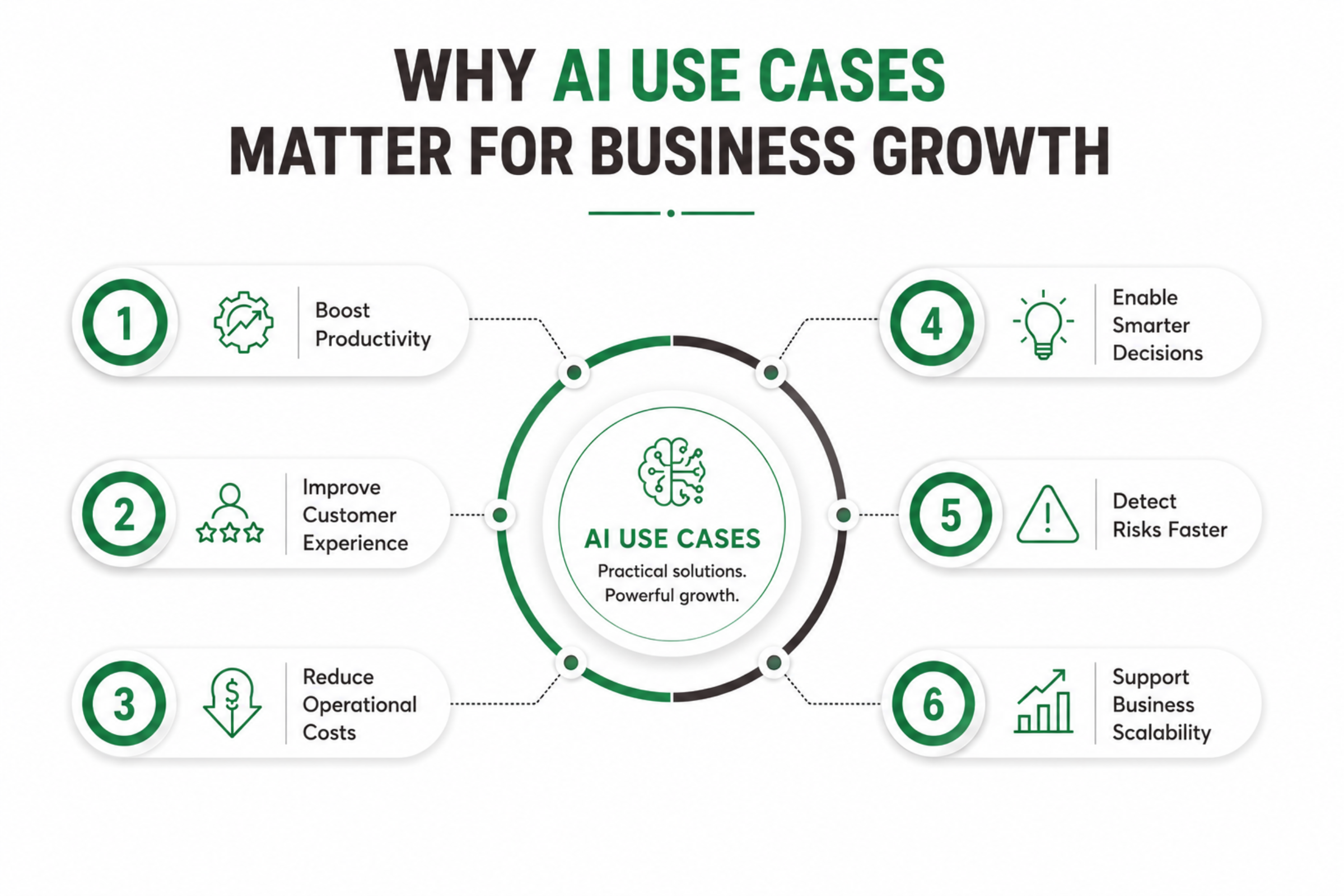
Why AI Use Cases Are Becoming Essential for Growth
Common Types of AI Use Cases
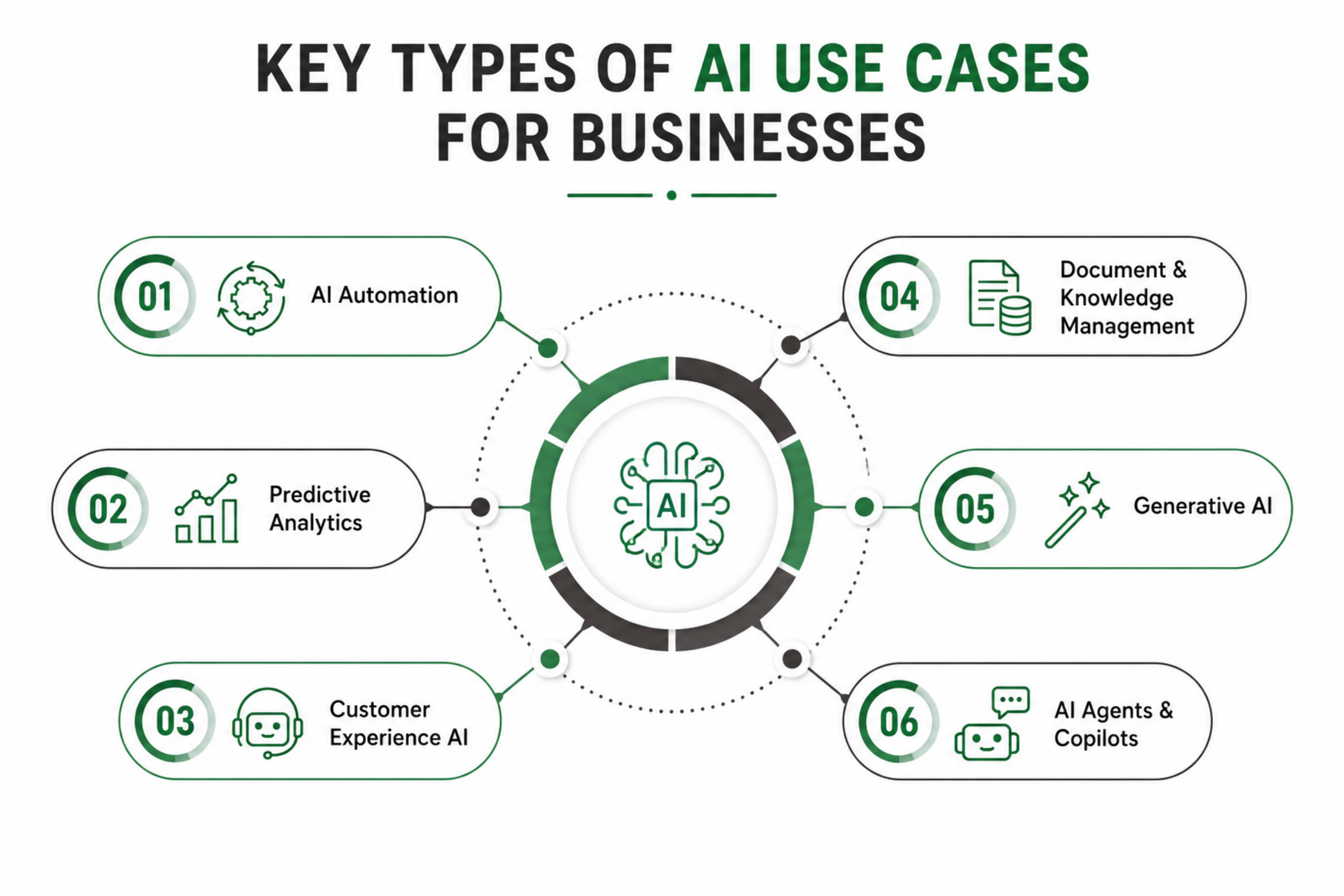
AI can be applied in many ways, but most business use cases fall into a few major categories.
1. AI Automation Use Cases
AI automation use cases focus on reducing repetitive manual work. These are often good starting points because they solve clear problems and can show measurable time savings.
Common examples include:
- Invoice processing
- Data entry automation
- Ticket routing
- Document classification
- Report generation
- Approval workflows
- Email response suggestions
- Claims processing
For example, an insurance company can use AI to extract information from claim documents, while a finance team can use AI to match invoices with purchase orders.
2. Predictive Analytics Use Cases
Predictive analytics helps businesses forecast what may happen next. It uses historical data and patterns to support better planning.
Common examples include:
- Demand forecasting
- Sales forecasting
- Customer churn prediction
- Fraud risk prediction
- Equipment failure prediction
- Delivery delay prediction
- Inventory planning
For example, a manufacturer can predict when equipment may need maintenance, while an ecommerce business can forecast which products may be in high demand during a seasonal sale.
3. Customer Experience Use Cases
AI can improve how customers interact with a business by making experiences faster, more personalized, and more convenient.
Common examples include:
- AI chatbots
- Voice assistants
- Product recommendations
- AI-powered search
- Sentiment analysis
- Personalized offers
- Automated support responses
In ecommerce, AI can recommend relevant products. In banking, AI can answer common service questions. In travel, AI can suggest personalized packages.
4. Document and Knowledge Management Use Cases
Many enterprise AI use cases involve documents, data, and internal knowledge. Businesses often deal with contracts, invoices, policies, PDFs, reports, manuals, claims, and customer records.
AI can help with:
- Document summarization
- Data extraction from PDFs and forms
- Contract review
- Internal knowledge search
- Policy Q&A assistants
- Compliance review
- Report generation
- Translation
This is valuable because employees often spend too much time searching, reading, reviewing, and processing information manually.
5. Generative AI Use Cases
Generative AI use cases involve creating new content, summaries, code, reports, responses, or ideas using AI.
Common examples include:
- Email drafting
- Blog and ad copy creation
- Product description generation
- Report writing
- Proposal creation
- Meeting summaries
- Code assistance
- Training material creation
Generative AI is useful for marketing, sales, customer support, HR, software development, and internal operations. However, human review is important, especially for legal, healthcare, finance, or customer-facing content.
6. AI Agent and Copilot Use Cases
AI copilots assist users by suggesting, summarizing, drafting, or guiding. AI agents can go further by completing multi-step tasks across systems.
Common AI agent use cases include:
- Customer support agents
- HR self-service agents
- IT helpdesk agents
- Sales assistants
- Finance workflow agents
- Procurement agents
- Internal knowledge agents
Agentic AI use cases are useful when a workflow requires multiple steps. For example, an AI support agent may understand a customer query, check order status, review return rules, generate a response, and create a support ticket if needed.
AI Use Cases for Businesses: From Automation to Insights
Expert Note:
“We’re making this analogy that AI is the new electricity. Electricity transformed industries: agriculture, transportation, communication, and manufacturing. I think we are now in that phase where AI technology has advanced to the point where we see a clear path for it to transform multiple industries.”
- Andrew Ng, AI pioneer, co-founder of Google Brain and Coursera, and founder of DeepLearning.AI
AI Use Cases by Business Outcome
Another useful way to understand AI is by business outcome. This helps companies choose AI based on goals rather than trends.
| Business Outcome | Relevant AI Use Cases |
| Improve customer experience | Chatbots, AI search, personalization, recommendations |
| Increase operational efficiency | Workflow automation, document processing, resource planning |
| Reduce risk | Fraud detection, compliance monitoring, cybersecurity alerts |
| Increase revenue | Lead scoring, dynamic pricing, product recommendations |
| Improve decisions | Predictive dashboards, business intelligence, scenario analysis |
| Support creativity | Content generation, design ideas, proposal writing |
| Modernize legacy systems | Natural language search, automated reporting, data extraction |
This outcome-based view makes it easier to identify the best AI use case for a specific business need.
Technologies Behind AI Use Cases
Different AI use cases need different technologies. Businesses do not need to understand every technical detail, but knowing the basics helps them make better decisions.
| AI Technology | Common Use Cases |
| Machine Learning | Recommendations, fraud detection, churn prediction, forecasting |
| Natural Language Processing | Chatbots, sentiment analysis, document understanding, translation |
| Generative AI | Content creation, report generation, email drafting, code assistance |
| Retrieval-Augmented Generation | Internal knowledge assistants, customer support bots, policy Q&A tools, document search |
| Computer Vision | Medical imaging, quality inspection, visual search, defect detection |
| Predictive Analytics | Demand forecasting, sales forecasting, maintenance prediction |
| Agentic AI | Multi-step workflow automation, support agents, finance agents |
| Multimodal AI | Text, image, video, audio, and document understanding |
| AI-Powered RPA | Back-office automation, data entry, document routing |
Retrieval-Augmented Generation, or RAG, helps AI generate answers using a company’s own data, documents, knowledge bases, policies, product information, or internal resources. This makes it useful for enterprise AI use cases where businesses want AI answers to be more accurate, relevant, and connected to their real operations.
For example, a company can use RAG to build an internal AI assistant that answers employee questions using SOPs, HR policies, training material, project documents, or technical guides.
This simple technology view is helpful in understanding what kind of AI solution may be needed for a specific use case.
AI Use Cases Across Industries
AI is being used across many industries. Each industry has different challenges, but the goal is usually similar: improve speed, reduce manual work, increase accuracy, personalize experiences, and make better decisions.
Quick Stat:
McKinsey’s 2025 survey found that 62% of organizations are at least experimenting with AI agents, and 23% are already scaling agentic AI systems in some part of the business
AI Use Cases in Healthcare
Healthcare organizations deal with large patient data, heavy documentation, staff shortages, administrative workload, diagnosis pressure, and the need for faster patient support.
Key AI use cases in healthcare include:
- Medical image analysis
- Patient support chatbots
- Appointment scheduling
- Clinical documentation automation
- Remote patient monitoring
- Predictive health insights
- Drug discovery support
- Billing and claims support
AI can assist doctors by highlighting possible abnormalities in X-rays, MRIs, or CT scans. It can help patients schedule appointments through chatbots. It can also summarize clinical notes and reduce documentation workload for healthcare teams.
Business value: Faster patient support, reduced administrative burden, improved care delivery, and better operational efficiency.
AI Use Cases in Banking and Finance
Banking and finance are among the strongest industries for AI because they involve large transaction volumes, fraud risks, compliance requirements, customer support needs, and complex decision-making.
Key AI use cases include:
- Fraud detection
- Credit scoring
- Risk assessment
- Loan processing automation
- Compliance monitoring
- AI customer support
- Personalized financial recommendations
- Investment research summaries
For example, AI can monitor transactions in real time and flag unusual activity. It can also help lenders assess credit risk more efficiently and support customers through AI chatbots.
Also Read: AI in Financial ServicesBusiness value: Stronger fraud prevention, faster approvals, better compliance, improved customer service, and smarter risk management.
Real-World Project Reference:
In one AI-driven fintech project for Bankuity, EvinceDev helped build a banking verification and lending platform that used transaction data, income analysis, spending patterns, and repayment behavior to support better borrower risk assessment. The solution helped lenders move beyond static credit checks and gain clearer visibility into income stability, underwriting decisions, and post-disbursal risk monitoring
AI Use Cases in Retail and Ecommerce
Retail and ecommerce businesses need to improve product discovery, personalization, conversions, inventory planning, pricing, and customer support.
Key AI use cases include:
- Product recommendations
- Personalized shopping experiences
- AI-powered site search
- Inventory forecasting
- Dynamic pricing
- Cart abandonment prediction
- Visual search
- Customer support chatbots
For example, an ecommerce store can recommend products based on browsing behavior, purchase history, and customer preferences. AI can also predict which products may go out of stock and which customers may abandon carts.
Business value: Higher conversions, increased average order value, better inventory control, improved customer experience, and reduced support workload.
AI Use Cases in Manufacturing
Manufacturing companies need to reduce downtime, maintain quality, improve production planning, control costs, and protect worker safety.
Key AI use cases include:
- Predictive maintenance
- Quality inspection
- Defect detection
- Production planning
- Worker safety monitoring
- Supply chain optimization
- Digital twins
- Energy optimization
AI can analyze machine data and predict when equipment may fail. Computer vision can inspect products and detect defects in real time. AI-powered planning tools can optimize production schedules based on demand and resource availability.
Business value: Reduced downtime, better product quality, lower maintenance costs, safer operations, and improved production efficiency.
AI Use Cases in Logistics and Supply Chain
Logistics and supply chain businesses deal with delivery delays, rising costs, warehouse complexity, inventory issues, supplier risks, and changing demand.
Key AI use cases include:
- Route optimization
- Demand forecasting
- Warehouse automation
- Shipment tracking
- Delivery delay prediction
- Inventory planning
- Procurement intelligence
- Supplier risk analysis
AI can suggest faster delivery routes based on traffic, distance, weather, and delivery priorities. It can also help predict demand so businesses can plan inventory and transportation more accurately.
Business value: Lower logistics costs, faster deliveries, better inventory control, improved planning, and higher customer satisfaction.
AI Use Cases in Insurance
Insurance companies manage claims, policies, underwriting, fraud risks, customer support, renewals, and large volumes of documents.
Key AI use cases include:
- Claims processing
- Fraud detection
- Risk assessment
- Document automation
- Policy recommendations
- Customer support chatbots
- Underwriting support
- Renewal prediction
AI can extract information from claim forms and supporting documents, flag suspicious claims for review, and help customers check claim status or understand policy details.
Business value: Faster claims handling, reduced fraud risk, better underwriting, improved customer experience, and lower manual workload.
AI Use Cases in Education
Education institutions and edtech platforms need to personalize learning, support teachers, improve student engagement, and track performance.
Key AI use cases include:
- Personalized learning
- AI tutors
- Automated grading
- Student performance prediction
- Learning analytics
- Content generation
- Student support chatbots
- Administrative automation
AI can recommend learning paths based on a student’s progress, help teachers create quizzes, and identify students who may need additional support.
Business value: Better learning outcomes, reduced teacher workload, personalized learning, and improved student engagement.
AI Use Cases in Marketing and Sales
Marketing and sales teams need better targeting, stronger personalization, improved lead quality, faster follow-ups, and clearer campaign insights.
Key AI use cases include:
- Lead scoring
- Customer segmentation
- Email personalization
- Campaign optimization
- Content generation
- Sales forecasting
- CRM insights
- Proposal generation
- Next-best-action recommendations
AI can rank leads based on conversion potential, personalize campaigns, and help sales teams understand which deals need attention.
Business value: Better targeting, more qualified leads, higher conversions, improved customer engagement, and faster sales cycles.
AI Use Cases in Human Resources
HR teams manage hiring, onboarding, training, employee engagement, workforce planning, and internal support.
Key AI use cases include:
- Resume screening
- Job description generation
- Employee onboarding
- HR chatbots
- Training recommendations
- Employee sentiment analysis
- Workforce planning
- Policy Q&A assistants
AI can help shortlist candidates, answer employee questions, and recommend training programs. Human review is important in HR to reduce bias and support fair decisions.
Business value: Faster hiring, better employee support, reduced HR workload, and smarter workforce planning.
AI Use Cases in Finance and Accounting
Finance and accounting teams need accuracy, speed, compliance, forecasting, and better visibility into financial performance.
Key AI use cases include:
- Invoice processing
- Expense classification
- Bookkeeping automation
- Cash flow forecasting
- Financial reporting
- Audit support
- Budget planning
- Compliance checks
AI can extract invoice details, match them with purchase orders, route them for approval, and forecast cash flow based on payment cycles and expenses.
Business value: Faster processing, fewer manual errors, better financial visibility, and stronger financial control.
AI Use Cases in IT and Cybersecurity
IT and cybersecurity teams deal with system performance, user support, security threats, alerts, incidents, and infrastructure complexity.
Key AI use cases include:
- Threat detection
- Anomaly detection
- IT helpdesk automation
- AIOps
- Log analysis
- Incident summarization
- Auto-remediation
- Access risk detection
AI can detect unusual login behavior, summarize incident reports, monitor system performance, and help employees resolve common IT issues.
Business value: Stronger security, faster incident response, reduced downtime, and lower IT workload.
AI Use Cases in Other Industries
AI is also creating value in many other industries.
| Industry | Common AI Use Cases |
| Real Estate | Property recommendations, price estimation, lead qualification, market analysis |
| Travel and Hospitality | Booking assistants, dynamic pricing, travel recommendations, review analysis |
| Telecommunications | Network optimization, outage prediction, churn prediction, support automation |
| Energy and Utilities | Smart grid optimization, demand forecasting, predictive maintenance |
| Government and Public Sector | AI in public governance supports citizen chatbots, document processing, fraud detection, permit approvals, public-service automation, and data-driven policy decisions. |
| Automotive | Driver assistance, fleet management, predictive maintenance, vehicle diagnostics |
| Media and Entertainment | AI’s impact on the entertainment industry includes personalized content recommendations, audience insights, automated subtitles, AI-generated media, and faster content production. |
| Agriculture | Crop disease detection, yield prediction, soil analysis, and irrigation optimization |
| Sports | Player performance analysis, injury prediction, training optimization, fan engagement, match strategy analysis, talent scouting |
AI Use Cases by Business Function
Apart from industry-wise use cases, businesses can also look at AI by department. This is helpful for companies that want to improve a specific business function first.
| Business Function | AI Use Cases |
| Customer Support | Chatbots, ticket routing, sentiment analysis, agent assist |
| Sales | Lead scoring, CRM automation, proposal generation, deal risk prediction |
| Marketing | Content creation, segmentation, email personalization, ad optimization |
| Operations | Workflow automation, demand planning, quality monitoring |
| Finance | Invoice processing, forecasting, audit support, fraud detection |
| HR | Resume screening, onboarding, HR chatbots, training recommendations |
| IT | Helpdesk automation, system monitoring, AIOps, incident response |
| Legal and Compliance | Contract review, policy monitoring, compliance checks |
| Procurement | Supplier analysis, purchase order automation, vendor risk detection |
| Leadership | Executive summaries, dashboards, scenario analysis, risk insights |
This function-based view makes it easier for a business to identify where AI can create value internally before expanding into larger enterprise AI use cases.
High-Impact AI Use Cases Businesses Can Start With
Not every business needs to begin with a complex AI system. In many cases, the best AI use case is simple, practical, and easy to measure.
Some high-impact starting points include:
- AI chatbot for customer support: Useful for businesses with high query volume.
- AI document processing: Useful for invoices, forms, claims, contracts, and reports.
- Internal knowledge assistant: Useful for teams with large SOPs, policies, manuals, or technical documents.
- Product recommendation engine: Useful for ecommerce, retail, media, and subscription platforms.
- Predictive analytics dashboard: Useful for forecasting sales, demand, churn, or risks.
- Invoice automation: Useful for finance and accounting teams.
- Fraud detection system: Useful for banking, fintech, ecommerce, and insurance.
- Customer segmentation: Useful for marketing and sales teams.
- Workflow automation: Useful for repetitive approvals, routing, and reporting.
- AI copilot for internal teams: Useful for summarizing, drafting, searching, and reporting.
A good starting point usually has four qualities: the problem is clear, the data is available, the task is repeated often, and the result can be measured.
How to Choose the Right AI Use Case for Your Business
Choosing the right AI use case is more important than choosing the most advanced AI tool.
AI consulting services can help businesses identify the right AI use case by assessing business goals, data readiness, implementation complexity, risks, and expected ROI.
A useful way to evaluate AI ideas is to score them across a few practical factors.
| Evaluation Factor | What to Ask |
| Business problem | Does this solve a real and clear problem? |
| Business impact | Will it save time, reduce cost, increase revenue, or improve experience? |
| Data availability | Do we have enough relevant data? |
| Data quality | Is the data accurate, clean, and usable? |
| Complexity | How difficult will it be to build and maintain? |
| Integration | Does it need to connect with CRM, ERP, ecommerce, apps, or databases? |
| Risk | Does it involve sensitive decisions or regulated data? |
| Time to value | Can we test it quickly with a pilot? |
| Scalability | Can it grow with the business? |
| Human review | Does it need manual approval or oversight? |
The right AI use case should be valuable, feasible, measurable, secure, and scalable.
Expert View:
The best AI use case is not always the most advanced one. In real projects, the strongest starting point is usually a repetitive, data-rich workflow where success can be measured clearly through time saved, cost reduced, errors avoided, or conversions improved.
- Swapnil Sawant, Senior Software Engineer, EvinceDev
AI Use Case Implementation Roadmap
A structured roadmap helps businesses move from AI idea to working solution.
Step 1: Identify the Business Problem
Start with a clear challenge, such as slow support response time, manual invoice processing, weak product recommendations, fraud risk, customer churn, or poor internal knowledge search.
Step 2: Map the Current Workflow
Understand who is involved, which tools are used, where the data comes from, where delays happen, and which steps can be improved.
Step 3: Review Data Readiness
Check whether the required data is available, clean, structured, accurate, and secure.
Step 4: Choose the Right AI Approach
Different use cases need different AI approaches. Chatbots may need NLP and generative AI. Recommendations may need machine learning. Quality inspection may need computer vision. Forecasting may need predictive analytics. Multi-step workflows may need agentic AI.
Step 5: Build a Proof of Concept
Start small before investing in a full solution. A proof of concept helps test feasibility, accuracy, user adoption, and business value.
Step 6: Integrate With Existing Systems
Connect the AI solution with platforms such as CRM, ERP, ecommerce systems, websites, mobile apps, databases, support tools, and dashboards.
Step 7: Add Security and Governance
Include access control, encryption, audit logs, human review workflows, compliance checks, and monitoring.
Step 8: Launch, Measure, and Improve
Track accuracy, performance, adoption, cost savings, business impact, and user feedback. AI systems need ongoing improvement as data and business needs change.
Expert Perspective:
AI implementation should not start with model selection. It should start with process mapping, data readiness, integration needs, and risk review. A technically strong AI model can still fail if it does not fit the actual business workflow.
- Swapnil Sawant, Senior Software Engineer, EvinceDev
Challenges of Implementing AI Use Cases
AI can create strong business value, but businesses need to plan implementation carefully. Common challenges include:
- Poor data quality: AI needs clean, accurate, and organized data to deliver reliable results.
- Unclear goals: Businesses should define what they want to improve before starting, such as speed, accuracy, cost, conversions, or customer experience.
- Integration complexity: AI solutions often need to connect with CRMs, ERPs, ecommerce platforms, databases, apps, or internal tools.
- Privacy and security risks: AI may work with sensitive customer, financial, healthcare, or employee data, so strong data protection is important.
- Bias and fairness issues: AI outputs can be biased if the data or rules are biased, especially in hiring, lending, insurance, and healthcare.
- Lack of explainability: Some AI systems may give results without clearly showing how they reached them.
- Employee adoption: Teams may resist AI if they do not understand how it supports their work.
- Ongoing maintenance: AI systems need regular monitoring, testing, updates, and improvement as data and business needs change.
Responsible AI and Governance
Responsible AI means using artificial intelligence in a way that is safe, fair, secure, transparent, and accountable.
This is especially important for healthcare, finance, insurance, HR, government, legal, and enterprise use cases.
A responsible AI approach should include:
- Data privacy and security
- Access control
- Bias testing
- Explainability
- Human review
- Compliance alignment
- Audit logs
- Model monitoring
- Clear AI usage policies
Responsible AI is not only about avoiding risk. It helps businesses build trust, improve adoption, and use AI safely at scale.
Quick Stat:
IBM’s 2025 Cost of a Data Breach Report found that 63% of organizations lacked AI governance policies, while extensive use of AI in security was linked with $1.9 million in cost savings compared with organizations that did not use these solutions
Emerging AI Use Cases Businesses Should Watch
AI is evolving quickly. It is moving beyond basic automation and becoming more capable of supporting complex workflows, real-time decisions, and physical-world operations.
Here are some emerging AI use cases businesses should watch closely.
“As we build out the next phase of the agentic web, we have a tremendous opportunity to transform every role, business process, and industry.”
1. AI Copilots
AI copilots help employees complete everyday tasks faster. They assist with writing, research, coding, reporting, customer support, data analysis, and decision-making.
Common examples:
- Drafting emails and reports
- Summarizing meetings or documents
- Supporting developers with code suggestions
- Helping sales teams prepare follow-ups
- Assisting managers with business insights
Why it matters:
AI copilots improve team productivity without fully replacing human decision-making.
2. AI Agents
AI agents can complete multi-step tasks across systems and workflows. Unlike basic chatbots, they can take actions, update records, create tickets, check information, and trigger workflows.
Common examples:
- Customer support agents
- HR self-service agents
- IT helpdesk agents
- Finance workflow agents
- Procurement agents
- Sales assistants
Why it matters:
AI agents can reduce manual handoffs and help teams complete repetitive workflows faster.
3. Multimodal AI
Multimodal AI can understand multiple types of information together, such as text, images, audio, video, and documents.
Common examples:
- Customer support using text and screenshots
- Healthcare analysis using images and patient notes
- Product search using images and descriptions
- Video analysis for training or safety
- Document review with images, forms, and text
Why it matters:
Multimodal AI makes AI systems more useful in real business situations where information comes in different formats.
4. Physical AI and Smart Automation
Physical AI brings artificial intelligence into real-world environments through robots, drones, sensors, smart devices, connected machines, and automated systems.
Common examples:
- Warehouse robots for picking and sorting
- Inspection drones for assets and infrastructure
- Smart sensors for machine monitoring
- AI-powered quality inspection
- Automated checkout in retail stores
- Shelf monitoring and inventory tracking
- Autonomous logistics and delivery systems
- Patient monitoring devices
Why it matters:
Physical AI connects digital intelligence with real-world operations, helping businesses improve speed, safety, accuracy, and productivity.
5. Legacy Modernization
Many businesses still use older systems that are difficult to search, update, or connect with modern tools. AI can help improve these systems without replacing everything immediately.
Common examples:
- Natural language search in old systems
- Automated reporting
- Data extraction from legacy documents
- AI assistants for internal tools
- Workflow automation across older platforms
Why it matters:
AI helps businesses get more value from existing systems while reducing manual work.
6. Digital Twins
Digital twins are virtual models of physical systems, machines, products, factories, supply chains, or infrastructure. AI can use these models to simulate performance and predict issues.
Common examples:
- Factory performance simulation
- Predictive maintenance planning
- Supply chain modeling
- Smart city planning
- Energy asset monitoring
- Vehicle performance testing
Why it matters:
Digital twins help businesses test, plan, and optimize operations before making real-world changes.
7. AI-Generated Media
AI-generated media helps businesses create creative assets faster, including images, videos, scripts, subtitles, product visuals, and ad creatives.
Common examples:
- Product images and lifestyle visuals
- Video scripts and subtitles
- Social media creatives
- Ad copy and campaign visuals
- Training videos
- Educational content
Why it matters:
AI-generated media can speed up content production, but human review is still important for quality, originality, and brand accuracy.
8. Cybersecurity Auto-Remediation
Cybersecurity auto-remediation uses AI to detect threats and support faster response actions. Instead of only sending alerts, AI can help prioritize incidents, summarize issues, and suggest next steps.
Common examples:
- Threat detection
- Alert prioritization
- Incident summaries
- Suspicious login detection
- Automated response suggestions
- Predefined remediation actions
Why it matters:
AI helps IT and security teams respond faster, especially when they manage large systems or high alert volumes.
9. AI for Sustainability
AI can help businesses reduce waste, optimize energy usage, improve route planning, and monitor environmental impact.
Common examples:
- Energy usage optimization
- Route optimization to reduce fuel use
- Waste reduction in manufacturing
- Smart grid management
- Environmental monitoring
- Resource planning
Why it matters:
AI can support both operational efficiency and responsible growth, making it valuable for businesses focused on sustainability.
How EvinceDev Helps Businesses Turn AI Use Cases Into Real Solutions
Identifying AI use cases is only the first step. To create real business value, companies need the right strategy, data planning, software architecture, development team, integration approach, security controls, and long-term support.
EvinceDev helps businesses move from AI ideas to practical, secure, and scalable AI-powered solutions.
Through AI development services and AI software development services, EvinceDev can support businesses with AI consulting, use case discovery, Custom AI solution development, AI chatbot development, generative AI solutions, AI-powered web and mobile apps, AI integration with existing systems, predictive analytics dashboards, workflow automation, internal knowledge assistants, and industry-specific AI solutions.
This is especially useful when ready-made AI tools are not enough. A custom AI solution can be designed around a business’s specific workflows, data, customers, platforms, and long-term goals.
EvinceDev helps businesses choose the right AI use case, build the right solution, integrate it with existing systems, and improve it as the business grows.
Conclusion
Applications of AI demonstrate how AI technology is being used to help businesses overcome their practical challenges in various industries and departments. Be it healthcare, banking, retailing, manufacturing, logistics, insurance, education, marketing, human resource management, finance, information technology, real estate, travel, and media, AI is making businesses faster, more accurate, personalized, and efficient.sm
However, the success of AI does not depend on using the most advanced technology first. It depends on choosing the right use case.
The best AI use case is the one that solves a clear business problem, uses available data, creates measurable value, and can be implemented responsibly.
Businesses should start by identifying practical opportunities, reviewing data readiness, estimating ROI, testing with a pilot, and scaling gradually. They should also consider security, privacy, governance, human review, and long-term maintenance.
With the right strategy and the right technology partner, businesses can turn AI ideas into real-world AI use cases that create measurable business value.