
Key Takeaways
- AI Accelerates Development: AI tools help teams code, test, and launch software faster.
- Automation Improves Efficiency: AI reduces repetitive tasks across testing, deployment, monitoring, and workflows.
- Smarter Software Experiences: AI enables personalization, chatbots, recommendations, and predictive features.
- AI Supports Better Decisions: Businesses can use AI-driven insights to analyze data and forecast outcomes.
- Responsible AI Matters: Security, privacy, bias control, and compliance are essential for successful AI adoption.
- Future Is AI-Driven: Trends like generative AI, AIOps, and edge AI are shaping modern software development.
Software development is no longer just about writing code. It is about building faster, smarter, and more adaptive digital solutions that can respond to real business needs. This is where AI in software development is changing the game.
With AI-powered tools, businesses can automate repetitive tasks, improve code quality, speed up testing, personalize user experiences, and make better decisions using data. From intelligent chatbots and recommendation engines to AI coding assistants and predictive analytics platforms, AI is becoming a core part of modern software ecosystems.
What makes this shift even more important is its impact on both sides of development. Companies are using AI to build smarter applications, while development teams are using AI to improve how software is planned, created, tested, deployed, and maintained.
As competition grows and digital expectations rise, AI in software development is no longer just an emerging trend. It is becoming a strategic approach for businesses that want to innovate faster, reduce costs, and build future-ready solutions.
In this blog, we will explore the key benefits, real-world use cases, and emerging trends shaping AI software development.
Quick Stat:
McKinsey estimates that generative AI could add up to $4.4 trillion annually to the global economy, showing the massive business impact of AI adoption across industries.
What Is AI Software Development?
AI software development refers to the process of building software applications using artificial intelligence technologies or integrating AI capabilities into software systems. It combines traditional development methodologies with advanced technologies such as machine learning, natural language processing, predictive analytics, and intelligent automation.
In simple terms, AI software development enables software systems to analyze data, learn from user behavior, automate tasks, and make intelligent decisions with minimal human intervention.
There are two primary ways businesses approach AI-driven development:
- Developing AI-powered applications
- Using AI tools to improve software engineering workflows
Examples of AI-powered applications include:
- Virtual assistants
- Chatbots
- Recommendation engines
- Fraud detection systems
- Predictive analytics platforms
- Smart healthcare applications
Meanwhile, AI technologies are being employed for automating various stages such as code generation, testing, debugging, deployment, and monitoring of software applications. This change has greatly influenced AI in software engineering through efficiency improvements and decreased workload.
Core Technologies Behind AI Development
Several technologies power modern artificial intelligence software development:
Machine Learning (ML)
Machine learning allows software systems to learn from data patterns and improve performance over time without explicit programming.
Natural Language Processing (NLP)
NLP enables software to understand, interpret, and generate human language. It powers chatbots, voice assistants, and sentiment analysis tools.
Computer Vision
Computer vision helps machines analyze images and videos. It is widely used in healthcare imaging, surveillance systems, and autonomous vehicles.
Generative AI
Generative AI creates new content such as code, images, text, and designs. The rise of generative AI in software development has transformed coding workflows and accelerated software delivery.
Robotic Process Automation (RPA)
RPA automates repetitive tasks and business processes, improving operational efficiency.
Compared to traditional development, AI-driven systems are more adaptive, intelligent, and capable of handling dynamic user interactions. This is why businesses are rapidly investing in AI for software development to gain long-term competitive advantages.
Also Read: Custom Fintech Software vs Off-the-Shelf: Which to Choose?Benefits of AI Software Development
AI in software development helps businesses build smarter, faster, and more efficient applications. It improves development speed, software quality, automation, and user experience while reducing manual effort.
1. Faster Development
AI tools help developers generate code, automate repetitive tasks, and build prototypes faster, reducing overall development time.
2. Improved Code Quality
AI can detect bugs, security risks, performance issues, and code inconsistencies early, helping teams create more reliable software.
3. Intelligent Automation
AI automates testing, deployment, monitoring, documentation, and workflows, making the development process more efficient.
4. Better Data-Driven Decisions
AI analyzes large datasets to provide insights into user behavior, demand, risks, and performance, helping businesses make smarter decisions.
5. Enhanced Customer Experience
AI enables personalized recommendations, smart search, chatbots, voice assistants, and real-time support to improve user engagement.
6. Cost and Efficiency Benefits
By reducing manual work, downtime, and errors, AI helps businesses lower costs and improve team productivity.
7. Scalability and Learning
AI-powered systems continuously learn from data and user interactions, allowing applications to adapt, improve, and scale over time.
Popular Use Cases of AI Software Development
AI in software development is helping businesses build smarter products, automate workflows, and improve decision-making across industries. Here are the most common use cases.
1. AI Coding Assistants
AI coding assistants help developers write, review, and improve code faster.
Key applications:
- Code generation
- Auto-completion
- Bug detection
- Refactoring
- Documentation support
Examples: GitHub Copilot, Cursor AI, Tabnine, Amazon CodeWhisperer
Quick Stat:
GitHub Research found that developers using GitHub Copilot completed coding tasks 55% faster, highlighting how AI is accelerating modern software development workflows.
2. AI Chatbots and Virtual Assistants
AI chatbots automate customer conversations and improve response times.
Common uses:
- Customer support
- FAQ handling
- Appointment scheduling
- Lead generation
- Product recommendations
Used in: Healthcare, banking, retail, education, and travel
Quick Stat:
Klarna’s AI customer service agent handles two-thirds of all customer chats, performing work equivalent to 700 full-time agents, according to the company’s 2024 disclosure.
3. Predictive Analytics
Predictive analytics uses AI to analyze past data and forecast future outcomes.
Common applications:
- Sales forecasting
- Fraud detection
- Customer churn prediction
- Market trend analysis
- Inventory optimization
Quick Stat:
UPS’s ORION system uses predictive AI to optimize delivery routes in real time, saving approximately 100 million miles driven and $400 million annually, as per the BSR case study.
4. Healthcare Software
AI helps healthcare providers improve diagnosis, monitoring, and treatment planning.
Key use cases:
- Medical diagnosis
- Patient monitoring
- Medical imaging analysis
- Drug discovery
- Personalized treatment recommendations
5. Cybersecurity Solutions
AI improves security by detecting risks and responding to threats in real time.
AI can help with:
- Malware detection
- Suspicious activity monitoring
- Login behavior analysis
- Threat prediction
- Automated threat response
Quick Stat:
IBM’s Cost of a Data Breach Report 2024 found that organizations with AI security automation contained breaches 108 days faster and saved an average of $2.2 million per incident.
6. Recommendation Engines
AI recommendation systems personalize user experiences by analyzing behavior and preferences.
Used by: Netflix, YouTube, Amazon, and Spotify
Business benefits:
- Higher engagement
- Better retention
- Improved conversions
- Personalized user experience
7. Financial Technology
AI is widely used in fintech software development to improve security, automation, and decision-making.
Common applications:
- Fraud detection
- Credit scoring
- Automated trading
- Risk management
- AI-powered financial assistants
8. Business Process Automation
AI helps businesses automate repetitive operations and improve efficiency.
Common areas:
- HR management
- Invoice processing
- Customer onboarding
- Workflow automation
- Supply chain optimization
Businesses offering custom software development services are increasingly integrating AI into enterprise automation solutions.
Also Read: PCI DSS Compliance in Software Development: A Complete GuideKey Trends in AI Software Development
The future of AI in software development is being shaped by smarter tools, faster workflows, and more responsible AI adoption. Here are the key trends businesses should watch.
1. Rise of Generative AI
Generative AI is helping teams write code, create documentation, design interfaces, and debug applications faster. Tools like ChatGPT, Gemini, Claude, and GitHub Copilot are making development workflows more efficient while reducing repetitive effort.
2. AI-Augmented Developers
AI is becoming a developer assistant, not a replacement. It helps with code suggestions, testing, debugging, and documentation, while developers continue to manage architecture, logic, creativity, and final decision-making.
Quick Stat:
Gartner predicts that 75% of enterprise software engineers will use AI coding assistants by 2028, reflecting the rapid rise of AI-powered development tools.
3. Low-Code and No-Code AI Platforms
Low-code and no-code platforms are making AI-powered application development easier for businesses. These tools help teams build prototypes, automate workflows, and launch applications faster with less manual coding.
4. AIOps and Intelligent DevOps
AIOps uses AI to improve IT operations and DevOps processes. It helps detect incidents, monitor performance, identify root causes, and reduce downtime, making software systems more reliable and scalable.
5. Explainable AI
As AI adoption grows, businesses need systems that are transparent and easy to understand. Explainable AI helps organizations build trust, meet compliance requirements, and make AI-driven decisions more accountable.
6. Edge AI and IoT Integration
Edge AI processes data directly on devices rather than relying solely on cloud systems. This enables faster responses, lower latency, improved privacy, and better performance for IoT devices, smart systems, and real-time applications.
7. Responsible AI and Governance
Responsible AI focuses on data privacy, bias reduction, security, compliance, and ethical use. Businesses offering Custom Software Development Solutions are increasingly adopting AI governance practices to build reliable and trustworthy software products.
Challenges of AI Software Development
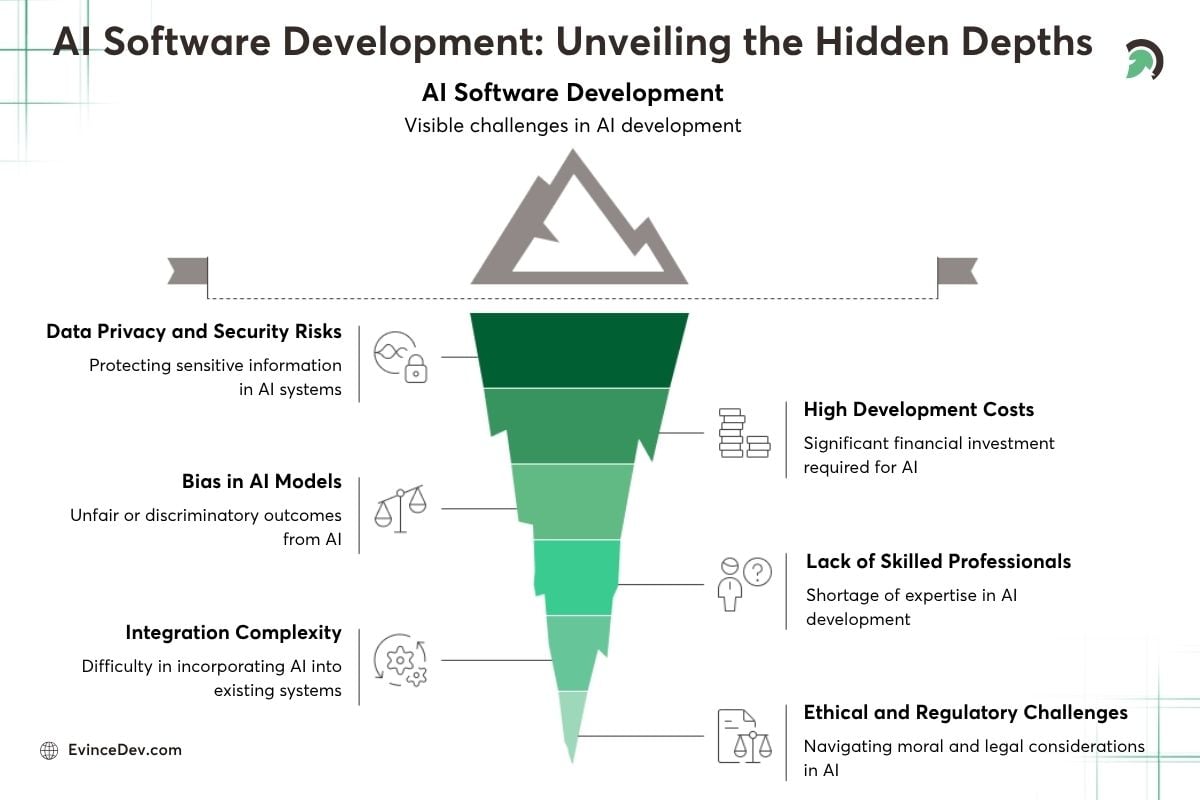
AI Software Development Challenges: Exploring the Hidden Complexities Behind AI Innovation
AI software development offers many benefits, but businesses must also manage key challenges to ensure secure, scalable, and responsible implementation.
1. Data Privacy and Security Risks
Challenge: AI systems require large amounts of data, which can increase privacy, cybersecurity, compliance, and unauthorized access risks.
Solution: Use strong data governance, encryption, access controls, and regular security audits.
2. High Development Costs
Challenge: AI-powered applications often need advanced infrastructure, skilled AI engineers, high computing power, and continuous model training.
Solution: Start with high-priority use cases, use scalable cloud platforms, and follow a phased development approach.
3. Bias in AI Models
Challenge: AI models can inherit bias from training data, leading to unfair outcomes, inaccurate predictions, or ethical concerns.
Solution: Audit models regularly, improve training datasets, and monitor outputs for fairness and accuracy.
4. Lack of Skilled Professionals
Challenge: Many businesses struggle to find experts in machine learning, data science, AI engineering, and advanced analytics.
Solution: Upskill internal teams, hire specialized talent, or work with experienced AI development partners.
5. Integration Complexity
Challenge: Integrating AI into legacy systems can create issues with data compatibility, scalability, infrastructure, and workflows.
Solution: Create a clear AI roadmap, modernize systems where needed, and implement AI in stages.
6. Ethical and Regulatory Challenges
Challenge: AI regulations are evolving, and businesses must ensure transparency, compliance, and responsible AI use.
Solution: Follow ethical AI practices, document AI decisions, and stay aligned with industry regulations.
The Future of AI Software Development
The future of AI software development is already taking shape in engineering teams and enterprise roadmaps worldwide. Several concrete developments will define the next three to five years.
Autonomous Coding Systems: AI agents that independently plan, write, and test code are moving from research to early production. Systems like Devin by Cognition AI can already resolve real GitHub issues without human intervention, handling narrow tasks today with broader ownership on the horizon.
AI-Driven Software Architecture: AI is beginning to assist beyond code, helping teams analyze requirements, suggest architectural patterns, and flag scalability risks before a line of code is written.
Self-Healing Applications: Rather than waiting for human intervention, these systems automatically detect anomalies, diagnose root causes, and apply fixes in real time. Platforms like Dynatrace and PagerDuty are already shipping early versions of this capability.
Hyper-Personalization: Future applications will adapt dynamically to individual user behavior in real time, going well beyond today’s recommendation engines toward interfaces that reorganize themselves based on how each user actually works.
Predictive Security and Optimization: AI will shift from reacting to incidents toward preventing them, forecasting performance bottlenecks, optimizing resource allocation automatically, and identifying security threats before breaches occur.
That said, human expertise remains central. Creative problem-solving, architectural judgment, and ethical decision-making will continue to require human developers. The most competitive teams will be those that combine both effectively.
Conclusion
AI in software development is reshaping how businesses design, build, and scale digital solutions. From intelligent automation and predictive analytics to AI-powered coding tools and personalized user experiences, AI is helping organizations improve productivity, reduce costs, and accelerate innovation.
As technologies like generative AI, AIOps, explainable AI, and edge computing continue to evolve, businesses that adopt AI strategically will be better prepared for the future. However, successful AI implementation requires the right planning, secure architecture, ethical practices, and expert development support.
This is where EvinceDev can help. As an AI solutions and custom software development company, EvinceDev delivers AI-enabled digital transformation, web and mobile applications, full-stack development, AI and IoT solutions, and scalable custom software built for real-world business needs. With expertise in AI solutions and custom software development, EvinceDev helps businesses build scalable, intelligent, and future-ready digital products.
By combining human expertise with AI-driven innovation, businesses can build smarter, more reliable, and future-ready digital solutions that support long-term growth.