
Key Takeaways
- Software outsourcing helps companies scale faster, cut costs, and access expert talent for high-quality digital solutions.
- Outsourcing boosts agility, accelerates delivery, and supports innovation through skilled global development teams.
- Businesses use outsourcing to enhance efficiency, reduce risks, and focus internal teams on strategic priorities.
- A structured outsourcing process ensures clear goals, predictable delivery, strong communication, and reliable outcomes.
- Future outsourcing trends focus on AI, cloud modernization, remote teams, security, and niche technical expertise.
Every business wants to build software faster. But not every business has the right developers, product engineers, cloud experts, QA specialists, and technical leaders available when the project needs to move.
That gap often slows down product launches, increases hiring pressure, and puts internal teams under constant delivery stress.
Software outsourcing helps solve this challenge by giving businesses access to skilled development teams without the long process of hiring, training, and managing every role in-house. Whether you are building a new product, modernizing legacy software, scaling an existing platform, or adding advanced capabilities like AI and automation, outsourcing can help you move faster with the right technical support.
This software outsourcing guide explains what software outsourcing means, why companies outsource software development, which engagement models to consider, what services can be outsourced, and how to choose the right outsourcing partner.
Quick Stat:
According to a Mordor Intelligence report, the software development outsourcing market is estimated to reach USD 618.38 billion in 2026 and is projected to grow to USD 977.04 billion by 2031.
What Is Software Outsourcing?
Software outsourcing is the practice of delegating software development responsibilities, either partially or entirely, to an external service provider. This can include engineering tasks, software maintenance, infrastructure management, QA and testing, DevOps, UI/UX, product modernization, and more.
Traditionally perceived as a cost-saving tactic, software outsourcing has matured into a multifaceted strategic approach. Today, enterprises leverage outsourcing to:
- Access global technology expertise
- Reduce time-to-market for software products
- Enhance operational agility
- Minimize risk and improve project predictability
- Focus internal teams on strategic priorities
Through software outsourcing, companies get the opportunity to access specialist skills in many different areas, such as customized software development solutions, product engineering, infrastructure management, and application support in the long run. This is one of the ways for organizations to expedite their digital strategies while ensuring quality at the same time. Through software outsourcing, you allow your external partner to build, manage, and maintain your software. Outsourcing may encompass:
- End-to-end product development
- Custom software development
- Cloud and infrastructure management
- Application modernization
- Technical consulting
- Cybersecurity management
- Ongoing support and maintenance
Organizations may outsource entire projects or specific components depending on their needs, resource gaps, or long-term business strategies.
Note: It is the combination of cross-functional knowledge, frameworks, process maturity, and access to professionals who might not even be available internally that makes outsourcing highly efficient. It allows organizations to carry out technology projects in an efficient manner and with better results.
Quick Stat:
According to Deloitte’s Global Outsourcing Survey 2024, businesses are increasingly using outsourcing to access skilled talent and build more agile operating models.
Why Companies Outsource Software Development
A number of businesses go for outsourcing because apart from reducing cost they need to take advantage of experienced custom software development services that enable innovation, architectural design, and quick delivery of solutions. This enables firms to create specialized software systems.
Quick Stat:
According to Deloitte’s Global Outsourcing Survey 2024, 80% of executives plan to maintain or increase their investment in third-party outsourcing.
Why Software Development Outsourcing Accelerates Growth
-
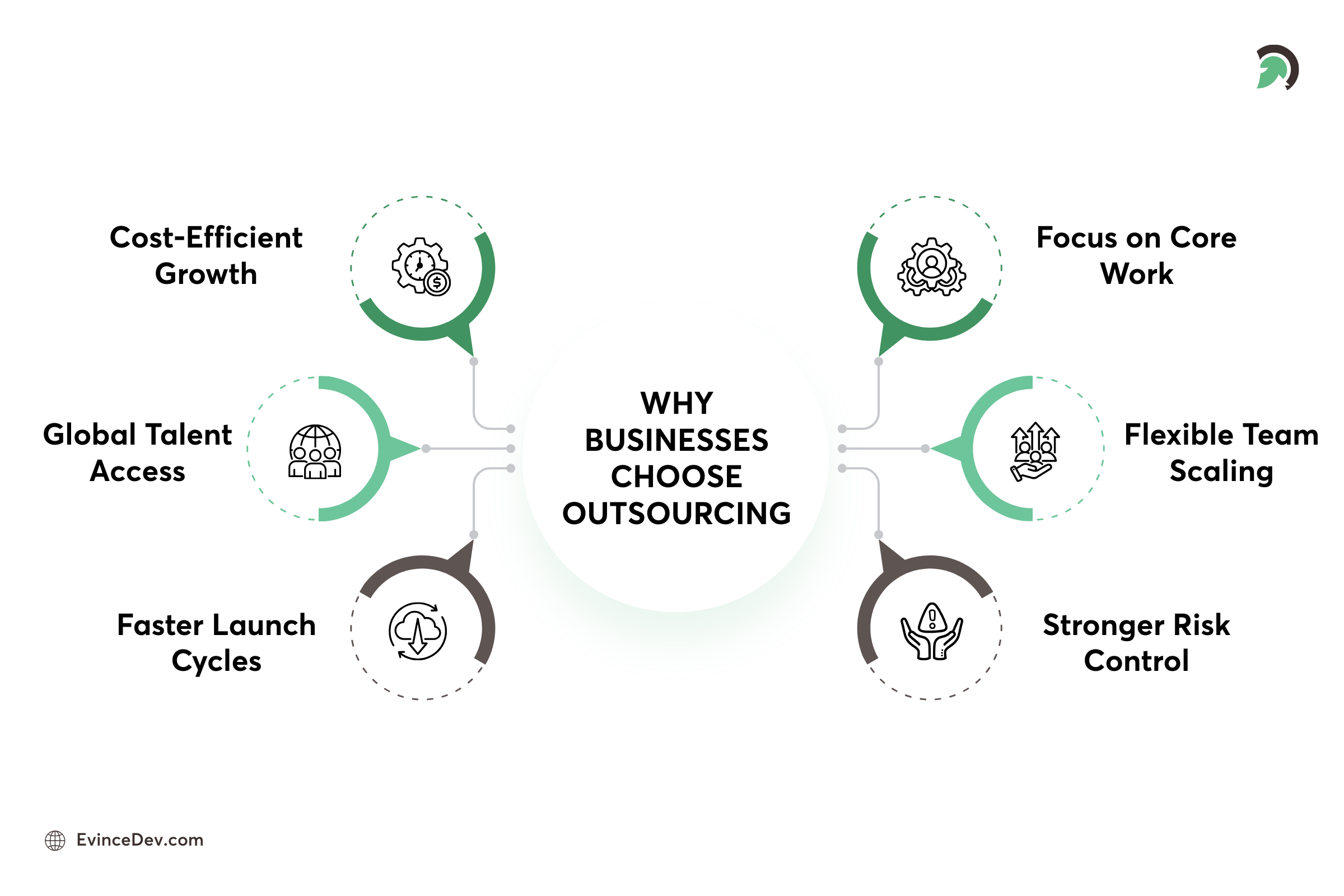
Cost Efficiency and Operational Optimization:
Building and maintaining a full in-house development team requires major investments in salaries, infrastructure, training, retention programs, and software tools. Outsourcing removes many of these overheads by providing predictable and often outcome-based cost structures. That means organizations only pay for the expertise and time they need, improving budget utilization and enabling them to allocate financial resources more flexibly.
-
Access to Specialized Global Talent:
Talent shortages in emerging technologies such as AI, cybersecurity, cloud computing, and data engineering still plague enterprises worldwide. Outsourcing opens the door to global talent pools with niche skills, industry-specific expertise, and advanced technical capabilities difficult or expensive to acquire locally.
-
Accelerated Time-to-Market:
Time is an essential ingredient in the digital race. Outsourcing teams work under well-established software development methodologies and engineering techniques that allow quicker delivery cycles. Having all the necessary resources, pre-designed frameworks, and domain knowledge, outsourcing partners can greatly shorten project completion time.
-
Focus on Core Business Functions:
Internal teams will be able to refocus their efforts on growth strategies, operations, customer relations, and business development. Outsourcing technical functions allows software product development to happen smoothly without distracting internal teams from their core objectives.
-
Addressing Scalability Challenges:
Outsourcing allows rapid scaling up or down of development capacity in response to project demands, market conditions, or changing business goals. In that respect, it’s essential when the enterprise has fluctuating workloads or has long-term plans for digital transformation.
-
Improved Risk Management:
The seasoned outsourcers possess proven methodologies, project management structures, security measures, and quality assurance processes that can be used to reduce any potential risks in technology, delay in projects, and delivery inaccuracy.
Market Insight:
A 2024 industry survey revealed that 93% of technology organizations were satisfied with the quality of their outsourcing engagements, highlighting the increasing trust and confidence enterprises place in outsourcing as a dependable delivery model.
Types of Software Outsourcing
The categorization of outsourcing models is commonly based on geographical proximity. Each model presents unique advantages and considerations:
Onshore Outsourcing
This involves partnering with a vendor within the same country.
- Advantages: Cultural alignment, minimal time zone differences, easy communication.
- Considerations: Generally, a higher cost due to local labor market pricing.
Nearshore Outsourcing
Partners are located in neighboring or nearby countries, typically in similar or overlapping time zones.
- Advantages: Geographic proximity, reasonable costs, smoother collaboration.
- Considerations: The Talent pool may be smaller than in offshore regions.
Offshore Outsourcing
This model involves teams located in distant countries such as India, Eastern Europe, or Southeast Asia.
- Advantages: Cost-effective rates, large talent pools, support for 24/7 development cycles.
- Considerations: Requires well-defined communication and project governance strategies to manage time-zone gaps.
Choosing the right type depends on your project complexity, collaboration preferences, internal processes, and budget.
Software Outsourcing Engagement Models
Beyond geographic categories, outsourcing engagements can be structured using different operational models. Each model suits a specific project type and organizational requirement.
Fixed-Price Model
- The scope, deliverables, timeline, and cost are predetermined.
- Best suited for: Small to medium projects with clear, stable requirements and minimal expected changes.
Time & Material Model
- Organizations pay based on the actual hours spent and materials used.
- Best suited for: Projects with evolving requirements, R&D initiatives, or ongoing development needs.
Dedicated Development Team
- For businesses following Agile delivery, this model can also support a scrum team outsourcing guide approach, where developers, QA engineers, designers, and project managers work in structured sprints.
- Best suited for: Enterprises requiring continuous development support or expansion of internal capabilities.
Staff Augmentation
- Supplementing your in-house software development team with external experts to fill skill gaps.
- Best suited for: Organizations needing rapid scaling or specialized technical proficiencies.
Hybrid Outsourcing Models
A combination of the above models is especially useful for complex enterprise ecosystems involving multiple parallel streams of work.
Common Software Development Services Businesses Outsource
Businesses use outsourcing software development service providers depending on their project objectives, technical specifications, budget, and internal team capabilities. Some businesses choose to outsource a whole software development project, while others choose to outsource some part of their project.
Common software development services businesses outsource include:
- Custom Software Development: Building tailored software solutions designed around specific business workflows, user needs, and operational goals.
- Web Application Development: Developing secure, scalable, and high-performing web applications for customers, employees, or business operations.
- Mobile App Development: Creating native or cross-platform mobile apps for iOS, Android, or both platforms.
- SaaS Product Development: Designing and developing cloud-based SaaS platforms with subscription models, user management, integrations, and scalable architecture.
- AI and ML Development: Adding intelligent features such as automation, predictive analytics, recommendation engines, chatbots, and AI-powered workflows.
- UI/UX Design: Creating user-friendly interfaces, wireframes, prototypes, and product experiences that improve usability and engagement.
- QA and Software Testing: Testing software for functionality, performance, usability, security, and compatibility before and after launch.
- DevOps and Cloud Engineering: Managing cloud infrastructure, CI/CD pipelines, deployment automation, monitoring, and system scalability.
- Software Modernization: Upgrading legacy software, improving architecture, migrating systems, and enhancing performance or security.
- Maintenance and Support: Providing ongoing bug fixes, updates, monitoring, feature improvements, and technical support after launch.
By outsourcing these services, businesses can access specialized expertise, reduce internal workload, and speed up software delivery without hiring every skill in-house.
What Are the Benefits of Software Outsourcing?
Outsourcing offers significant long-term advantages that contribute to organizational resilience and digital maturity.
-
Access to Expert Knowledge and Advanced Tools:
Outsourcing companies continuously upgrade their technical knowledge, frameworks, and tools to remain competitive. This ensures access to state-of-the-art solutions and emerging technologies.
-
Improved Development Quality:
Quality assurance is intrinsic to outsourcing teams. Structured testing, code reviews, CI/CD pipelines, automated QA, and strong documentation practices contribute to consistently high-quality deliverables.
-
Operational Continuity and Faster Delivery:
With teams distributed across regions, work can progress around the clock, especially in offshore models. This leads to shorter software development life cycles and improved responsiveness.
-
Reduced Infrastructure Costs:
Enterprises can avoid heavy investments in physical infrastructure, cloud systems, development environments, and permanent software licenses.
-
Seamless Scalability:
Outsourcing vendors maintain agile resourcing capabilities. Whether expanding the team for a product launch or scaling down post-deployment, the flexibility supports financial planning and operational efficiency.
-
Enhanced Focus on Innovation:
By delegating technical responsibilities, organizations gain more bandwidth to innovate, explore new market opportunities, and refine their strategic vision.
Quick Stat:
According to a recent report, organizations that outsource software development typically realize cost savings of approximately 40% and experience time-to-market improvements of up to 50%. These gains reflect the maturity of outsourcing vendors in terms of delivery frameworks, engineering expertise, and resource scalability.
Common Use Cases of Software Outsourcing
Software outsourcing can be very helpful for companies that want to speed things up, have access to specific technical expertise, or develop their product without adding additional people to their full time staff. It is usually utilized in cases when internal capacities are limited.
Common use cases include:
- Launching an MVP faster when startups need to validate an idea without building a full in-house team.
- Scaling development capacity when internal teams need extra developers, designers, QA engineers, or DevOps support.
- Modernizing legacy software when old systems need better performance, security, usability, or cloud readiness.
- Adding advanced features such as AI, automation, analytics, integrations, or custom workflows.
- Supporting long-term product growth through continuous development, maintenance, and post-launch enhancements.
This makes outsourcing a practical option for startups, growing businesses, and enterprises that need flexible software development support without slowing down internal priorities.
Challenges of Software Outsourcing And How to Mitigate Them?
While outsourcing is highly beneficial, it is not without challenges. Effective strategies can mitigate the most common issues:
- Communication and Time-Zone Barriers: Differences in communication styles or limited overlapping hours can impact coordination.
- Mitigation: Establish clear communication schedules, adopt collaboration tools, use detailed documentation, and maintain well-defined sprint structures.
- Cultural Misalignment: Variations in business etiquette and work styles may affect team synergy.
- Mitigation: Promote cross-cultural awareness and choose vendors with global delivery experience.
- Security and Compliance Risks: Outsourcing increases data exposure outside organizational boundaries.
- Mitigation: Implement NDAs, secure access controls, encrypted communication channels, compliance checks (ISO, GDPR), and regular security audits.
- Quality Assurance Challenges: Project outcomes may fall short without proper quality controls.
- Mitigation: Set measurable KPIs, conduct code reviews, monitor project progress, and ensure adherence to industry standards.
How to Choose the Right Outsourcing Partner?
It is essential to evaluate whether outsourcing partners can provide end-to-end custom software development services backed by strong technical skills, a reliable delivery methodology, and a portfolio demonstrating their expertise across a wide range of industries. Enterprises can assess vendors for the following reasons:
-
Technical Proficiency and Experience:
Review technology stacks, solution expertise, certifications, and industry knowledge. Look for partners with proven capabilities aligned to your project’s needs.
-
Strong Portfolio and Case Studies:
Assess the vendor’s track record by studying similar implementations, organizational maturity, and client testimonials.
-
Transparent Communication Approach:
Evaluate their communication cadence, reporting structure, escalation mechanisms, and clarity in scheduling and documentation.
-
Development Methodologies:
Agile, Scrum, DevOps, and hybrid methodologies ensure predictable development cycles and continuous improvement.
-
Pricing Structure and Flexibility:
Ensure the pricing model is transparent and aligns with your budget, without hidden costs or rigid constraints.
-
Cultural Compatibility:
Cultural alignment ensures smoother collaboration and more cohesive team dynamics.
-
Long-Term Commitment and Support:
A reliable outsourcing partner invests in long-term client success and offers ongoing maintenance, support, and advisory services.
Outsourcing Process (Step-by-Step Guide)
Here’s the step-by-step framework for the software development outsourcing process:
-
Step 1: Requirement Definition:
Create a comprehensive requirement document outlining business goals, functionality, timelines, KPIs, technical specifications, and constraints.
-
Step 2: Vendor Research and Shortlisting:
Explore vendors through industry portals, references, and comparative analyses. Shortlist based on expertise, portfolio, cultural fit, and industry reputation.
-
Step 3: Proposal Evaluation
Review technical solutions, cost structures, expected timelines, project governance models, and resource allocation plans.
-
Step 4: Interviews and Vendor Assessment:
Conduct interviews with potential teams to assess communication, technical competence, and domain understanding.
-
Step 5: Contracting & Finalization:
Finalize contracts outlining deliverables, milestones, SLAs, payment schedules, and security obligations.
-
Step 6: Onboarding and Knowledge Transfer:
Familiarize the outsourcing team with the project background, workflows, internal stakeholders, tools, and communication protocols.
-
Step 7: Development Phase:
Execute development using structured sprints, continuous reviews, daily standups, and iterative deliverables.
-
Step 8: QA, Testing, and Validation:
Perform functional, security, performance, and usability testing to ensure high-quality outputs.
-
Step 9: QA,Deployment and Release:
Deploy the solution in production environments following best practices for release management and monitoring.
-
Post-Launch Support and Maintenance:
Address bugs, enhancements, performance issues, and future upgrades.
Future Trends in Software Outsourcing
Software outsourcing continues to evolve as digital ecosystems expand rapidly. The following trends will shape its future:
- AI-Based Software Development and Automation: AI would keep on accelerating the process of development of custom software by automating the routine tasks, making testing more effective, and speeding up this process by eliminating manual procedures.
- Cloud-Based Outsourcing: Enterprises would increasingly resort to outsourcing cloud-based migrations, DevOps, and modernization of the infrastructure due to the need to get rid of old technologies and build scalable digital ecosystem.
- Remote Development Teams: Building remote software development teams would stay relevant for enterprises that prefer to hire developers flexibly and scale fast.
- Security-Oriented Software Outsourcing: Enterprises would be interested in outsourcing software development from organizations that implement strict cybersecurity procedures, protect sensitive information, and know all compliance regulations beforehand.
- Specialized Technical Skills Outsourcing: The demand for specialized skills in such niche fields as AI, RPA, IoT, blockchain, AR/VR, data engineering, and others would only grow.
Conclusion
Software outsourcing has been one of the most beneficial strategies for helping enterprises accelerate digital innovation, optimize resources, and scale their businesses with confidence. If an enterprise chooses the right software development partner, such as EvinceDev, it can reinforce its technical capabilities, mitigate development risks, and attain long-term competitive advantage. Understanding an organization’s unique business needs, an experienced software development company would provide the specialized expertise, structured delivery processes, and agility to respond effectively to constantly evolving business demands.
As enterprises navigate increasingly dynamic markets, the ability to leverage global talent, integrate emerging technologies, and execute complex projects with precision will remain critical. Software outsourcing provides the foundation, flexibility, and advanced competencies needed to support these objectives.
FAQs
1. What is software outsourcing?
Software outsourcing is the practice of hiring an external development company or team to design, build, test, maintain, or support software instead of handling everything in-house.
2. Why do companies outsource software development?
Companies outsource software development to reduce costs, access skilled talent, speed up delivery, scale teams faster, and help focus internal teams on core duties and the business priorities.
3. What are the Common Engagement Models in software outsourcing?
The Common Engagement Models in software outsourcing include fixed-price, time and material, dedicated development team, staff augmentation, and hybrid models.
4. How much does software outsourcing cost?
Software outsourcing cost may vary depending on project scope, team size, technology stack, location, timeline, and engagement model. A simple MVP usually costs less than the complex enterprise platform.
5. What software development services can businesses outsource?
Businesses can outsource services spanning from custom software development, web app development, mobile app development, SaaS product development, UI/UX design, QA testing, modernization to maintenance and support.
6. What are the risks of software outsourcing?
Common risks may include communication gaps, unclear scope, time-zone differences, quality issues, security concerns, and even limited project visibility. However, these risks can be minimized to an extent with a clear documentation and the regular reporting.