
Key Takeaways
- Hidden Administrative Costs: Repeated entry, document chasing, and report preparation consume finance capacity as project portfolios grow.
- Balances Need Context: Funding restrictions, pending obligations, and cash availability determine what a project can spend.
- Connected Workflows: Linking funding records, expenses, approvals, and reporting reduces manual work and improves project visibility.
- Financial Oversight Remains Essential: Automation applies documented rules, while finance teams retain responsibility for policies, exceptions, and approvals.
- Start with a Focused Pilot: Improve one workflow, validate it against accounting records, and measure results before expanding.
A supplier invoice arrives for a sponsored community project. The project leader expects a straightforward approval: funding is in place, and the purchase is within budget. But finance still needs to confirm which grant can cover it, whether other commitments affect the available balance, and whether the supporting documents are complete.
For a fiscal sponsor, that review is part of responsible financial oversight. The workload grows when staff must search spreadsheets, email threads, and separate systems to complete it. Across 50 or more projects, routine payment requests and reports can require hours of information gathering and reconciliation.
These are the hidden costs of manual fund accounting. They build through repeated data entry, delayed spending decisions, corrections, and reporting work, leaving the same finance team with less capacity to support a growing project portfolio.
This blog examines where those costs arise, what a connected fund accounting workflow includes, and how sponsors can improve approvals and reporting around their existing systems while retaining financial control.
Quick Stat:
According to Sage’s 2025 Nonprofit Technology Impact Report, 41% of respondents identified a lack of process automation and organizational efficiency as a major operational challenge
What Is Fund Accounting for Fiscal Sponsors?
A fiscal sponsor is an established nonprofit that provides financial oversight and administrative support for charitable projects. Fund accounting helps it track where funding comes from, how it is used, and any donor restrictions attached to it.
Each project may receive several grants supporting different activities. Finance therefore needs to track expenses against both the correct project and an eligible funding source. A project’s total balance alone cannot show what is available for a particular expense.
What Does Manual Fund Accounting Really Cost?
For comprehensive fiscal sponsors, commonly called Model A sponsors, projects operate within the sponsor’s organization. When financial records and approvals are disconnected, routine accounting work can consume capacity across the entire project portfolio.
Repeated Entry Reduces Finance Capacity
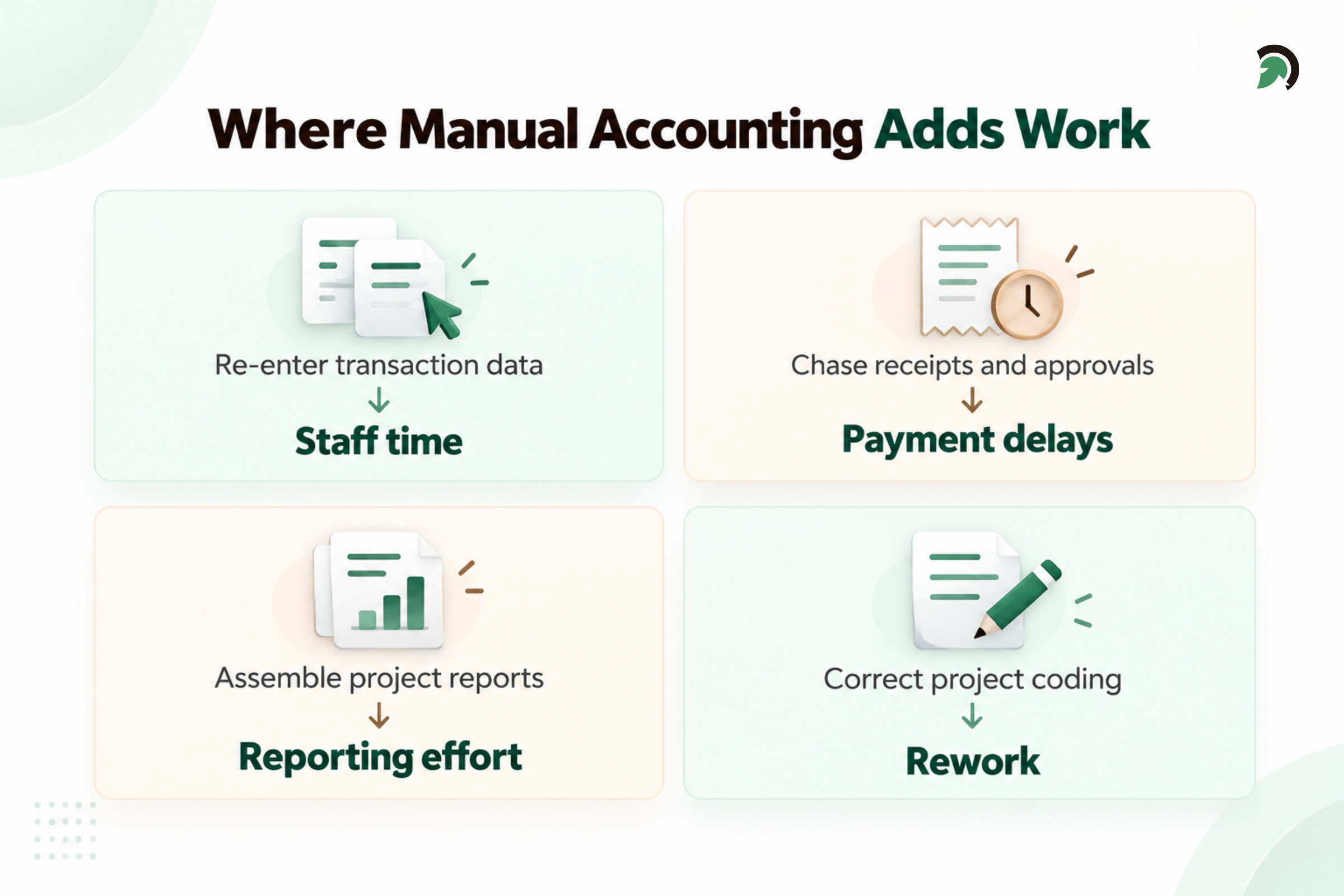
When donations, expenses, and grant records sit in separate tools, staff repeatedly export, enter, and reconcile information. This processing consumes time that could support financial review, project guidance, and planning.
Unclear Balances Delay Spending Decisions
A project’s remaining balance does not necessarily show what it can spend. Grant restrictions, pending invoices, and existing commitments affect spending capacity. A youth program, for example, may have funding remaining for mentor training but little available for transportation.
Quick Stat:
According to Nonprofit Finance Fund’s 2025 State of the Nonprofit Sector Survey, 52% of nonprofit respondents had three months or less cash on hand.
Missing Information Slows Payments and Reports
Missing receipts, unclear funding assignments, and approvals buried in email create follow-ups before payments can proceed. Reporting adds more work when finance must combine accounting exports, grant spreadsheets, and supporting documents for each request.
Quick Stat:
According to BTQ Financial’s 2025 survey of 100 nonprofit leaders, 31% identified accurate and timely financial reporting as a key challenge.
Corrections and Staff Dependencies Limit Growth
An incorrectly coded expense may require changes across project statements, grant reports, and trackers. When spreadsheet formulas and fee exceptions are understood by only one employee, absences can also disrupt routine work. Each additional project puts more pressure on that process.
To understand the cost, measure hours spent on repetitive processing, reporting, corrections, and follow-ups, then apply the organization’s fully loaded staff cost. This provides a baseline for improvement while recognizing that financial review and oversight remain necessary.
How Manual Accounting Slows Down Fiscal Sponsorship Operations
What Does a Connected Fund Accounting Workflow Include?
A connected approach links funding records, expense requests, approvals, and reporting around the accounting system. Staff use consistent identifiers and review exceptions instead of rebuilding information across separate files.
The design should support the sponsor’s accounting policies and agreements. Software cannot decide those policies on its own.
A Shared Project and Grant Structure
Projects and grants need identifiers that remain consistent across systems. An expense record should connect to the relevant project, funding source, category, and supporting evidence.
A project label is an internal tracking device. It does not, by itself, establish a donor restriction. Finance needs to record the actual terms and distinguish externally restricted funding from internal budget decisions.
Grant records should also capture relevant periods, reporting requirements, and responsible staff. Accounting treatment still requires appropriate review, especially where funding agreements contain conditions or other complex provisions.
Donation and Payment Integrations
An integration can transfer donation details into a review process or accounting system without repeated typing. It should preserve the information needed to identify the contribution and reconcile the related bank settlement.
Processing fees, refunds, and grouped payouts need attention. The amount deposited may differ from the original contribution, so an integration must account for those differences.
Missing project assignments and failed transfers should appear in a visible exception queue. A silent failure simply moves the manual problem elsewhere.
Structured Expense Submission and Approvals
An expense form can require a purpose, project assignment, invoice, and other necessary details before submission. Approval routing can then follow documented responsibilities.
Requesters should see whether an expense is awaiting information, under review, approved, or paid. This reduces status emails and makes stalled requests easier to identify.
Controls should preserve appropriate separation between requesting, approving, and releasing payments. An automated check can flag an issue; authorized staff still resolve eligibility and approve exceptions.
Documented Fees and Shared Costs
Sponsorship fee arrangements should follow the written agreement. The National Network of Fiscal Sponsors notes that sponsors can apply administrative allocations differently, including against incoming revenue or incurred expenses.
Shared payroll, insurance, and software costs also need documented allocation methods. Supporting records should explain why a project receives a charge and whether the relevant funding permits it.
The system can apply approved methods consistently and retain the calculation history. Finance remains responsible for the method, exceptions, and corrections.
Quick Stat:
According to the Fiscal Sponsor Directory’s published statistics, 96% of listed sponsors reported charging a percentage of project revenues.
Project Reporting and Linked Evidence
Project leaders need understandable reports with clear update dates. Where appropriate, reporting should distinguish posted expenses from pending obligations and explain what an available-to-spend figure includes.
Supporting invoices, approvals, and relevant funding documents should remain connected to their records. Access permissions should limit each user to appropriate information.
AI can assist with receipt extraction or suggest classifications, but those suggestions require review. Reliable identifiers, controlled approvals, and reconciled accounting records provide the foundation.
How Does a Transaction Move Through the Connected Workflow?
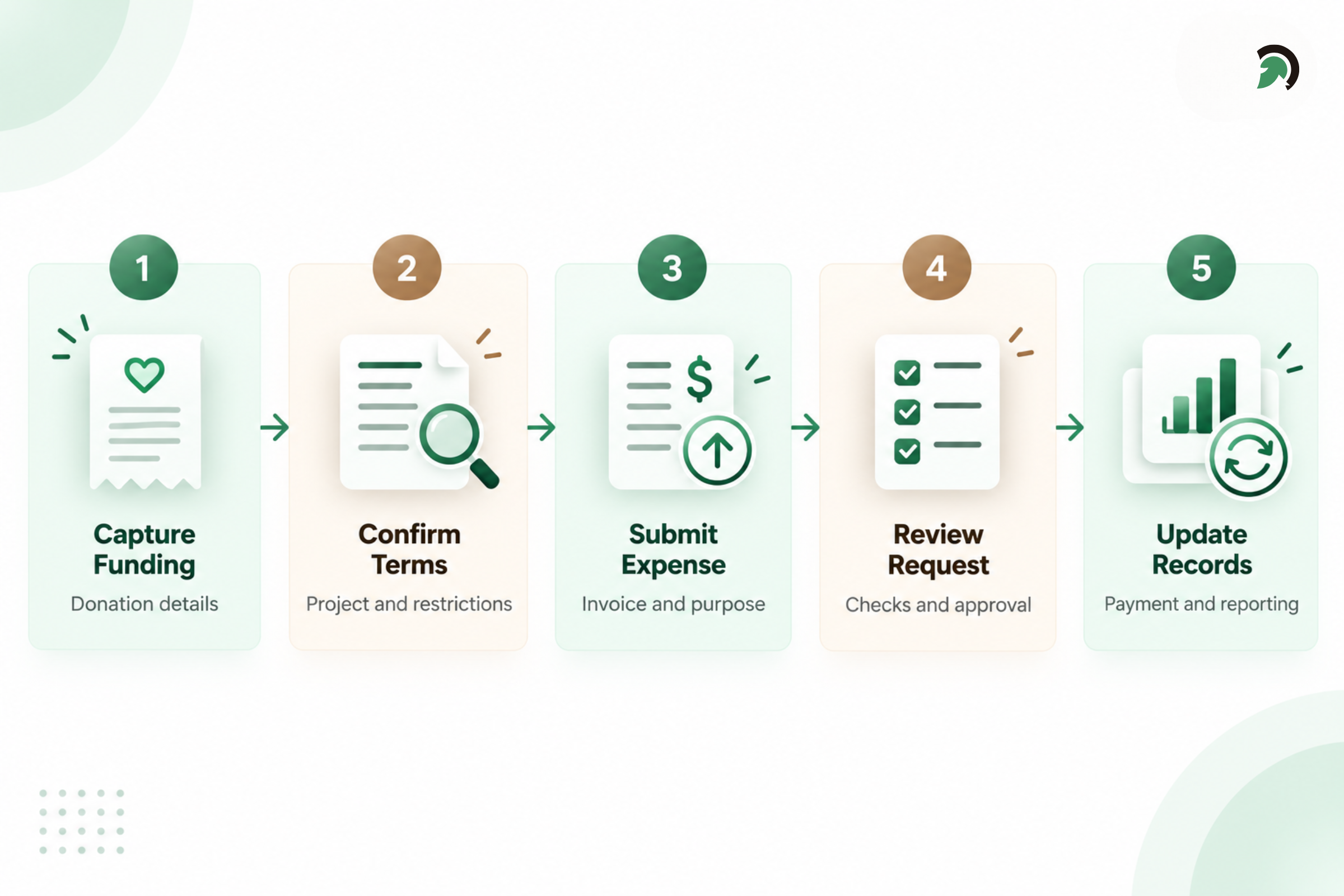
Consider an illustrative donation supporting a community food project, followed by a request to purchase supplies. The workflow moves through the donation platform, project portal, approval process, and accounting system.
1. 5 Essential Steps in Fiscal Sponsor Expense Management
1. Capture the Funding Record
The donation platform sends the contribution details and project designation through an integration. The original transaction reference is retained so finance can identify duplicates, trace corrections, and reconcile payouts.
Incomplete or unmatched records go to review rather than receiving an assumed assignment.
2. Confirm the Project and Funding Terms
Finance verifies the project and records relevant donor restrictions from the supporting terms. If the funding requires a more detailed accounting assessment, that happens before the record is treated as ready for use.
The approved information becomes available to the expense review process.
3. Submit the Expense with Supporting Details
The project team submits the supplier invoice through a portal or expense tool. The request includes the purpose, amount, project, and required documents.
Where a funding assignment is proposed, reviewers can confirm it against the approved records.
4. Review and Approve the Request
The workflow checks required information and routes the request to authorized reviewers. Finance considers permitted use, timing, obligations, and available cash where relevant.
Exceptions return for clarification or follow a documented escalation path. Approval does not automatically mean that payment has occurred.
5. Record Payment and Update Reporting
The accounting system records expenses and related payables according to the sponsor’s accounting policies. Once an authorized payment is made, the payment record is updated and reconciled with the bank activity. Connected project reports refresh on the defined schedule.
The invoice, approval history, and payment reference remain linked, giving staff a traceable record for project reporting and later review.
Where Can Standard Accounting Tools Leave Workflow Gaps?
The category worth examining is the standard accounting package surrounded by spreadsheets, email approvals, and disconnected project tools.
Standard software may already provide project dimensions, grant tracking, approval features, or integration options. The first question is whether those capabilities are configured and used effectively.
Gaps can remain when a sponsor needs detailed project access, multiple fee arrangements, grant-specific reporting, or approvals that span several systems. A finance team might produce an accurate accounting report while still needing separate spreadsheets to explain pending commitments.
Adding another tool can help, but it can also introduce another set of identifiers and another reconciliation task. The benefit depends on how information moves between the tools.
A useful assessment follows a real transaction from receipt to reporting. It identifies where staff re-enter information, where rules are applied manually, and where evidence becomes detached from the record.
The response may be configuration, integration, a targeted portal, or replacement of a component that cannot meet the requirements. Custom development should address a verified gap with clear ownership and support arrangements. It should not duplicate functions the existing platform already performs well.
How Can Sponsors Improve the Workflow Without Disrupting Operations?
Implementation should begin with a defined process and an agreed measure of success. Donation coding, expense submission, or project reporting can provide a manageable starting point.
The following timeline ranges are illustrative planning estimates, not industry benchmarks or delivery commitments. Actual scope depends on system access, data quality, integration capabilities, and the sponsor’s review capacity.
Assess the Workflow and Establish a Baseline
A focused assessment might take one to two weeks when staff and sample records are available. It maps systems, manual steps, ownership, and common exceptions.
The sponsor supplies sample reports, grant documents, fee agreements, approval policies, and representative transactions. Finance and project staff explain what happens in practice.
This phase should establish which records are authoritative and measure the workload being improved.
Define the Data and Controls
A further one to two weeks may be appropriate for a narrow design phase. The team agrees on project identifiers, required fields, permissions, fee rules, and approval routes.
Finance validates the accounting and control requirements. Technical contacts confirm system access and integration limits. Where connections cannot support timely updates, reporting must reflect that limitation clearly.
Unresolved policy questions should be addressed before they become software behavior.
Build and Test a Representative Pilot
A limited integration and approval pilot could require four to six weeks, depending on complexity. Historical cleanup, unsupported systems, or custom reporting can extend that range.
Select projects with different funding arrangements and test normal transactions alongside refunds, missing documents, incorrect assignments, and failed transfers.
Compare outputs with the accounting records. Confirm that corrections do not create duplicates and that access controls prevent unintended visibility. Keep existing review procedures available while the pilot is validated.
Roll Out with Clear Responsibilities
A staged rollout allows training, feedback, and controlled expansion. Each integration needs an owner, a failure notification process, and a way to recover interrupted transfers.
Where the current accounting system is suitable, it can remain in place with historical records and established finance approval authority. The project should document exactly what changes and what stays untouched.
Measure reporting effort, payment turnaround, correction rates, and administrative hours after rollout. Compare similar project types and workloads so quieter periods are not mistaken for system improvements.
Bottom Line
A fiscal sponsor’s capacity to support more projects depends on how easily its teams can track funding, approve expenses, and access reliable financial information. Connecting these workflows reduces the effort spent rebuilding reports and chasing documents, giving finance more time for oversight and project support.
EvinceDev helps translate these operational gaps into practical software improvements, from accounting integrations to project portals and approval workflows. The approach starts with existing systems and the sponsor’s financial controls, building a clearer path from funding received to spending reviewed and reported.