
Key Takeaways
- State and product rules differ: Rate caps, loan limits, and disclosure requirements depend on the applicable state and loan type.
- Checks continue after funding: Extensions, payment changes, and repeat applications can trigger new compliance decisions.
- Manual tracking creates gaps: Spreadsheets and policy documents can become inconsistent across online, branch, and servicing workflows.
- A compliance engine checks decisions: It applies approved rules, flags exceptions, and records why an action was allowed or blocked.
- People remain responsible for the rules: Compliance teams approve and update rule interpretations while connected systems apply them consistently.
A borrower asks for more time to repay a short-term loan. Before a branch employee can respond, several questions need answers: Does the state permit this change? Can the lender charge a fee? Has the borrower had another recent loan? Which documents must be provided? The answers depend on the loan product, the applicable state rules, and the borrower’s account history.
For a lender serving several states through online and branch channels, these checks arise every day. Multi-state lending compliance becomes harder when staff must piece together answers from spreadsheets, policy documents, and separate systems. This blog explains how rate caps, rollover limits, and disclosure rules affect lending decisions, and how a compliance engine can apply approved rules consistently from the initial offer through servicing and repeat borrowing.
Quick Stat:
In a 2014 study of storefront payday lending, the CFPB found that more than 80% of payday loans were rolled over or followed by another loan within 14 days. That frequency makes repeat-loan and account-history checks an important part of the lending workflow.
What Does Manual Multi-State Compliance Cost Lenders?
A hybrid lender with 25 to 100 employees may serve several states and products with a small compliance team. Loan officers, branch employees, service agents, and online workflows all need current answers. Yet the same rule may live in a spreadsheet, a policy guide, a branch checklist, and a software setting. Updating one source does not automatically update the others.
That disconnect has practical consequences at each stage of the loan:
- At origination: An online application calculates a permitted charge, but an employee changes the fee or term in another system. Unless the revised offer is checked again, the lender may present terms that do not match its approved policy.
- During servicing: A borrower requests more time to pay. Staff must determine whether the action is an extension, repayment arrangement, or new transaction, and whether the proposed date or charge is allowed. A manual lookup delays the response; a missed check can lead to an impermissible change.
- On a repeat application: Existing or recent loans may affect eligibility. If the necessary history is held in another system or required state database, the decision must wait for that information. An incomplete check can result in an offer the lender should not make.
- When issuing disclosures: Even correctly priced terms can be paired with an outdated document or delivered at the wrong point in the process. The team then has to investigate what the borrower received and whether the transaction needs correction.
Each exception takes time to investigate, explain, correct where necessary, and document. The effect on deals or processing time depends on the lender’s own volumes and systems; there is no universal cost figure. The underlying problem is that staff can look up a rule, but the rule is not reliably connected to the action they are taking.
Compliance checks continue after funding. A request for more time, a change in payment terms, or a repeat application can require the lender to review the borrower’s account history and apply a different set of rules before proceeding.
How a Lending Compliance Rule Engine Validates Loans
What Do Rate Caps, Rollover Limits, and Disclosure Rules Mean?
These requirements control different parts of a loan. Understanding the difference helps lenders build checks that answer the question in front of them.
| Requirement | What it addresses | Example of a system check |
| Rate or charge cap | Whether the proposed interest and fees fall within the limits for the applicable product | Recalculate permitted charges before presenting or changing an offer |
| Rollover or renewal restriction | Whether the existing obligation can be extended, renewed, or replaced on the proposed terms | Check the loan status, transaction history, timing, and any new fees |
| Disclosure requirement | What information must be given to the borrower and when | Select the approved documents and confirm delivery at the required step |
| Repeat-borrowing limit | Whether another loan is permitted in light of existing or recent loans | Check the available history and required state data sources before approval |
A fee cap might limit a specific charge on a transaction. An annual percentage rate, or APR, expresses the cost of credit using an annualized calculation. They are different measures. A lender therefore needs calculations appropriate to each applicable limit, as well as accurate borrower-facing disclosures. The word rollover also needs care. In everyday conversation, staff may use it for any request for more time. A statute may distinguish a fee-bearing rollover from a no-charge extension, a payment deferral, a repayment plan, or a new transaction. The system should capture what is actually proposed instead of relying on one broad label.
Disclosure rules are equally operational. A document template is only useful if it matches the loan, contains the correct terms, and reaches the borrower at the required time. Regulation Z’s closed-end disclosure provisions address items such as the finance charge and APR when they apply. State laws can impose additional transaction-specific notices or agreement requirements. Short-term lending compliance therefore spans pricing, account changes, and communication with the borrower.
How Do State Rules Differ in Practice?
State rules depend on both where the loan is made and what type of loan it is. Florida and Washington illustrate why a lender needs more than a single state setting in its software.
| What the lender must check | Florida deferred presentment transactions | Washington small loans |
| Pricing | Standard and installment transactions have different fee provisions. | Charges and aggregate outstanding principal are limited. |
| More time to pay | Rollovers are prohibited. Certain no-charge payment relief is available when statutory conditions are met. | An agreed extension beyond the usual termination period is permitted if no additional fee or interest is charged. |
| Disclosures and agreements | The written agreement must contain specified transaction details, and the borrower must receive a copy. The required Regulation Z disclosure must be provided when the transaction is initiated. | When making the loan, the lender must disclose its terms, including principal, total payments, the fee or interest rate, and APR. |
| Another loan | An outstanding transaction or one that ended less than 24 hours earlier can prevent a new transaction. Required checks include the state’s database. | A borrower cannot receive more than eight small loans from all licensees in a twelve-month period. |
| Information needed | Product type, current and recent transactions, and the action requested. | Proposed terms, outstanding principal, and relevant borrowing history. |
Sources: Florida Statutes § 560.404 and Washington RCW 31.45.073 and 31.45.088.
What this means for lenders: A request for more time is not enough information to make a decision. The lender must identify the product and state, check the borrower’s account history, and assess the proposed date and charges under the applicable rules. A compliance engine can bring those checks into the loan workflow before staff confirms the request.
Quick Stat:
A CFPB report recorded extended payment plan usage of 0.4% of payday loans in Florida in 2021, compared with 13.4% in Washington in 2020.
How Does a Compliance Engine Work?
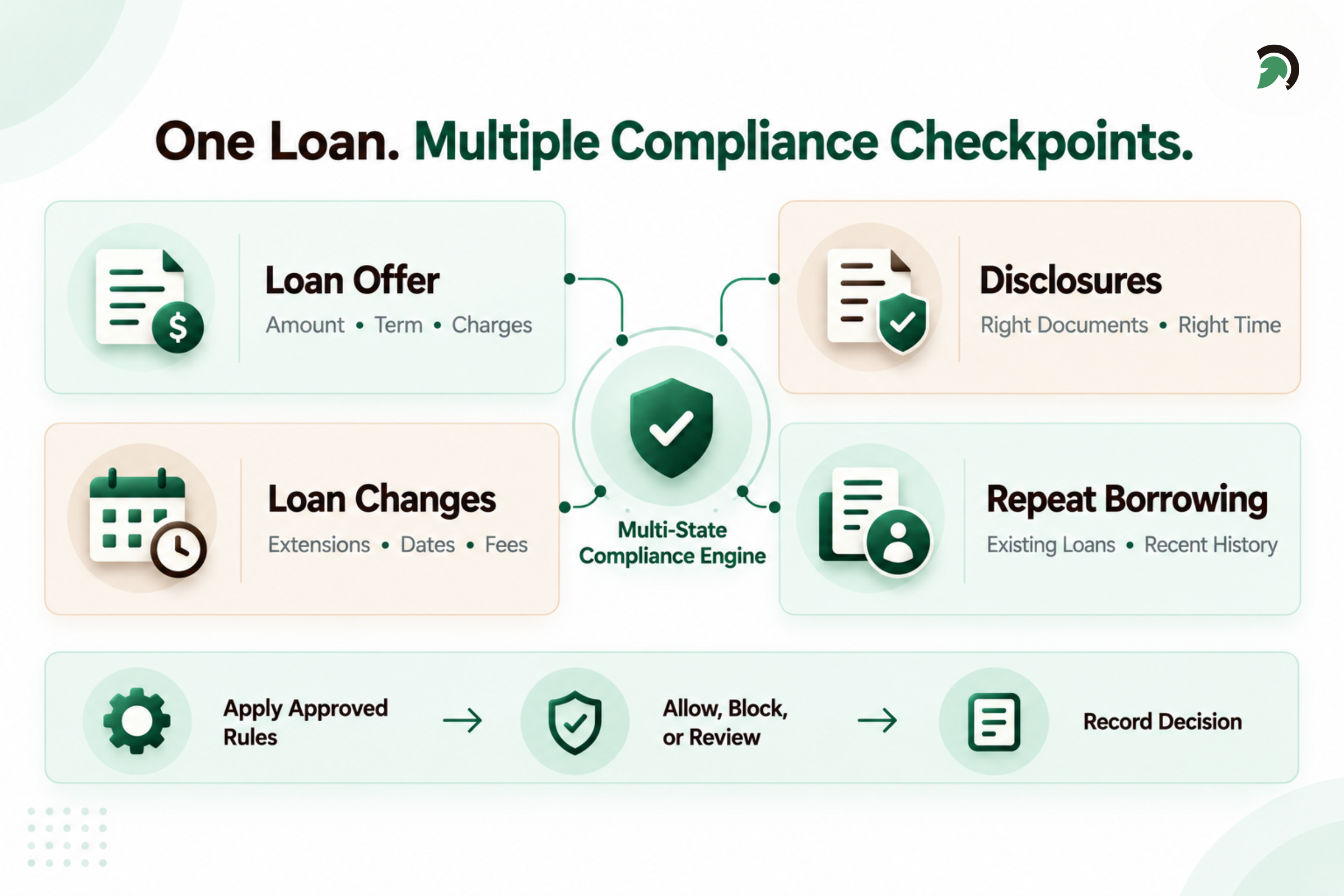
A compliance rule engine puts approved lending rules into the systems where loan decisions happen. When someone creates an offer or requests a change to an existing loan, the engine checks the relevant information before the action proceeds. It then returns a decision staff can understand and records how it reached that result.
The workflow has four main steps:
- Identify the transaction. The system sends the applicable state, loan product, proposed action, and borrower information to the engine. For an existing loan, it also sends the current balance and relevant account history.
- Apply the approved rules. The engine checks the proposed amount, term, interest, fees, and other conditions against the rules for that transaction. An extension request may require different checks from a new loan application.
- Return a clear result. The engine allows the action, blocks it, or sends it for review when information is missing or a decision needs human judgment. Staff sees the reason, so they know what to do next.
- Handle documents and record the decision. The connected document workflow selects the required approved disclosures and tracks their delivery at the appropriate stage. The system records the inputs, rule version, and outcome for later review.
Effective lending compliance automation depends on accurate data from origination and servicing systems. Compliance and legal teams still need to approve how the rules are interpreted and keep them current.
What Would an Automated Extension Check Look Like?
Imagine a borrower contacting a lender’s branch to ask for more time to pay a short-term loan. The employee opens the account and selects an extension request. The servicing system sends the product, applicable state, original terms, current balance, prior changes, and proposed new due date and charges to the compliance engine.
The engine identifies the approved rule version for that transaction. It checks whether the proposed action is available, whether any added charge is permitted, whether the new date is acceptable, and which borrower notices or agreements are required. If the request qualifies, the employee sees the permitted next step and the documents to provide. If it does not, the employee sees the reason and can discuss an approved alternative or refer the case to the compliance team. The available options depend on the product and state. The branch and online team can use the same approved process, while the system records the inputs, result, and rule version.
What Should a Reliable Compliance Engine Include?
A compliance engine is only as dependable as the rules, data, and controls behind it. For a lender operating across states and channels, five capabilities matter most.
1. Approved Rules for Each Product and State
Compliance and legal teams should determine how each requirement applies to a loan product, approve the interpretation, and assign an effective date. Technology teams can then turn that approved policy into testable rules. Clear ownership ensures that changes are reviewed before they affect lending decisions.
2. Rule Versions and Change Controls
The lender should be able to see which rule version was used for an earlier decision and which version applies now. New or revised rules need approval, testing, and a controlled release process. This is the foundation of reliable lending rule management.
3. Connections Across Lending Systems
The engine needs current information from loan origination, servicing, and document systems. Where a state requires a database check, that step must also be connected to the relevant workflow. Some lending software platforms include rule-setting features, but lenders should confirm that the checks work across online and branch channels.
4. A Clear Path for Exceptions
Incomplete information should trigger review rather than an automatic approval. Staff need to see why a case was flagged, who can resolve it, and what action is permitted while it is under review. Any override should be restricted to authorized users and recorded.
5. Decision Records and Ongoing Testing
For each decision, the system should record the information used, the rule version applied, the result, and any approved override. Teams should also test common and unusual scenarios when rules or connected systems change. These records help them investigate questions and spot gaps in the workflow.
Should Lenders Build, Buy, or Integrate?
The right approach depends on the lender’s products, existing systems, and the decisions those systems need to check. Before choosing a compliance tool, map four common workflows: creating an offer, issuing disclosures, changing a loan, and reviewing a repeat application. Note where the required data lives and whether each workflow can pause until a check is complete.
| Approach | When it may fit | What to verify |
| Configure or buy | An existing platform or available product supports the lender’s states, loan products, and rule types. | Can the team update approved rules, test changes, and apply them across online and branch workflows? |
| Integrate | Origination, servicing, and document systems work separately but can share data with a common decision layer. | Can each system send the information needed and act on the engine’s response before a transaction proceeds? |
| Build | Existing tools cannot represent the lender’s product-specific rules, review steps, or decision records. | Can the lender maintain the custom system as rules, products, and channels change? |
For many lenders, the answer may combine these approaches. Lending system integration services can connect existing tools to shared compliance checks, while targeted lending software development solutions can address capabilities the tools lack. A fintech software development team can help assess which parts to configure, connect, or build. For a lender with 25 to 100 employees, lending platform modernization should start with the gaps that affect real decisions. The aim is a system the compliance team can oversee, and staff can use consistently, without making every rule update a development project.
Also Read: The Legacy Modernization Decision Framework: Wrap, Replace, or Rebuild?How Can a Lender Get Started Without Rebuilding Everything?
Begin with a product-by-state inventory. For each product, record the approved rules for amounts, charges, terms, renewals, repeat borrowing, and disclosures. Include sources, effective dates, owners, and the decisions affected. Have qualified compliance or legal reviewers confirm the interpretation before it becomes executable logic. Next, choose one high-volume decision where inconsistent manual handling creates a clear problem. Pricing checks before offers and servicing checks before extensions are good candidates. Map the data needed, define what should happen when data is missing, and test ordinary cases alongside edge cases: an outstanding loan, a recently closed transaction, an attempted extra fee, and a change that takes effect on a specific date.
Then connect the check to the employee and borrower workflows. A rule that exists in a dashboard but does not stop the offer or servicing action offers limited protection. Train staff on the reasons shown by the system and the path for legitimate exceptions. Review failed checks and overrides to discover unclear policies, data gaps, or confusing screens.
Bottom Line
Multi-state lending compliance requires more than checking an offer before it is issued. Rate caps, rollover limits, repeat-borrowing rules, and disclosures can affect decisions throughout the life of a loan. For hybrid lenders, those decisions need to follow the approved rules whether a borrower applies online or speaks with a branch employee. A Multi-State Compliance Engine can make those checks part of the lending workflow. It can assess a proposed action, flag a case that needs review, and record which rule was applied. Compliance teams remain responsible for interpreting and approving the rules; the technology helps put those decisions into practice consistently.
EvinceDev can help lenders map the decisions that need controls, develop the rules engine, and connect it with loan origination, servicing, and document systems. That work may include automating pricing and loan-change checks, routing exceptions to the right team, and creating decision records that support ongoing review. The approach can be shaped around the lender’s existing platforms, products, and state coverage.