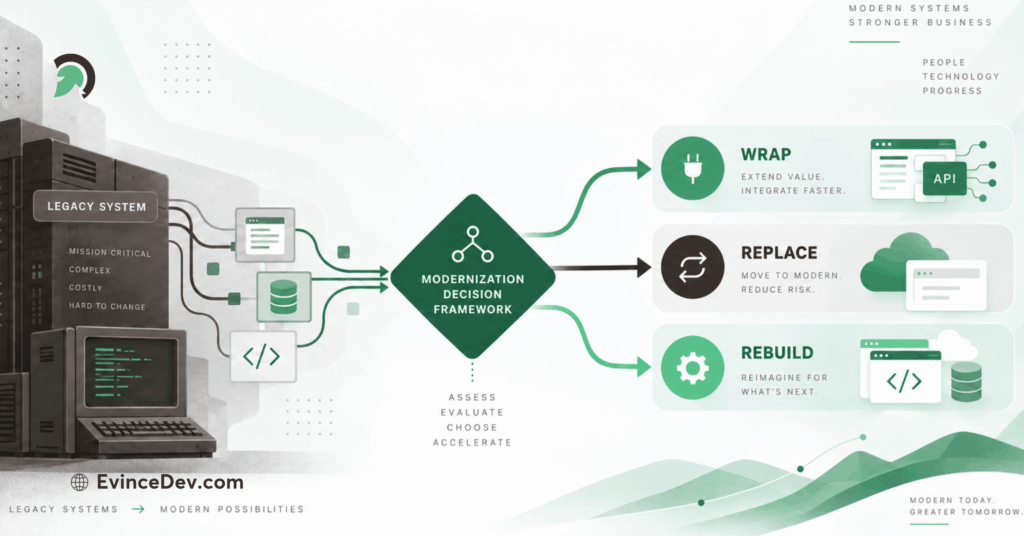
Key Takeaways
- Modernize with Purpose: Legacy modernization should solve business constraints, not simply replace old technology.
- Choose the Right Path: Wrap when the core still works, replace standardized capabilities, and rebuild strategically important systems.
- Assess Five Key Factors: Business value, technical health, differentiation, change complexity, and future flexibility should guide the decision.
- Modernize in Phases: Large systems can combine wrap, replace, rebuild, and retire strategies across different capabilities.
- Avoid Unnecessary Change: If a legacy system remains stable, low-risk, and cost-effective, modernization may not yet be the right investment.
A legacy system rarely fails all at once. More often, it keeps working while quietly making everything around it harder.
New integrations take longer. Simple changes require workarounds. Maintenance costs rise. Teams become dependent on a shrinking pool of specialists. New products and workflows are designed around the limitations of the system instead of the needs of the business.
That is when modernization becomes less of a technology question and more of a strategic one: Do you keep the core and modernize around it, replace it with a proven platform, or rebuild the capabilities that matter most?
This blog breaks down those three paths through five decision factors: business value, technical health, strategic differentiation, change complexity, and future flexibility. It also compares Wrap, Replace, and Rebuild side by side, shows how the framework applies across industries, explains when modernization may not be necessary, and provides a practical checklist to help identify the right path.
Should You Wrap, Replace, or Rebuild a Legacy System?
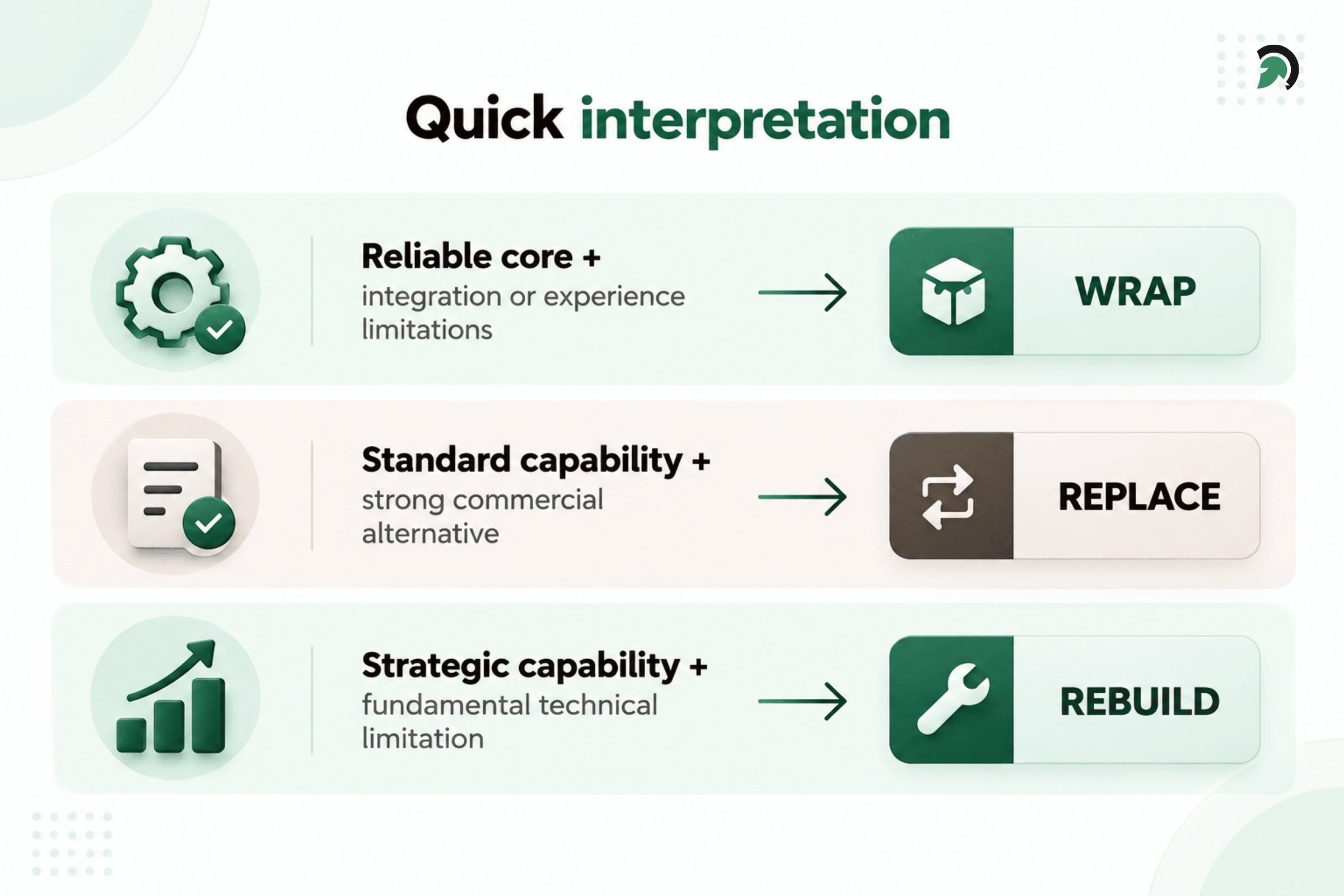
A legacy modernization decision framework helps businesses choose whether to wrap, replace, or rebuild an aging system. Wrap it when the core still works but integration or access is limiting it. Replace it when a proven platform can meet most requirements. Rebuild it when the capability is strategically important, and the existing architecture can no longer support future needs.
What Is a Legacy Modernization Decision Framework?
A legacy modernization decision framework is a structured way to decide what should happen to an aging application or core business system.
The objective is not simply to replace old technology with newer technology. It is to determine which parts of the existing system still provide value, which parts are creating constraints, and how much change is actually necessary.
That distinction matters because legacy modernization does not automatically mean rebuilding an application from scratch.
Modernization can take several forms. Microsoft, for example, distinguishes between retiring, replacing, rehosting, refactoring, rearchitecting, and rebuilding applications.
For a business evaluating an important aging core system, many of those technical options can be organized around three broader strategic choices:
Wrap the Existing System
Keep the core system in place while introducing modern APIs, interfaces, integration services, or other layers around it. The business continues using the functionality that already works while making the system easier to connect with newer applications, channels, partners, or data services.
Replace the Existing System
Retire the legacy application and move the required business capability to an existing product, SaaS solution, ERP, CRM, industry platform, or other packaged system. The focus shifts from continuing to maintain proprietary software to adopting a solution that already addresses most of the requirements.
Rebuild the Existing System
Create a new application around current and future business requirements. The new system can replace the legacy application completely or take over its capabilities incrementally until the old platform is no longer required.
What This Framework Is, and What It Is Not
The Wrap, Replace, or Rebuild framework helps organizations determine how much change an aging system actually needs. It does not assume that every legacy application should be replaced or rebuilt.
An older system can still hold significant business value through specialized workflows, operational rules, integrations, data, compliance controls, and industry-specific logic that have evolved over years of use. Replacing those capabilities without understanding their role can create more disruption than improvement.
At the same time, keeping a system simply because it still works can become costly when maintenance rises, integrations become difficult, security risks increase, or the platform can no longer support new business needs.
The framework therefore avoids two extremes: rebuilding a system simply because it is old, and retaining it indefinitely because it still functions.
Instead, it asks a more practical question:
Can the current system continue supporting what the business needs next at an acceptable level of cost, complexity, risk, and flexibility?
The answer helps determine whether the business should wrap the existing core, replace it with a proven platform, or rebuild strategically important capabilities.
Quick Stat:
According to Saritasa’s 2025 survey of U.S. IT professionals, 62% of organizations still rely on legacy software, while 43% identify security vulnerabilities as a major concern.
How the Wrap, Replace, or Rebuild Decision Framework Works
The modernization decision becomes clearer when an aging system is evaluated across five dimensions. Technology is one of them, but it should not be the only one. Business value, technical health, differentiation, change complexity, and future flexibility all influence whether the right path is to Wrap, Replace, or Rebuild.
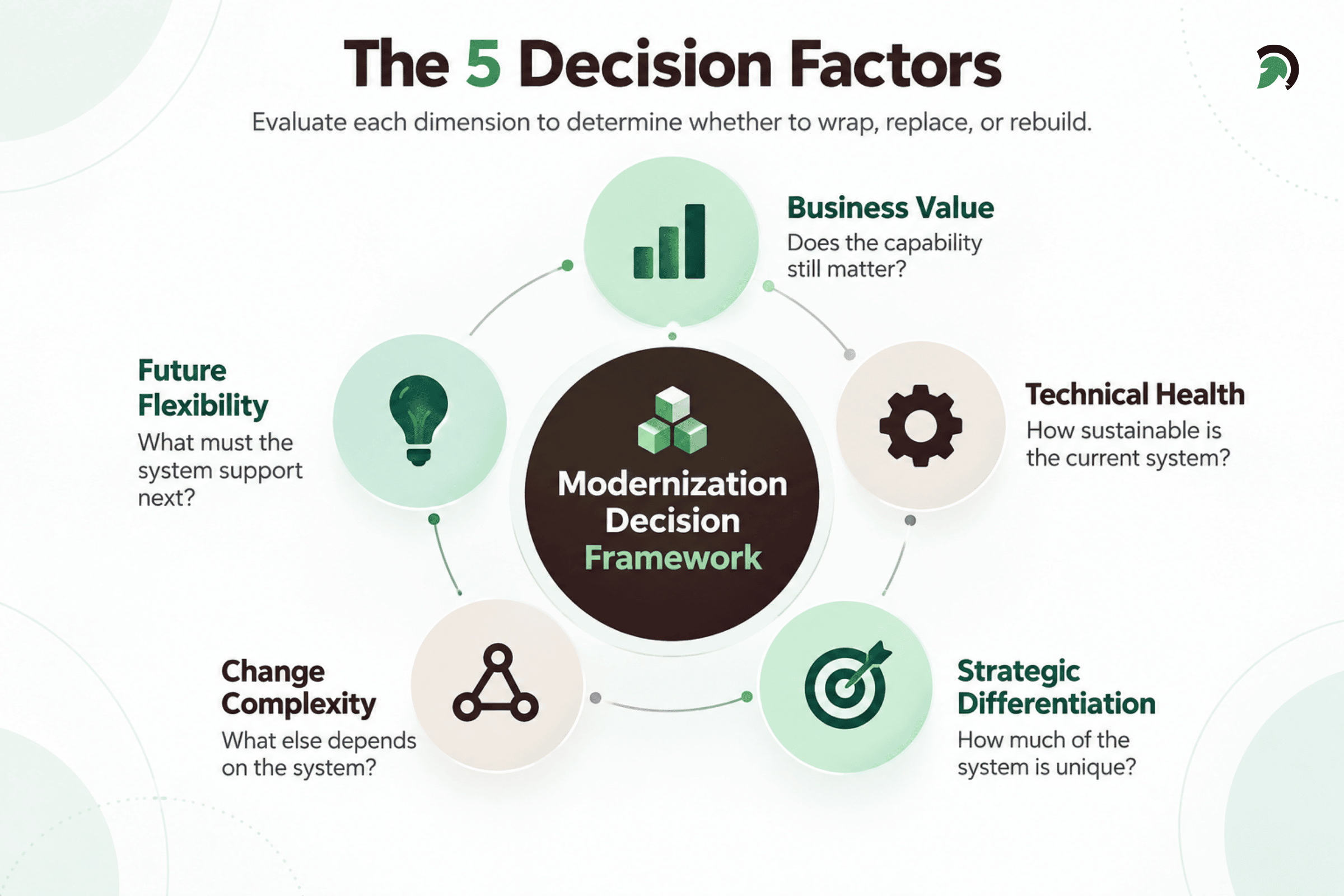
How to Evaluate a Legacy System Modernization Strategy
1. Business Value: Is the Capability Still Worth Investing In?
What to assess
Start with the business capability the system supports. The first question is not how old the technology is, but whether the capability still creates enough value to justify further investment.
Key questions
- What business process does the system enable?
- How important is that process to customers or operations?
- Would downtime affect revenue, service delivery, compliance, or fulfillment?
- How many other applications or teams depend on it?
- Will the business still need this capability several years from now?
What the answer tells you
If the capability is declining in importance, retirement may be more appropriate than modernization. If it remains central to transactions, operations, inventory, patient records, servicing, or fulfillment, the system is a stronger candidate for Wrap, Replace, or Rebuild.
2. Technical Health: How Sustainable Is the Current System?
What to assess
Evaluate how difficult the system is to operate, maintain, secure, and change. Technical debt matters most when it begins creating measurable business or operational consequences.
Key questions
- Does the system rely on unsupported frameworks or infrastructure?
- Are security patches or upgrades becoming difficult?
- Are integrations fragile or tightly coupled?
- Are deployment cycles slow or risky?
- Is the business dependent on a small number of specialists?
- Are scalability, testing, or documentation becoming constraints?
What the answer tells you
If the core remains stable and maintainable, wrapping may extend its useful life. If technical limitations are widespread and continue increasing cost, risk, or delivery time, replacement or rebuilding becomes more compelling.
Quick Stat:
According to Pega and Savanta, 68% of IT decision-makers say legacy systems and applications prevent their organizations from fully embracing modern technologies.
3. Strategic Differentiation: How Much of the System Is Unique?
What to assess
Determine whether the system supports standardized processes or contains capabilities that genuinely differentiate the business.
Key questions
- Does the system contain proprietary workflows or business rules?
- Would a commercial platform support most requirements without heavy customization?
- Does the capability influence pricing, fulfillment, underwriting, production, or customer experience?
- Would replacing the system force the business to give up valuable processes?
- Does maintaining custom software create a competitive advantage?
What the answer tells you
If the capability is standardized, replacement may offer better economics. If the system contains unique workflows or logic central to competitive differentiation, preserving or selectively rebuilding those capabilities may be more valuable.
4. Change Complexity: What Else Depends on the System?
What to assess
Legacy systems rarely operate in isolation. Before changing one, understand the network of applications, data flows, users, and operational processes connected to it.
Key questions
- What systems consume data from the application?
- What systems provide data to it?
- How many integrations would need to change?
- Are dependencies fully documented?
- Would migration interrupt critical operations?
- Are historical data, batch jobs, or partner connections involved?
What the answer tells you
A system with many tightly coupled dependencies may be risky to replace all at once. In those cases, wrapping or incremental rebuilding may provide a safer path. If dependencies are limited and well understood, replacement may be easier to manage.
5. Future Flexibility: What Must the System Support Next?
What to assess
Look beyond the current operating model. The system should be evaluated against what the business expects to launch, connect, scale, or change over the next several years.
Key questions
- Will the business launch new digital products or channels?
- Will customers or partners need API access?
- Will mobile, AI, or automation become more important?
- Will transaction volumes increase significantly?
- Will the organization expand into new markets?
- Does the business need to release functionality more frequently?
What the answer tells you
If the current system can support future requirements with limited extension, wrapping may be sufficient. If future growth requires capabilities the architecture cannot realistically support, replacement or rebuilding may provide a stronger long-term foundation.
The Legacy Modernization Decision Tree
A simple decision sequence can help narrow the available paths.
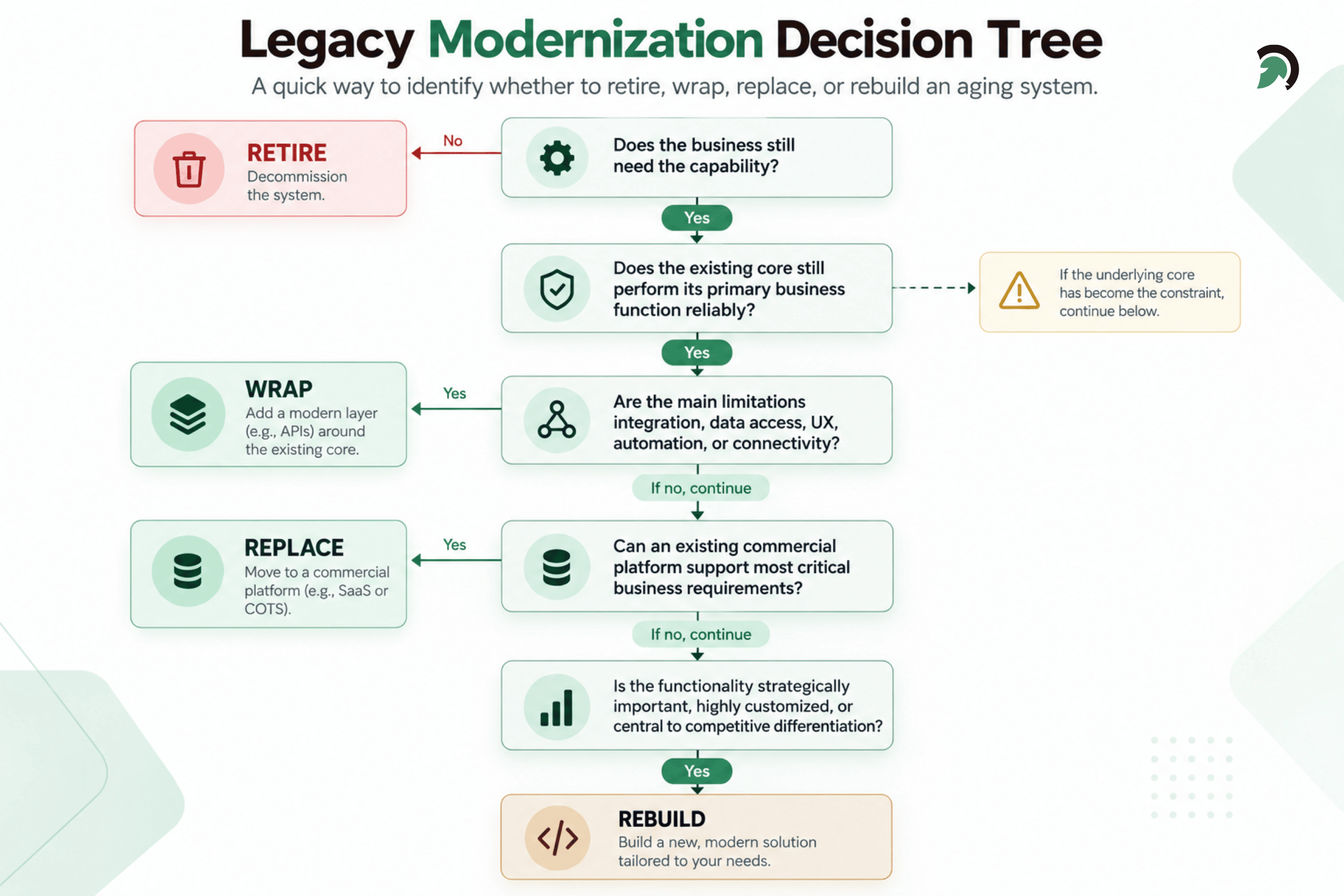
Legacy Application Modernization Options Explained
This decision tree is not intended to produce an automatic answer.
It provides an initial direction. Cost, security, data migration, dependencies, regulatory requirements, operational disruption, and organizational readiness still need to be assessed before a final modernization decision is made.
Wrap vs. Replace vs. Rebuild: How Do the Options Compare?
The three approaches address different types of modernization problems.
| Decision Factor | Wrap | Replace | Rebuild |
| Existing core remains valuable | High | Low | Variable |
| Speed to initial improvement | High | Medium | Lower |
| Initial investment | Low to Medium | Medium | High |
| Customization flexibility | Medium | Low to Medium | Very High |
| Migration complexity | Low to Medium | Medium to High | High |
| Existing business logic retained | Mostly | Limited | Selectively |
| Technical debt removed | Partially | Mostly | Mostly |
| Vendor dependency | Low | Higher | Low to Medium |
| Long-term flexibility | Medium | Vendor dependent | High |
The important point is that there is no universally superior option. The right choice depends on what the organization is trying to preserve, remove, or enable.
Quick Stat:
According to Red Hat, more than half of organizations already modernizing applications report benefits in security (58%), scalability (53%), and reliability (52%).
When to Wrap a Legacy System
What It Means
Wrapping keeps the legacy core in place while adding a modern layer around it, such as APIs, integration services, new interfaces, or reporting capabilities.
Modern Application → API Layer → Legacy Core
This allows the business to extend the value of proven logic without forcing every new system to connect directly with aging technology. A well-designed modern API integration layer can help connect newer applications, services, and data sources to the legacy core without creating additional point-to-point dependencies.
When It Fits
Wrapping works best when:
- the core business logic still works reliably
- integration or accessibility is the main limitation
- new applications need access to legacy data
- replacing the system would create unnecessary risk
- modernization needs to happen incrementally
What to Watch
Wrapping does not remove the underlying technical debt. If the core is insecure, unstable, expensive to maintain, or difficult to scale, wrapping may only delay a broader modernization decision.
When to Replace a Legacy System
What It Means
Replacement moves the business capability from custom legacy software to an established platform such as SaaS, ERP, CRM, WMS, TMS, or another commercial solution.
The goal is to stop maintaining custom software where a proven product can meet most requirements effectively.
When It Fits
Replacement works best when:
- the capability is important but not strategically unique
- mature platforms already support most requirements
- maintaining custom software has become costly
- the business can adapt its processes to the target platform
- vendor-managed upgrades provide greater value than continued custom development
What to Watch
Replacement still requires careful planning around data migration, integrations, process changes, training, licensing, and vendor dependency. If extensive customization has to be recreated, the expected benefits of replacement can quickly decline.
When to Rebuild a Legacy System
What It Means
Rebuilding creates new software around current and future business requirements rather than continuing to extend the existing application.
It allows the organization to redesign architecture, workflows, integrations, data models, security, and user experiences while preserving only the capabilities that still provide value.
When It Fits
Rebuilding works best when:
- the capability is strategically important
- workflows are highly specialized
- the existing architecture significantly limits change
- commercial platforms cannot meet critical requirements
- scalability or maintainability problems are fundamental
- future growth requires greater flexibility
What to Watch
Rebuilding typically requires the greatest investment and migration effort. It does not need to happen all at once, though. Capabilities can be moved incrementally into new services while the legacy platform continues running, reducing risk and allowing each stage to be validated before the old functionality is retired.
What Should You Modernize First?
Large legacy applications rarely need every component modernized at the same time.
A practical starting point is to look for areas where business value and technical constraint intersect.
Prioritize capabilities that have:
High business impact + High technical friction + Manageable migration scope
For example:
- an inventory service that cannot provide timely stock availability
- a checkout integration causing recurring transaction failures
- a manufacturing interface delaying production information
- a claims workflow dependent on manual handoffs
- an aging customer portal preventing new self-service capabilities
Starting with a contained but meaningful capability helps the organization validate its modernization architecture, migration process, operating model, and technical assumptions before expanding the program.
How the Framework Applies Across Industries
The systems change from industry to industry, but the decision framework remains largely the same.
Hospital Patient-Records System
Situation: A hospital depends on an older patient-records system integrated with scheduling, laboratory, pharmacy, billing, and clinical workflows. The core system remains dependable, but newer applications need better access to patient information.
Likely direction: Wrap
Why: Secure APIs and integration services can expose selected data and functionality without immediately replacing a mission-critical clinical system. Replacement can still be considered later if the core becomes technically or operationally unsustainable.
Manufacturer’s ERP
Situation: A manufacturer’s ERP supports purchasing, production planning, materials, inventory, warehouse processes, and supplier interactions. Years of customization have accumulated around the platform.
Likely direction: Replace or selectively rebuild
Why: If most processes are standardized, moving to a modern ERP may be more economical. If the existing application contains production logic unique to the manufacturer, those differentiating capabilities may need to remain custom or be rebuilt separately rather than forced into a standardized ERP model.
Retailer’s Inventory Platform
Situation: A retailer’s aging inventory system calculates stock correctly but cannot easily provide timely availability across ecommerce, stores, marketplaces, mobile applications, and fulfillment systems.
Likely direction: Wrap
Why: A modern inventory API or availability service can expose the required information without immediately replacing the entire inventory engine. A larger rebuild may become necessary later if the retailer moves toward more advanced distributed inventory and fulfillment models.
Financial-Services Platform
Situation: A financial-services organization depends on a servicing, underwriting, or transaction platform containing extensive business rules, compliance logic, historical data, and downstream integrations.
Likely direction: Wrap and incrementally rebuild
Why: Stable core capabilities can initially remain in place while new functionality is developed outside the legacy platform. This phased approach to FinTech platform modernization allows selected capabilities to move gradually into modern services where greater flexibility, integration, or automation creates clear business value.
Distribution and Logistics System
Situation: A distributor relies on older software for inventory allocation, warehouse movement, routing, shipment documents, and fulfillment.
Likely direction: Replace or use a hybrid approach
Why: If a modern ERP, warehouse-management, or transportation-management platform handles most requirements, replacing standardized functionality may be more economical than rebuilding it. Proprietary allocation or fulfillment logic that differentiates the business can remain custom and integrate with the new platform.
One System Can Use More Than One Modernization Strategy
Wrap, Replace, and Rebuild do not always have to be mutually exclusive.
A large legacy system might be broken into capabilities and treated differently.
For example, an organization could:
- Wrap a dependable transaction engine with modern APIs
- Replace a commodity reporting module with an analytics platform
- Rebuild a proprietary pricing or fulfillment capability
- Retire functionality that is no longer used
This is why modernization decisions are often more useful at the capability level, not only at the application level.
The goal is not to assign one label to a large system.
It is to determine which treatment creates the best balance of business value, technical improvement, risk, and future flexibility for each important capability.
When You Should Not Modernize a Legacy System Yet
Modernization is not automatically the right investment. Retaining an existing system may make sense when:
- it remains stable and inexpensive to operate
- the security and compliance risk is acceptable
- few users depend on it
- the supported business process is declining in importance
- another initiative will soon eliminate the requirement
- the application already has a planned retirement date
- modernization cost exceeds the expected business benefit
A modernization program also should not begin only because newer architecture or technology appears more attractive.
If an application still performs its job effectively and its risks remain manageable, retaining it can be a legitimate business decision.
The goal is not to modernize the most software. The goal is to remove the constraints that prevent the business from moving forward.
Quick Stat:
According to Saritasa, 50% of organizations have not upgraded their legacy software because their current system still works.
Legacy Modernization Decision Checklist
Legacy Modernization Framework for Choosing the Right Approach
Before choosing Wrap, Replace, or Rebuild, ask these six questions.
Is the capability still strategically important? If not, consider retiring the system before investing in modernization.
Does the core business logic still work reliably? If yes, preserving what works may be more valuable than replacing the entire system.
Are integration, data access, UX, or automation the main limitations? If yes, Wrap may be the most practical approach.
Can an established platform meet most critical requirements? If yes, evaluate Replace before committing to extensive custom development.
Does the business depend on unique workflows or proprietary logic? If yes, Rebuild may provide greater control and long-term flexibility.
Does the expected business value justify the migration cost and operational risk? If not, retain the system or modernize a smaller capability first.
Bottom Line
There is no universally correct legacy modernization strategy. For one organization, the right move may be exposing a dependable legacy core through modern APIs. For another, replacing custom software with a proven platform may remove unnecessary complexity. Where competitive advantage depends on specialized workflows and the existing architecture can no longer support them, incremental rebuilding may offer the stronger long-term path.
The decision should start with five questions: What still creates business value? How healthy is the technology? What truly differentiates the business? How complex will the change be? What flexibility will the organization need next?
Answering those questions helps businesses determine what should be kept, what should be replaced, and what is worth rebuilding.
EvinceDev helps organizations approach legacy modernization through Digital Transformation & Integration, connecting existing systems, modernizing critical capabilities, and designing architectures that support what the business needs next.
Explore how a structured modernization strategy can help you determine what to keep, what to change, and what to build next.