
Key Takeaways
- Choose for Fit: Select technologies based on project needs, scalability, security, budget, and long-term maintenance.
- Balance Frontend and Backend: A strong web solution depends on the right combination of user-facing and server-side technologies.
- Keep Architecture Simple: Avoid unnecessary tools and frameworks that increase complexity, cost, and maintenance effort.
- Plan for Growth: Use databases, cloud platforms, APIs, and DevOps tools that can support future traffic and features.
- Follow Emerging Trends: AI, WebAssembly, serverless architecture, and edge computing are shaping modern web development.
Modern websites are no longer limited to displaying static information. They support online transactions, customer portals, real-time communication, personalized content, automation, analytics, and complex business workflows.
Building these digital experiences requires a combination of programming languages, frameworks, databases, APIs, cloud platforms, testing tools, and security practices. Together, these components are known as web development technologies.
However, the most popular technology is not always the right technology. A stack that works well for a corporate website may not suit a SaaS platform, ecommerce marketplace, enterprise portal, or AI-powered application.
This guide provides a practical web development introduction, explains the major technology categories, and helps businesses and development teams understand how to select the right tools for different types of projects.
What Is Web Development?
Web development is the process of planning, designing, building, testing, deploying, and maintaining websites and browser-based applications. It includes everything from simple business websites to large platforms that manage users, payments, workflows, data, and third-party integrations.
Web development is generally divided into three areas:
- Frontend Development: Frontend development covers everything users see and interact with in a browser, including page layouts, navigation, forms, animations, dashboards, and interactive elements.
- Backend Development: Backend development manages business logic, databases, authentication, APIs, integrations, and server-side processing.
- Full-Stack Development: Full-stack development combines frontend and backend responsibilities. Full-stack developers work across user interfaces, application logic, databases, and deployment environments.
The combination of tools selected for these areas forms the technology stack of a website or application.
Why Choosing the Right Web Development Technology Matters
“A good architecture is important, otherwise it becomes slower and more expensive to add new capabilities in the future.”
Martin Fowler, Chief Scientist at Thoughtworks and Software Architecture Author
Technology choices influence how quickly an application can be built, how securely it handles data, how easily it scales, and how much it costs to maintain.
Selecting the right technologies for web development can help a business:
- Improve website and application performance
- Deliver a better user experience
- Support future traffic and feature growth
- Strengthen security and data protection
- Simplify integrations with business systems
- Reduce development and maintenance costs
- Shorten time to market
- Make future upgrades easier
Poor technology decisions can create performance issues, security risks, integration limitations, and expensive modernization requirements.
The right stack should therefore be selected according to business goals, user needs, technical requirements, team expertise, and long-term maintenance expectations.
Main Types of Web Development Technologies
A complete website or web application usually combines several technology categories.
The main categories include:
- Frontend technologies
- Backend technologies
- Database technologies
- API and integration technologies
- Content management systems
- Cloud and hosting platforms
- DevOps and deployment tools
- Testing technologies
- Security technologies
The following web development technologies list explains the role of each category and the commonly used tools within it.
Frontend Web Development Technologies
Frontend technologies control how a website looks, feels, and responds to user actions.
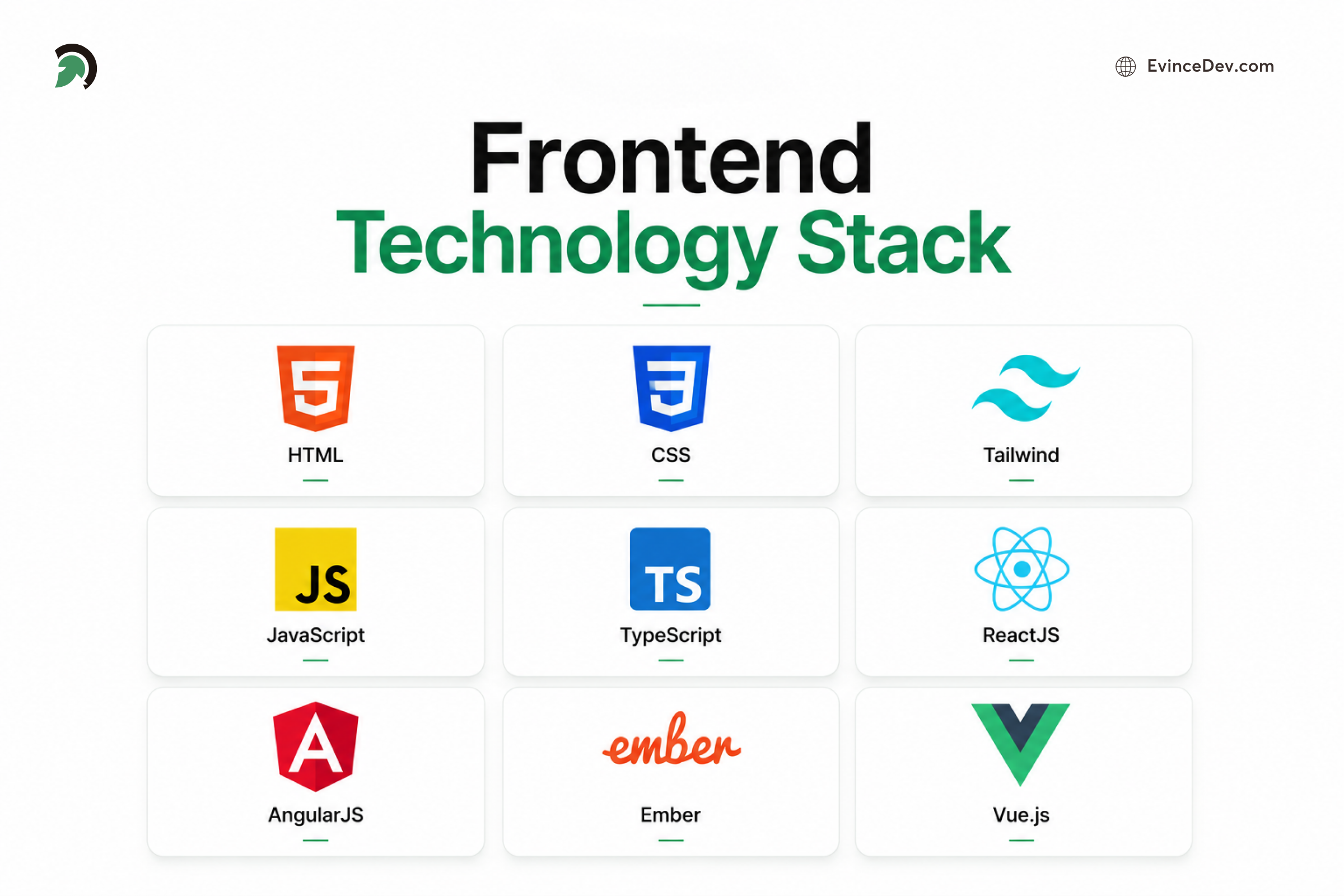
Frontend Web Development Technologies
HTML
What it is:
HTML, or HyperText Markup Language, defines the structure and meaning of web content. It organizes headings, paragraphs, images, links, forms, buttons, navigation menus, and other page elements.
Key strengths:
HTML is universally supported by browsers and provides the foundation for accessible and search-friendly web pages.
Best suited for:
Every website and browser-based application uses HTML in some form.
Related technologies:
CSS, JavaScript, browser APIs, and accessibility standards.
Key consideration:
Using semantic HTML is important because it helps browsers, search engines, and assistive technologies understand page content correctly.
CSS
What it is:
CSS, or Cascading Style Sheets, controls the visual appearance of a website.
Key strengths:
It manages colors, typography, spacing, layouts, animations, transitions, and responsive behavior.
Best suited for:
CSS is used across all websites and applications that require visual styling.
Related tools:
Sass, Tailwind CSS, Bootstrap, PostCSS, CSS Grid, and Flexbox.
Key consideration:
Large CSS codebases require clear naming conventions, reusable components, and consistent design standards to remain maintainable.
JavaScript
What it is:
JavaScript is the main programming language used to add interactivity and dynamic behavior to websites.
Key strengths:
It can update content without reloading a page, validate forms, display alerts, manage application state, and communicate with backend APIs.
Best suited for:
Interactive websites, dashboards, web applications, ecommerce platforms, and browser-based tools.
Popular frameworks and libraries:
React, Angular, Vue.js, Next.js, Svelte, and jQuery.
Key consideration:
Poorly optimized JavaScript can affect page speed, browser performance, and user experience.
Quick Stat:
According to HTTP Archive, the median JavaScript payload reached 558 KB on mobile and 613 KB on desktop in 2024, representing a 14% increase from the previous measurement.
TypeScript
What it is:
TypeScript is an extension of JavaScript that adds static typing and additional development features.
Key strengths:
It helps developers identify certain errors before execution and makes larger codebases easier to understand and maintain.
Best suited for:
Enterprise applications, SaaS products, large frontend systems, and projects involving multiple developers.
Popular integrations:
React, Angular, Vue.js, Node.js, and Next.js.
Key consideration:
TypeScript introduces an additional compilation and configuration layer, so teams need appropriate development standards and tooling.
Quick Stat:
GitHub reported that TypeScript overtook JavaScript and Python in August 2025 to become the most-used programming language on GitHub, adding more than one million contributors during the year.
Popular Frontend Frameworks and Libraries
Frontend frameworks and libraries provide reusable components, application patterns, routing, state management, and development tools.
| Technology | Best suited for | Key strength | Key consideration |
| React | Interactive applications | Reusable component model | Requires additional tools for a complete application |
| Angular | Large enterprise systems | Structured all-in-one framework | Higher learning curve |
| Vue.js | Small to large interfaces | Flexible and approachable | Smaller enterprise ecosystem than React or Angular |
| Next.js | Full-stack React applications | Routing, rendering, and performance | Requires understanding of server and client rendering |
| Svelte | Lightweight applications | Reduced browser-side overhead | Smaller ecosystem and talent pool |
These are among the best web development technologies for modern frontend development, but the ideal choice depends on application size, rendering requirements, team expertise, and maintenance needs.
Backend Web Development Technologies
Backend technologies process data, apply business rules, manage authentication, connect databases, and communicate with external systems.
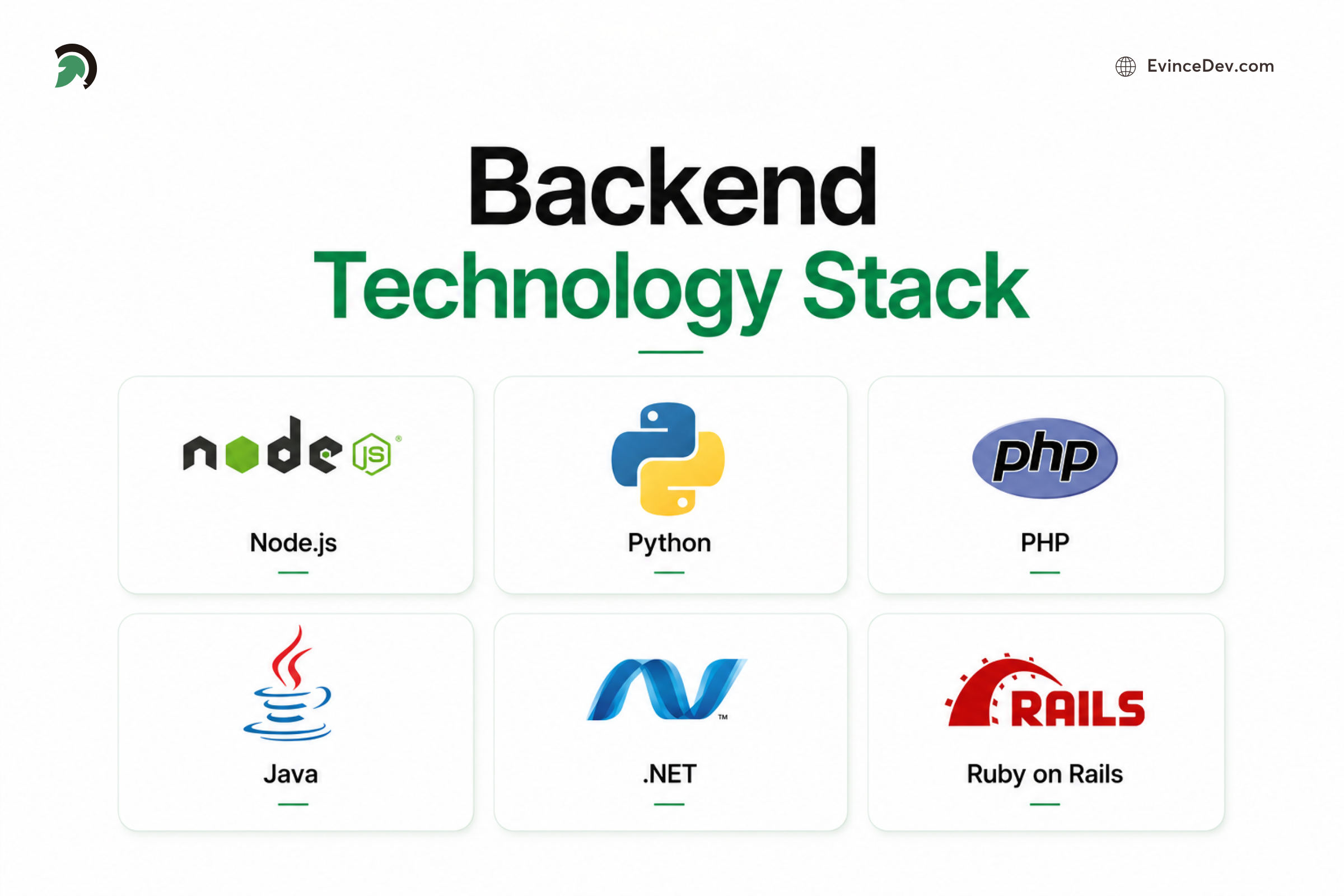
Backend Technologies Powering Modern Websites
Node.js
What it is:
Node.js is a JavaScript runtime that allows developers to run JavaScript on the server.
Key strengths:
It supports asynchronous processing, handles large numbers of concurrent connections, and allows teams to use JavaScript across the frontend and backend.
Best suited for:
Real-time applications, APIs, streaming platforms, collaboration tools, and microservices.
Popular frameworks:
Express, NestJS, Fastify, and Koa.
Key consideration:
Node.js is well suited to input and output-heavy workloads, but CPU-intensive processing may require worker processes or additional services.
Python
What it is:
Python is a general-purpose language widely used for web development, automation, data processing, and artificial intelligence.
Key strengths:
It offers readable syntax, a large ecosystem, and strong integration with machine learning and analytics tools.
Best suited for:
AI-powered applications, SaaS platforms, APIs, automation systems, and data-driven products.
Popular frameworks:
Django, Flask, and FastAPI.
Key consideration:
Performance-sensitive systems may require asynchronous processing, caching, or supporting infrastructure.
PHP
What it is:
PHP is a server-side programming language used for websites, ecommerce systems, content platforms, and business applications.
Key strengths:
It has broad hosting support, a mature ecosystem, and strong compatibility with content management systems.
Best suited for:
Corporate websites, CMS platforms, ecommerce stores, and custom portals.
Popular frameworks:
Laravel, Symfony, and CodeIgniter.
Key consideration:
Application quality depends heavily on the selected framework, architecture, coding standards, and security practices.
Java
What it is:
Java is a general-purpose programming language commonly used for large, secure, and long-running business systems.
Key strengths:
It offers strong performance, mature tooling, structured development patterns, and broad enterprise support.
Best suited for:
Banking platforms, enterprise portals, large APIs, financial applications, and microservices.
Popular frameworks:
Spring Boot, Spring Framework, Jakarta EE, and Quarkus.
Key consideration:
Java applications can require more initial setup and architectural planning than lightweight alternatives.
.NET
What it is:
.NET is Microsoft’s cross-platform development platform, commonly used with C# and ASP.NET Core.
Key strengths:
It provides strong development tools, security capabilities, performance, and deep integration with Microsoft platforms.
Best suited for:
Enterprise applications, internal portals, cloud systems, APIs, and software used within Microsoft environments.
Popular tools:
ASP.NET Core, Entity Framework Core, Blazor, Azure, and Visual Studio.
Key consideration:
Teams should consider their existing infrastructure, Microsoft ecosystem usage, and developer availability.
Ruby on Rails
What it is:
Ruby on Rails is a web application framework built with the Ruby programming language.
Key strengths:
It follows a convention-based approach that can reduce setup time and accelerate product development.
Best suited for:
Startups, marketplaces, SaaS platforms, and minimum viable products.
Popular tools:
Ruby, Rails, Sidekiq, and RSpec.
Key consideration:
Its developer ecosystem is smaller than those of JavaScript, Python, and Java.
Backend Technology Comparison
| Technology | Common use case | Main advantage | Important limitation |
| Node.js | Real-time applications | Strong concurrency support | Less suitable for heavy CPU processing |
| Python | AI and data applications | Strong AI ecosystem | May require optimization at scale |
| PHP | CMS and ecommerce | Mature and cost-effective | Quality varies by architecture |
| Java | Enterprise platforms | Reliability and scalability | More initial complexity |
| .NET | Microsoft-based systems | Strong enterprise tooling | Best fit often depends on ecosystem |
| Ruby on Rails | Rapid product development | High development speed | Smaller developer pool |
Database Technologies for Web Development
Databases store and organize application information such as user profiles, orders, products, payments, content, and activity records.
Relational Databases
What they are:
Relational databases store information in tables with defined relationships and use SQL for data management.
Key strengths:
They provide structured schemas, reliable transactions, strong consistency, and powerful query capabilities.
Best suited for:
Financial systems, ecommerce platforms, CRM tools, ERP systems, and applications with structured data relationships.
Popular options:
PostgreSQL, MySQL, Microsoft SQL Server, Oracle Database, and MariaDB.
Key consideration:
Schema design and indexing must be planned carefully to maintain performance as data grows.
NoSQL Databases
What they are:
NoSQL databases use document, key-value, column, or graph-based data models.
Key strengths:
They provide flexible schemas and can support large-scale distributed workloads.
Best suited for:
Content platforms, event data, caching, real-time applications, and systems with rapidly changing data structures.
Popular options:
MongoDB, Redis, Cassandra, DynamoDB, and Firebase Firestore.
Key consideration:
NoSQL does not mean one standard database model. Each platform offers different consistency, query, and scaling characteristics.
SQL vs NoSQL
| Factor | SQL databases | NoSQL databases |
| Data model | Tables and relationships | Documents, key-value, column, or graph |
| Schema | Structured | Flexible |
| Transactions | Strong support | Varies by platform |
| Relationships | Strong | Often handled differently |
| Best suited for | Structured business data | Flexible or distributed data |
Many modern applications use both. For example, an ecommerce platform may use PostgreSQL for orders and Redis for caching.
API and Integration Technologies
APIs allow separate systems, applications, and services to exchange data.
REST APIs
What they are:
REST APIs use standard HTTP methods to send and receive information.
Key strengths:
They are widely supported, simple to understand, and suitable for many integrations.
Best suited for:
Web applications, mobile applications, partner integrations, and public APIs.
Common methods:
GET, POST, PUT, PATCH, and DELETE.
Key consideration:
Poorly designed endpoints can create over-fetching, duplication, and inconsistent responses.
GraphQL
What it is:
GraphQL allows clients to request only the data fields they need.
Key strengths:
It gives frontend teams greater control and can reduce unnecessary data transfer.
Best suited for:
Applications with complex user interfaces, multiple clients, or frequently changing data requirements.
Popular tools:
Apollo, Relay, GraphQL Yoga, and Hasura.
Key consideration:
Teams must manage query complexity, caching, authorization, and performance carefully.
WebSockets
What they are:
WebSockets create a continuous, two-way connection between the browser and server.
Key strengths:
They support instant communication without repeated requests.
Best suited for:
Chat applications, live dashboards, collaboration tools, notifications, gaming, and tracking systems.
Popular tools:
Socket.IO, ws, SignalR, and native WebSocket APIs.
Key consideration:
Persistent connections require careful scaling, monitoring, and connection management.
Third-Party APIs
What they are:
Third-party APIs allow applications to use external services instead of building every feature internally.
Common use cases:
Payments, messaging, maps, analytics, identity management, CRM integration, and AI functionality.
Popular examples:
Stripe, PayPal, Twilio, Google Maps, Salesforce, HubSpot, Auth0, and cloud AI platforms.
Key consideration:
Businesses should assess pricing, uptime, security, data privacy, rate limits, and vendor dependency before integration.
Content Management Technologies
Content management systems allow nontechnical users to create and publish digital content.
Traditional CMS Platforms
What they are:
Traditional CMS platforms manage both website content and presentation from the same system.
Key strengths:
They provide ready-made editing tools, themes, plugins, and publishing workflows.
Best suited for:
Business websites, blogs, news platforms, landing pages, and content-focused websites.
Popular options:
WordPress, Drupal, and Joomla.
Key consideration:
Large plugin ecosystems can introduce security, performance, and compatibility issues if not managed carefully.
Quick Stat:
As of July 2026, WordPress is used by 41.2% of all websites and holds a 59.1% share of websites using a known CMS, according to W3Techs
Headless CMS Platforms
What they are:
A headless CMS stores and manages content while delivering it through APIs to separate frontend applications.
Key strengths:
It supports flexible frontend development and content delivery across websites, mobile apps, and other channels.
Best suited for:
Omnichannel platforms, modern web applications, ecommerce experiences, and multi-brand content systems.
Popular options:
Strapi, Contentful, Sanity, Storyblok, and Directus.
Key consideration:
Headless architecture usually requires more development work than a traditional CMS.
Traditional CMS vs Headless CMS
| Factor | Traditional CMS | Headless CMS |
| Frontend | Connected to the CMS | Developed separately |
| Setup speed | Faster | Requires more development |
| Flexibility | Theme and plugin dependent | High |
| Multi-channel delivery | Limited | Strong |
| Best suited for | Standard content websites | Custom digital experiences |
Cloud and Hosting Technologies
Cloud and hosting platforms provide the infrastructure needed to deploy and run websites and applications.
Major Cloud Platforms
What they provide:
Large cloud platforms offer computing, storage, databases, networking, identity management, serverless functions, monitoring, and security tools.
Key strengths:
They support scalable infrastructure and a broad range of managed services.
Best suited for:
SaaS products, enterprise platforms, ecommerce systems, APIs, and distributed applications.
Popular options:
Amazon Web Services, Microsoft Azure, and Google Cloud Platform.
Key consideration:
Cloud services can become expensive or difficult to manage without clear architecture, monitoring, and cost controls.
Frontend and Managed Hosting Platforms
What they provide:
These platforms simplify website deployment, content delivery, serverless functions, and frontend hosting.
Key strengths:
They offer fast deployment workflows, global content delivery, and developer-friendly automation.
Best suited for:
Frontend applications, static websites, headless CMS projects, and server-rendered JavaScript applications.
Popular options:
Vercel, Netlify, Cloudflare, and DigitalOcean.
Key consideration:
Teams should review platform limits, pricing models, portability, and backend requirements.
DevOps and Deployment Technologies
DevOps technologies help teams automate software delivery, infrastructure management, testing, and deployment.
Docker
What it is:
Docker packages an application and its dependencies into a container.
Key strengths:
It creates consistent environments across development, testing, and production.
Best suited for:
APIs, microservices, cloud deployments, and applications with multiple dependencies.
Related tools:
Docker Compose, container registries, and Kubernetes.
Key consideration:
Containers improve consistency but still require security updates, image management, and monitoring.
Kubernetes
What it is:
Kubernetes manages containerized applications across clusters of computing resources.
Key strengths:
It supports automated deployment, scaling, service discovery, and recovery.
Best suited for:
Large distributed systems, microservices platforms, and high-availability applications.
Related tools:
Helm, Istio, Prometheus, and managed Kubernetes services.
Key consideration:
Kubernetes may be unnecessarily complex for small or straightforward applications.
CI/CD Platforms
What they are:
Continuous integration and continuous delivery tools automate application building, testing, and deployment.
Key strengths:
They reduce manual deployment errors and improve release consistency.
Best suited for:
Teams that release updates frequently or manage multiple environments.
Popular options:
GitHub Actions, GitLab CI/CD, Jenkins, Azure DevOps, and CircleCI.
Key consideration:
Pipelines must be secured because they often access source code, credentials, and production infrastructure.
Terraform
What it is:
Terraform is an infrastructure-as-code tool used to define cloud resources through configuration files.
Key strengths:
It improves infrastructure consistency, documentation, and repeatability.
Best suited for:
Cloud environments, multi-region systems, and infrastructure managed across development teams.
Related tools:
OpenTofu, Pulumi, Ansible, and cloud-native templates.
Key consideration:
Infrastructure state and credentials must be protected carefully.
Web Development Testing Technologies
Testing tools help identify functional, performance, security, and compatibility issues.
Unit and Integration Testing
What it tests:
Unit testing checks individual functions or components, while integration testing verifies that multiple parts work together.
Key strengths:
It helps identify defects early and supports safer code changes.
Best suited for:
Business logic, API services, frontend components, and backend modules.
Popular tools:
Jest, Vitest, JUnit, Pytest, PHPUnit, and NUnit.
Key consideration:
Tests should focus on meaningful behavior rather than simply increasing test coverage percentages.
End-to-End Testing
What it tests:
End-to-end testing simulates complete user journeys within an application.
Key strengths:
It validates workflows such as registration, checkout, payments, and account management.
Best suited for:
Business-critical processes and user-facing applications.
Popular tools:
Playwright, Cypress, and Selenium.
Key consideration:
End-to-end tests can become slow and unstable if too many are added without a clear strategy.
Performance Testing
What it tests:
Performance testing evaluates page speed, response times, stability, and system behavior under load.
Key strengths:
It helps teams identify bottlenecks before they affect users.
Best suited for:
High-traffic websites, ecommerce platforms, APIs, and enterprise systems.
Popular tools:
Lighthouse, k6, JMeter, and WebPageTest.
Key consideration:
Performance testing should reflect realistic user behavior and infrastructure conditions.
Web Security Technologies and Practices
Security must be considered throughout design, development, testing, deployment, and maintenance.
Authentication and Access Control
What it covers:
Authentication confirms user identity, while authorization controls what each user can access.
Common technologies:
OAuth 2.0, OpenID Connect, JSON Web Tokens, multi-factor authentication, and role-based access control.
Best suited for:
Customer portals, internal systems, SaaS platforms, and applications handling sensitive information.
Key consideration:
Authentication tokens, sessions, passwords, and access rules must be managed securely.
Data and Application Protection
What it covers:
These controls protect data during transmission, storage, and processing.
Common practices:
HTTPS, TLS, encryption, secure cookies, input validation, secrets management, and dependency scanning.
Best suited for:
Every production website or application.
Key consideration:
Security controls should be selected according to application risk, data sensitivity, and regulatory obligations.
Monitoring and Defensive Security
What it covers:
Monitoring technologies help detect suspicious activity, application errors, and attempted attacks.
Common tools:
Web application firewalls, security monitoring systems, audit logs, intrusion detection, and vulnerability scanners.
Key consideration:
Security tools must be supported by clear incident response and maintenance processes.
Latest Web Development Technologies and Trends in 2026
The latest web development technologies are focused on improving development speed, performance, intelligence, deployment flexibility, and user experience.
AI-Assisted Web Development
What it is:
AI-assisted development uses artificial intelligence to support coding, testing, documentation, debugging, and code review.
Key benefits:
It can reduce repetitive work and help developers navigate complex codebases more quickly.
Best suited for:
Software teams building and maintaining large applications.
Common use cases:
Code completion, test creation, documentation, refactoring, and debugging.
Key consideration:
AI-generated code must still be reviewed for correctness, security, maintainability, and licensing concerns.
Quick Stat:
GitHub identified more than 1.1 million public repositories using an LLM SDK in 2025, with nearly 694,000 of those projects created within the previous 12 months, representing 178% year-over-year growth.
Progressive Web Apps
What they are:
Progressive web apps combine browser-based development with selected app-like capabilities.
Key benefits:
They may support installation, offline access, push notifications, and improved mobile usability.
Best suited for:
Ecommerce platforms, field-service tools, content platforms, and customer-facing applications.
Related technologies:
Service workers, web app manifests, caching APIs, and push notifications.
Key consideration:
Capabilities can vary between browsers, operating systems, and devices.
WebAssembly
What it is:
WebAssembly is a low-level format that allows high-performance code to run in browsers.
Key benefits:
It supports performance-intensive applications and allows languages such as Rust, C, and C++ to work alongside JavaScript.
Best suited for:
Browser-based design tools, games, scientific software, video processing, and engineering applications.
Related tools:
Rust, Emscripten, Blazor WebAssembly, and WASI.
Key consideration:
WebAssembly complements JavaScript rather than replacing it.
Serverless Architecture
What it is:
Serverless architecture allows developers to deploy application functions without managing traditional servers directly.
Key benefits:
It can reduce infrastructure administration and support automatic scaling.
Best suited for:
APIs, scheduled jobs, event-driven workloads, and applications with changing demand.
Popular platforms:
AWS Lambda, Azure Functions, Google Cloud Functions, and Cloudflare Workers.
Key consideration:
Teams must consider execution limits, cold starts, observability, and provider dependency.
Edge Computing
What it is:
Edge computing processes certain requests closer to the user rather than at a distant central server.
Key benefits:
It can reduce latency and improve performance for globally distributed users.
Best suited for:
Authentication, content delivery, personalization, redirects, and lightweight API processing.
Popular platforms:
Cloudflare Workers, Vercel Edge Functions, and edge services from major cloud providers.
Key consideration:
Not every workload is suitable for edge execution, particularly operations requiring centralized data or heavy processing.
Low-Code and No-Code Platforms
What they are:
Low-code and no-code platforms allow users to build applications through visual tools and predefined components.
Key benefits:
They can accelerate internal tools, prototypes, dashboards, and simple workflows.
Best suited for:
Small applications, workflow automation, business forms, and proof-of-concept projects.
Popular options:
Microsoft Power Apps, Bubble, Webflow, Retool, and Appsmith.
Key consideration:
Complex integrations, unique functionality, and large-scale requirements may still require custom web application development technologies.
How to Choose the Right Web Development Technology Stack
There is no universally correct technology stack. The selection process should begin with the project requirements.
- Project Type: A marketing website, SaaS platform, customer portal, ecommerce store, and enterprise system each require different capabilities.
- Performance Requirements: Teams should define expected traffic, page-speed targets, transaction volumes, response times, and real-time processing needs.
- Scalability: The architecture should support expected business growth without adding unnecessary complexity too early.
- Security and Compliance: The technology stack should reflect data sensitivity, access controls, audit requirements, and industry regulations.
- Team Expertise: A platform can only be maintained effectively when the team has the necessary skills and experience.
- Integration Needs: The stack should support required connections with payment providers, CRMs, ERPs, identity platforms, and legacy systems.
- Development Budget: The most complex architecture is not always the best. Technology decisions should balance performance, cost, development speed, and maintenance.
- Long-Term Support: Teams should assess documentation quality, community support, upgrade paths, ecosystem stability, and talent availability.
The best web development technologies are those that satisfy project requirements while keeping the architecture as simple and maintainable as possible.
Expert Perspective:
The best technology stack is rarely the one with the most tools. It is the one that keeps the product simple to build, secure to operate, and easy to evolve as requirements change. Teams should evaluate technologies based on long-term maintenance, integration fit, talent availability, and business risk, not popularity alone.
- Henit Nathwani, Dept. Head – Mobile, EvinceDev
Recommended Technology Stacks for Different Projects
| Suggested technology stack | |
| Corporate website | WordPress, PHP, MySQL |
| Content platform | Next.js, headless CMS, PostgreSQL |
| Ecommerce platform | React or Next.js, Node.js, PostgreSQL, Redis |
| SaaS application | React, Node.js or .NET, PostgreSQL, AWS or Azure |
| Enterprise portal | Angular, Java or .NET, SQL Server |
| Real-time application | React, Node.js, WebSockets, Redis |
| AI-powered application | React, Python, FastAPI, PostgreSQL, vector database |
| Internal business tool | Vue or React, .NET or Node.js, PostgreSQL |
| Browser-based design tool | TypeScript, WebAssembly, cloud APIs |
These combinations are examples rather than fixed rules. The final architecture should be validated against business and technical requirements.
Frontend vs Backend vs Full-Stack Technologies
Many web development courses teach a complete stack such as MERN, which includes MongoDB, Express, React, and Node.js.
| Area | Main responsibility | Common tools |
| Frontend | User interface and browser interaction | HTML, CSS, JavaScript, React, Angular |
| Backend | Logic, APIs, databases, and security | Node.js, Python, PHP, Java, .NET |
| Full stack | Frontend and backend development | Combined frontend, backend, database, and cloud tools |
These courses provide a useful foundation, but professional web development also requires knowledge of security, accessibility, testing, architecture, performance, source control, and deployment.
Common Mistakes When Selecting Web Development Technologies
- Choosing Technology Based Only on Popularity: Popular tools may not match the application’s functionality, budget, or maintenance requirements.
- Overengineering the Architecture: Microservices, Kubernetes, and multi-cloud systems may add unnecessary cost and complexity to smaller applications.
- Ignoring Long-Term Maintenance: Technology decisions should account for upgrades, security patches, developer availability, and ecosystem support.
- Using Too Many Tools: Every additional framework, platform, and database increases maintenance and security responsibilities.
- Overlooking Security: Security should influence authentication, APIs, data storage, deployment, and testing from the beginning.
- Copying Another Company’s Stack: A stack designed for a global platform may be unnecessarily complex for a smaller business.
- Ignoring Integration Requirements: Teams should identify required business systems and APIs before selecting frameworks and platforms.
How a Web Development Company Helps Select the Right Technologies
An experienced web development company evaluates business goals, user needs, technical requirements, integrations, security expectations, scalability, budget, and long-term maintenance before recommending a stack.
Professional web development services may include:
- Business and technical discovery
- Technology-stack selection
- Application architecture
- Frontend and backend development
- API and database design
- Cloud deployment
- Testing and security validation
- Ongoing maintenance and modernization
A reliable web development company should explain why each technology is recommended, what trade-offs it introduces, and how it supports the product roadmap.
The right web development services provider can also help prevent overengineering and reduce the risk of choosing tools that become difficult or expensive to maintain.
Bottom Line
Choosing the right web development technologies is about finding the best fit for your project, not simply selecting the newest framework or most popular platform. The ideal stack should support performance, security, scalability, integration needs, development efficiency, and long-term maintenance.
EvinceDev provides web development services that help businesses evaluate technology options, design the right architecture, and build reliable digital products aligned with real business goals. With the right technical foundation, organizations can launch faster, adapt more easily, and support sustainable growth.