Java may be one of the longest-standing programming languages, but it is far from outdated. It continues to support high-traffic platforms, enterprise applications, APIs, and cloud-based systems where performance, stability, and scalability matter.
A major reason for Java’s continued relevance is the wide range of web Java framework options available for different architectures and development needs. Java frameworks reduce repetitive work, simplify application architecture, and give developers proven tools for building everything from lightweight web services to complex enterprise platforms. The challenge is not finding a framework, but choosing the right one for the project.
Quick Stat:
In Stack Overflow’s 2025 Developer Survey, 29.4% of respondents reported using Java, reinforcing its continued relevance for backend, enterprise, and web application development.
Why Use Java Frameworks?
Java frameworks simplify and accelerate development by providing pre-built tools, libraries, and functionalities. They reduce the need for repetitive coding, streamline database integration, and enhance application scalability and performance. Frameworks also enforce coding best practices, ensuring that applications are secure, reliable, and maintainable.
Frameworks foster community-driven development, offering robust documentation, frequent updates, and active support networks. Whether you’re building microservices, full-stack solutions, or enterprise-grade systems, Java frameworks provide a solid foundation, enabling developers to focus on solving complex problems rather than reinventing the wheel.
Top Java Frameworks for Web Development in 2026
Let’s explore the top 10 Java frameworks you should consider in 2026.
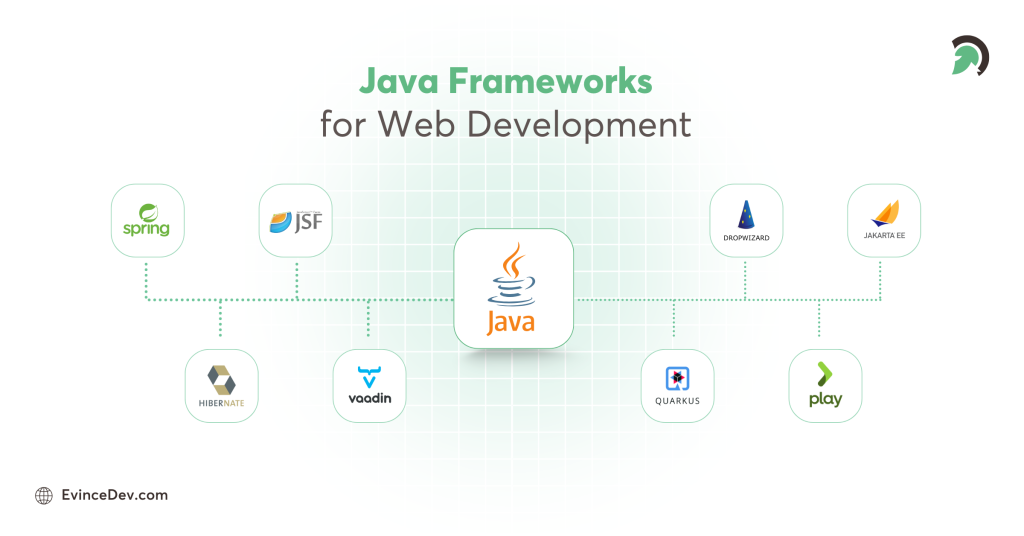
Spring Boot
Spring Boot has emerged as one of the most popular Java frameworks for building web applications efficiently. Built on top of the Spring Framework, it simplifies the development of production-ready applications by offering auto-configuration, embedded servers, and minimal boilerplate code. Spring Boot enables rapid development of enterprise-grade and microservices-based solutions with ease.
Why choose Spring Boot?
- Accelerates web app development with pre-configured setups
- Ideal for building scalable microservices and RESTful APIs
- Backed by a strong community and rich Spring ecosystem
Hibernate
Hibernate is a leading Java framework for object-relational mapping (ORM), simplifying database interactions by mapping Java objects to database tables. It eliminates the need for extensive SQL coding, enabling developers to focus on business logic. Hibernate’s features, like caching and lazy loading, make it ideal for data-driven applications requiring efficient database operations.
Key Features of Hibernate
- Simplifies database connectivity and operations.
- Eliminates boilerplate code for database interactions.
- Works efficiently with all major databases.
Jakarta Faces, Formerly JSF
Jakarta Faces, developed by Oracle, is a component-based framework for building user interfaces in Java-based web applications. It simplifies UI development with reusable components and tight integration with Jakarta EE, enabling seamless back-end connectivity. JSF is ideal for enterprise projects, offering features like state management, event handling, and support for custom components, ensuring scalability and efficiency. Jakarta Faces remains one of the established Java frontend frameworks for component-based, server-rendered enterprise interfaces.
Why Choose Jakarta Faces?
- Provides a library of reusable UI components.
- Simplifies UI development with a declarative approach.
- Integrates effortlessly with other Java EE technologies.
Vaadin
As a server-side Java web application framework, Vaadin allows teams to build interactive interfaces while working primarily with Java. It is well-suited for full-stack web application development and supports seamless creation of single-page applications (SPAs). With its extensive UI components, built-in themes, and Java-based architecture, Vaadin ensures efficient, scalable, and intuitive web development.
Vaadin Highlights
- Simplifies building interactive user interfaces.
- Offers a modern, responsive, and mobile-friendly design out of the box.
- Integrates well with existing Java backends.
Dropwizard
Dropwizard is a lightweight, high-performance framework tailored to build RESTful web services with a minimal setup. It combines Java libraries like Jetty, Jersey, and Jackson into a cohesive ecosystem and it is ideal for microservices architecture, Dropwizard simplifies development with built-in support for metrics, health checks, and configuration management, enabling developers to create efficient services quickly.
Features of Dropwizard
- Comprehensive support for monitoring and logging.
- Bundles popular Java libraries like Jetty, Jackson, and Metrics.
- Simplifies application deployment with a minimalistic approach.
Quarkus
Quarkus is a cutting-edge Java framework optimized for developing Kubernetes-native as well as cloud-native applications. Designed for containerized environments, it usually offers fast startup times and low memory usage, making it ideal for microservices and the serverless architectures. With seamless integration of popular Java libraries, Quarkus enables developers to build high performance, scalable applications while ensuring the efficiency in the modern cloud ecosystems.
Expert Perspective
Java expert Adam Bien has highlighted Quarkus as an important bridge between established Java standards and cloud-native development, particularly for teams seeking faster startup, an improved developer experience, and fewer external dependencies.
Why Choose Quarkus?
- Boots up applications in milliseconds.
- Reduces memory consumption for serverless and microservices architectures.
- Perfect for Java development in cloud-native ecosystems.
Jakarta EE
Jakarta EE (formerly Java EE) is an enterprise-grade framework for building scalable and secure web applications. Managed by the Eclipse Foundation, it offers a comprehensive suite of APIs for web services, persistence, security, and messaging. Jakarta EE is ideal for organizations seeking standardization and long-term support in enterprise software development.
Why use Jakarta EE?
- Rich set of APIs for enterprise web development
- Industry-standard platform with wide adoption
- Excellent support for scalability, security, and modular architecture
Micronaut
Micronaut is a modern, JVM-based framework designed for building lightweight, modular microservices and serverless applications. Known for its fast startup time as well as low memory footprint, Micronaut supports ahead-of-time (AOT) compilation, which improves runtime performance. It provides excellent support for dependency injection, reactive programming, and cloud-native features.
Key Benefits of Micronaut
- Low memory usage with fast startup ideal for microservices
- Native support for AOT and serverless deployments
- Integrates easily with GraalVM and major cloud providers
Play Framework
Play is a high-productivity, reactive web framework for Java and Scala. Its lightweight, stateless architecture and non-blocking model make it suitable for highly concurrent web applications. Current Play 3 releases use Apache Pekko and Pekko Streams for reactive processing.
Why Choose Play Framework?
- Asynchronous, non-blocking I/O for high-performance apps
- Built-in tools for rapid development and testing
- Designed for scalability and reactive architecture
Spring Core
Spring Core is a foundation of the entire Spring ecosystem and provides the essential features like dependency injection, bean lifecycle management, and inversion of control (IoC) that enable modular, maintainable, as well as, testable applications. While often used alongside Spring Boot, Spring Core remains crucial for custom setups or deeper framework control.
Advantages of Spring Core
- Robust dependency injection and bean management
- Enables modular and decoupled architecture
- Forms the base for all other Spring ecosystem tools
Quick Comparison of the Top Java Frameworks
Different Java frameworks for web applications are designed around specific architectures, deployment environments, performance needs, as well as development models. The table below provides a quick comparison to help you understand where each option fits best before exploring them in detail.
| Framework | Best Suited For | Main Strength | Key Consideration |
| Spring Boot | Enterprise applications and APIs | Mature ecosystem and broad integration support | Large projects can become complex without disciplined architecture |
| Quarkus | Kubernetes, containers, and serverless applications | Fast startup and cloud-native tooling | Its ecosystem is smaller than Spring’s |
| Micronaut | Microservices and serverless applications | Compile-time dependency injection and low memory usage | Smaller developer community than Spring Boot |
| Jakarta EE | Standardized enterprise systems | Portability and specification-driven development | Often relies on a compatible application server or runtime |
| Vaadin | Internal tools and business applications | Enables UI development primarily in Java | Offers less frontend flexibility than separate JavaScript frameworks |
| Play Framework | Reactive and highly concurrent web applications | Non-blocking architecture | May require familiarity with both Java and Scala ecosystems |
| Dropwizard | REST APIs and lightweight services | Simple, opinionated setup | Provides fewer built-in capabilities than Spring Boot |
| Jakarta Faces | Server-rendered enterprise interfaces | Component-based UI development | May not suit frontend-heavy modern applications |
| Hibernate | Relational database persistence | Mature ORM and Jakarta Persistence support | Requires careful query and fetching optimization |
| Helidon or Javalin | Lightweight APIs and microservices | Minimal overhead and straightforward development | Smaller feature set and ecosystem |
How to Choose the Right Java Framework
The best web framework for Java is not necessarily the most popular one. It is the framework that fits the application’s architecture, performance requirements, deployment environment, and long-term maintenance goals.
Before making a decision, consider the following factors:
- Project type: Enterprise applications, REST APIs, microservices, internal tools, and cloud-native systems often require different frameworks.
- Scalability needs: Choose a framework that can support expected traffic, data volume, integrations, and future growth.
- Performance requirements: Startup time, memory usage, response speed, and concurrency can influence the right choice.
- Team expertise: A framework with strong internal knowledge can reduce development time, errors, and onboarding effort.
- Deployment environment: Some frameworks are better suited for traditional servers, while others are designed for containers, Kubernetes, or serverless platforms.
- Ecosystem and support: A mature community, clear documentation, regular updates, and third-party integrations can make development and maintenance easier.
- Long-term maintenance: Consider upgrade complexity, backward compatibility, testing support, and how easy the application will be to extend over time.
For example, Spring Boot is a strong choice for enterprise applications and APIs, while Quarkus and Micronaut are better suited for cloud-native and serverless environments. Vaadin can work well for Java-based business interfaces, while Play is more appropriate for reactive applications. Hibernate is typically used alongside another framework when database persistence is a major requirement.
Also Read: Top 10 Reasons Why ASP.NET Will Speed Up Web Application DevelopmentPartner with EvinceDev for Your Java Development Needs
The evolution of Java frameworks has provided developers with abundant tools for building high-quality web applications. Whether you’re a part of a web development company in New York or a solo developer exploring new opportunities, these frameworks will keep you ahead of the curve in 2026.
Java frameworks continue to make web development faster, more structured, as well as easier to scale. From Spring Boot and Hibernate to Quarkus, Micronaut, and Jakarta EE, each framework serves different project requirements, architectures, and performance goals.
Selecting the right web Java framework can make development more structured, while supporting future integrations, updates, and business growth. However, choosing the right framework depends on several factors such as application complexity, scalability, deployment environment, integration needs, as well as long term maintenance. A well-matched framework can improve development efficiency while helping the application remain secure, reliable, and adaptable as business needs evolve.
EvinceDev helps businesses select as well as implement the right Java framework for web application development, whether they are building a new platform, modernizing a legacy system, or expanding an enterprise application. Our Java developers work with frameworks such as Spring Boot, Hibernate, Quarkus, and Micronaut to create secure, high-performing, and maintainable solutions aligned with specific business requirements.
FAQs
Which Java framework is best for web development in 2026?
Spring Boot remains a strong general-purpose choice, because of its mature ecosystem, enterprise adoption, integration support, as well as, the suitability for APIs, microservices, and backend applications.
Which Java framework is best for microservices?
Spring Boot, Quarkus, and Micronaut are widely considered for microservices. The right choice mostly depends on the ecosystem requirements, startup performance, memory usage, as well as, team experience.
Is Hibernate a web framework for Java?
Hibernate is an object-relational mapping framework. It manages persistence between Java objects and relational databases and is commonly used alongside Spring Boot, Jakarta EE, or other application frameworks.
What is the difference between Spring Boot and Jakarta EE?
Spring Boot is an opinionated application framework within the Spring ecosystem. Jakarta EE is a standardized collection of enterprise Java specifications that can be implemented by different application servers and runtimes.
Is JSF still used in 2026?
The technology now continues as Jakarta Faces and it is still relevant for component-based, server-rendered enterprise applications, although the modern frontend-heavy projects may use separate JavaScript frameworks now.
Which Java framework is best for cloud-native development?
Quarkus and Micronaut are designed specifically for cloud-native, containerized, and server-less workloads. Spring Boot also provides extensive cloud as well as Kubernetes support through its broad ecosystem.
What should businesses look for in a web application framework Java developers can use?
When evaluating a web application framework Java teams can adopt, consider scalability, security, documentation, cloud compatibility, integration support, and internal development expertise.