Key Takeaways
- FinTech Is Reshaping Nonprofit Fundraising: Payment gateways, recurring donations, digital wallets, and financial automation are transforming donor experiences.
- Scalable Architecture Is Essential: Cloud infrastructure, APIs, modular systems, and analytics help fundraising platforms manage growth and high-volume campaigns.
- Donor Experience Directly Impacts Growth: Personalized engagement, mobile-first experiences, and CRM capabilities help improve donor retention and campaign performance.
- Security and Compliance Are Critical: Payment security, fraud prevention, access controls, and data privacy practices are essential for donor trust and platform reliability.
- AI Is Driving Smarter Fundraising Operations: Predictive analytics, donor segmentation, campaign forecasting, and AI-powered engagement are shaping the future of fundraising technology.
Digital fundraising has evolved beyond simple “Donate Now” buttons. Modern nonprofits now operate in a connected digital ecosystem where donor expectations, financial transparency, mobile accessibility, and secure payment experiences directly influence fundraising success.
At the same time, FinTech innovation is reshaping how donations are collected, processed, analyzed, and managed. From real-time payments and recurring donations to AI-driven donor engagement and cloud-based operations, technology is changing how nonprofits manage campaigns and build donor relationships.
This shift has increased the demand for advanced fundraising platform development that combines donor engagement, secure financial infrastructure, automation, analytics, and scalable cloud technologies.
For CXOs, nonprofit leaders, and technology decision-makers, fundraising technology is no longer just an operational tool. It is a strategic investment that impacts donor trust, campaign performance, efficiency, and long-term growth.
In this blog, we will explore how modern fundraising platforms work, the technologies behind them, the role of FinTech, key development considerations, security requirements, AI capabilities, and the future of fundraising technology.
Quick Stat:
As per the Blackbaud Institute Charitable Giving Report, online giving grew by 12.1% in 2024, while mobile donations increased by 14%, showing the continued shift toward digital-first fundraising experiences.
What Is a Fundraising Platform?
A fundraising platform is a digital system designed to help organizations collect donations, manage fundraising campaigns, engage donors, process financial transactions, and analyze fundraising performance.
Modern fundraising platforms often combine multiple systems into a single ecosystem, including payment processing, donor relationship management, campaign management, analytics, compliance monitoring, and communication tools.
Unlike traditional donation websites that only collect payments, advanced fundraising platform development focuses on building scalable digital ecosystems that support the complete fundraising lifecycle.
These platforms may include:
- Donation portals
- Mobile fundraising applications
- Peer-to-peer fundraising systems
- Crowdfunding tools
- Recurring donation management
- Donor analytics dashboards
- Financial reporting systems
This has also led to an increase in the need for the development of online donation platforms where engaging users and financial transactions can be combined.
It has meant enhanced donor experiences and improved efficiency for nonprofit organizations. It has also meant developing platforms that can handle complex financial transactions for technology companies.
Why Nonprofits and FinTech Are Converging
The growing relationship between nonprofits and FinTech is one of the biggest drivers behind modern fundraising technology innovation.
Historically, nonprofit fundraising relied heavily on manual donations, event-based campaigns, and traditional banking systems. However, digital-first donor behavior has transformed expectations around convenience, speed, transparency, and accessibility.
Modern donors now expect mobile-friendly donation experiences, instant payment confirmations, digital wallet support, recurring donation options, personalized engagement, and real-time campaign updates.
Meeting these expectations requires sophisticated financial infrastructure, which is where FinTech software development plays a critical role.
FinTech technologies help fundraising platforms support:
- Secure online transactions
- Multi-currency payments
- Payment gateway integrations
- Fraud monitoring
- Subscription-based recurring donations
- Automated reconciliation
- Financial reporting
This convergence has also increased the demand for digital donation platform development that combines user-friendly fundraising experiences with enterprise-grade payment and financial management systems.
For nonprofits, this means better donor experiences and operational efficiency. For technology leaders, it means building platforms capable of handling both engagement and financial transaction complexity.
Also Read: How AI in Payment Processing Improves Speed, Accuracy and ScaleKey Market Trends Driving Fundraising Platform Development
Several technology and donor behavior trends are accelerating investment in fundraising technology.
Rise of Digital and Mobile Donations
More donors now contribute through smartphones, digital wallets, UPI, and online payment systems rather than traditional methods. This has made mobile-first platform design essential.
Modern fundraising app development increasingly focuses on:
- mobile donation flows,
- simplified checkout experiences,
- digital wallet integration,
- and a frictionless recurring donation setup.
Growth of Recurring Donations
Subscription-style giving models are becoming increasingly popular because they create predictable revenue streams for nonprofits.
This has increased demand for recurring donation software that can:
- automate monthly contributions,
- manage billing cycles,
- handle payment failures,
- and track donor retention metrics.
Data-Driven Fundraising
Organizations are increasingly using analytics to improve donor engagement strategies.
Modern donor management platform capabilities now include:
- donor segmentation,
- campaign performance tracking,
- behavioral analytics,
- lifetime donor value analysis,
- and predictive fundraising insights.
AI-Powered Engagement
Artificial intelligence is transforming how organizations identify donor opportunities, personalize communication, and forecast fundraising performance.
AI systems can now analyze donor behavior patterns to recommend:
- personalized campaigns,
- engagement timing,
- donation recommendations,
- and donor retention strategies.
Cross-Border Fundraising
Global fundraising initiatives require platforms capable of handling:
- multiple currencies,
- international payment gateways,
- localized experiences,
- and regional compliance requirements.
As a result, modern fundraising platform development increasingly includes scalable international payment infrastructure.
Core Features of a Modern Fundraising Platform
Successful nonprofit fundraising platform development requires much more than donation collection functionality. Modern platforms must support engagement, financial management, analytics, scalability, and security.
Donation Management System
- What it does: Manages one-time donations, recurring contributions, campaign-specific donations, pledge management, and automated receipts. Advanced donation management software development can also support donor tax documentation, matching donation programs, gift tracking, and a complete donor contribution history.
- Why it matters: It helps nonprofits manage the full donation lifecycle with accuracy, transparency, and less manual effort.
Payment Gateway Integration
- What it does: Connects the platform with Stripe, PayPal, Razorpay, Adyen, Authorize.net, or banking APIs. These integrations support card payments, bank transfers, ACH processing, digital wallets, UPI, and mobile payments.
- Why it matters: For an online fundraising platform for nonprofits, a reliable payment infrastructure is essential because failed transactions can directly affect campaign performance and donor trust.
Donor Relationship Management
- What it does: Helps organizations track donor activity, monitor engagement history, segment donor groups, personalize communication, and manage long-term fundraising relationships.
- Why it matters: A donor management platform helps nonprofits move from one-time, transaction-based giving toward stronger donor engagement and retention.
Campaign Management Tools
- What it does: Allows teams to create fundraising campaigns, set goals, monitor performance, and analyze donor participation.
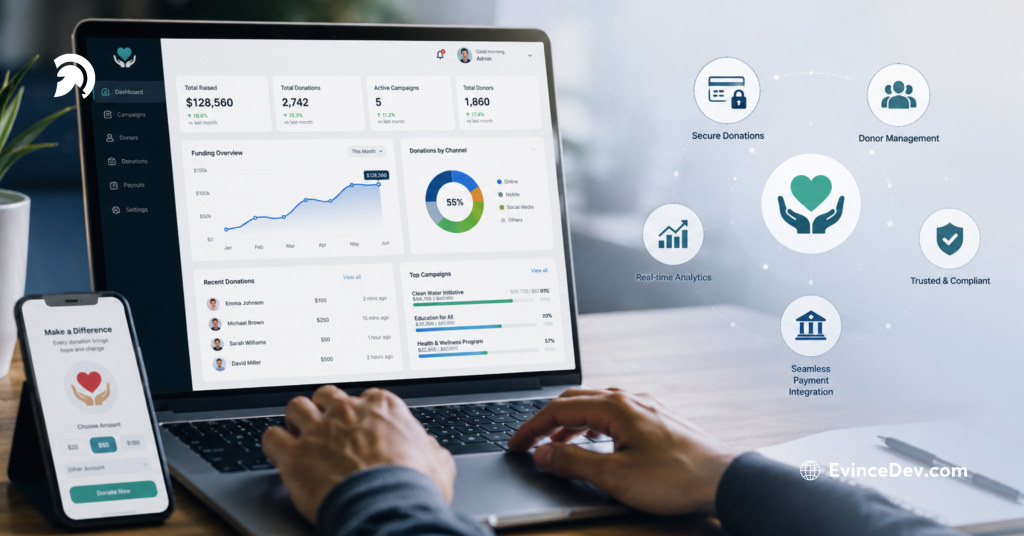
- Why it matters: Real-time dashboards give leadership teams better visibility into fundraising progress, campaign momentum, and operational performance during active campaigns.
Peer-to-Peer and Community Fundraising
- What it does: Allows supporters to create their own fundraising campaigns on behalf of an organization.
- Why it matters: This capability is widely used in crowdfunding platform development because it helps nonprofits expand reach, activate communities, and bring more donors into the campaign through trusted personal networks.
Analytics and Reporting
- What it does: Turns fundraising data into actionable insights through donor retention analytics, campaign ROI tracking, fundraising forecasting, payment analytics, and operational dashboards.
- Why it matters: These insights help nonprofit leaders understand what is working, where campaigns need improvement, and how to make better fundraising and engagement decisions.
Quick Stat:
According to Salesforce, 76% of nonprofits lack a defined data strategy, highlighting the growing need for modern fundraising platforms with integrated analytics, donor insights, and centralized reporting capabilities.
Technology Architecture Behind Fundraising Platforms
| Architecture Layer | What It Supports | Common Technologies |
| Frontend Layer |
|
React, Angular, Vue.js, Flutter, React Native |
| Backend Infrastructure | Handles donations, donor management, workflows, APIs, and integrations. | Node.js, Python, Java, .NET, Go |
| Cloud Infrastructure |
|
AWS, Microsoft Azure, Google Cloud Platform |
| Payment Infrastructure | Manages payments, settlements, refunds, chargebacks, and transactions. | Payment gateways, banking APIs, payment orchestration platforms |
| Data and Analytics Systems | Processes donor analytics, reporting, segmentation, and fundraising insights. | Data warehouses, BI tools, analytics pipelines, AI/ML models |
| Security and Compliance Layer | Protects donor data, payments, APIs, and platform security compliance. | IAM, encryption tools, WAF, SIEM, monitoring systems |
Quick Stat:
According to research featured by NonProfit PRO, 42% of nonprofits are planning to change or upgrade their financial software platforms within the next 18 months, highlighting the growing demand for modern, scalable, and nonprofit-focused fundraising technology.
Role of AI in Fundraising Platform Development
Artificial intelligence is becoming a major differentiator in modern fundraising platform development.
Rather than simply automating repetitive tasks, AI systems are now helping organizations improve donor engagement, optimize campaigns, and increase fundraising efficiency.
Predictive Donor Analytics
AI models can analyze historical donor behavior to predict:
- donation likelihood,
- campaign responsiveness,
- donor churn risk,
- and long-term donor value.
This helps organizations prioritize engagement strategies more effectively.
Personalized Donor Engagement
AI systems can personalize:
- email communication,
- donation recommendations,
- campaign messaging,
- and donor outreach timing.
For example, machine learning systems may identify which donors are more likely to respond to education-focused campaigns versus emergency fundraising campaigns.
AI-Powered Chatbots
Many platforms now use conversational AI systems to:
- answer donor questions,
- assist with donations,
- guide users through campaigns,
- and improve donor support experiences.
Fraud Detection
AI systems can monitor donation behavior for anomalies such as:
- suspicious transaction patterns,
- bot activity,
- repeated failed transactions,
- or unusual geographic activity.
This improves payment security and reduces fraud risks.
Campaign Forecasting
AI-driven forecasting systems help organizations estimate:
- campaign performance,
- expected donation volume,
- and donor engagement outcomes.
These insights support more strategic fundraising planning.
Also Read: AI in Financial Services: Use Cases, Benefits, and the Future of Intelligent FinanceSecurity and Compliance Considerations
Security is one of the most critical aspects of charity fundraising software and FinTech-enabled fundraising systems. Because fundraising platforms process sensitive donor and payment information, organizations must implement strong cybersecurity and compliance practices.
- Payment Security: Platforms handling payment information should follow PCI DSS-aligned development practices to support secure payment operations. Security controls often include encryption, tokenization, secure APIs, and transaction monitoring.
- Data Privacy: Fundraising platforms frequently manage personal donor information, making privacy compliance essential. Depending on where the platform operates and where donors are located, organizations may need to address GDPR, regional privacy regulations, data retention policies, and consent management requirements.
- Identity and Access Management: Strong authentication and access control systems help prevent unauthorized access to the platform. Common practices include multi-factor authentication, role-based access control, and privileged access monitoring.
- Audit Logging and Monitoring: Continuous monitoring systems help organizations track suspicious activity, identify security incidents, and improve operational visibility. Centralized logging also supports compliance reporting and operational audits.
- Fraud Prevention: Donation fraud and payment abuse can significantly impact nonprofit operations. Security systems often include anomaly detection, velocity checks, IP monitoring, and payment verification mechanisms.
Challenges in Fundraising Platform Development
Despite the growing opportunities in digital fundraising, building scalable fundraising systems comes with several technical and operational challenges.
- Payment Integration Complexity: Supporting multiple payment providers, currencies, and regional payment methods can significantly increase platform complexity. Different payment gateways also have varying APIs, settlement processes, and compliance requirements.
- Scalability Challenges: Fundraising campaigns can create sudden traffic spikes, especially during emergencies or viral campaigns. Platforms must be capable of handling large concurrent user activity, high transaction volume, and real-time reporting workloads.
- Data Fragmentation: Many nonprofit organizations still operate across disconnected systems. Integrating CRM systems, accounting platforms, fundraising tools, and payment systems often becomes a major operational challenge.
- Security Risks: Because fundraising platforms process financial transactions and donor data, they are attractive targets for cyberattacks and fraud. Organizations must continuously invest in security monitoring, vulnerability management, and infrastructure protection.
- Donor Experience Expectations: Modern donors expect frictionless digital experiences similar to commercial applications. Poor user experience can negatively impact donation conversion rates and donor retention.
Build vs Buy: Should Organizations Develop Custom Fundraising Platforms?
One of the most important strategic decisions for nonprofit leaders is whether to purchase existing fundraising software or invest in custom fundraising software development. The right choice depends on the organization’s fundraising goals, operational complexity, integration needs, and long-term growth plans.
Option 1: Off-the-Shelf Fundraising Platforms
Off-the-shelf fundraising platforms are off-the-shelf solutions that will assist an organization in setting up its fundraising operation more quickly. The features included in such platforms include fundraising functions like contribution collection, campaigns, donors’ information, and reports.
Such platforms might prove appropriate for companies that require quick setup, less upfront cost, and a fully functional system to perform fundraising activities.
On the other hand, pre-built platforms will present challenges like limited customizability, less flexible integration, limited scalability, and dependence on the provider. As the fundraising process grows, these challenges might hinder the ability of the organization to customize the platform according to its needs.
Option 2: Custom Fundraising Platform Development
Custom fundraising software development allows organizations to build a platform around their specific operational needs, donor engagement strategy, payment workflows, and reporting requirements.
A custom platform can support tailored donor experiences, advanced analytics, flexible integrations, scalable architecture, and full platform ownership. This approach is especially valuable for organizations with complex fundraising models, large donor networks, global fundraising operations, or advanced reporting requirements.
How to Make the Right Decision
For many organizations, the decision is not only about cost or speed. It is about long-term fit.
Off-the-shelf platforms work well when fundraising needs are standard and speed is the priority. Custom platforms are more suitable when the organization needs stronger control, deeper integrations, better scalability, and a platform that can evolve with its fundraising strategy.
Ultimately, the decision depends on long-term fundraising strategy, operational complexity, donor engagement goals, and growth plans.
Best Practices for Building Scalable Fundraising Platforms
Successful fundraising platform development requires balancing user experience, security, scalability, and operational efficiency. The platform should be designed to perform reliably during high-volume campaigns, protect donor and payment data, and adapt as fundraising needs evolve.
API-First Architecture
- Implementation focus: Build APIs that connect the platform with payment gateways, CRM systems, accounting software, and analytics platforms.
- Business value: Improves integration flexibility and helps nonprofits connect fundraising operations with their broader technology ecosystem.
Cloud-Native Development
- Implementation focus: Use cloud infrastructure to support scalability, reliability, deployment flexibility, and operational resilience.
- Business value: Helps the platform handle traffic spikes during major campaigns, seasonal giving periods, or emergency fundraising events.
Mobile-First User Experience
- Implementation focus: Design donation forms, campaign pages, payment flows, and dashboards for smooth mobile use.
- Business value: Reduces donor friction and improves donation completion rates across devices.
Modular System Design
- Implementation focus: Build the platform in modular components that can be updated, scaled, or enhanced independently.
- Business value: Improves maintainability and makes it easier to add new features without disrupting the entire system.
DevSecOps Integration
- Implementation focus: Integrate security throughout the development lifecycle using vulnerability management, automated testing, and infrastructure security practices.
- Business value: Reduces security risks and improves release quality.
Continuous Analytics and Optimization
- Implementation focus: Use behavioral analytics, A/B testing, donor engagement analysis, and campaign performance metrics to monitor performance.
- Business value: Helps teams identify what works, improve donor journeys, and make better fundraising decisions.
Future of Fundraising Platforms
The future of fundraising technology will likely become even more data-driven, automated, and personalized. Emerging trends such as AI-driven fundraising ecosystems, blockchain-based donation transparency, embedded finance capabilities, real-time donor engagement systems, and predictive fundraising analytics are shaping the evolution of modern platforms.
Future platforms may also support conversational donations, voice-enabled giving, decentralized fundraising systems, and hyper-personalized donor experiences. As digital fundraising becomes more sophisticated, organizations will increasingly require platforms that combine secure financial infrastructure with intelligent engagement capabilities.
This will continue driving demand for advanced fundraising platform development solutions capable of supporting both operational scalability and long-term donor trust.
Conclusion
Digital fundraising is rapidly evolving into a technology-driven ecosystem where donor experience, financial infrastructure, data intelligence, and cybersecurity all play equally important roles. Modern fundraising platforms are no longer limited to collecting donations. They now function as intelligent operational systems that support donor engagement, financial management, analytics, compliance, and strategic fundraising growth.
For nonprofits, investing in the right technology can improve operational efficiency, donor retention, transparency, and long-term fundraising sustainability.
For technology leaders and CXOs, the growing convergence of nonprofit operations and FinTech innovation creates opportunities to build scalable, secure, and data-driven fundraising ecosystems that support evolving donor expectations.
At EvinceDev, we help organizations build secure, scalable, and future-ready fundraising platforms tailored to the requirements of modern nonprofits and FinTechs. From payment infrastructure and donor engagement systems to AI-powered analytics and cloud-native platform development, our team focuses on creating technology solutions that support long-term fundraising growth and operational efficiency.
Organizations that successfully combine modern FinTech capabilities, intelligent analytics, secure infrastructure, and donor-centric digital experiences will be better positioned to build trust, improve fundraising outcomes, and sustain long-term impact in an increasingly digital fundraising landscape.