
Key Takeaways
- Custom or SaaS: Choose custom fintech software for flexibility or SaaS tools for faster launch and lower costs.
- Scaling Matters: Custom platforms scale better for growing fintech firms with complex products and user demands.
- Security Counts: Custom fintech solutions offer stronger control over security, compliance, and sensitive customer data.
- Startup Friendly: Off-the-shelf fintech software helps startups launch quickly without large development investments.
- AI Drives Growth: AI in fintech improves fraud detection, automation, customer support, and financial personalization.
- Budget vs Value: Off-the-shelf software lowers upfront costs, while custom solutions offer stronger long-term ROI.
- Faster Go Live: Ready-made fintech platforms reduce development time and help businesses enter markets quickly.
- Hybrid Is Rising: Many fintech businesses combine ready-made tools with custom features for better flexibility.
The fintech industry has transformed the way businesses and consumers interact with financial services. From digital payments and mobile banking to robo-advisors and lending platforms, technology is now at the core of the financial ecosystem. As competition intensifies, fintech companies must invest in the right software solutions to remain secure, scalable, and customer-focused.
One of the biggest decisions organizations face is whether to build custom fintech software or adopt an off-the-shelf solution. Both options offer distinct advantages and challenges, and the right choice often depends on business goals, budget, compliance requirements, and long-term growth plans.
With the rising demand for fintech software development, businesses are increasingly evaluating which approach can deliver the best return on investment while supporting innovation and operational efficiency. In this guide, we will compare custom fintech software and off-the-shelf solutions in detail to help you determine which option is best suited for your organization.
Quick Stat:
According to BCG, the global fintech market is expected to reach nearly $1.5 trillion in revenue by 2030, highlighting the growing demand for scalable and innovative fintech solutions.
What Is FinTech Software?
FinTech software refers to digital solutions designed to improve, automate, or streamline financial services. These applications are used across various sectors, including banking, insurance, payments, investment management, and personal finance.
Examples of fintech software include:
- Mobile banking applications
- Payment processing systems
- Peer-to-peer lending platforms
- Investment and trading apps
- Cryptocurrency exchanges
- Insurance claim automation tools
- Expense management software
As the financial industry evolves, businesses are increasingly relying on advanced financial software development strategies to enhance customer experience and improve operational efficiency. Modern consumers expect seamless transactions, personalized services, and high-level security, making software selection a critical business decision.
In addition, regulatory requirements such as PCI DSS, GDPR, AML, and KYC create additional pressure for fintech businesses to adopt secure and compliant technologies. Whether a company chooses a pre-built solution or invests in custom software, the decision directly impacts scalability, security, flexibility, and long-term profitability.
What Is Custom FinTech Software?
Custom fintech software is a solution specifically designed and developed to meet the unique needs of a business. Unlike ready-made products, custom platforms are built from scratch with personalized features, workflows, integrations, and branding.
A company investing in custom development has full control over the architecture, design, and functionality of the software. This approach is especially valuable for organizations with unique operational processes or innovative financial products.
Examples of custom fintech software include:
- Digital banking platforms
- AI-powered fraud detection systems
- Proprietary trading software
- Wealth management dashboards
- Blockchain-based financial applications
- Custom lending and credit scoring platforms
As businesses expand their digital capabilities, the demand for fintech software development services continues to rise because companies want solutions tailored to their exact goals rather than generic tools with limited flexibility.
Advantages of Custom FinTech Software
Custom fintech software gives businesses more flexibility, control, and scalability than standard, ready-made solutions. Below are the key advantages:
1. Tailored to Specific Business Needs
What it means:
Custom software is designed around the company’s exact workflows, customer expectations, and operational goals.
Why it matters:
Businesses do not have to adjust their processes to fit a generic system. Instead, the software supports the way the business already operates.
Example:
A lending company can build custom loan approval workflows, automated credit assessments, and specialized compliance checks.
2. Better Scalability for Long-Term Growth
What it means:
Custom fintech platforms can be expanded as the business grows.
Why it matters:
As users, transactions, and services increase, the platform can be upgraded without being limited by vendor restrictions.
Example:
A growing fintech startup can add new features, payment methods, markets, or integrations as demand increases.
3. Enhanced Security and Compliance
What it means:
Custom software allows businesses to build security and compliance features based on their specific risks and regulatory needs.
Why it matters:
Fintech applications handle sensitive financial data, so strong protection is essential for reducing risks and building customer trust.
Example:
A company can add encryption, multi-factor authentication, fraud detection, access controls, and compliance-ready workflows.
4. Competitive Advantage
What it means:
Custom software helps businesses create unique features and customer experiences.
Why it matters:
In a crowded fintech market, unique functionality can help a business stand out from competitors using similar off-the-shelf tools.
Example:
AI in fintech can be used to deliver smarter recommendations, predictive analytics, and automated financial insights.
5. Seamless Integration Capabilities
What it means:
Custom fintech software can be built to connect smoothly with existing tools and systems.
Why it matters:
Better integrations improve data flow, reduce manual work, and support smoother operations.
Example:
The software can integrate with payment gateways, CRMs, analytics tools, banking APIs, accounting systems, and legacy platforms.
Limitations of Custom FinTech Software
While custom software offers strong flexibility, scalability, and control, it also comes with a few challenges businesses should consider before investing.
1. Higher Initial Investment
Building custom fintech software requires a higher upfront budget for planning, design, development, testing, infrastructure, security, and maintenance. Businesses may also need skilled developers or an experienced fintech development company to ensure successful execution.
2. Longer Development Timeline
Custom software takes time to build because it goes through requirement analysis, UI/UX design, development, testing, security audits, compliance checks, and deployment. This can be challenging for businesses that need to launch quickly.
3. Ongoing Maintenance Responsibilities
Custom fintech software requires continuous updates, security patches, bug fixes, performance improvements, and compliance upgrades after launch. Some businesses manage this through fintech development outsourcing to reduce internal workload and access specialized support.
What Is Off-the-Shelf FinTech Software?
Off-the-shelf fintech software refers to pre-built solutions designed for broad market use. These platforms are ready to deploy and typically follow a subscription or licensing model. Businesses can quickly implement these solutions without investing heavily in development.
Common examples include:
- Accounting software
- Payment gateways
- Budgeting tools
- CRM platforms
- Investment management systems
- Digital wallet applications
Many startups also use a white-label fintech platform to launch services quickly under their own brand identity without building technology from scratch. These solutions are attractive because they reduce development time and lower initial costs.
Advantages of Off-the-Shelf FinTech Software
Off-the-shelf fintech software helps businesses launch faster, reduce initial costs, and manage operations with less technical effort.
Below are the key advantages:
1. Faster Deployment
What it means:
Ready-made software can be implemented quickly because the core features are already built.
Why it matters:
Businesses can start operations without waiting months for custom development.
Example:
A fintech startup can launch a basic payment or lending platform quickly to enter the market faster.
2. Lower Upfront Costs
What it means:
Off-the-shelf software usually follows a subscription or licensing model.
Why it matters:
Businesses can avoid large development expenses and use their budget for marketing, customer acquisition, or growth.
Example:
A small fintech company can use a pre-built platform instead of hiring a full development team from the beginning.
3. Vendor-Managed Maintenance
What it means:
The software provider handles updates, bug fixes, security patches, and general maintenance.
Why it matters:
This reduces the technical workload for the business and removes the need for a large in-house IT team.
Example:
When a security update is needed, the vendor manages it without the business having to handle it internally.
4. Proven Reliability
What it means:
Most established off-the-shelf platforms have already been used and tested by many businesses.
Why it matters:
Companies can benefit from stable performance, existing customer support, and tested functionality.
Example:
A fintech business can choose a widely used payment processing tool with proven uptime and support.
5. Ideal for Startups
What it means:
Off-the-shelf solutions are useful for startups that need speed and affordability more than deep customization.
Why it matters:
Startups can test ideas, validate business models, and enter the market before investing in custom systems.
Example:
A startup can begin with a ready-made solution and later move to custom software as its needs become more complex.
Limitations of Off-the-Shelf FinTech Software
Despite their convenience, pre-built solutions have several drawbacks.
- Limited Customization: Generic platforms are designed for mass use, which means customization options are often restricted. Businesses may struggle to adapt the software to unique workflows or innovative product ideas.
- Scalability Challenges: As businesses grow, they may outgrow the capabilities of off-the-shelf software. Performance limitations, user restrictions, or integration barriers can become major obstacles over time.
- Vendor Dependency: Using third-party software means relying heavily on the vendor for updates, feature improvements, and support. If the provider changes pricing models, discontinues services, or experiences downtime, the business may face operational disruptions.
- Integration Difficulties: Ready-made software may not integrate seamlessly with existing systems, especially in organizations using legacy infrastructure. This can create inefficiencies and additional operational complexity.
- Reduced Control Over Security: While reputable vendors implement strong security standards, businesses have limited control over the platform’s architecture and data handling processes. For organizations with strict compliance needs, this lack of control may be a significant concern.
Custom FinTech Software vs Off-the-Shelf
Choosing between custom and off-the-shelf software requires careful evaluation of business priorities.
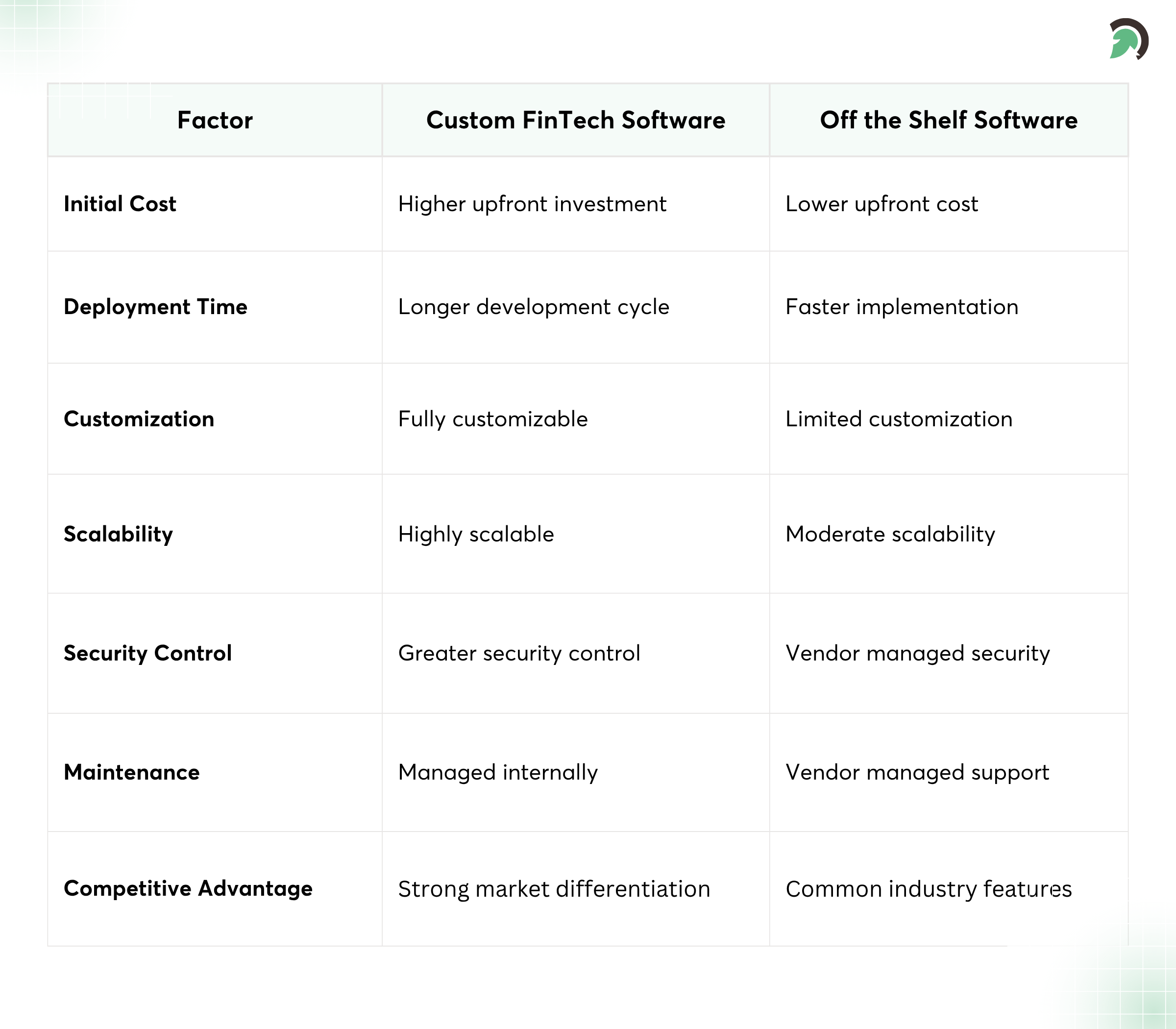
FinTech Software Comparison for Business Growth
Custom software is generally better for businesses seeking innovation, flexibility, and long-term scalability, while off-the-shelf solutions are better suited to organizations prioritizing affordability and speed.
Key Factors to Consider Before Choosing
- Business Goals: The first step is understanding your long-term objectives. If your company plans to introduce innovative financial products or complex workflows, custom software may be the better choice. However, if your goal is rapid deployment and operational simplicity, off-the-shelf software may be sufficient.
- Budget Constraints: Budget plays a major role in software selection. Custom development involves a higher initial investment, while ready-made solutions reduce upfront expenses but may involve recurring subscription fees. Businesses should evaluate both short-term affordability and long-term return on investment.
- Time-to-Market Requirements: Companies entering competitive markets often prioritize speed. Ready-made solutions help businesses launch quickly, while custom software requires a longer development cycle. Startups testing new ideas may benefit from rapid deployment before investing in advanced customization.
- Compliance and Security Needs: Fintech companies operate in highly regulated environments. Businesses handling large volumes of sensitive financial data may require custom security frameworks and compliance tools tailored to specific regulations.
- Integration Requirements: Organizations using multiple internal systems should assess integration compatibility carefully. Custom software generally provides better integration flexibility than off-the-shelf products.
When Should You Choose Custom FinTech Software?
Custom software is ideal for businesses that:
- Require unique features or workflows
- Need advanced scalability
- Prioritize long-term growth
- Handle sensitive financial data
- Want full control over security and compliance
- Seek competitive differentiation
For example, a digital bank building proprietary lending systems and fraud detection algorithms would benefit significantly from custom development.
Businesses investing in advanced fintech app development often choose custom solutions to deliver highly personalized user experiences and innovative features.
When Should You Choose Off-the-Shelf Software?
Off-the-shelf solutions are better suited for businesses that:
- need rapid deployment
- have limited budgets
- require standard functionality
- want minimal maintenance responsibility
- are testing market demand
A startup launching a simple payment service may initially benefit from a ready-made platform before transitioning to custom software later. Many organizations begin with pre-built systems and gradually migrate toward customized infrastructure as they scale.
The Rise of Hybrid FinTech Solutions
Many modern businesses now adopt a hybrid approach that combines ready-made tools with custom-built features. For example, a company may use a third-party payment gateway while building its own customer analytics dashboard or AI-driven recommendation engine. This strategy helps businesses balance affordability, flexibility, and scalability. Hybrid solutions are becoming increasingly popular because they allow companies to innovate selectively without rebuilding every component from scratch.
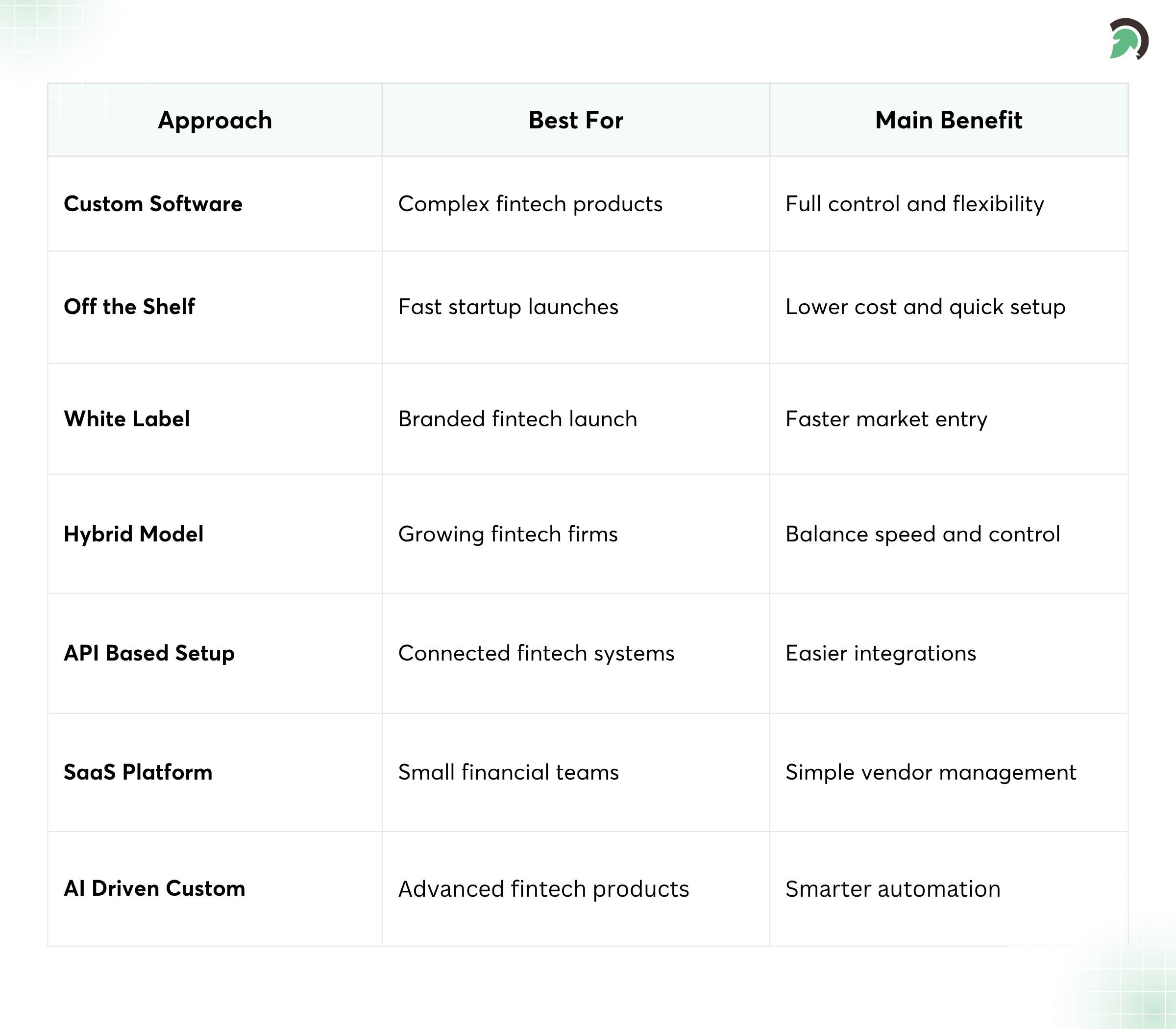
Choosing Custom SaaS or Hybrid FinTech Software
The Role of AI in Modern FinTech Software
Artificial intelligence is rapidly reshaping the fintech landscape.
Today, AI in fintech is being used for:
- Fraud detection
- Personalized financial recommendations
- Credit scoring
- Automated customer support
- Risk analysis
- Predictive analytics
Businesses investing in custom solutions can integrate AI capabilities more effectively because the software architecture can be tailored to support advanced machine learning models and automation tools. As AI adoption continues to grow, companies focusing on advanced fintech app development strategies are increasingly prioritizing intelligent automation and data-driven decision-making.
Quick Stat:
According to Future Market Insights, the AI in the fintech market is projected to grow from $18.2 billion in 2026 to nearly $79.6 billion by 2036, reflecting the increasing adoption of AI-powered financial solutions.
Final Verdict: Which Should You Choose?
There is no universal answer when choosing between custom fintech software and off-the-shelf solutions.
Custom software is the right choice for businesses seeking:
- Scalability
- Innovation
- Advanced security
- Long-term flexibility
- Competitive differentiation
Off-the-shelf software is ideal for organizations prioritizing:
- Faster deployment
- Lower upfront costs
- Operational simplicity
- Minimal maintenance responsibilities
Ultimately, the decision depends on your business goals, technical requirements, budget, and growth strategy.
Companies planning long-term expansion and innovation often find custom development more valuable despite the higher initial investment. On the other hand, startups and smaller businesses may benefit from the speed and affordability of ready-made solutions.
Conclusion
The fintech industry continues to evolve rapidly, and choosing the right software foundation is critical for long-term success. Whether you opt for custom fintech software or an off-the-shelf solution, the decision will directly impact your scalability, security, customer experience, and operational efficiency. The growing demand for fintech software development highlights the importance of building technology ecosystems that support innovation, compliance, and future growth.
Custom software offers flexibility, scalability, and differentiation, making it ideal for businesses with unique goals and complex requirements. Off-the-shelf solutions, meanwhile, provide affordability and rapid deployment, making them attractive for startups and companies seeking simplicity. By understanding the strengths and limitations of both approaches, businesses can make informed decisions that align with their strategic vision.
EvinceDev helps startups and financial businesses develop secure fintech platforms, digital financial applications, and custom software solutions tailored to modern financial needs. Whether you need a tailored fintech platform, secure integrations, scalable architecture, or support in modernizing your financial solution, EvinceDev can help you build a future-ready product that supports growth in the competitive fintech market.