

Key Takeaways:
- AI boosts accuracy: AI reduces manual errors in financial reporting by validating data and applying consistent logic across workflows.
- Faster analysis : AI speeds up financial analysis by automating data processing, helping teams generate insights without delays.
- Real-time insights: AI enables real-time financial visibility, helping businesses track performance and act on data instantly.
- Error detection: AI identifies anomalies and inconsistencies early, reducing reporting risks and improving data reliability.
- Automates tasks: AI automates repetitive reporting tasks, allowing finance teams to focus more on strategy and decision-making.
- Better forecasting: AI uses historical data patterns to improve forecasting accuracy and support smarter financial planning decisions.
- Scales easily: AI systems handle large volumes of financial data efficiently, supporting business growth without extra workload.
Every finance team knows the feeling: the close is behind schedule, the numbers “look right but need checking,” and leadership wants answers yesterday. That’s where AI in financial reporting becomes more than a buzzword; it becomes an operating advantage. When done well, AI in financial reporting helps teams move from slow, manual consolidation to faster, more reliable insights that support decisions, compliance, and forecasting.
To set the context, financial reporting in modern businesses encompasses the processes and controls that transform raw accounting data into statements and management outputs, such as monthly financial packages, statutory filings, internal dashboards, and audit-ready records. Accuracy, compliance, and timeliness aren’t optional; they’re foundational.
Traditional reporting can be effective, but it often struggles with:
- Accuracy: manual entry, copy-and-paste workflows, and reconciliation steps increase the likelihood of errors.
- Compliance: requirements change, and audit trails can become hard to maintain consistently.
- Timely insights: reporting cycles are frequently longer than the business expects.
- Scale: large transaction volumes across multiple systems slow down consolidation and validation.
- Visibility: many organizations don’t get near real-time visibility into performance, risks, or anomalies.
That’s why adoption of AI-powered financial reporting is accelerating. The goal is straightforward: automate repetitive steps, reduce errors, and increase precision so finance professionals can spend more time analyzing and less time chasing data issues.
What is AI in Financial Reporting?
AI in financial reporting refers to the use of techniques such as machine learning (ML), natural language processing (NLP), and automation to improve the extraction, processing, validation, analysis, and reporting of financial data.
In practical terms, AI enhances reporting by learning patterns in financial data and applying rules or predictions to speed up workflows. Instead of relying on a strictly manual pipeline, teams can shift to systems that can interpret information, detect inconsistencies, and generate structured outputs based on consistent logic.
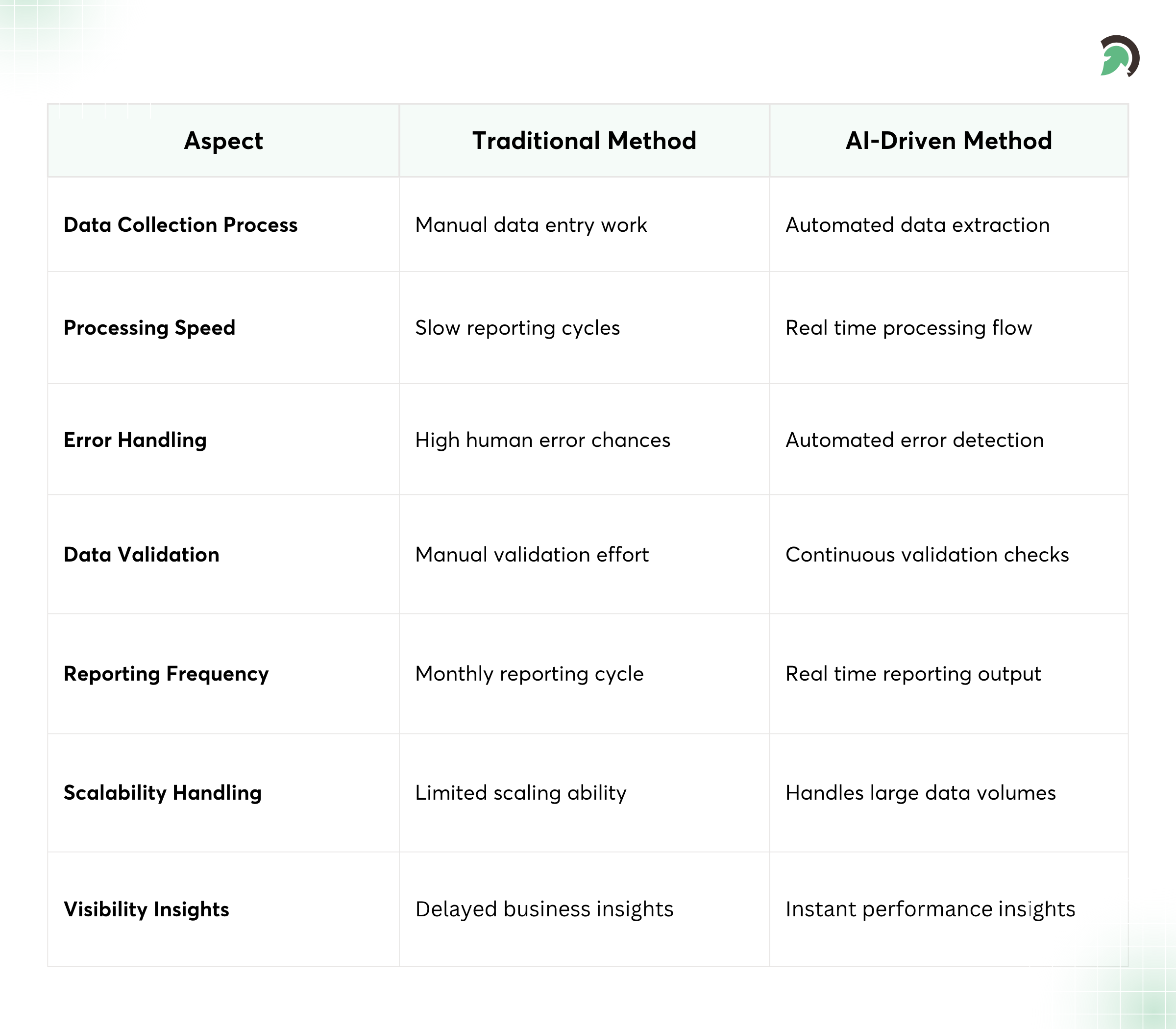
Here’s the difference in plain language:
- Traditional reporting: people manually collect data, reconcile systems, build spreadsheets, and validate results.
- AI-powered reporting: systems extract and classify data automatically, validate it continuously, and accelerate report generation while flagging what needs human review.

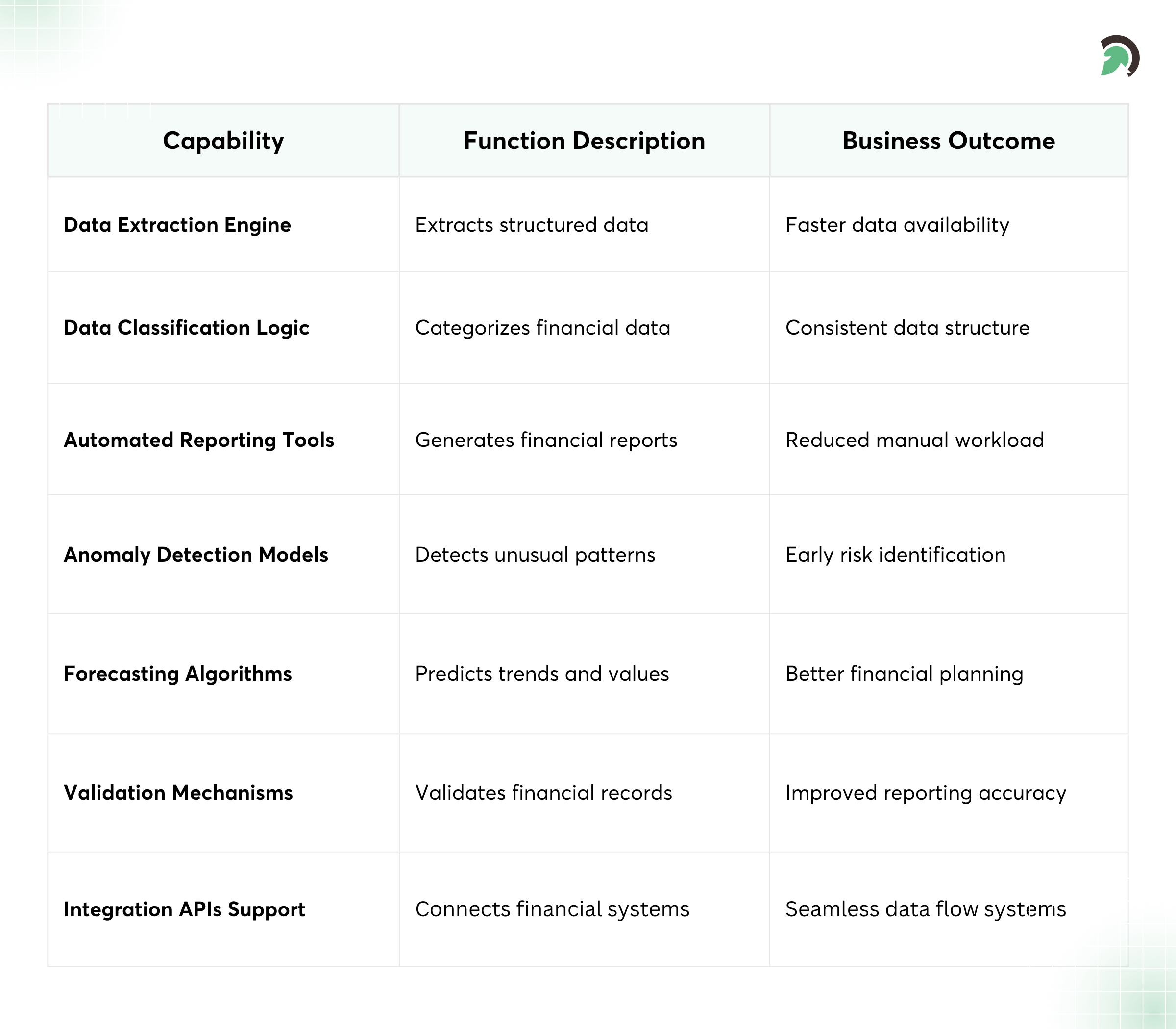
Core capabilities typically include:
- Data extraction and processing: pulling transaction and document data from ERPs, subledgers, and files; normalizing fields; mapping to accounting structures.
- Automated report generation: creating standardized outputs for management reporting and statutory packages.
- Predictive analytics: forecasting revenue, expense trends, cash flow, and variance drivers based on historical patterns.
- Anomaly detection: spotting unusual journal entries, unexpected category shifts, or outlier expense behavior before it becomes a downstream issue.
Limitations of Traditional Financial Reporting
Traditional financial reporting often looks like a checklist: pull data from multiple systems, reconcile, map to reporting templates, review variances, and finalize the package. The issue isn’t that the checklist is wrong: it’s that it’s built for a slower world.
Here are the most common limitations organizations experience when reporting has to stretch across more transactions, more geographies, or more compliance complexity:
-
Manual data entry and reconciliation
Spreadsheets and manual mapping can work at a small scale. But as the number of data sources grows, ERP, billing, procurement, payment providers, expense systems, and more, manual reconciliation becomes a bottleneck.
-
High risk of human errors
Even with strong controls, human review can only catch so much. Typos, inconsistent categorization, missed entries, and formula mistakes can slip in, especially during high-pressure close periods.
-
Time-consuming reporting cycles
Most reporting timelines reflect the time it takes to find and fix data issues, not the time it takes to analyze outcomes. When the pipeline is slow, the business decisions that depend on it arrive late.
-
Delayed insights for decision-making
Finance teams may know the “why” behind performance only after weeks. That means decisions get delayed, and opportunities get missed.
-
Difficulty handling large volumes of financial data
High transaction volumes are hard to validate manually. The more data you have, the harder it becomes to ensure completeness and consistent categorization.
-
Lack of real-time visibility
Many organizations can’t answer real-time questions like “Are we trending off plan?” or “Which accounts show unusual movement this week?” until the reporting cycle is complete.
How AI is Transforming Financial Reporting
When teams implement AI carefully, the impact shows up quickly: faster month-end closes, fewer rework cycles, and better visibility into performance and risk. Most importantly, AI in financial reporting shifts finance from reactive to proactive by continuously monitoring and flagging issues.
Key transformations include:
- Automation of repetitive accounting tasks reduces manual journal preparation, repetitive mappings, and templated report building.
- Real-time data processing and reporting refresh dashboards more frequently, reducing reporting lag.
- Continuous monitoring of financial data detects unusual entries, missing transactions, or category mismatches as they happen.
- Intelligent insights for better decision-making surface variance drivers and trend implications earlier in the cycle.
Common AI functions driving those improvements:
- Data classification and tagging automatically assign transactions to the right categories, cost centers, or report dimensions.
- Pattern recognition in financial data learn recurring behavior in expenses, revenue lines, and journal patterns.
- Forecasting and trend analysis model expected performance and highlight deviations.
- Risk and anomaly detection detect fraud signals, outlier activity, or control exceptions.
Key Use Cases of AI in Financial Reporting
It’s one thing to say “AI improves reporting.” It’s another to see where it actually fits into a real workflow. Below are high-value use cases that show up across industries.
1. Automated Data Collection and Processing
AI can extract data from multiple financial systems and transform it into a consistent structure for reporting. Instead of waiting for data pulls and then manually cleaning them, teams can streamline the pipeline.
- Extract data from ERPs, subledgers, and related systems
- Reduce manual input and reconciliation efforts
- Standardize formats for faster downstream analysis
2. Real-Time Financial Reporting
With the right architecture, reports can be generated instantly or near-instantly. That means fewer “static” snapshots and more dynamic performance visibility.
- Generate reports instantly
- Enable faster business decisions
- Support agile planning and operational monitoring
3. Error Detection and Data Validation
One of AI’s most practical contributions is catching problems early. AI can identify inconsistencies, missing records, and anomalies before they end up in published statements or leadership decks.
- Identify inconsistencies and anomalies
- Improve reporting accuracy
- Reduce rework during close
4. Financial Forecasting and Planning
Beyond reporting what happened, AI supports forecasting and scenario modeling. That helps finance teams move into a more forward-looking role.
- Predict revenue, expenses, and cash flow
- Support strategic planning
- Quantify variance drivers and expected outcomes
5. Regulatory Reporting Automation
Regulatory and compliance reporting can be burdensome, especially when requirements differ by jurisdiction or standards evolve over time. AI can automate parts of the workflow to reduce manual effort and improve consistency.
- Automate compliance reports
- Ensure adherence to financial regulations
- Strengthen audit readiness with consistent data handling
Technologies Powering AI in Financial Reporting
AI-driven reporting isn’t a single product; it’s a stack. The most effective systems combine multiple technologies to handle extraction, understanding, validation, analytics, and integration.
- Machine Learning (ML): learns patterns from historical financial data to make predictions and detect anomalies.
- Natural Language Processing (NLP): interprets text from documents, notes, and narrative fields; extracts structured information.
- Robotic Process Automation (RPA): automates repetitive steps in legacy workflows and bridges between systems.
- Big Data Analytics: processes large datasets efficiently for modeling and validation.
- Cloud computing platforms: scale computation and support secure deployment patterns.
- APIs for financial system integration: enable data exchange between ERP, banking, and other reporting systems.
In many real deployments, you may also see AI delivered through modern engineering workflows, especially when organizations need tailored financial software development services or deeper platform integration. Some teams work with providers offering AI integration services to connect reporting, data pipelines, and AI models safely and reliably.
Benefits of AI in Financial Reporting
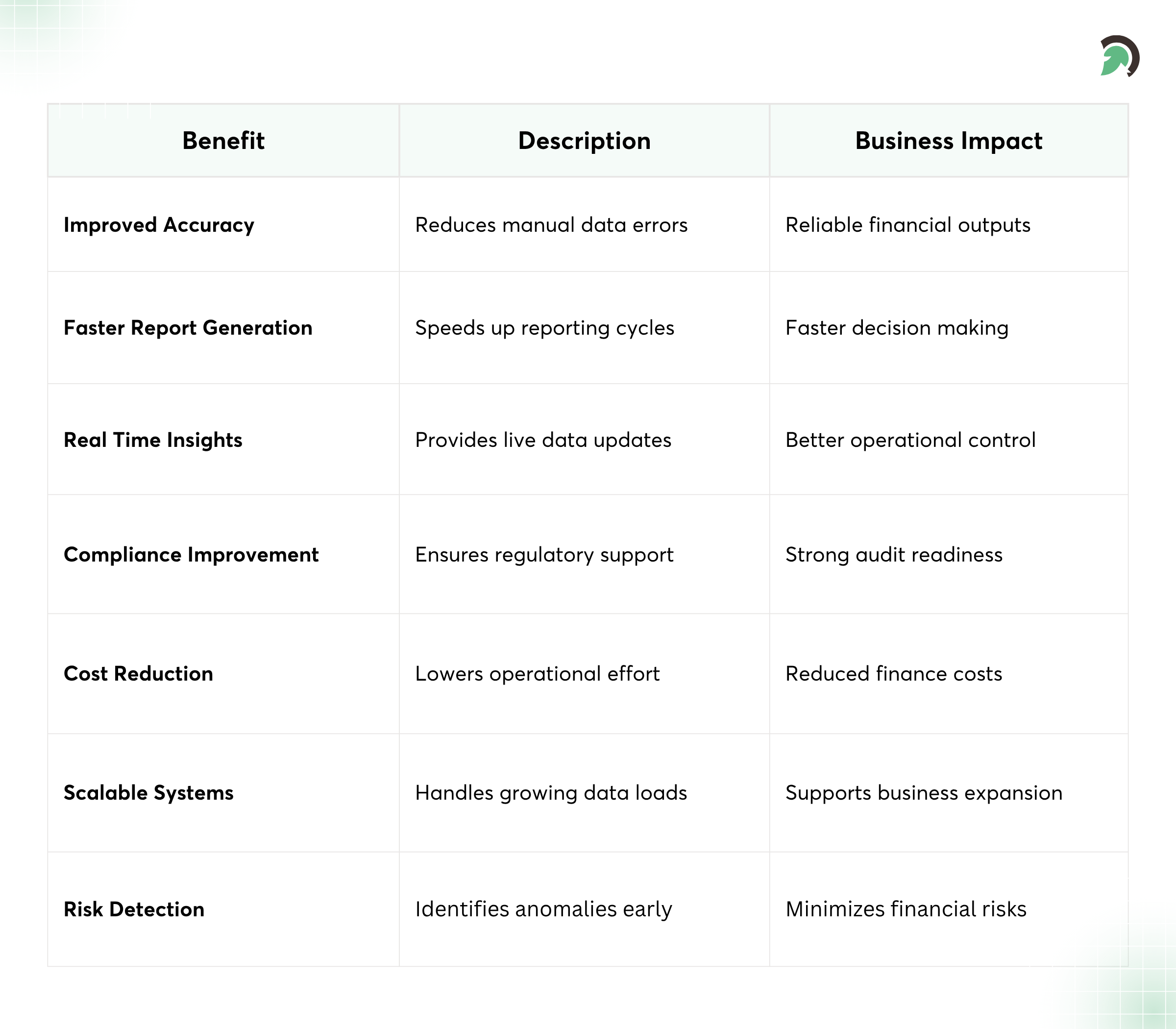
Let’s get practical: what business outcomes do teams typically expect from implementing automated financial reporting solutions?
-
Improved accuracy and reduced human error
AI validates data and applies consistent logic. That reduces mistakes caused by manual handling.
-
Faster report generation and analysis
Instead of waiting for data cleanup and spreadsheet rebuilding, teams move faster from ingestion to insights.
-
Real-time financial insights
More frequent reporting improves the speed of decision-making, especially for operational performance and cash planning.
-
Enhanced compliance and audit readiness
With the right controls, systems can produce better audit trails and standardized documentation.
-
Reduced operational costs
When fewer hours are spent on rework, reconciliation, and manual processing, operating costs typically decrease.
-
Scalable reporting systems
AI-based pipelines scale more gracefully as transaction volumes and reporting complexity increase.
Implementation of AI in Financial Reporting
Even strong technology won’t deliver value if implementation is rushed. A smart approach balances speed with governance.
Here’s a step-by-step pathway that works well in most organizations, whether you’re exploring AI financial reporting software or building capabilities around financial analytics software development.
- Assess current reporting processes: Map the end-to-end workflow: data sources, transformations, controls, report outputs, and pain points.
- Identify automation opportunities: Prioritize steps with high volume, repetitive logic, or frequent errors those are the best candidates.
- Collect and structure financial data: Ensure consistent schemas, accounting mappings, and dimension structures.
- Select AI tools and technologies: Choose ML, NLP, validation rules, and automation components based on your use cases.
- Integrate with existing accounting systems: Use APIs and secure data flows to ensure reliable financial data integration.
- Test for accuracy and compliance: Run parallel testing. Compare AI outputs against known “correct” results and evaluate control exceptions.
- Deploy and monitor performance: Track metrics such as error rates, reconciliation effort, and variance-detection quality.
- Continuously optimize models: Update based on new data, revised standards, and evolving business processes.
Compliance and Regulatory Considerations
AI can improve compliance, but it also introduces new governance expectations. Organizations need clarity on standards, data handling, and decision accountability.
Key considerations include:
- Financial reporting standards (IFRS, GAAP): ensure models and reporting outputs align with required accounting policies.
- Data privacy and security regulations: protect sensitive financial and personal data.
- Auditability and transparency: maintain logs, traceability, and consistent control evidence.
- Explainable AI for financial decisions: where AI flags exceptions, ensure teams understand why it flagged them.
- Risk management and governance: define model ownership, change management, and approval workflows.
In practice, this often means combining AI with human review for high-impact areas and maintaining a well-documented model lifecycle. If you’re partnering with engineering teams, ask how they support governance and evidence capture, especially if you’re doing custom financial reporting software development or building a broader fintech ecosystem.
Challenges of AI in Financial Reporting
It’s also fair to talk about what can go wrong. AI implementations can underperform if foundational factors are ignored.
-
Data quality and consistency issues
If the input data is inconsistent or poorly mapped, AI can amplify errors at scale. Before modeling, invest in normalization and clear data standards.
-
Integration with legacy financial systems
Older ERPs and reporting tools may not have modern API access. Some teams use RPA bridges, but those still need governance.
-
Initial implementation cost
Costs can be higher upfront due to data work, integration, testing, and compliance reviews. The payoff usually comes after process stabilization.
-
Regulatory concerns around AI usage
Regulators and auditors will care about the effectiveness of controls and the evidence. Teams must be ready to explain how the AI affects reporting outcomes.
-
Need for skilled professionals
You’ll likely need a mix of finance domain expertise and technical capability data engineering, ML development, and security.
-
Resistance to change within organizations
Finance teams may worry that automation reduces control or threatens roles. A strong change management plan clarifies that AI is designed to assist professionals, not replace accountable decision-making.
Best Practices for AI-Driven Financial Reporting
If you want AI to earn trust, treat it like a controlled system, not a black box.
-
Ensure high-quality, structured data
Clean data beats clever models. Prioritize consistent mappings, validated dimensions, and complete transaction coverage.
-
Use explainable AI models
Where possible, choose approaches that provide reasoning signals. At a minimum, provide traceable evidence of why a rule or model flagged something.
-
Maintain audit trails for compliance
Document transformations, model versions, and approvals. Build workflows that produce audit-friendly logs.
-
Combine AI with human oversight
Use AI to prioritize review, not to eliminate accountability entirely. High-impact items should always have a qualified sign-off.
-
Regularly update and validate models
Update models as business processes change. Validate performance with ongoing sampling and control checks.
-
Focus on data security and governance
Limit access, enforce encryption, and keep a clear governance model for who can change what and when.
Future Trends in AI for Financial Reporting
The direction is clear: reporting is becoming more continuous, more predictive, and more integrated into broader business operations.
- Real-time and continuous reporting systems: dashboards and disclosures updated more frequently as data arrives.
- AI-driven financial advisory: systems that recommend actions based on forecast gaps and risk signals.
- Integration with ERP and fintech platforms: tighter connectivity between accounting, payments, onboarding, and transaction ecosystems.
- Advanced predictive analytics: more granular forecasting and driver-based variance modeling.
- Automated audit processes: enhanced evidence capture and exception-based audit sampling.
- Increased adoption across industries: from retail and SaaS to banking and manufacturing, where transaction complexity demands smarter reporting.
Some organizations will also expand AI workflows beyond reporting into compliance and customer risk processes. For example, linking reporting signals to fraud-monitoring workflows and identity checks can support a stronger operational posture.
If your team is exploring partnerships in the fintech space, you might encounter offerings that blend reporting automation with broader platform capabilities, such as fintech software development or specialized product work. Depending on the scope, teams may also consider solutions for fraud-monitoring workflow integration and KYC/AML automation software to reduce manual review pressure throughout the lifecycle.
How Businesses Can Get Started
If you’re starting from scratch or you’ve tried pilots before, don’t make this harder than it needs to be. Start with clarity and measurable outcomes.
- Evaluate current reporting inefficiencies
Identify where time is spent: data pulls, mapping, reconciliation, variance analysis, report formatting, or audit prep. - Define clear objectives for AI adoption
Examples: reduce close cycle time, improve anomaly detection, automate a compliance report, or increase forecast accuracy. - Choose the right technology partners
Look for experience with AI-powered financial reporting deployments, not just model demos. - Start with pilot use cases
Choose one or two processes with clear data inputs and obvious output success criteria. - Scale gradually with measurable outcomes
Expand only after the pilot proves accuracy, audit readiness, and real operational improvement.
Done right, AI in financial reporting becomes the backbone for modern finance, turning reporting into a faster, more accurate feedback loop. That’s a shift your team will feel immediately when close day stops being a marathon.
EvinceDev has helped teams think through these kinds of practical, end-to-end implementation decisions especially when integration and governance matter as much as the analytics.
Conclusion
AI in financial reporting isn’t about replacing accountants; it’s about removing friction from the parts of reporting that slow you down and increase risk. When you automate data extraction, validation, and report generation, you get fewer errors, faster closes, and more dependable insights for planning and compliance. Just as importantly, a well-governed AI system helps you move from “we’ll review it later” to “we’ll flag it early,” which changes how finance teams operate.
The next step is to pick one pilot workflow that delivers measurable outcomes, accuracy improvements, reduced reconciliation effort, or faster package delivery, and then scale from there. If you’re exploring options like ai financial reporting software or custom financial software development services, start with the integration and auditability requirements first, not the model demo. With the right approach and partners, your reporting process can evolve into a real-time decision engine. Explore solution paths thoughtfully, and you’ll be ready for what finance will demand next.
For teams mapping this journey end-to-end, EvinceDev is worth considering as you translate goals into a trustworthy implementation plan.