

Key Takeaways:
- Compliance ROI: Automating checks and reporting reduces cost, risk, and manual effort at scale.
- KYC Built Fast: Strong digital onboarding improves verification speed without weakening controls.
- AML In Action: Real-time monitoring helps teams catch suspicious activity before risk grows.
- Audit-Ready Log: Detailed records make reviews, investigations, and reporting far easier.
- Secure by Core: Encryption and access controls protect sensitive financial data end to end.
- Scalable Design: Modular architecture supports growth across markets, products, and data loads.
- Smart Risk View: AI-assisted analysis helps prioritize alerts and reduce false positive noise.
- Future-Proof Ops: Continuous updates keep compliance systems aligned with changing regulations.
RegTech Software Development sits at the intersection of finance, law, and modern engineering. For banks, fintech startups, insurers, and payment platforms, compliance is no longer a back-office burden you can handle with spreadsheets and manual reviews. It is a core business function tied directly to growth, trust, and operational survival. As regulations expand across jurisdictions and customer expectations rise, technology has become the most practical way to manage compliance at scale. This shift is also changing how fintech software development teams approach compliance, security, and product architecture.
At its core, RegTech refers to technology built to help organizations meet regulatory requirements more efficiently and accurately. Financial services include everything from identity verification and anti-money laundering checks to reporting, risk scoring, audit trails, and data governance. When done well, it reduces human error, speeds up decision-making, and lowers the risk of costly violations.
The pressure is only increasing. Financial institutions now operate in a world shaped by stricter KYC, AML, privacy, cybersecurity, and payments regulations. Add cross-border transactions, digital onboarding, embedded finance, and real-time payments, and the compliance workload becomes far more complex than traditional systems were designed to handle.
That is exactly why RegTech has become such a high-priority investment. It helps teams automate repetitive checks, standardize workflows, monitor transactions in real time, and maintain clean records for regulators and auditors. The result is not just better compliance. It is a better business performance. Businesses increasingly invest in regtech software development services to automate compliance workflows, improve reporting accuracy, and reduce operational risk.
Key value drivers include:
- Faster compliance checks during onboarding and transactions
- Better accuracy across large volumes of financial data
- Lower operational and reporting costs
- Earlier detection of suspicious activity and policy breaches
- Stronger readiness for audits, investigations, and regulatory reviews
What is RegTech Software?
RegTech software is a category of digital solutions designed to automate, streamline, and strengthen regulatory compliance processes in financial ecosystems. These systems help organizations collect, validate, monitor, analyze, and report compliance-related data without depending entirely on manual intervention.
Traditional compliance systems often rely on siloed tools, manual reviews, fragmented documentation, and delayed reporting cycles. RegTech platforms, by contrast, are designed for speed, integration, and intelligence. They pull data from multiple sources, apply rules automatically, flag anomalies, and create traceable workflows that are easier to audit.
In practical terms, RegTech can cover:
- Customer identity checks and onboarding verification
- Ongoing AML screening and transaction analysis
- Fraud monitoring across accounts, devices, and behaviors
- Automated regulatory reporting and recordkeeping
- Risk assessment across customers, transactions, and operations
- Policy management and compliance workflow orchestration
The main stakeholders using these platforms include:
- Banks that need enterprise-grade oversight across large transaction volumes
- Fintech companies that must scale compliance without slowing user growth
- Insurance providers handling sensitive customer data and fraud exposure
- Regulatory bodies that benefit from cleaner, faster, and more standardized reporting
Why RegTech is Important for Financial Platforms
If you run a financial platform today, compliance is no longer optional infrastructure. It is part of the product experience, the operating model, and the brand promise.
Regulatory requirements continue to grow across areas such as KYC, AML, GDPR, PSD2, sanctions screening, transaction monitoring, and consumer data protection. At the same time, regulators expect faster reporting, better transparency, and more defensible controls. Manual compliance methods simply cannot keep pace with this environment for long.
Financial platforms also face a tough balancing act. They need to onboard users quickly, keep transactions running smoothly, and launch new services quickly. But every shortcut creates risk. A weak onboarding process may invite fraud. Delayed monitoring may miss suspicious transfers. Poor recordkeeping may lead to penalties during an audit. For modern fintech software development, that means building compliance into the platform without slowing growth or user experience.
This is where financial compliance software development becomes strategically important. Instead of treating compliance as a patchwork of tools and internal workarounds, businesses can build systems that support real-time oversight from day one.
Why RegTech matters so much:
- Compliance costs rise as transaction volume and market reach increase
- Regulators want timely, accurate, and explainable reporting
- Customers expect secure, trustworthy financial experiences
- Investors and partners look closely at risk controls before scaling commitments
- Reputational damage from compliance failures can be long-lasting
For many platforms, the real benefit is not just avoiding fines. It is creating a compliance framework that supports growth without constant operational friction.

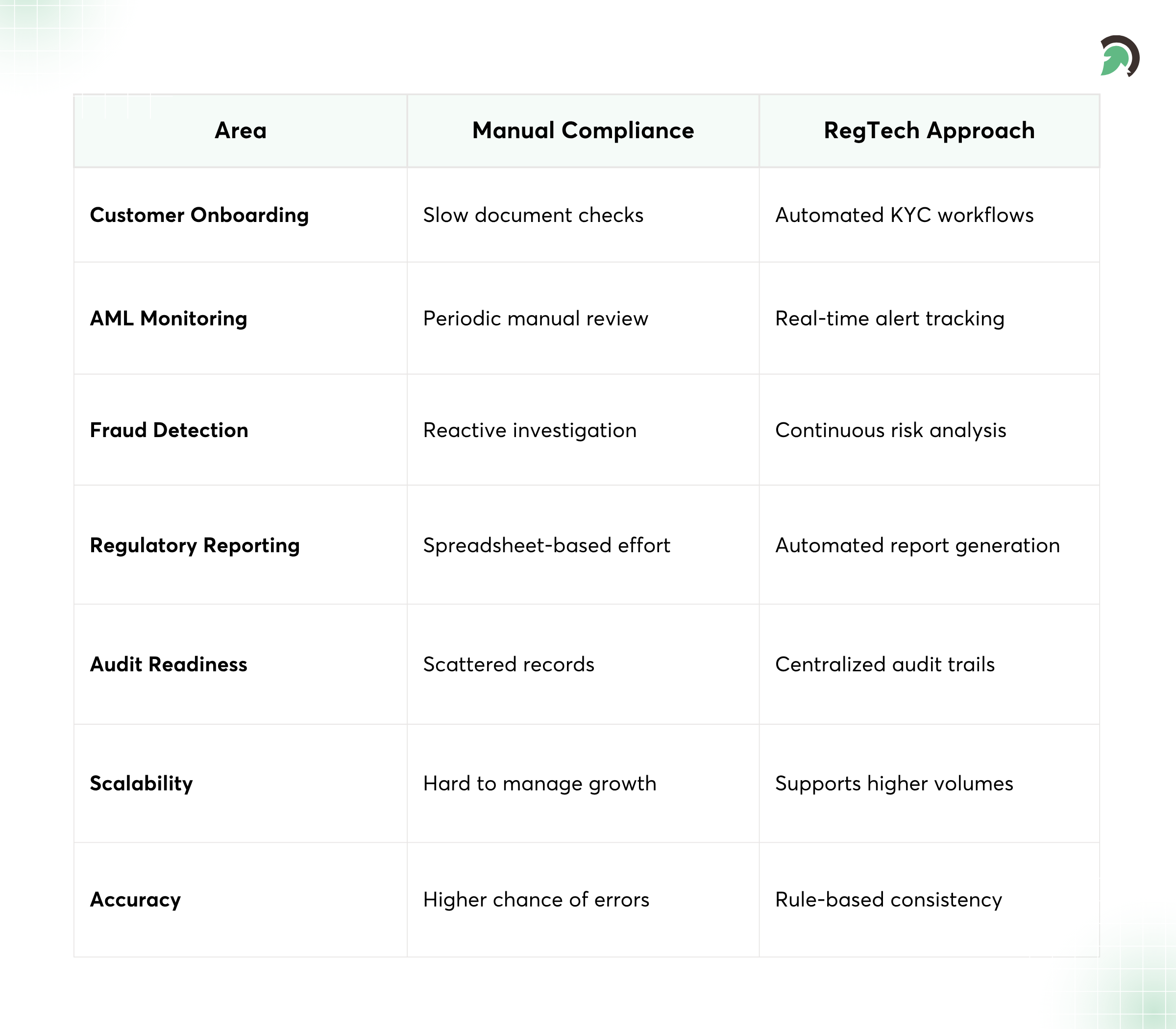
Core Functions of RegTech Software
A strong RegTech platform is not a single feature. It is a coordinated system of compliance capabilities working together across the customer and transaction lifecycle.
Identity verification, or KYC, is often the first layer. The software verifies documents, validates customer information, checks sanctions and watchlists, and supports risk-based onboarding decisions. This is where many KYC software development solutions create immediate value by reducing onboarding delays while maintaining regulatory standards. This is especially important in fintech app development, where onboarding speed and trust directly affect user conversion
Transaction monitoring is another core function. AML systems analyze payment behavior, detect unusual patterns, and flag activity that may require review. In AML compliance software development, this often involves rules engines, threshold checks, anomaly detection, and case management workflows.
Fraud detection adds another protective layer. While AML focuses on illicit financial activity from a regulatory standpoint, fraud systems often look for account takeover attempts, synthetic identities, suspicious device behavior, and abnormal user actions.
Regulatory reporting automation helps teams generate required reports faster and with fewer manual errors. Instead of assembling data from disconnected systems, the platform prepares structured outputs, stores supporting records, and keeps a clear audit trail.
Risk assessment and management tools score customers, transactions, merchants, or operational units based on configurable policies. These scores can influence approval decisions, escalation paths, and monitoring intensity.
Compliance workflow automation ties everything together. It assigns tasks, logs reviewer decisions, stores evidence, triggers alerts, and ensures nothing disappears into email chains or spreadsheets.
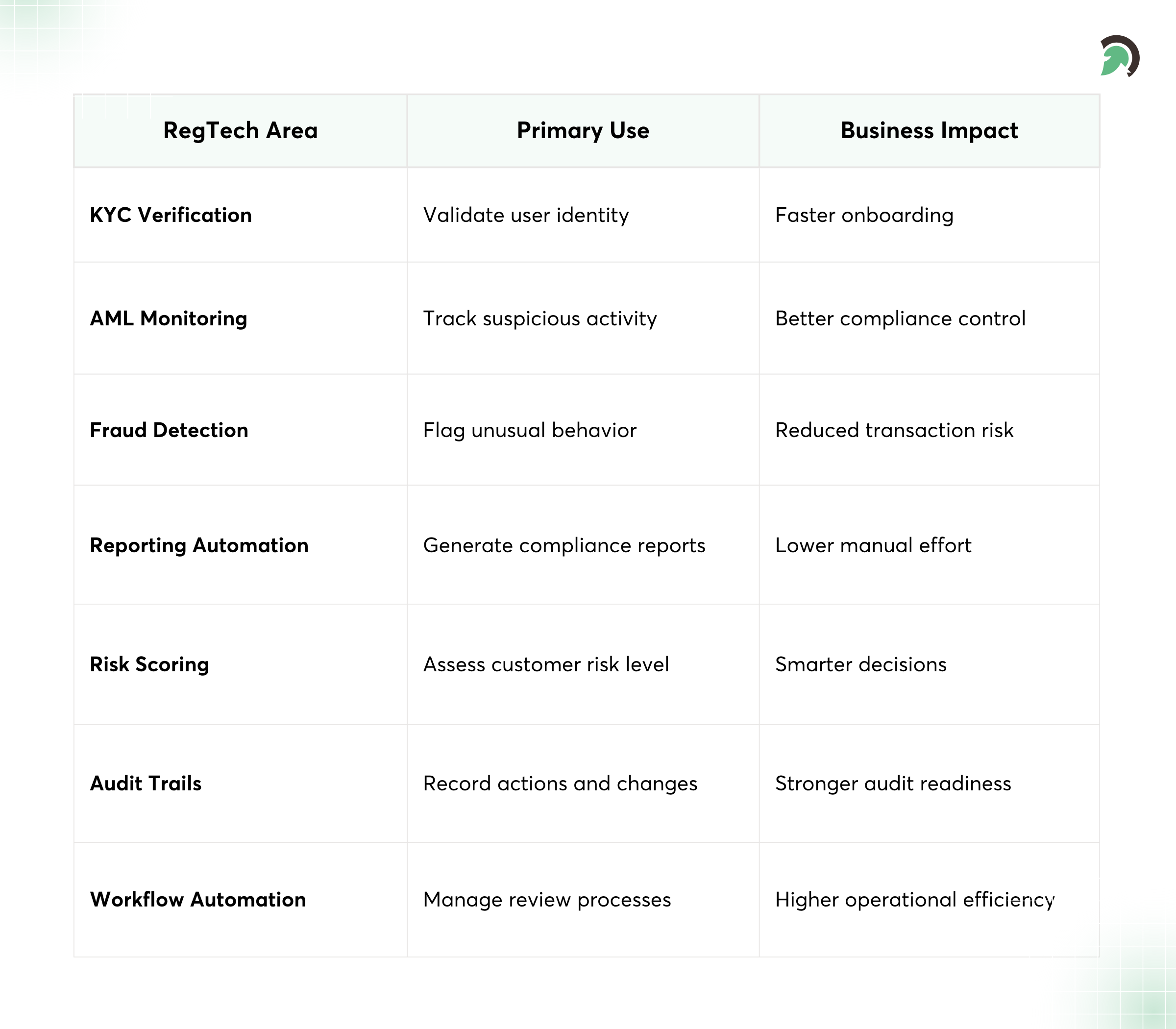
Key Features of RegTech Software
The best RegTech products combine regulatory rigor with strong engineering fundamentals. They are built to process high-volume data, integrate with existing systems, and provide actionable insights without overwhelming compliance teams.
Essential features typically include:
- Real-time compliance monitoring for customers, transactions, and risk events
- Automated alerts for suspicious behavior, documentation gaps, or rule violations
- AI-driven risk analysis to prioritize reviews and reduce false positives
- Data encryption in transit and at rest to protect sensitive information
- Detailed audit trails showing who did what, when, and why
- API integrations with core banking platforms, CRM tools, identity systems, and payment gateway integration services
- Scalable architecture that supports growth across markets and products
One feature that often separates mature solutions from basic tools is explainability. It is not enough to flag a transaction as risky. Teams need to understand the reason, trace the decision logic, and defend the outcome to auditors or regulators. That is especially important when machine learning models are involved.
Another overlooked feature is usability. Compliance software is used by analysts, reviewers, operations teams, and managers under pressure. A cluttered interface slows investigations and creates avoidable errors. Good UI design matters just as much as technical depth.
Types of RegTech Solutions
1. KYC & Identity Verification Systems
Regulatory and compliance pressures faced by financial institutions have increased manifold in the recent past. This has led to the evolution of KYC & Identity Verification Systems. Ease of digital onboarding with these solutions in place helps organizations impress customers with a fast, efficient, and secure first impression. Post-onboarding, this user data gets continuously monitored under AML Compliance Solutions for further lifecycle monitoring. Customer risk is re-evaluated based on transactions initiated and conducted by the AML and customer-first experience teams.
Leveraging cloud storage and computing, using mobility data during verification, and integrating, for instance, liveness-check functionalities into mobile apps are trends in this category of RegTech Solutions.
2. AML Compliance Solutions
AML Compliance Solutions enable your existing system to perform real-time monitoring of your users (key data updated after every financial transaction), generate alerts based on mismatches and suspicious behavior, attract new business opportunities by reaching customers through published reports, and scale your current team by reducing their manual, mundane tasks.
Intelligent opinions on alerts and trends in the past identity that only AI tool could compare would be a “too-big-a-pie-for-a-human-to-eat” style strategy. API threats trading satisfies this often-stated demand. For such solutions, measurable KPIs from the past include false alerts generated, user data compromised, secure tokens update required, etc.
3. Authorization Tools
The fraud-detection contingent has been winning the chessboard following checkwriting and later card, the adversarial strategy adopted by the industry.
Features you need to consider for inclusion are AI for deciding in real-time whether any transaction should be allowed to proceed, MONITOR for a cluster of small transactions or certain processes (by matching the type of process associated with the financial account) to alert the stakeholder for possibly abusive transaction perspective, and employing velocity checks on said process. Cross-selling opportunities and use as a PR tool are also open for tag monitoring, especially for resource-related cases like the payments system.
High-potential lead generation is the mainstay opportunity out there. FIs adopting RegTech would not like to miss out on such.
4. Advisory and Compliance App for the mobile app
These RegTech solutions involve exciting memory-sharing. You may either have an account on your platform act as a lead generator for the thieves, risking and master device, or, if the videographer has the unique liveness-detecting capabilities in the use system currently integrated, you could enable the program to close a job from within.
PR would benefit from publicizing the trend of using a master device account and utilizing integrated liveness detection for Kill-the-Business transfers.
Benefits of RegTech Software Development
- Reduced compliance costs: Automation reduces the manual workload for onboarding, reviews, reporting, and case handling. Over time, this can significantly reduce operational spend.
- Faster regulatory reporting: Structured data flows and automated templates make reporting more consistent and much less painful.
- Improved accuracy and reduced human error: Rule-based workflows and system validations reduce the mistakes that often happen in manual processes.
- Real-time risk detection: Instead of waiting for batch reviews, teams can detect suspicious behavior in real time and respond faster.
- Enhanced data security: Well-designed platforms use encryption, access controls, monitoring, and secure infrastructure to protect sensitive records.
- Better scalability for growing financial platforms: As volumes increase, automated systems can handle more complexity without requiring compliance headcount to grow at the same pace.
Challenges in RegTech Software Development
The opportunity is real, but so is the complexity.
Regulations change constantly, and every update can affect workflows, thresholds, reporting formats, or retention policies. Integration is another common hurdle, especially when institutions still depend on legacy core systems.
Data privacy is also a major concern. Compliance platforms process highly sensitive customer and transaction data, so poor security architecture can create serious legal and operational exposure.
Other common challenges include:
- High initial development cost for advanced, enterprise-grade systems
- Variation in regional rules across the US, EU, India, and other markets
- Difficulty balancing automation with explainability
- Need for cross-functional expertise in finance, risk, legal, and engineering
- Managing false positives without missing truly suspicious activity
This is one reason many companies choose a specialized regtech software development company rather than a general product vendor. Domain depth matters here.
Compliance and Regulatory Considerations
A RegTech platform must be designed around the regulations it supports, not retrofitted after launch.
That usually starts with KYC and AML obligations, including customer identification, due diligence, sanctions checks, transaction monitoring, and suspicious activity workflows. Data privacy laws such as GDPR shape how personal data is collected, stored, processed, and deleted.
FATF guidelines influence AML expectations across many jurisdictions, while PCI DSS becomes important when payment card data is involved. Regional requirements also vary widely. US regulations may differ sharply from EU directives or India-specific financial compliance rules.
Important design considerations include:
- Clear data lineage and retention policies
- Consent management, where applicable
- Jurisdiction-aware workflows and reporting logic
- Tamper-resistant audit records
- Role-based access and least-privilege controls
- Transparent review and escalation histories
In broader financial software development, auditability is one of the most valuable qualities you can build. If a regulator asks how a decision was made, your system should provide an answer quickly.
Best Practices for Building RegTech Solutions
- Design compliance-first architecture: Compliance requirements should shape data models, workflows, permissions, and logs from the beginning.
- Use modular and scalable systems: Separate services for onboarding, monitoring, reporting, and case management make the platform easier to maintain and update.
- Implement strong data security measures: Use encryption, tokenization where appropriate, secure key management, and strict access control policies.
- Ensure real-time monitoring capabilities: Real-time visibility helps teams respond faster and reduce risk exposure.
- Maintain detailed audit logs: Every important action should be traceable. That includes rule triggers, manual overrides, reviewer notes, and report submissions.
- Regularly update systems in response to regulatory changes: Build a process for policy updates, rule reviews, testing, and release management to keep compliance logic current.
Future Trends in RegTech
RegTech is evolving as financial platforms become more digital and compliance expectations continue to grow. Businesses are moving toward faster, smarter, and more connected compliance systems.
AI-driven automation is becoming more common in fraud detection, transaction monitoring, and risk analysis. There is also growing demand for real-time reporting, cloud-based compliance platforms, and stronger identity verification methods.
Key trends include:
- AI-powered compliance automation
- Real-time regulatory reporting
- Cloud-based RegTech solutions
- Biometric and digital identity verification
How to Choose a RegTech Software Development Company
Choosing the right RegTech development partner is critical, as compliance systems directly impact risk management, scalability, and regulatory readiness. A strong partner should understand both financial regulations and modern software architecture.
Start by evaluating domain expertise. The company should have experience working with financial platforms and a clear understanding of KYC, AML, data privacy, and reporting requirements across regions.
Next, assess their technical capabilities. Look for teams that can build scalable, secure systems and integrate with existing banking, payment, and identity infrastructure without disruption.
Other important factors to consider:
- Proven experience in financial and compliance projects
- Strong focus on data security and regulatory standards
- Ability to build scalable and flexible architecture
- Clear development process with testing and support
- Portfolio of relevant case studies or solutions
Finally, choose a partner who aligns with your business goals, not just your technical requirements. The right company will help you build a solution that supports compliance while enabling growth and a better user experience.
Conclusion
RegTech software is no longer something only large institutions invest in. It has become an essential part of building a financial business that can grow responsibly, manage risk, and keep up with changing regulations. From KYC and AML to fraud detection, reporting, and auditability, the most effective solutions are designed with compliance built in from the beginning, not added later. As fintech app development becomes more advanced, scalable compliance systems play a major role in long-term product success.
If you are planning your next compliance initiative, it helps to start with a clear use case, the right architecture, and a team that understands both regulation and product engineering. EvinceDev works with businesses to build secure and scalable RegTech solutions that support real operational needs. In a market where trust, speed, and transparency matter more than ever, EvinceDev can help turn compliance into a stronger foundation for growth.