

Key Takeaways:
- Care Workflow: Build software that simplifies charting, scheduling, billing, and follow-ups to reduce admin burden for care teams.
- Secure by Design: Strong access controls, privacy safeguards, and compliant data handling are essential from day one in development.
- Telehealth Ready: Behavioral platforms should support virtual care, client portals, and flexible remote access for better continuity.
- EHR Integration: Interoperability matters because behavioral health teams need smoother data exchange across systems and providers.
- Patient Portals: Easy messaging, reminders, intake forms, and self-service tools can improve engagement and ongoing participation.
- Billing Support: Integrated billing and documentation features help practices streamline claims, coding, and reimbursement workflows.
- Scalable Systems: The right architecture should support multi-location growth, more providers, and rising patient data volumes.
- Usability First: Clean workflows and fast navigation matter because clinicians want less screen time and more patient time.
Choosing the right vendor for behavioral healthcare software development is one of those decisions that quietly shapes everything, from clinical quality to staff efficiency, patient trust, and your ability to scale. If you’ve ever lived through a “quick launch” that later turned into endless patching, you already know the stakes. This guide walks you through how to evaluate a healthcare software company for behavioral health, so you don’t just get software, but build a long-term system your team can rely on.
Start with a Clear Understanding of Your Clinical and Operational Needs
Before you compare features, pause and define what “success” means in your environment. Behavioral programs aren’t interchangeable. A system that works for outpatient therapy may fail to support intensive care, group sessions, or high-touch care coordination.
Identify whether your focus is clinical care, operations, or both
Many organizations begin with clinical priorities documentation, treatment plans, workflow routing, and then realize their real bottleneck is operational: scheduling, billing workflows, referrals, authorizations, or reporting. Decide what matters most now and what must be supported later.
- Clinical care: documentation, progress notes, care plans, assessments, interoperability with clinical practices
- Operations: scheduling, forms, staff roles, reporting, patient intake, billing coordination
- Both: most mature organizations need integrated workflows that minimize admin burden for clinicians
Map daily workflows of therapists, admins, and patients before evaluating vendors
It’s tempting to ask for demos based on marketing promises. Instead, map what happens on a normal day step-by-step because that’s what software has to support.
Try this practical exercise:
- Therapists: How do they start sessions? Where do they document? What triggers follow-ups?
- Admins: How do they manage intake, authorizations, scheduling changes, and patient communications?
- Patients: What do they need at home: forms, reminders, telehealth access, secure messaging?
When vendors understand your workflows, your evaluation becomes grounded. You’ll also avoid the classic mismatch: “The platform has the features” vs. “The platform fits our day.”

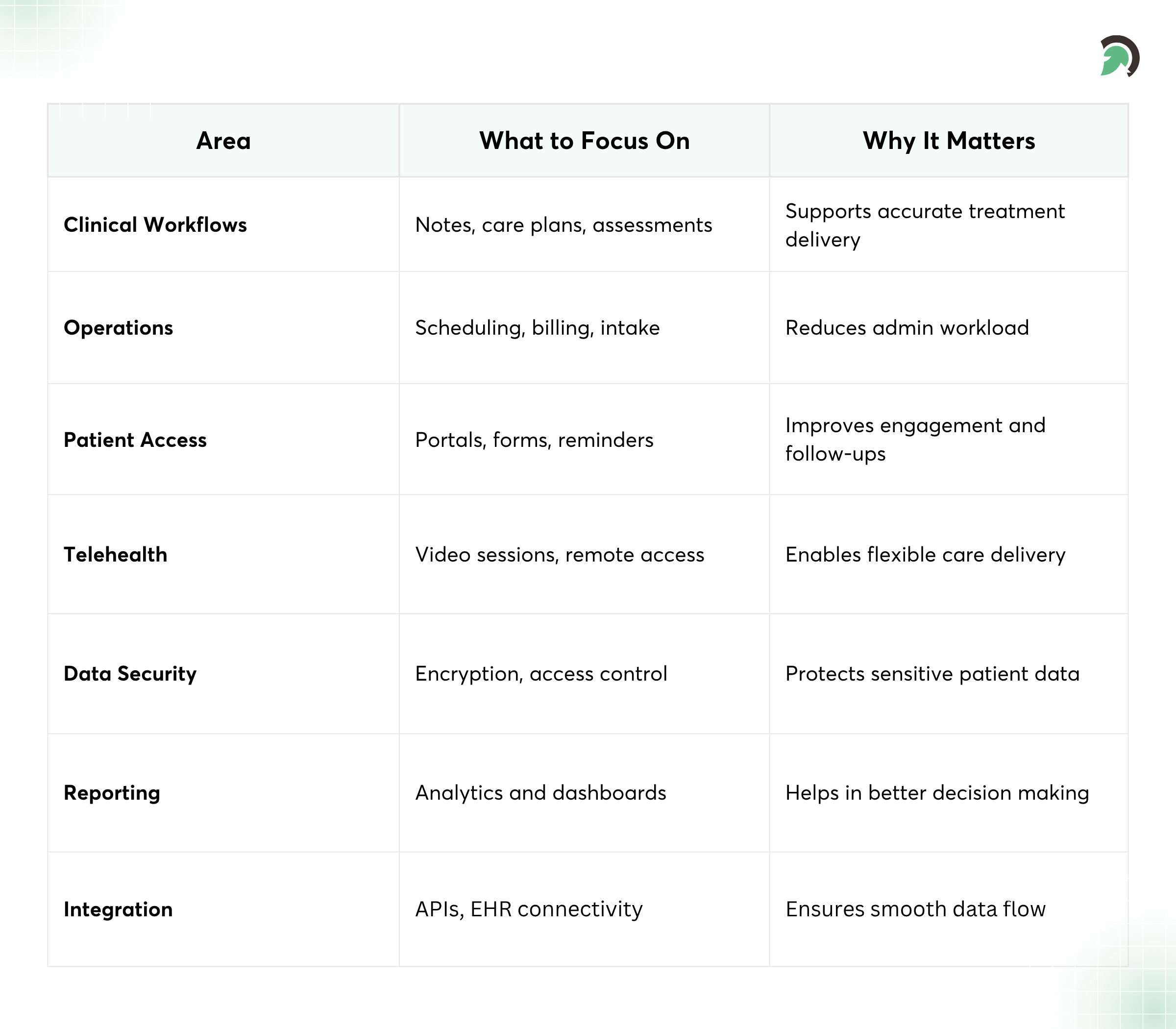
Evaluate Industry-Specific Experience, Not Just General Development Skills
Not all development teams think in behavioral health terms. You want a behavioral health software development partner that understands the nuances of therapy workflows, documentation patterns, and compliance expectations associated with mental health data.
Look for companies with behavioral health domain expertise
Ask whether their portfolio includes behavioral programs, specifically outpatient, intensive outpatient, residential, school-based services, or community mental health. General “healthcare” experience can be helpful, but behavioral health software development services require domain literacy.
- Therapy workflow familiarity (notes, treatment plans, session structure)
- Understanding of clinical documentation realities (what clinicians actually write, not what forms assume)
- Experience with compliance processes that affect product design
Prioritize partners who understand mental health nuances over generic healthcare vendors
Mental health operations have unique constraints: sensitive communications, careful access controls, and documentation practices designed to support continuity of care. A vendor that has built mental health software development solutions before will more quickly anticipate adoption barriers.
During evaluation, listen for signals like:
- They ask workflow questions before talking about modules
- They can explain how they handle role-based access for clinicians vs. admin staff
- They discuss operational edge cases (late cancellations, referral follow-ups, high-risk escalation paths)
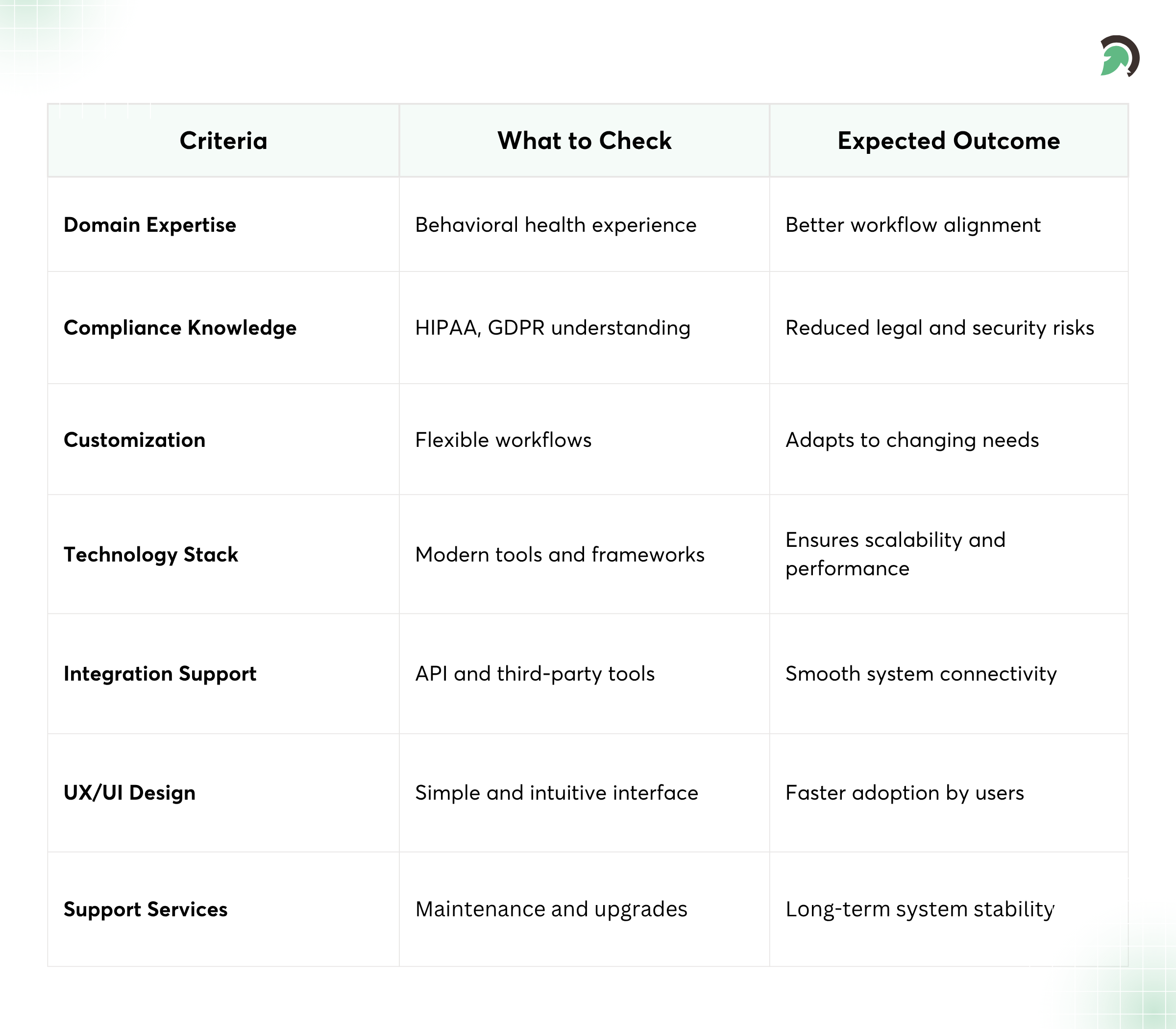
Check Compliance Readiness and Security Capabilities Early
Compliance and security shouldn’t be an afterthought or a final checklist item. If the vendor can’t explain what they do in practical implementation terms, treat that as a risk signal.
Ensure understanding of HIPAA, GDPR, and regional healthcare regulations
Your partner should be able to speak clearly about compliance requirements and how they map to product behavior, not just legal phrasing. Depending on your footprint, that often includes HIPAA, GDPR, and any regional healthcare regulations relevant to your organization.
When discussing a HIPAA-compliant behavioral health software initiative, focus on:
- Data classification: what data is stored, transmitted, and retained
- Privacy-by-design decisions (where encryption applies, how access is limited)
- Data subject rights handling (where GDPR may apply)
- Audit and monitoring approach
A reliable partner should explain compliance in practical, implementation-level terms
Good vendors don’t just say “we’re compliant.” They outline how compliance becomes engineering. Ask questions like:
- How is encryption implemented for data in transit and at rest?
- What access controls exist (RBAC, MFA, session controls)?
- How do you generate and protect audit logs?
- What is your incident response process?
- How do you handle vendor access to systems?
These details help you assess whether the solution can withstand real-world audits and security expectations.
Analyze Their Approach to Customization and Scalability
A long-term platform must evolve with your clinical model. If your program expands from outpatient to blended care, or adds new services, your software should adapt without forcing a rebuild.
Determine if solutions are flexible or template-based
Many teams start with a “mostly standard” base. That can be fine until customization becomes too expensive or too slow to keep pace with changes in your workflow. Evaluate how they approach customization.
- Can they configure workflows without heavy code changes?
- How do they handle client-specific forms, permissions, and routing rules?
- Will future feature requests align with their product roadmap, or get treated as one-off exceptions?
Avoid rigid platforms that limit future feature expansion or integrations
Scalability isn’t only about handling more patients. It’s about staying flexible when your services grow, your staffing changes, and new integrations become necessary.
When interviewing a behavioral healthcare software development services team, test their maturity by asking:
- How do they scale infrastructure and performance as usage grows?
- How do they manage versioning for features and workflows?
- What integration patterns do they recommend to avoid vendor lock-in?
Review Technology Stack and Integration Capabilities
Even the best behavioral healthcare app can struggle if it can’t connect to your ecosystem. Integration is where operational value is won or lost: faster intake, fewer duplicate records, and smoother handoffs between systems.
Check compatibility with EHR systems, APIs, and third-party tools
Look for clear integration support. You want a vendor who understands data flow and interoperability, not just screen-level features.
- Compatibility with your existing EHR systems and reporting requirements
- API availability and documentation quality
- Support for third-party tools (care coordination, billing services, identity providers)
Also, ask how they handle data mapping and updates, especially when upstream systems change.
Strong integration support ensures smoother operations and data flow
During technical review, clarify how integrations affect real daily work:
- What happens if an integration is delayed or fails?
- How are data discrepancies surfaced and resolved?
- Do they provide monitoring for integration health?
If a vendor can’t explain failure modes and data reconciliation, integration risks can become an ongoing operational pain point.
Assess UI/UX Focus for Both Clinicians and Patients
Usability is not a “nice-to-have.” In behavioral health, software often sits at the intersection of stress, urgency, and sensitive information. If the UI is confusing, adoption falls, and clinicians work around the system, defeating the purpose.
Look for intuitive dashboards and simple navigation
Clinician interfaces should reduce friction. Admin interfaces should make operational tasks efficient. Patient interfaces should be accessible and reassuring.
- Clinicians: clear documentation flow, minimal clicks, fast access to key information
- Admins: efficient task routing, clear status tracking, easy exception handling
- Patients: simple forms, understandable next steps, consistent communication
Evaluate accessibility for patients with varying technical skills
Accessibility includes both technical usability and emotional usability. Patients may be using phones, may have limited time, or may feel overwhelmed. Evaluate:
- Readable layouts, straightforward language, and reduced cognitive load
- Mobile-first design or responsive usability
- Support for different accessibility needs (where applicable)
Poor usability creates admin work and delays. A vendor that takes UX seriously is more likely to deliver behavioral healthcare IT solutions that teams can actually run day to day.
Validate Development Process and Transparency
A solid delivery process doesn’t just manage project timelines it protects quality. Behavioral healthcare software development can quickly become complicated when clinical stakeholders, security requirements, and operational workflows converge.
Ask about development methodology (Agile, iterative delivery)
In practice, you want a process that enables learning early. That means iterative development, frequent demonstrations, and early validation with stakeholders.
- How do they break down work into deliverable increments?
- How do they handle changing requirements?
- What does a typical sprint review look like for clinical stakeholders?
Transparent workflows reduce risk and improve collaboration
Clear communication is an underrated success factor. Evaluate their transparency through:
- Regular progress reporting cadence
- Documented decisions (especially around compliance and workflow design)
- How they manage dependencies and escalation when issues appear
If everything is “we’ll figure it out later,” your implementation risk rises.
Examine Support, Maintenance, and Post-Launch Commitment
The launch moment is not the end. In behavioral operations, you need stability and improvements that keep pace with evolving care needs, security expectations, and integration requirements.
Check the availability of ongoing support and upgrades
Ask what happens after go-live. What support channels exist? What are typical response times? How are urgent issues handled?
- Support coverage hours and escalation paths
- Maintenance schedules and release management approach
- Whether they provide security updates and monitored improvements
Long-term success depends on continuous improvement, not just launch
Strong partners treat post-launch as part of the product lifecycle. Ideally, you’ll see:
- Ongoing roadmap alignment with your clinical and operational priorities
- Performance and usability improvements over time
- Training and change-management support to help teams adopt the system
Review Portfolio, Case Studies, and Client Feedback
Portfolio review should help you answer one question: “Can they solve problems like ours?” The best case studies show tradeoffs, constraints, and outcomes, not just screenshots.
Analyze past behavioral healthcare projects
Look specifically for work related to:
- therapy workflows and documentation
- telehealth workflows
- patient engagement components
- operational tools like scheduling, referrals, and reporting
Case studies should demonstrate problem-solving, not just features
When reviewing case studies, ask:
- What problem triggered the project?
- What constraints existed (timelines, security, staffing, integration)?
- How was success measured?
- What did they do when requirements changed?
If you can’t find meaningful examples, it may be worth asking why their work doesn’t reflect your niche.
Compare Cost with Value, Not Just Budget
Cost conversations often miss the real point: value is tied to compliance readiness, scalability, usability, and implementation risk. A cheaper solution that requires constant rework can cost more in the long run.
Break down pricing based on features, compliance, and integrations
Request a clear breakdown. “Custom” can mean anything from well-planned configuration to endless bespoke development. Compare proposals by what’s included.
- Feature scope (what is in/out)
- Compliance-related work (security, audit, privacy engineering)
- Integration efforts (APIs, data mapping, monitoring)
- Ongoing costs (support, upgrades, hosting responsibilities)
A slightly higher investment often delivers better scalability and security
In behavioral healthcare, that tradeoff is often worth it. Better engineering and clearer processes reduce operational friction, minimize security risks, and support behavioral healthcare app development that doesn’t stall after day one.
Identify Red Flags Before Finalizing a Partner
Some warning signs show up early. If you notice them, don’t ignore them; resolve them now, or walk away.
Lack of healthcare compliance knowledge
- Vague answers about HIPAA controls and audit mechanisms
- No clarity on data retention, encryption, or access workflows
- Overreliance on “we’ll handle it later.”
Limited customization options
- They can’t explain how they support workflow differences across programs
- Customization requires rebuilding core parts repeatedly
Poor communication or unclear timelines
- Inconsistent messaging during discovery
- No measurable plan for milestones, demos, or stakeholder sign-off
- Unclear ownership of responsibilities during implementation
Early warning signs can prevent costly mistakes later
You’re not just buying software you’re entering a delivery relationship. Clarity and competence early usually correlate with fewer post-launch surprises.
Build a Shortlist and Conduct Practical Evaluations
When the shortlist is ready, shift from sales conversations to practical validation. You’re trying to reduce uncertainty, not collect brochures.
Request demos tailored to your workflows
Ask for demos that follow your actual therapist/admin/patient workflows, not generic feature reels. If they can’t show your day inside the product, it’s a sign they’re not connecting product capabilities to outcomes.
Conduct technical and compliance discussions
Schedule deeper sessions for security, architecture, integration, and implementation planning. This is where you validate whether their behavioral healthcare software development services can meet your operational reality.
- Review their approach to audit logs and access control
- Discuss integration patterns with your EHR/other systems
- Validate environment setup, testing strategy, and release process
Real product walkthroughs reveal more than sales presentations
In a strong walkthrough, you should see:
- Clear navigation and role-based views
- How documentation and workflows are structured
- How patient experiences are designed for clarity and trust
Final Decision Checklist for Choosing the Right Company
If you want a simple way to decide, evaluate the partner against your criteria and document your scoring. The goal isn’t to “win” an argument it’s to choose the team most aligned with your long-term vision.
Domain expertise
- Behavioral health knowledge in real delivery not only marketing
- Experience supporting therapy workflows and documentation needs
Security and compliance readiness
- Practical implementation approach to HIPAA/GDPR (as relevant)
- Clear security engineering and audit controls
Scalability and flexibility
- Ability to evolve workflows as your services expand
- Performance and infrastructure readiness for growth
Proven track record
- Relevant behavioral projects with measurable outcomes
- Client references or credible case studies demonstrating execution
Choose a partner aligned with your long-term vision, not just immediate needs
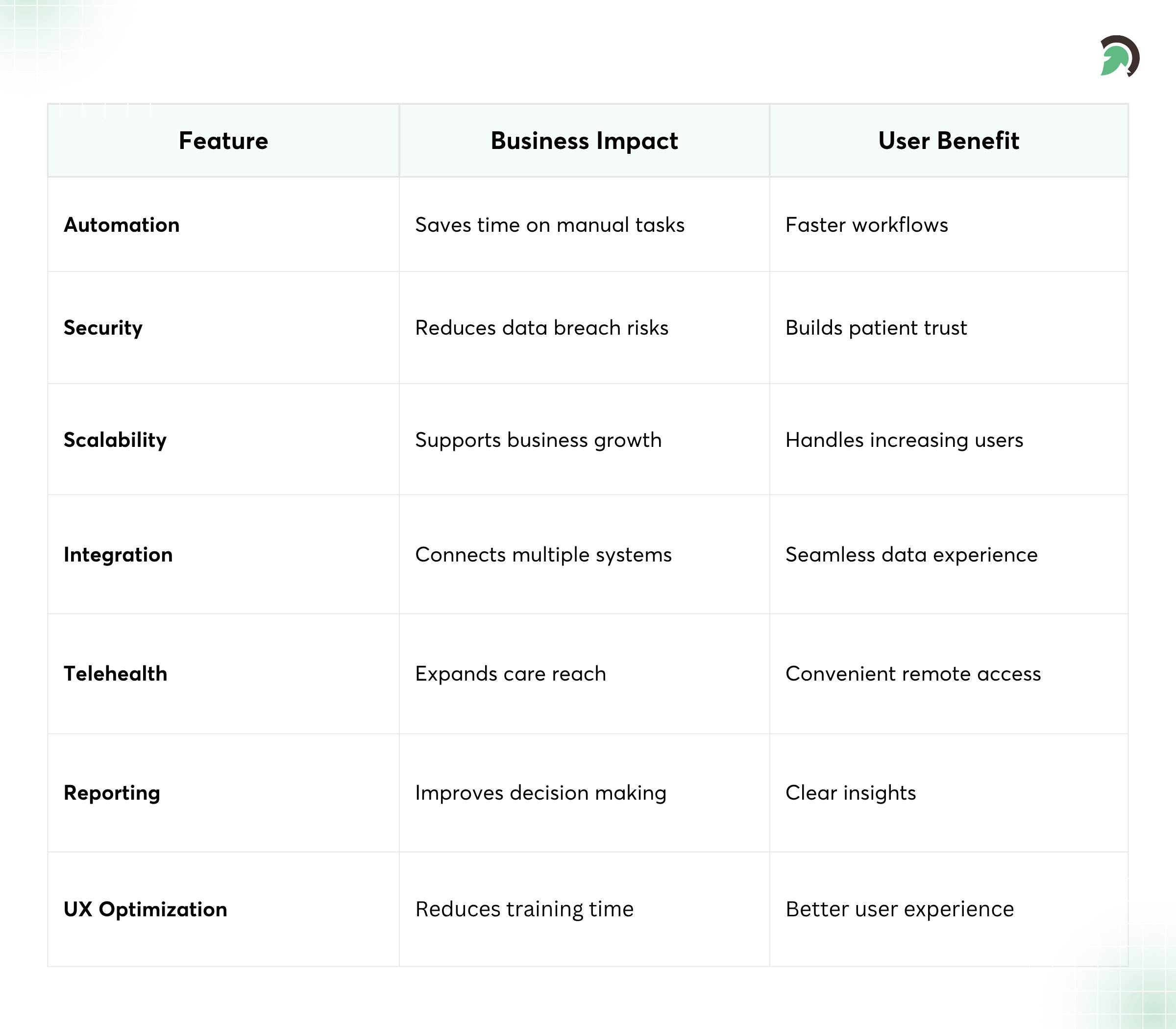
When your partner understands the clinical reality, security requirements, and operational constraints, the outcome is more than a “system.” It becomes a platform that helps clinicians focus on care and helps administrators run efficiently without compromising trust.
Conclusion
Behavioral healthcare software development is no longer just about digitizing processes; it is about building systems that truly support clinicians, improve patient outcomes, and adapt to evolving care models. From secure data handling and compliance to seamless workflows and patient engagement, every decision in development directly impacts how effectively care is delivered. Organizations that prioritize thoughtful design and scalable architecture are better positioned to reduce operational friction while maintaining trust and continuity in care.
As behavioral health continues to evolve with digital transformation, the focus will shift toward more connected, intelligent, and patient-centered platforms. Choosing the right development approach today can shape long-term efficiency and clinical success. Working with experienced teams like EvinceDev helps translate complex requirements into reliable, future-ready solutions. If you are planning to build or enhance your behavioral healthcare platform, now is the time to explore solutions that align with your long-term vision and care delivery goals.