

Key Takeaways:
- Trusted Accuracy: AI data processing improves financial accuracy by reducing manual errors and validating large data sets fast.
- Real-Time Speed: Fast AI processing helps fintech platforms analyze transactions instantly and support quicker financial decisions.
- Built to Scale: AI systems can process growing transaction volumes efficiently without slowing down fintech platform performance.
- Smarter Insights: AI helps fintech teams uncover patterns, detect anomalies, and generate useful insights from complex data.
- Fraud Detection: AI data processing strengthens fraud detection by identifying unusual activity faster across high-volume transactions.
- Compliance Support: AI improves compliance workflows by monitoring financial data, tracking events, and supporting audit readiness.
- Operational Efficiency: Automated data processing reduces manual workload, saves time, and improves efficiency across fintech operations.
- Secure Processing: Trusted AI data processing supports secure fintech systems with better monitoring, control, and data protection.
If your FinTech team is wrestling with errors, delays, and endless reconciliations, you’re not alone. That’s exactly why ai in financial data processing has become a board-level priority: it helps teams move faster without sacrificing accuracy. In this guide, I’ll break down what financial data processing really involves, why traditional approaches struggle as data grows, and how ai in financial data processing (used thoughtfully) can improve accuracy across real-world FinTech workflows.
Financial data processing in fintech software systems is the complete set of steps for collecting, transforming, validating, reconciling, and reporting financial information. from raw inputs (like transactions or documents) to decisions and audit-ready outputs (like ledgers, statements, and regulatory reports).
What makes this domain uniquely demanding is the balance you have to strike between:
- Accuracy (numbers must reconcile, and classifications must be correct)
- Speed (latency impacts risk, customer experience, and settlement)
- Consistency (the same type of event should always be interpreted the same way)
Traditional data processing methods often rely on rules, manual review, or brittle ETL pipelines. They can work until the data volume, formats, and edge cases expand. Modern financial platforms now ingest information from payments, banking rails, card networks, merchant invoices, customer onboarding systems, and trading feeds. The result: more streams, more formats, and more opportunities for mismatch.
This is where AI in financial data processing changes the game for modern fintech software development teams. Instead of only reacting to known patterns, AI systems can detect issues early, infer meaning from messy inputs, standardize data consistently, and learn from historical outcomes. The transformation isn’t just faster processing; it’s better information.
What is Financial Data Processing in FinTech?
Financial data processing is the operational and technical workflow that turns raw data into reliable financial records and insights. In practice, it includes:
- Ingestion (pulling data from sources like payment gateways, CRMs, or data feeds)
- Transformation (formatting, mapping fields, normalizing values)
- Validation (checking totals, schemas, constraints, and business rules)
- Enrichment (adding metadata, categories, risk flags)
- Reconciliation (matching events across systems)
- Reporting & compliance (producing audit trails and regulatory outputs)
To get specific, fintech data typically falls into these buckets:
- Transaction data: payments, refunds, chargebacks, transfers, settlements
- Customer data: profiles, identities, account status, onboarding events
- Compliance and regulatory data: KYC/KYB artifacts, AML signals, audit logs
- Market and trading data: quotes, executions, positions, reference data
These workflows sit at the core of banking, payments, lending, and investment platforms. A delay or mistake in one step doesn’t stay localized; it ripples into fraud monitoring, credit decisions, customer support, and compliance reporting.
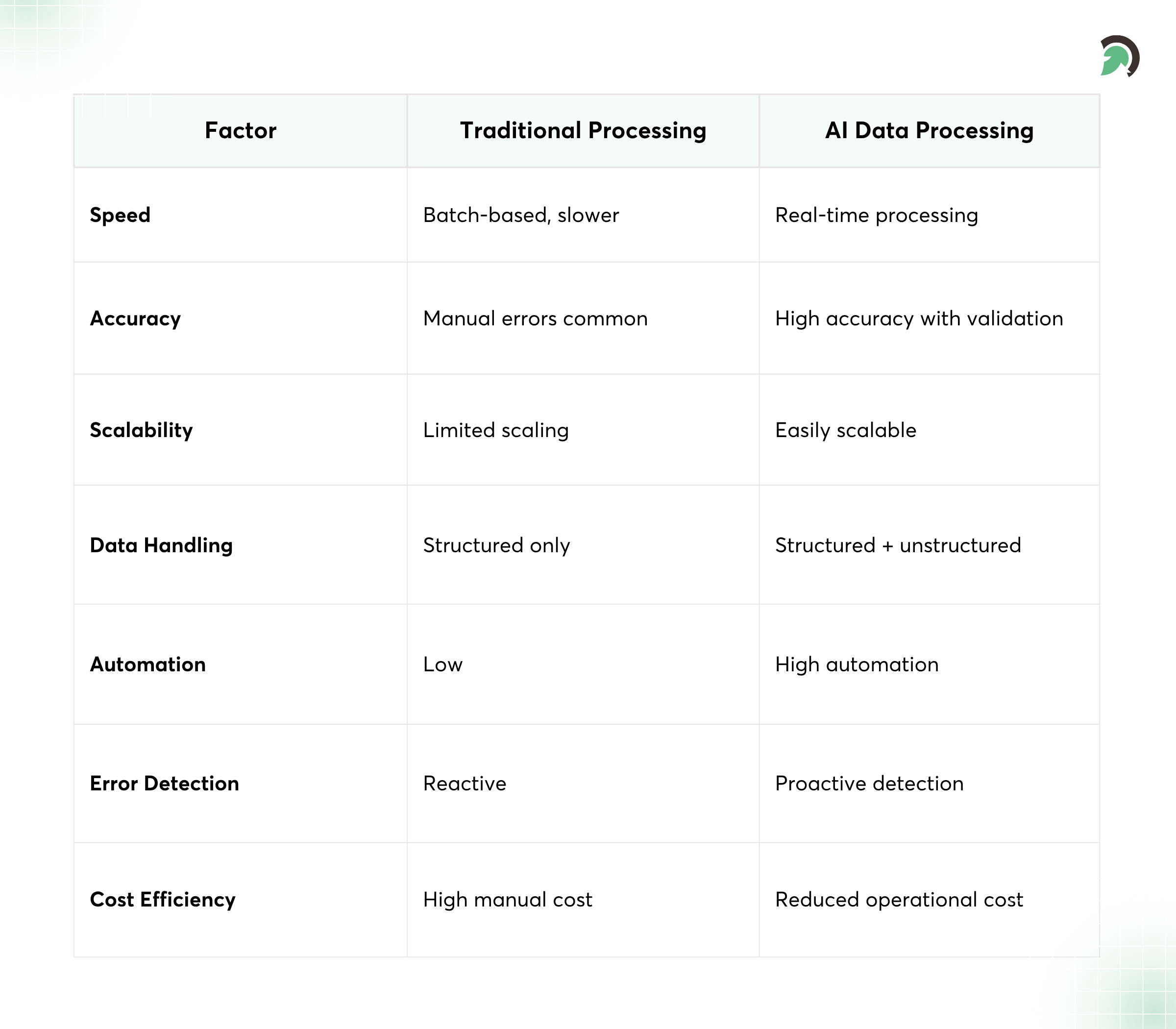
Limitations of Traditional Financial Data Processing
Traditional approaches were built for a world where data formats were more stable and volumes were lower. Today, the environment is different, and those methods show clear cracks.
-
Manual data entry and reconciliation
Humans still do important checks, but manual entry becomes costly and inconsistent as transaction counts rise. Reconciliation is especially painful when data arrives in different structures or with missing fields.
-
Data silos across systems
Even within one organization, payment systems, risk systems, accounting, and customer platforms often don’t share data in a harmonized way. The outcome is fragmented views and repeated transformations.
-
High error rates and inconsistencies
Rules-based pipelines can’t easily handle every “real life” edge case, such as partial refunds, inconsistent merchant naming, or documents with formatting variations. Errors then surface later, when they’re more expensive to fix.
-
Delayed processing and reporting
Batch processing is convenient, but it introduces latency. When teams wait hours or even days for reporting, they lose the ability to catch issues quickly and respond to customers in real time.
-
Limited scalability for large datasets
Scaling rules-based workflows can mean scaling engineering effort, too. As datasets grow, throughput and maintainability become major constraints.
-
Inefficient handling of unstructured data
Invoices, bank statements, contracts, and onboarding documents are often unstructured or semi-structured. Traditional ETL struggles without heavy manual tagging, and that’s a bottleneck.

How AI is Transforming Financial Data Processing
AI doesn’t just “speed things up.” It changes the way systems understand, validate, and improve data. Instead of treating data as static fields, AI treats information as something that can be interpreted and verified.
-
Automation of data ingestion and processing
AI can reduce the need for hand-configured extraction and mapping by learning patterns across data sources. This is especially valuable for financial data integration, where sources may vary in naming conventions, schemas, and formatting.
-
Real-time data validation and analysis
Modern fintech app development teams increasingly need real-time checks. AI-powered systems can validate incoming events against expectations and flag anomalies while the data is still fresh.
-
Continuous learning from data patterns
As new transaction types emerge and fraud tactics evolve, machine learning can update model behavior. The goal isn’t “set and forget,” it’s continuous improvement based on outcomes.
-
Improved data standardization and normalization
AI helps convert inconsistent inputs into consistent outputs. That means fewer mismatches between systems, fewer manual correction loops, and clearer reporting.
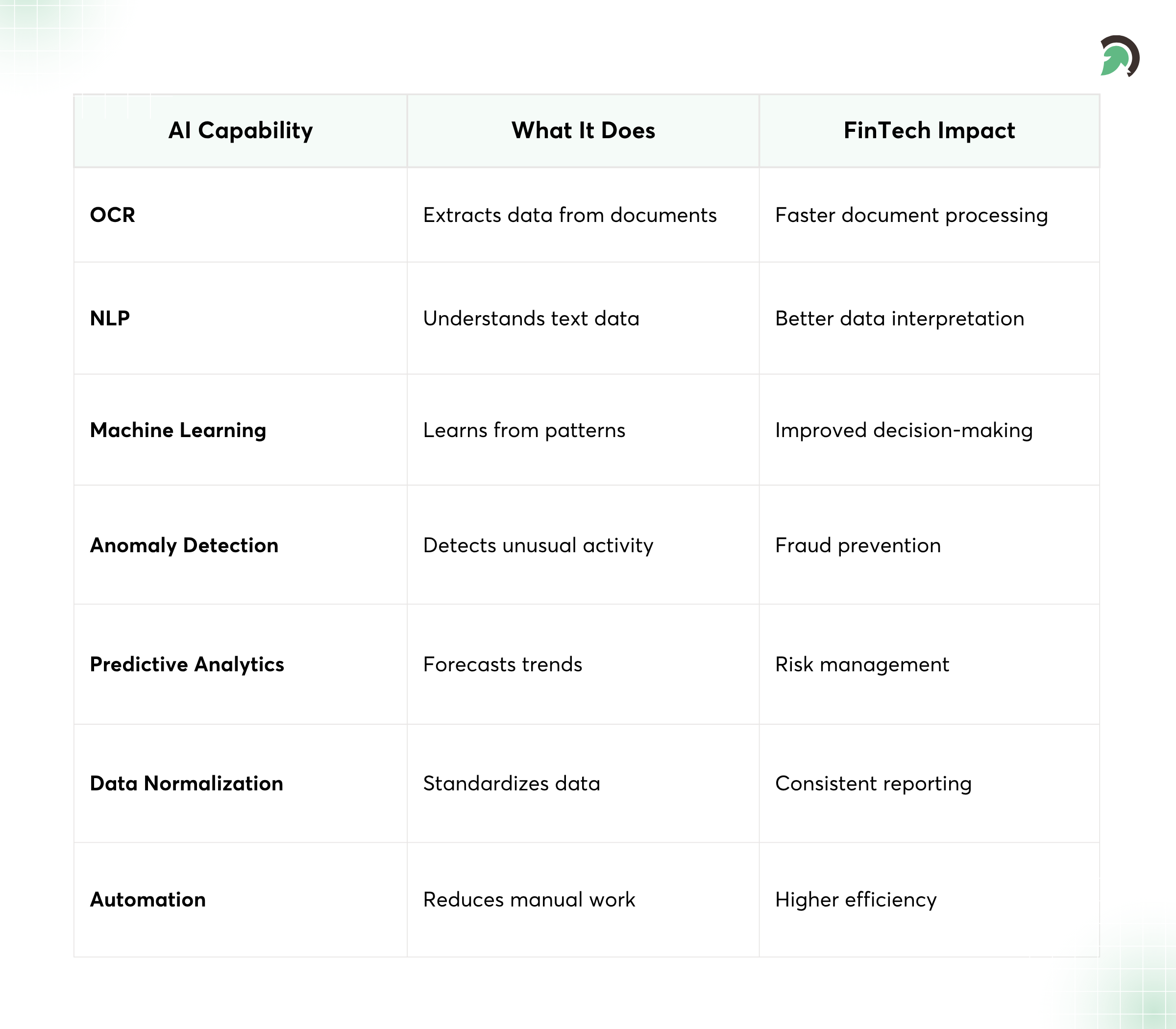
Here are key AI capabilities that power AI in financial data processing initiatives:
- Data extraction (OCR, NLP) to interpret documents and text fields
- Pattern recognition to classify records and detect relationships
- Anomaly detection to spot unusual events and potential errors
- Predictive analytics to forecast risk, failure likelihood, or reconciliation gaps
Key Use Cases of AI in Financial Data Processing
If you’re evaluating AI financial data-processing solutions, it helps to map them to outcomes. These are the most common and most measurable use cases teams deploy first.
1. Automated Data Extraction
Invoices, statements, and compliance documents are rich sources of financial truth, but they’re often hard to parse with traditional tooling. AI can extract key fields like:
- Amounts, dates, account numbers
- Line items and tax details
- Merchant names and reference IDs
This works across both structured and unstructured data, which is a huge unlock for teams that still rely on brittle document processing.
2. Data Cleansing and Normalization
Before data can be reconciled or analyzed, it has to be clean. AI can remove duplicates, detect inconsistent formats, and standardize values across systems.
In practice, that means fewer issues like:
- Trailing characters or inconsistent casing in merchant names
- Date format mismatches (MM/DD vs DD/MM)
- Currency formatting inconsistencies
3. Real-Time Transaction Processing
When transaction volume spikes, your system must keep up. AI supports automated financial data processing by improving throughput, reducing rework, and enabling faster decision-making, especially for risk and settlement workflows.
4. Financial Reconciliation Automation
Reconciliation is often where costs hide. AI can match transactions across multiple systems by learning how events relate, even when reference IDs differ or when records are partial.
The result is reduced manual accounting effort and fewer “surprise” exceptions at month-end.
5. Anomaly and Error Detection
Some errors are accidental (mis-keyed fields), and some are harmful (fraud or manipulation). AI can identify inconsistencies in financial data and prevent reporting errors and fraud by:
- Flagging out-of-range amounts
- Detecting suspicious transaction patterns
- Highlighting mismatches between expected and observed events
When you combine these signals with robust workflows for review and action, you get a scalable fraud-monitoring workflow integration that doesn’t overload your operations team.
Technologies Powering AI in Financial Data Processing
AI in financial operations is an ecosystem, not a single technology. Most production systems blend several approaches to handle the realities of messy data.
- Machine Learning (ML): classification, anomaly detection, predictive models
- Natural Language Processing (NLP): extracting meaning from text fields and narratives
- Optical Character Recognition (OCR): reading documents and converting images into usable text
- Robotic Process Automation (RPA): orchestrating legacy steps and approvals where needed
- Big data analytics platforms: processing high-volume event streams
- Cloud computing infrastructure: scalable compute for batch and real-time pipelines
- API-based integrations: connecting payment gateways, CRMs, ERPs, and data warehouses
Benefits of AI in Financial Data Processing
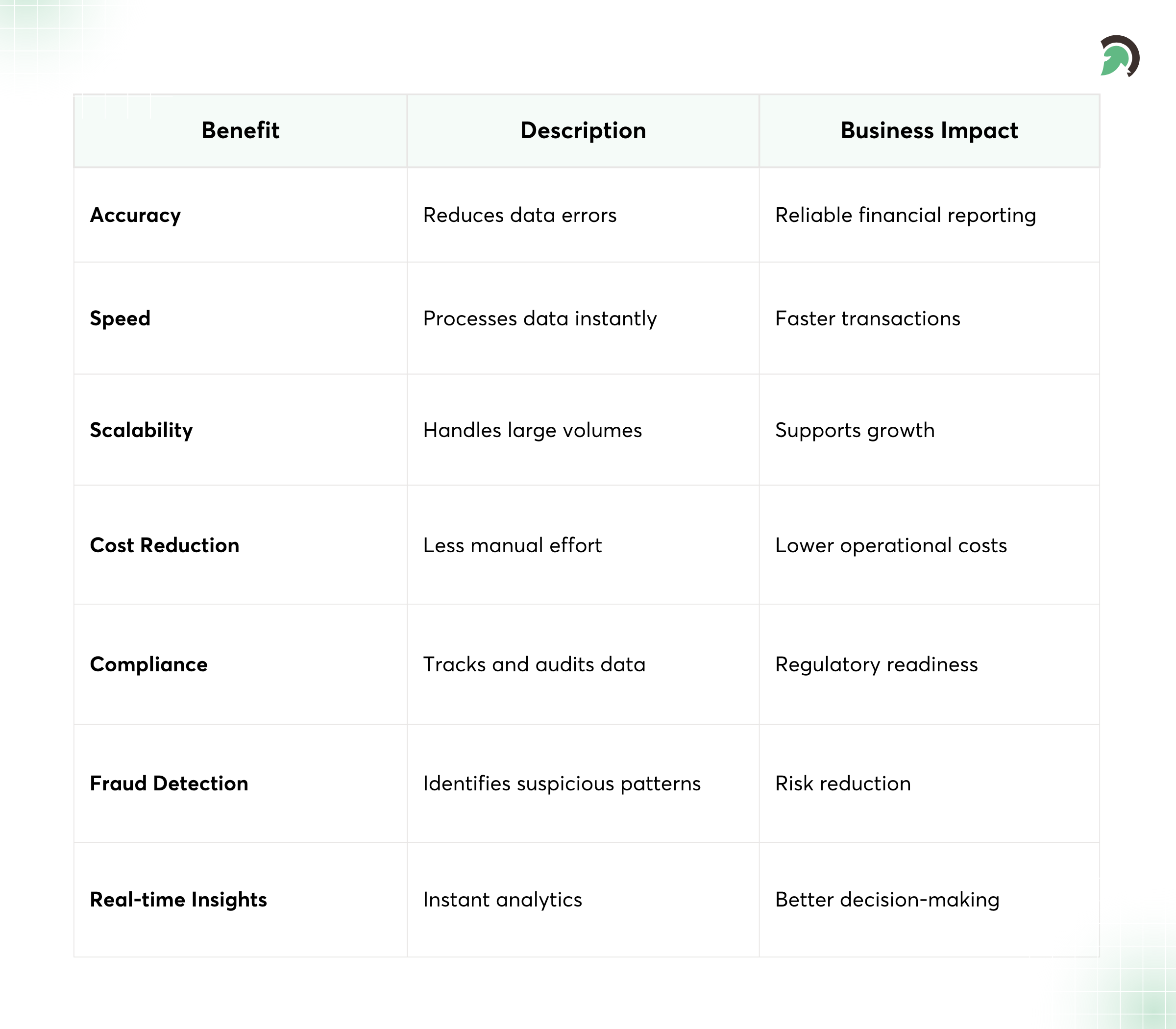
Let’s talk about what teams usually care about: outcomes. The best deployments are measured by accuracy, time-to-settlement, exception rates, and compliance readiness.
- Improved data accuracy and consistency: AI helps standardize inputs and validate outputs, which reduces downstream reporting errors.
- Faster processing and reduced latency: Real-time validation means issues are detected sooner, often before they hit reconciliation or customer workflows.
- Reduced manual intervention and operational costs: By automating extraction, normalization, and matching, teams can reallocate effort to higher-value review tasks.
- Real-time insights and reporting: Instead of waiting for monthly closes, stakeholders get more current visibility into transaction health and risk indicators.
- Enhanced scalability for growing data volumes: AI-powered data pipelines are built to handle variability and scale without proportional increases in manual labor.
- Better compliance and audit readiness: When implemented with auditability in mind, AI can support stronger evidence trails for approvals, transformations, and decisions, an essential factor in financial compliance.
Implementation of AI in Financial Data Processing
Most teams fail not because AI doesn’t work but because they try to deploy too much too fast. A phased, workflow-first approach is usually the most reliable path to production.
Step-by-step roadmap:
- Identify key data processing workflows (where errors cost the most: ingestion, reconciliation, document extraction, compliance reporting)
- Collect and integrate data sources (transactions, statements, customer records, KYC/KYB artifacts)
- Clean and prepare data for AI models (labels, ground truth, schema alignment)
- Select appropriate AI technologies (OCR for documents, NLP for narratives, anomaly detection for monitoring)
- Integrate with existing fintech systems via APIs and adapters, keep it pragmatic
- Test for accuracy and performance with representative datasets and real edge cases
- Deploy and monitor in real-time (track precision/recall, false positives, exception resolution time)
- Continuously improve models based on outcomes and operator feedback
If you’re building an AI-powered financial data platform roadmap, I also recommend documenting “decision points” where humans should approve versus where automation can safely run unattended.
Data Security and Compliance Considerations
AI is powerful, but financial data is sensitive. You need a security and compliance plan that matches the risk profile of your workflows.
-
Data privacy regulations (GDPR, regional laws)
Even if you’re focused on US customers, you may still face GDPR-like requirements depending on your business footprint. Design for data minimization and controlled access.
-
Financial compliance standards
Depending on your jurisdiction and product type, you may need to meet requirements tied to recordkeeping, reporting, and auditability. If you handle regulated data, treat compliance as part of the engineering lifecycle rather than a final step.
-
Secure data storage and encryption
Use encryption at rest and in transit. Consider tokenization or field-level protection for highly sensitive attributes.
-
Access control and governance
Implement role-based access controls, least privilege, and strong operational governance around who can view, export, or modify data.
-
Auditability and transparency
Your system should support audit trails that explain what happened: source inputs, transformations, model outputs, and review actions. This becomes especially important for automation decisions that affect financial outcomes.
Challenges of AI in Financial Data Processing
Let’s be honest: AI introduces its own set of challenges. But when you recognize them early, you can manage them systematically.
-
Data quality and availability issues
If inputs are missing, corrupted, or inconsistent, even the best model will struggle. You may need data engineering and enrichment before AI modeling becomes productive.
-
Integration with legacy systems
Many fintech teams run critical workflows on legacy components. AI must fit into those constraints through APIs, staging layers, and careful orchestration.
-
Model bias and accuracy concerns
Models can underperform for certain customer segments or transaction types. That’s why you need performance monitoring and ongoing evaluation, not just initial validation.
-
High implementation complexity
Production AI isn’t just training a model. You need pipelines, monitoring, human-in-the-loop review, and robust exception handling.
-
Regulatory concerns around AI usage
Regulators may scrutinize automated decisions. You may need explainability, documented validation, and controls to ensure decisions are consistent and defensible.
-
Need for skilled professionals
You’ll likely need a mix of domain experts (finance/compliance) and engineers/data scientists who can build, evaluate, and maintain models responsibly.
Best Practices for AI-Driven Data Processing
If you want AI to improve reliability rather than introduce new risk, these practices help a lot.
- Ensure high-quality, clean data inputs: Set up data contracts, schema validation, and standardized ingestion rules so your models start with trustworthy data.
- Use explainable AI models: Where possible, choose models and techniques that support interpretation. For high-impact decisions, you need defensible reasoning.
- Maintain audit trails for compliance: Every transformation should be traceable. Store relevant metadata about model outputs, versions, and operator actions.
- Combine AI with human oversight: Start with “AI suggests, humans confirm” for sensitive workflows. Over time, automate more confidently as you build evidence of performance.
- Regularly retrain models: Transaction patterns change. Fraud tactics evolve. Retraining cycles should be scheduled and triggered by drift metrics.
- Implement strong data governance policies: Governance ensures data access, usage rules, and retention policies are consistent across teams and vendors.
If you’re also implementing KYC AML automation software, align governance with how identity and risk decisions are made because those workflows directly affect financial eligibility and compliance obligations.
Future Trends in AI for Financial Data Processing
What’s coming next is less about “one more model” and more about end-to-end systems that run continuously, govern themselves, and adapt to changing conditions.
- Real-time, continuous data pipelines that validate and reconcile as events arrive
- AI-driven data governance and compliance that detects policy violations and missing audit evidence
- Integration with open banking ecosystems to ingest data in standardized ways across partners
- Advanced predictive analytics for reconciliation gaps, risk escalation, and anomaly root causes
- Automated decision-making systems with robust controls and escalation paths
- Increased adoption across fintech platforms as ROI becomes clearer and tooling matures
For teams building finance software development roadmaps, the big opportunity is convergence: payment, onboarding, risk, and accounting workflows sharing a unified data understanding.
How FinTech Companies Can Get Started
If you’re deciding where to begin with financial data processing software, start with the workflow that produces the most measurable pain. The quickest wins are usually document extraction, normalization, and exception detection because they reduce manual work immediately.
A practical starting plan:
- Assess current data processing challenges (where errors happen, where delays occur, where audits slow you down)
- Identify automation opportunities with clear success metrics (exception rate, reconciliation time, processing latency)
- Choose the right AI tools or partners based on data types and integration needs
- Start with pilot use cases (keep scope tight: one ingestion stream, one document type, one reconciliation workflow)
- Scale with advanced AI capabilities once accuracy and operational reliability are proven
And if your architecture involves payment rails and external systems, plan for payment gateway integration services and consistent financial data integration from day one. That’s the difference between a demo that looks good and an automated system that holds up under load.
Conclusion
AI data processing is becoming a core foundation for fintech software platforms that need to operate with precision, speed, and reliability. As financial ecosystems grow more complex, the ability to process large volumes of data accurately and in real time is no longer optional. It directly impacts decision-making, risk management, customer experience, and regulatory alignment. Organizations that invest in scalable and intelligent data processing systems are better positioned to respond to market demands and maintain trust in every transaction.
Looking ahead, fintech innovation will continue to depend on systems that can handle increasing data complexity without compromising performance. This is where strategic technology partnerships make a difference. Working with experienced teams like EvinceDev can help translate data challenges into scalable, secure solutions built for long-term growth. If you are exploring ways to strengthen your fintech platform, now is the time to evaluate how AI-driven data processing can support your next phase.