
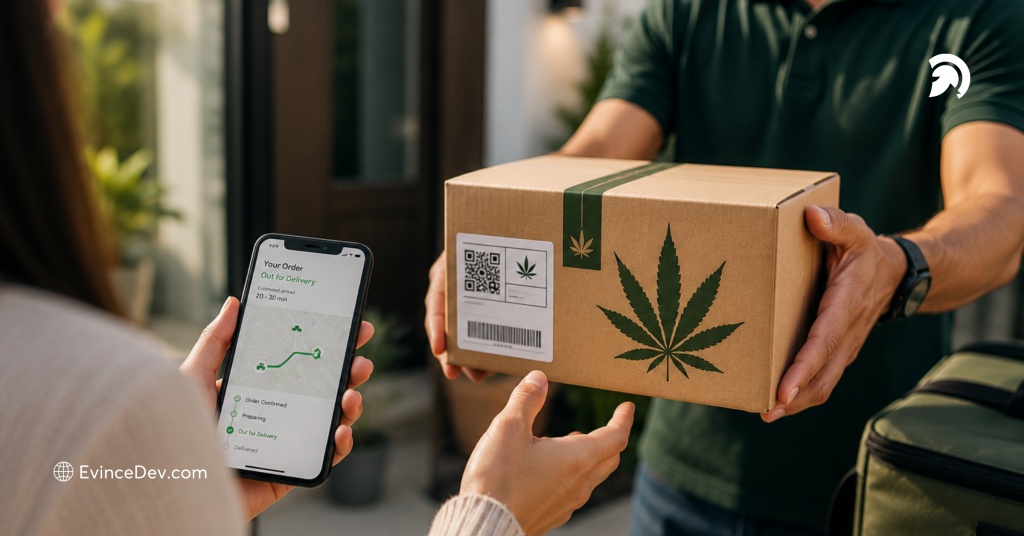
Key Takeaways
- Start With Compliance: Plan for age checks, delivery rules, data security, and local regulations from the beginning.
- Keep the Experience Simple: Customers should be able to browse, order, track, and receive updates without friction.
- Build for Every User Role: Customer apps, driver apps, and admin panels should work together smoothly.
- Plan Integrations Early: Inventory, maps, identity checks, analytics, and payment workflows need careful setup.
- Cost Depends on Complexity: Features, platforms, compliance needs, and integrations all influence the final budget.
- Think Beyond Launch: A scalable architecture supports future updates, additional locations, and business growth.
Ordering almost anything from a mobile app has become second nature, from groceries and meals to medicines and retail products. In legal cannabis markets, customers now expect a similar level of convenience, visibility, and ease when interacting with licensed dispensaries and delivery businesses.
This growing shift has made cannabis delivery app development an important consideration for businesses looking to modernize customer experiences and streamline operations. A well-built platform can support product browsing, order management, delivery tracking, inventory visibility, and customer engagement in one connected ecosystem.
However, building a cannabis delivery solution is not the same as developing a standard ecommerce or food delivery app. Businesses must carefully plan for age verification, delivery restrictions, inventory controls, payment processing, data security, and jurisdiction-specific compliance requirements from the beginning.
In this guide, we will cover the essential features, compliance considerations, development process, technology stack, cost factors, and key challenges involved in building a secure and scalable cannabis delivery solution.
Quick Stat:
According to Verified Market Reports, the global cannabis delivery service market is projected to grow from $1.5 billion in 2024 to $7.5 billion by 2033, reflecting rising demand for convenient, technology-enabled delivery experiences.
Who Is This Guide For?
This guide is intended for:
- Licensed cannabis retailers
- Dispensaries exploring digital commerce solutions
- Delivery service operators
- Entrepreneurs evaluating cannabis technology opportunities
- Businesses planning custom software development projects in regulated industries
Note: This article is intended for informational purposes only and should not be considered legal, regulatory, or compliance advice. Cannabis regulations vary significantly by jurisdiction, and businesses should consult qualified legal and compliance professionals before launching cannabis-related digital services.
What Is a Cannabis Delivery App?
A cannabis delivery app is a digital platform that allows customers to browse products, place orders, complete verification requirements, and receive deliveries from licensed cannabis retailers or dispensaries where such services are legally permitted.
Depending on the business model, these applications may support:
- Single dispensary operations
- Multi-vendor marketplaces
- Medical cannabis delivery services
- Inventory management
- Delivery fleet management
- Customer loyalty programs
Today, many companies make an investment in having a centralized cannabis delivery system that brings together the customer, delivery staff, and administrative personnel. The company does not have to rely on various fragmented systems, but rather on one system that takes care of all the processes involved.
Types of Cannabis Delivery Apps
| App Type | Description |
| Dispensary-Owned App | Built for a single dispensary |
| Marketplace App | Supports multiple vendors |
| Medical Cannabis App | Focuses on patient verification and delivery |
| Enterprise Delivery Platform | Supports multiple locations and delivery operations |
Where Is Cannabis Delivery Legal?
Before investing in cannabis delivery app development, businesses must understand the legal landscape of the markets they plan to serve. Cannabis regulations vary significantly across countries, states, provinces, and local jurisdictions, directly influencing how delivery platforms are designed and operated.
Globally, cannabis laws range from legal adult-use markets to strictly regulated medical programs. As legalization continues to expand, businesses are increasingly adopting digital ordering and delivery solutions to improve customer accessibility while complying with regional requirements.
Cannabis Regulations Around the World
| Region | General Legal Status* |
| United States | Varies by state and local jurisdiction, cannabis remains illegal at the federal level |
| Canada | Legal federally, with retail sales and delivery regulated at the provincial level |
| Germany | Adult-use cannabis is legal under specific regulations; implementation continues to evolve |
| Netherlands | Controlled and regulated framework with longstanding cannabis policies |
| Australia | Primarily medical cannabis programs regulated by federal and state authorities |
| United Kingdom | Medical cannabis is permitted under specific conditions and prescriptions |
| Malta | Adult-use cannabis is legal under regulated frameworks |
| Uruguay | Cannabis is legal under a nationally regulated framework |
States Where Recreational Cannabis Is Legal in the United States
As of 2026, recreational cannabis is legal in several U.S. states, including Alaska, Arizona, California, Colorado, Connecticut, Delaware, Illinois, Maine, Maryland, Massachusetts, Michigan, Minnesota, Missouri, Montana, Nevada, New Jersey, New Mexico, New York, Ohio, Oregon, Rhode Island, Vermont, Virginia, and Washington.
Washington, D.C., also permits adult-use cannabis under its own regulatory framework.
Note: Virginia has legalized adult possession and personal cultivation, while parts of its commercial retail framework continue to evolve.
In addition to these states, many others operate regulated medical cannabis programs that allow qualified patients to access cannabis products under state-specific guidelines.
For businesses developing delivery solutions, the legal status of cannabis is only one part of the equation. Legal adult-use or medical access does not automatically mean cannabis delivery is permitted. Regulations can also affect age-verification requirements, identity checks, delivery zones, purchase limits, inventory tracking, reporting obligations, and payment-processing workflows. As a result, compliance planning should be incorporated into every stage of cannabis delivery app development to help ensure the platform aligns with applicable laws and operational requirements.
*Cannabis laws and delivery regulations are subject to change. Businesses should verify current federal, state, local, and international requirements before launching cannabis-related digital services or delivery operations.
Why Businesses Are Investing in Cannabis Delivery App Development
Digital order experiences have gained more traction and acceptance within various sectors, and cannabis stores are no different. Consumers want mobile convenience when browsing through items, placing orders, and receiving notifications, without having to travel physically to the store.
This shift in consumer behavior has encouraged businesses to explore cannabis delivery app development as part of broader digital transformation initiatives.
Quick Stat:
According to Verified Market Reports, the cannabis delivery service market is expected to grow at a 20.5% CAGR through 2033, driven by expanding legalization, delivery adoption, and digital commerce experiences.
Key business benefits include:
- Improved Customer Convenience: Customers can browse products and place orders from mobile devices at any time.
- Expanded Market Reach: Delivery services help businesses serve customers beyond physical storefront locations.
- Better Customer Retention: Loyalty programs, personalized recommendations, and promotions encourage repeat purchases.
- Operational Efficiency: Automation helps reduce manual order processing and delivery coordination.
- Business Insights: Analytics dashboards provide visibility into customer behavior, sales trends, inventory performance, and delivery operations.
By investing in cannabis delivery app development, businesses can improve customer experiences while gaining better control over daily operations.
How Does a Cannabis Delivery App Work?
Depending on local laws, regulations, and other factors such as the mode of operation of a cannabis dispensary, the process may differ. However, generally, a cannabis delivery application integrates all the parties involved, including the customer, dispensary, drivers, and management, within a single system aimed at easing customer orders and efficient workflow management.
A typical cannabis delivery app workflow may include:
1. Customer Registration
Users create an account using basic details such as name, contact information, and delivery address. The platform may also include secure login options such as OTP, email verification, or multi-factor authentication.
2. Age and Identity Verification
Before users can place an order, the app may require age and identity verification based on applicable laws. This helps licensed businesses confirm customer eligibility and reduce compliance risks.
3. Product Browsing and Selection
Customers can browse available products by category, product type, price, brand, or availability. A clear product catalog helps users compare options and make informed purchase decisions where legally permitted.
4. Cart Management and Order Placement
Once customers select products, they can add them to the cart, review quantities, check delivery availability, and place an order. The platform may also apply purchase limits or location-based restrictions automatically.
5. Payment Processing and Order Review
Payment workflows depend on local regulations and supported payment providers. After checkout, the order may be reviewed by the dispensary or admin team before fulfillment begins.
6. Driver Assignment and Dispatch
After approval, the system assigns the order to an available delivery driver. Admins may use dispatch tools, route optimization, and delivery scheduling features to manage fulfillment efficiently.
7. Real-Time Delivery Tracking
Customers can receive order status updates and track delivery progress in real time. This improves transparency and reduces the need for manual support inquiries.
8. Delivery Verification
At delivery, the recipient may need to verify their identity again before the order is handed over. This step can include ID checks, digital signatures, delivery confirmation, or other compliance-related verification methods.
9. Order Completion and Records
Once the delivery is completed, the system updates the order status, generates records, and stores transaction details for reporting, customer support, and operational review.
The exact workflow may vary depending on jurisdiction-specific cannabis laws, delivery rules, licensing conditions, payment limitations, and internal business processes. That is why compliance planning should be included from the earliest stage of cannabis delivery app development.
Must-Have Features for Cannabis Delivery App Development
The success of any cannabis delivery app development project depends heavily on selecting the right features for customers, delivery personnel, and administrators.
Customer App Features
- User registration and login
- Age verification
- Product catalog
- Product search and filters
- Shopping cart
- Order scheduling
- Real-time tracking
- Push notifications
- Reviews and ratings
- Loyalty programs
- Order history
A well-designed cannabis ordering app should prioritize usability, transparency, and convenience while supporting required compliance workflows.
Driver App Features
- Delivery assignment
- Route optimization
- GPS navigation
- Delivery confirmation
- Order status updates
- Customer communication
- Earnings tracking
Admin Panel Features
- Inventory management
- Product management
- Customer management
- Order management
- Compliance reporting
- Promotions management
- Delivery management
- Analytics dashboard
Feature Breakdown by User Type
| Feature | Customer | Driver | Admin |
| Product Browsing | ✓ | ✕ | ✓ |
| Order Tracking | ✓ | ✓ | ✓ |
| Route Management | ✕ | ✓ | ✓ |
| Inventory Management | ✕ | ✕ | ✓ |
| Reporting & Analytics | ✕ | ✕ | ✓ |
Compliance Considerations for Cannabis Delivery Apps
Cannabis delivery app development requires stronger compliance than standard ecommerce because cannabis rules vary by state, city, license type, and customer category.
1. License Validation
Verify that dispensaries, retailers, delivery operators, and drivers are connected to valid cannabis licenses. License status should be checked during onboarding and reviewed regularly.
2. Track-and-Trace Integration
The app may need to integrate with seed-to-sale systems such as METRC or BioTrack to sync inventory, sales, transfers, deliveries, and product movement.
3. Delivery Manifest Management
The platform should generate and store delivery manifests with order details, driver information, product data, route details, timestamps, and customer verification status.
4. Age and Driver ID Verification
The app should support customer age checks, government ID verification, and driver-side identity verification before completing delivery.
5. Delivery Zone and Local Rule Controls
Use geo-fencing and rule-based checks to control delivery availability by ZIP code, city, county, and local jurisdiction.
6. State-Specific Purchase Limits
The platform should enforce purchase limits by state, product type, customer type, and medical or adult-use status.
7. Cannabis Tax Handling
Support configurable cannabis taxes, including excise tax, sales tax, local cannabis taxes, delivery fees, and product or location-based tax rules.
8. Audit Logs and Compliance Reporting
Log key actions such as orders, payments, inventory updates, driver assignment, ID checks, delivery completion, cancellations, refunds, and failed deliveries.
9. Data Retention and Privacy Controls
Define how customer, transaction, identity, and location data is stored, accessed, protected, and retained according to applicable regulations.
Technology Stack for Cannabis Delivery App Development
Choosing the right technology stack is critical for performance, scalability, and long-term maintainability.
| Layer | Technologies |
| Mobile App | Flutter, React Native |
| Web Portal | React.js, Angular |
| Backend | Node.js, .NET, Python |
| Database | PostgreSQL, MongoDB |
| Cloud | AWS, Azure, Google Cloud |
| Maps | Google Maps API |
| Notifications | Firebase |
| Analytics | Power BI, Tableau |
Organizations pursuing cannabis delivery app development often adopt cloud-native architectures to support future growth, high availability, and operational flexibility.
Payment Processing and Third-Party Integrations
Modern delivery applications rarely operate in isolation, in fact, most of the businesses need integrations with multiple systems to support their daily operations.
Common integrations include:
- CRM systems
- Inventory management software
- ERP platforms
- Identity verification providers
- Marketing automation tools
- Analytics platforms
Most organizations also need the ability to integrate payment gateways for easy online transactions and a hassle-free experience.
Nevertheless, the payment processing requirements differ from place to place and even from one bank to another. Organizations have to determine their payment requirements according to the regulations.
Cannabis Ecommerce Capabilities
Today’s cannabis businesses increasingly operate as digital commerce brands rather than relying solely on physical storefronts.
A modern cannabis ecommerce app may include:
- Personalized recommendations
- Loyalty programs
- Product catalogs
- Promotions and discounts
- Inventory synchronization
- Customer profiles
- Order history
- Customer support tools
Many organizations follow this approach of combining the delivery functionality with eCommerce app development initiatives to create a smooth customer experience across digital channels.
On-Demand Delivery Experiences
Consumer expectations for convenience continue to influence delivery-focused businesses across industries.
As a result, many organizations are exploring on demand cannabis delivery app solutions that support:
- Scheduled deliveries
- Same-day delivery workflows
- Real-time order tracking
- Automated dispatching
- Route optimization
- Delivery status notifications
Many of these capabilities draw from best practices established through on demand app development across retail, logistics, and ecommerce industries.
Cannabis Delivery App Development Process
Developing a robust delivery service entails far more than simply coding. The creation of a delivery service for cannabis requires a comprehensive development approach to business objectives, user experience design, compliance processes, logistics, integration, security, and scalability. Utilizing a systematic development process can help minimize the risk and ensure that the result is pragmatic and deployable.
1. Discovery & Planning
The process starts by identifying the business models, end-users, processes, and regulations. The purpose is to establish what the system should be able to do for its users, such as the customers, drivers, dispensary team members, and administrators.
Key activities may include:
- Business requirements gathering
- Compliance and risk assessment
- Target audience research
- Competitor and market analysis
- User journey mapping
- Feature prioritization
- Technical feasibility planning
This stage is especially important for cannabis delivery app development because compliance, location restrictions, inventory rules, and delivery verification workflows can directly influence the app architecture.
2. UI/UX Design
After identifying the necessary needs, it is time to develop user-friendly interfaces for customers, drivers, and administrators. It is essential to keep in mind that designing an interface should be done while maintaining navigation and the process of verifying the users.
Key design activities may include:
- Wireframe creation
- User flow mapping
- Interactive prototypes
- Customer app interface design
- Driver app interface design
- Admin dashboard design
- Usability review
A good design should simplify product browsing, checkout, order tracking, driver navigation, and admin management without making the experience feel complicated.
3. Architecture & Technology Planning
Before development begins, the technical foundation should be planned carefully. This includes deciding the app structure, backend architecture, database setup, APIs, cloud infrastructure, and third-party integrations.
Key planning areas may include:
- Mobile and web platform selection
- Backend architecture
- Database design
- Cloud infrastructure planning
- API strategy
- Security architecture
- Scalability planning
This step helps ensure the application can support future growth, more users, additional locations, and new feature requirements.
4. Development
During the development stage, the design and technical plan are converted into a working application. This includes building customer-facing features, driver tools, admin controls, backend systems, and integration layers.
Key development activities may include:
- Frontend development
- Backend development
- Mobile app development
- Admin panel development
- API development
- Third-party integrations
- Inventory management integration
- Maps and tracking integration
- Notification system setup
The development phase should follow secure coding practices and include regular reviews to ensure the product remains aligned with business and compliance needs.
5. Testing & Quality Assurance
Tests are essential in detecting problems prior to launching. Because cannabis delivery systems manage customer information, ordering processes, locations, and other related functions, QA must focus not only on function but also on security.
Key testing activities may include:
- Functional testing
- Security testing
- Performance testing
- Usability testing
- Integration testing
- Payment workflow testing
- Location and tracking testing
- User acceptance testing
Thorough testing helps ensure the app works smoothly across devices, handles real-world traffic, protects sensitive data, and supports reliable delivery operations.
6. Deployment
A cannabis delivery application needs constant maintenance even after deployment. There can be changes that affect the laws and regulations, the expectations of the consumers, operations methods, and technology needs.
Key deployment activities may include:
- Production environment setup
- App Store submission
- Play Store submission
- Web portal deployment
- Backend deployment
- Monitoring setup
- Final launch validation
Deployment should be handled carefully to avoid downtime, performance issues, or missed configuration requirements.
7. Ongoing Maintenance & Optimization
A cannabis delivery app requires continuous support after launch. Regulations, customer expectations, operating models, and technology requirements may change over time, so the platform should be regularly updated and optimized.
Key maintenance activities may include:
- Security updates
- Performance optimization
- Bug fixes
- Feature enhancements
- Compliance-related updates
- Third-party integration updates
- Technical support
- Analytics-based improvements
The success of any cannabis delivery application development project should be followed by constant testing, monitoring, and support planning. This will ensure that the platform is secure, scalable, and keeps pace with market changes.
Cannabis Delivery App Development Cost
The overall cannabis delivery app development cost depends on several factors.
Key Cost Drivers
- Number of features
- Platform selection
- Compliance requirements
- Third-party integrations
- Delivery management capabilities
- Security requirements
- Scalability goals
| Complexity Level | Typical Scope |
| MVP | Core ordering and delivery features |
| Standard App | Ordering, tracking, loyalty features |
| Marketplace Solution | Multi-vendor support and advanced workflows |
| Enterprise Platform | Advanced integrations and analytics |
Businesses should focus on identifying their core requirements before estimating budgets, as project scope significantly impacts development costs.
Popular Cannabis Delivery Solutions in the Market
There are various platforms which have played an instrumental role in setting up expectations of users in the cannabis technology environment.
For instance, tools such as the dutchie plus cannabis delivery app have played an essential role in driving the adoption rate of ordering and delivery through digital means. When developing your cannabis delivery apps, businesses will conduct research on various cannabis delivery applications in order to gauge the expectations of customers.
The competitive analysis can help businesses gain insight into different functionalities and operations.
Challenges in Cannabis Delivery App Development
While delivery applications create significant opportunities, businesses should be prepared for several implementation challenges.
Common challenges include:
- Regulatory complexity
- Inventory synchronization
- Delivery logistics
- Data security requirements
- Payment processing limitations
- Multi-location management
- Scalability concerns
Addressing these challenges during planning and architecture design can help reduce implementation risks and improve long-term platform performance.
Quick Stat:
Industry forecasts estimate the global cannabis delivery service market could reach $14.1 billion by 2032, driven by continued digital adoption and delivery-focused consumer preferences, according to DataIntelo report.
Conclusion
With the advancement of digital commerce, delivery apps are becoming increasingly important in the overall customer journey for companies in the regulated marketplace. The development of a cannabis delivery app may prove to be a significant investment for companies as they seek convenience and growth.
But there is more to it than just developing an application. Companies need to properly weigh customer experience, efficiency, security, scalability, and compliance considerations during the process.
If done correctly, organizations can create a solution that fulfills customers’ needs and enables sustainable business growth at the same time.
For businesses planning secure, scalable, and user-friendly delivery or ecommerce platforms, EvinceDev can support the journey with custom software development expertise tailored to complex digital product needs.