
Key Takeaways
- PCI DSS Basics: PCI DSS protects cardholder data across payment applications and systems.
- Secure Development: Compliance must be integrated into every stage of software development.
- Data Protection: Encryption, tokenization, and access control are essential for payment security.
- Application Scope: eCommerce, fintech, SaaS, POS, and payment gateway apps need PCI DSS compliance.
- Risk Reduction: PCI DSS helps reduce data breaches, payment fraud, and compliance penalties.
- Secure APIs: Payment APIs must be protected with authentication, encryption, and monitoring.
- Continuous Compliance: PCI DSS is not a one-time task but an ongoing security process.
- Business Trust: PCI-compliant applications improve customer confidence and payment reliability.
Digital payment systems have become the foundation of modern online businesses. From eCommerce stores and SaaS platforms to banking apps and subscription services, organizations now process massive volumes of card transactions every day. While this digital transformation improves convenience and customer experience, it also increases the risk of cyberattacks, payment fraud, and data breaches.
As cybercriminals continue targeting payment ecosystems, businesses must prioritize payment security compliance to protect customer payment information and maintain trust. This is where PCI DSS compliance in software development becomes critically important.
PCI DSS, or Payment Card Industry Data Security Standard, is a globally recognized security framework designed to protect cardholder data. Any software application that stores, processes, or transmits payment card information must follow these security standards to reduce vulnerabilities and secure payment transactions.
In this blog, we will explore what PCI DSS compliance means in software development, why it matters, the key PCI DSS requirements, best practices for building PCI-compliant applications, and how businesses can develop secure payment software for modern digital ecosystems.
Quick Stat:
According to IBM’s Cost of a Data Breach Report 2024, the global average cost of a data breach reached $4.88 million, highlighting the growing need for strong payment security compliance and secure software development practices.
What Is PCI DSS Compliance?
PCI DSS stands for Payment Card Industry Data Security Standard. It is a security framework established by the Payment Card Industry Security Standards Council (PCI SSC), founded by major payment card brands, including Visa, Mastercard, American Express, Discover, and JCB.
The primary objective of PCI DSS is to protect sensitive cardholder data from theft, misuse, and unauthorized access during payment processing.
PCI DSS compliance in software development involves designing, developing, deploying, and maintaining software applications in accordance with these security standards. It ensures that payment systems remain secure throughout the software development lifecycle.
Any organization handling payment card data must comply with PCI DSS standards, regardless of business size or transaction volume.
Examples of PCI DSS software development include:
- eCommerce payment platforms
- Mobile payment applications
- Payment gateway systems
- POS software
- FinTech applications
- Subscription billing platforms
- Banking and digital wallet applications
For example, if an eCommerce platform allows customers to make payments using credit cards, the application must encrypt payment information, secure APIs, implement strong authentication controls, and prevent vulnerabilities such as SQL injection or cross-site scripting attacks.
PCI DSS is not just a technical requirement. It is a business-critical framework that improves security, builds customer confidence, and reduces financial risks associated with payment fraud.
Why PCI DSS Compliance Matters in Software Development
Modern payment applications are frequent targets for cybercriminals because they contain valuable financial information. A single vulnerability in an application can expose thousands of customer payment records.
This is why PCI DSS software development is essential for businesses operating in digital commerce and financial ecosystems.
Protecting Sensitive Payment Data
Payment applications often process highly sensitive information, including:
- Credit card numbers
- CVV details
- Cardholder names
- Billing addresses
- Authentication credentials
Without proper security controls, attackers can intercept or steal this information during transactions.
PCI DSS requirements help organizations secure payment data through encryption, access control, secure authentication, and continuous monitoring.
Reducing Financial and Reputational Damage
A payment data breach can lead to:
- Heavy regulatory penalties
- Financial losses
- Legal liabilities
- Customer distrust
- Brand reputation damage
Non-compliant businesses may also face restrictions from payment processors and card networks.
Supporting Customer Trust
Customers expect businesses to protect their financial information. PCI-compliant applications demonstrate that a company follows recognized security standards and prioritizes data protection. For eCommerce businesses and fintech companies, strong ecommerce payment security can directly influence customer confidence and conversion rates.
Meeting Industry and Regulatory Expectations
Many payment processors, card networks, banks, and financial institutions require software vendors and merchants to follow fintech compliance standards before they can integrate or operate payment systems. For businesses handling cardholder data, PCI DSS compliance is often a baseline expectation, not an optional security practice.
PCI DSS compliance helps demonstrate that the application follows recognized payment security controls for protecting card data, securing transactions, managing user access, and monitoring payment environments.
It is commonly required for:
- Payment gateway integrations
- Banking and financial institution partnerships
- Digital payment platforms
- SaaS billing and subscription systems
- eCommerce checkout and payment workflows
- FinTech applications handling card-based transactions
By meeting PCI DSS requirements early in the software development lifecycle, businesses can reduce integration delays, simplify security reviews, and build stronger trust with payment partners and customers.
Which Applications Need PCI DSS Compliance?
Any application that stores, processes, or transmits payment card information requires PCI DSS compliance.
Common examples include:
- eCommerce Platforms: Online stores handling card transactions must implement strong ecommerce payment security measures to protect customer data during checkout and payment processing.
- Payment Gateway Systems: Payment gateway development projects require strict security controls because they transmit sensitive financial data between merchants and financial institutions.
- FinTech Applications: Modern fintech software development solutions often include digital wallets, payment systems, investment platforms, and banking applications that require PCI DSS compliance.
- SaaS Billing Platforms: Subscription-based SaaS products processing recurring payments must secure payment workflows and customer billing information.
- Mobile Payment Apps: Mobile payment applications handling in-app transactions or wallet services must implement encryption, authentication, and secure session management.
- POS Systems: Retail POS applications process payment card information directly and must maintain a PCI-compliant infrastructure and software security controls.
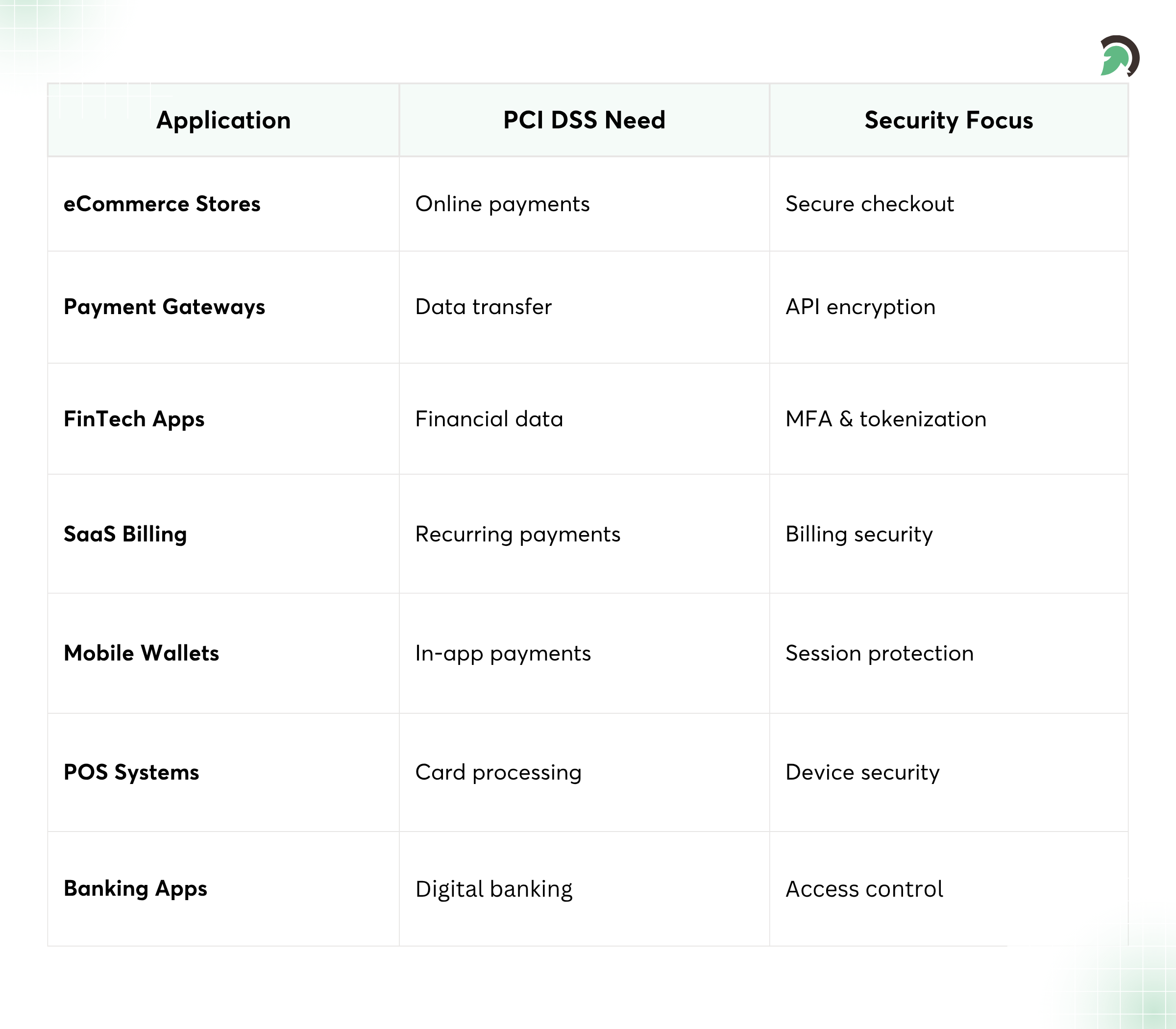
PCI DSS Compliance Use Cases for Payment Apps
Understanding Cardholder Data and Sensitive Authentication Data
To understand PCI DSS requirements, developers must first understand the types of payment data being protected.
Cardholder Data (CHD)
Cardholder data includes:
- Primary Account Number (PAN)
- Cardholder name
- Expiration date
- Service code
This information must be protected during storage and transmission.
Sensitive Authentication Data (SAD)
Sensitive authentication data includes:
- CVV or CVC numbers
- PINs
- Magnetic stripe data
- EMV chip data
PCI DSS strictly limits the storage of sensitive authentication data after authorization.
For developers building secure payment software, understanding these classifications is essential for implementing proper security controls and reducing compliance risks.
Key PCI DSS Requirements for Software Development
PCI DSS requirements are grouped into several major security categories that guide organizations in building secure payment ecosystems. For software development teams, these requirements help define how payment applications should be designed, developed, tested, monitored, and maintained.
- Build and Maintain Secure Systems
Organizations must:
- Install network security controls
- Use firewalls
- Secure application configurations
- Eliminate default passwords
Developers should ensure applications follow secure configuration standards and minimize unnecessary services or ports.
- Protect Stored Cardholder Data
Applications must protect stored payment information using:
- Encryption
- Tokenization
- Data masking
Many businesses reduce compliance complexity by avoiding direct storage of payment card data whenever possible.
- Encrypt Data Transmission
Payment information transmitted across networks must be encrypted using secure protocols such as TLS. This is especially important in payment gateway security and API integrations.
- Protect Systems Against Malware
Organizations must:
- Deploy anti-malware solutions
- Monitor systems continuously
- Regularly update security tools
- Develop and Maintain Secure Software
Secure coding practices are essential for PCI DSS software development.
Developers should:
- Validate user inputs
- Prevent SQL injection
- Mitigate XSS vulnerabilities
- Conduct secure code reviews
- Patch vulnerabilities regularly
- Restrict Access to Cardholder Data
Access to payment data should follow the principle of least privilege.
Role-based access control (RBAC) helps organizations limit access based on job responsibilities.
- Identify and Authenticate Users
Strong authentication mechanisms are required, including:
- Multi-factor authentication (MFA)
- Unique user IDs
- Secure password policies
- Monitor and Log Access
Organizations must monitor all access to payment systems and maintain detailed logs for auditing and threat detection.
- Regularly Test Security Systems
PCI DSS requires:
- Vulnerability assessments
- Penetration testing
- Security scanning
Continuous testing helps identify weaknesses before attackers exploit them.
- Maintain Security Policies
Businesses must establish formal information security policies covering:
- Employee access
- Incident response
- Security awareness
- Risk management
PCI DSS Secure Software Development Lifecycle
Achieving PCI DSS compliance in software development requires integrating security throughout the development lifecycle.
Planning Phase
During planning, organizations should:
- Define compliance scope
- Identify payment workflows
- Conduct risk assessments
- Map cardholder data flows
This helps developers understand where payment information enters, moves through, and exits the system.
Design Phase
The architecture stage should focus on:
- Secure system design
- Network segmentation
- Tokenization strategies
- Encryption mechanisms
- API security planning
Secure architecture reduces vulnerabilities before development begins.
Development Phase
During development, teams should follow secure coding standards and DevSecOps practices.
Key activities include:
- Input validation
- Secure authentication implementation
- API security controls
- Encryption integration
- Dependency management
This stage is critical for building PCI-compliant applications.
Testing Phase
Security testing should include:
- Vulnerability scanning
- Penetration testing
- Code reviews
- Compliance validation
Automated security testing can help identify issues early in the development process.
Deployment and Maintenance
After deployment, organizations must:
- Monitor systems continuously
- Patch vulnerabilities regularly
- Review access controls
- Update security configurations
PCI DSS compliance is an ongoing process rather than a one-time certification.
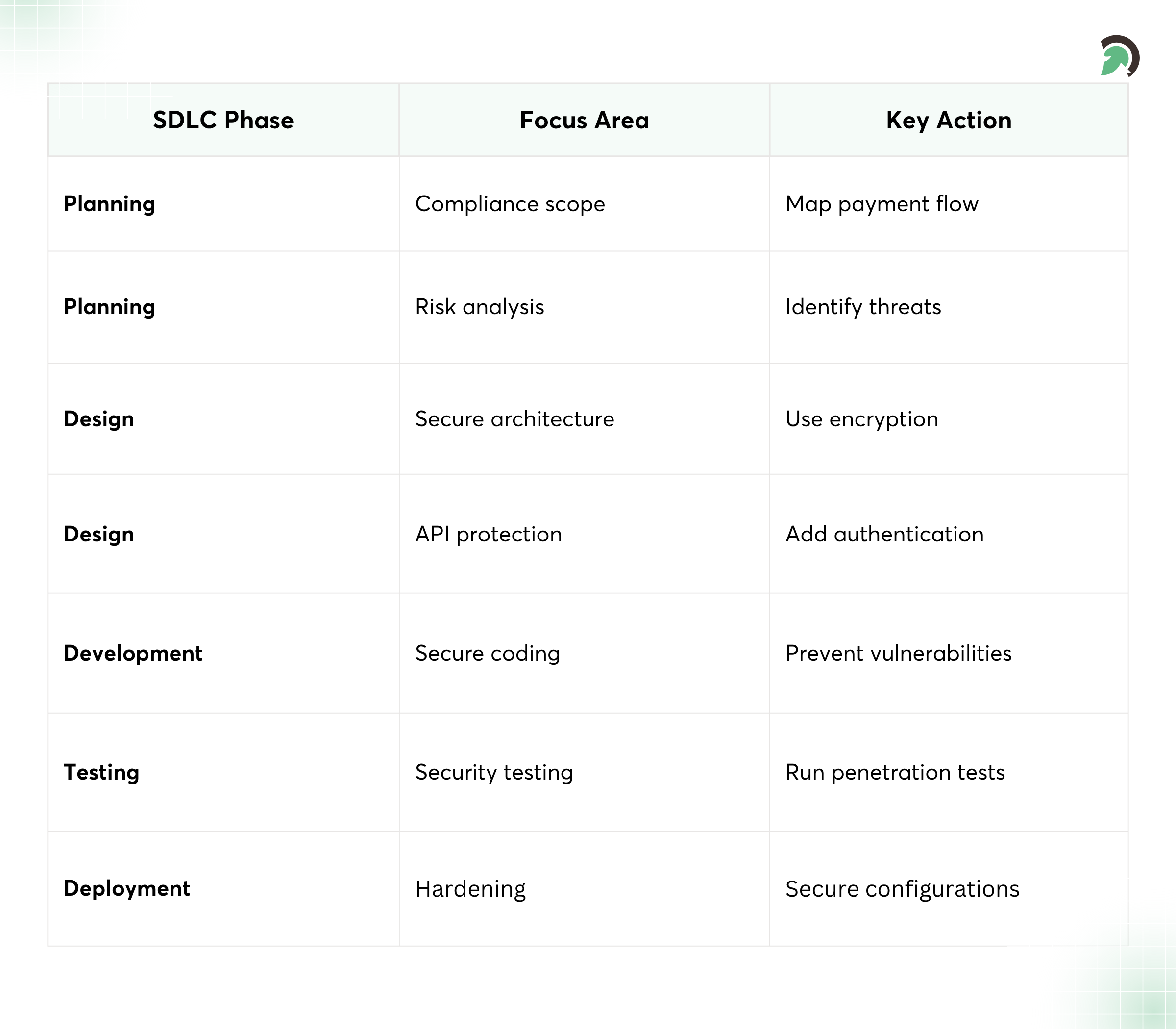
PCI DSS Software Development Lifecycle Checklist
Essential Security Practices for PCI DSS Software Development
Building secure payment software requires more than basic compliance. Organizations should implement advanced security practices to strengthen payment ecosystems.
- End-to-End Encryption
Encrypting payment data from capture through processing helps reduce exposure risk.
- Tokenization
Tokenization replaces sensitive payment information with non-sensitive tokens, reducing the amount of cardholder data stored in systems.
This is widely used in payment gateway development and modern ecommerce software solutions.
- Multi-Factor Authentication (MFA)
MFA adds an additional layer of protection by requiring multiple verification methods before granting access.
Quick Stat:
Microsoft states that enabling multi-factor authentication can block more than 99.9% of automated account compromise attacks, making MFA essential for PCI-compliant applications.
- Secure API Development
Payment APIs should implement:
- Authentication tokens
- Rate limiting
- Encryption
- Input validation
API security is especially important in fintech software development projects.
Quick Stat:
Akamai reported a 137% increase in API attacks targeting financial services organizations, making payment gateway security and API protection critical for fintech platforms.
- Role-Based Access Control
RBAC ensures that users can access only the information necessary for their responsibilities.
- Secure Session Management
Applications should:
-
- Use secure cookies
- Prevent session hijacking
- Implement timeout controls
- Continuous Monitoring
Real-time monitoring helps detect suspicious activities and respond quickly to threats.
- Secure Cloud Infrastructure
Many businesses now rely on secure cloud applications for payment processing. Cloud environments must be properly configured to prevent security misconfigurations and unauthorized access.
- DevSecOps Integration
Modern SaaS security best practices encourage integrating security directly into DevOps workflows.
DevSecOps enables:
- Automated security scanning
- Continuous compliance monitoring
- Faster vulnerability remediation
Quick Stat:
Gartner predicts that by 2027, over 75% of large enterprises will prioritize cybersecurity in SaaS procurement decisions, increasing the importance of SaaS security best practices and compliance-driven software development.
Common PCI DSS Compliance Challenges
Many organizations face challenges when implementing PCI DSS requirements in software development.
Legacy Systems
Older applications often lack modern security controls and require significant upgrades.
Complex Third-Party Integrations
Payment ecosystems frequently rely on:
- Third-party APIs
- Payment processors
- Cloud services
- External plugins
Each integration introduces additional security risks.
Compliance Maintenance
PCI DSS compliance requires ongoing monitoring, updates, testing, and audits.
Many businesses underestimate the effort required to maintain compliance over time.
Cloud Security Complexity
Cloud-based payment applications require careful management of:
- Access permissions
- Data storage
- Network configurations
- Shared responsibility models
Limited Security Expertise
Smaller organizations and startups may lack dedicated cybersecurity teams with PCI DSS expertise.
How to Achieve PCI DSS Compliance for Software Applications
Organizations can follow a structured process to achieve PCI DSS compliance.
Step 1: Define Compliance Scope
Identify:
- Systems handling payment data
- Connected networks
- Payment workflows
- Third-party integrations
Reducing compliance scope can simplify implementation.
Step 2: Map Cardholder Data Flow
Understand how payment information moves through the application and infrastructure.
Step 3: Implement Security Controls
Deploy:
- Encryption
- Firewalls
- Authentication systems
- Access controls
- Monitoring tools
Step 4: Conduct Security Testing
Perform:
- Vulnerability assessments
- Penetration testing
- Secure code reviews
Step 5: Complete Compliance Validation
Depending on business size and transaction volume, organizations may need:
- Self-Assessment Questionnaires (SAQs)
- External audits
- Qualified Security Assessor (QSA) reviews
Step 6: Maintain Continuous Compliance
PCI DSS compliance requires ongoing:
- Monitoring
- Patching
- Testing
- Documentation updates
PCI DSS Compliance Levels Explained
PCI DSS defines different compliance levels based on transaction volume.
- Level 1: Organizations process over 6 million transactions annually.
Requirements often include:
-
- Annual external audits
- Quarterly scans
- Comprehensive security reviews
- Level 2: Organizations processing 1 to 6 million transactions annually.
- Level 3: Organizations processing 20,000 to 1 million eCommerce transactions annually.
- Level 4: Organizations processing fewer than 20,000 eCommerce transactions annually. Validation requirements vary depending on the level and payment card brands involved.
Benefits of PCI DSS Compliance in Software Development
Implementing PCI DSS requirements offers several business and technical advantages.
- Improved Security: Compliance strengthens overall payment security and reduces vulnerabilities.
- Reduced Risk of Data Breaches: Security controls help prevent unauthorized access and payment fraud.
- Increased Customer Trust: Customers are more likely to trust businesses that prioritize secure payment software and payment data protection.
- Better Business Partnerships: Many payment providers prefer working with PCI-compliant vendors and applications.
- Stronger Development Practices: PCI DSS encourages secure coding standards, testing procedures, and better infrastructure management.
- Competitive Advantage: Organizations with strong payment security compliance can differentiate themselves in competitive digital markets.
PCI DSS vs Other Security Standards
PCI DSS focuses specifically on protecting payment card data, while other frameworks address broader compliance and privacy requirements.
- PCI DSS vs GDPR: GDPR focuses on personal data privacy for EU residents, while PCI DSS specifically protects payment card information.
- PCI DSS vs HIPAA: HIPAA secures healthcare information, whereas PCI DSS protects financial payment data.
- PCI DSS vs ISO 27001: ISO 27001 provides a broader information security management framework, while PCI DSS offers specific payment security requirements.
Many businesses implement multiple compliance frameworks together, depending on their industry.
Future Trends in PCI DSS and Payment Security
The payment security landscape continues evolving rapidly.
PCI DSS 4.0 Adoption
PCI DSS 4.0 introduces updated requirements focused on:
- Continuous security
- Customized implementation approaches
- Stronger authentication
- Improved risk management
AI-Powered Fraud Detection
AI and machine learning are increasingly used to identify suspicious transactions and abnormal payment behaviors.
Zero Trust Security Models
Zero Trust architectures assume no user or device is automatically trusted, improving security across payment ecosystems.
Biometric Authentication
Fingerprint scanning, facial recognition, and behavioral biometrics are becoming common in secure payment software.
Cloud-Native Payment Security
As businesses adopt secure cloud applications, organizations are focusing on cloud-native security tools and automated compliance monitoring.
DevSecOps Expansion
Security integration within development pipelines will continue growing as organizations prioritize faster and more secure software releases.
Conclusion
As digital payments continue expanding across industries, protecting payment data has become a critical business responsibility. PCI DSS compliance in software development helps organizations build secure payment applications that reduce fraud risks, improve customer trust, and meet industry security standards.
Whether developing eCommerce platforms, SaaS billing systems, fintech applications, or payment gateway solutions, businesses must integrate security into every stage of the software development lifecycle.
From encryption and tokenization to secure APIs and continuous monitoring, PCI DSS requirements provide a strong framework for building PCI-compliant applications and maintaining payment security compliance in modern digital ecosystems.
Organizations that prioritize PCI DSS software development not only strengthen cybersecurity but also position themselves for long-term growth in the evolving digital payments landscape.
For businesses investing in fintech software development, payment gateway development, ecommerce software solutions, and secure cloud applications, EvinceDev can support the development of secure, scalable, and payment-ready digital solutions aligned with modern security expectations.