

Key Takeaways
- Faster Digital Onboarding: Reduce onboarding time with AI-driven identity verification workflows.
- Improved AML Compliance: Monitor sanctions, PEP lists, and suspicious activities in real time.
- Stronger Fraud Prevention: Detect fake IDs, deepfakes, and fraud attempts using AI and biometrics.
- AI-Powered Verification: Automate document checks, behavior analysis, and risk scoring.
- Scalable Fintech Infrastructure: Support high onboarding volumes with secure cloud-based KYC systems.
- Continuous Customer Monitoring: Track suspicious transactions and changing risk patterns beyond onboarding.
- Industry-Wide Adoption: Support banking, lending, crypto, insurance, and digital wallet platforms.
- Secure System Design Matters: Build KYC systems with secure APIs, encryption, and compliance-ready architecture.
The rapid growth of digital financial services has transformed how customers interact with banks, payment platforms, lending providers, and fintech applications. Users now expect instant account creation, seamless onboarding, and secure digital transactions without visiting a physical branch. However, with this convenience comes a major challenge for financial institutions: verifying customer identities while maintaining strict regulatory compliance.
Traditional Know Your Customer (KYC) processes were heavily manual, time-consuming, and vulnerable to human error. Customers often had to submit multiple documents, wait days for approval, and complete repetitive verification steps. As fintech platforms scale globally, these outdated methods can no longer support modern customer expectations or evolving compliance requirements.
This is where KYC automation fintech solutions are transforming the industry. By combining AI-driven verification, biometric authentication, OCR technology, and automated compliance workflows, fintech companies can accelerate onboarding while strengthening fraud detection and regulatory adherence.
In this blog, we will explore how automated KYC systems work, the major challenges fintech companies face during implementation, the complete onboarding workflow, and the system design considerations behind modern identity verification platforms.
What Is KYC Automation in Fintech?
KYC automation refers to the use of digital technologies and intelligent workflows to automate customer identity verification and compliance checks within financial services platforms. Instead of relying on manual document review, automated systems validate customer identities in real time using AI, APIs, biometrics, and compliance databases.
In the fintech ecosystem, KYC processes are critical for:
- Preventing financial fraud
- Verifying customer legitimacy
- Meeting regulatory requirements
- Reducing money laundering risks
- Supporting secure digital transactions
Modern identity verification systems can automatically:
- Extract data from uploaded documents
- Match facial biometrics with ID photos
- Perform AML and sanctions screening
- Detect suspicious activity patterns
- Generate risk scores for onboarding decisions
Automated KYC has become a foundational component of modern digital onboarding systems used across banks, digital wallets, lending apps, crypto exchanges, and insurance platforms.
Unlike traditional verification processes that may take several days, automated onboarding systems can verify users within minutes while maintaining strong compliance standards.
Quick Stat:
According to McKinsey, agentic AI-driven KYC workflows can improve compliance productivity by 200% to 2,000% by automating onboarding, screening, and monitoring tasks.
Why KYC Automation Is Important for Fintech Companies
As digital financial platforms continue to scale, the need for efficient onboarding and secure identity verification has become more important than ever.
Faster Customer Onboarding
Customers today expect instant access to financial services. Long onboarding delays can significantly increase user drop-offs. Automated KYC systems streamline registration and reduce verification time from days to minutes.
This is especially important for platforms offering:
- Digital banking
- Buy now, pay later solutions
- Crypto trading apps
- Insurance services
- Investment platforms
Efficient onboarding automation fintech systems help improve customer acquisition and retention rates.
Improved Regulatory Compliance
Financial institutions must comply with increasingly strict global regulations related to customer identity verification and anti-money laundering.
Automated AML KYC compliance systems continuously monitor customer data against:
- Sanctions lists
- Politically exposed person (PEP) databases
- Suspicious transaction indicators
- AML watchlists
This reduces compliance risks while improving audit readiness.
Enhanced Fraud Prevention
Cybercrime and digital identity fraud continue to rise globally. AI-powered verification systems help detect:
- Fake IDs
- Deepfakes
- Synthetic identities
- Document tampering
- Account takeover attempts
Modern fraud prevention KYC systems use machine learning models to identify suspicious onboarding behavior in real time.
Lower Operational Costs
The cost of maintaining manual verifiers can be high. Automation helps to cut down operational costs and increase the accuracy of verification processes. Fintech companies can achieve high onboarding volumes without having to raise operational costs.
Better User Experience
Seamless customer onboarding processes lead to increased customer satisfaction and fewer losses through abandoned registrations. Verification can be done using smartphones, biometrics, and automatic scanning.
Quick Stat:
According to MarketsandMarkets, the global digital identity verification market is projected to grow from $10.9 billion in 2023 to $21.8 billion by 2028.
Key Technologies Used in Automated KYC Systems
Modern KYC platforms rely on multiple advanced technologies working together to deliver fast, secure, and scalable verification processes.
Artificial Intelligence and Machine Learning
AI has become a major driver behind modern KYC AML automation systems.
Machine learning models can:
- Detect fraudulent behavior patterns
- Analyze transaction anomalies
- Improve risk scoring accuracy
- Identify suspicious onboarding attempts
- Support continuous compliance monitoring
The growing role of AI in Fintech has significantly improved identity verification accuracy and fraud detection capabilities.
Optical Character Recognition (OCR)
OCR technology automatically extracts information from uploaded identity documents, such as:
- Passports
- Driver’s licenses
- National ID cards
- Utility bills
This eliminates manual data entry and accelerates onboarding workflows.
OCR engines can extract:
- Name
- Address
- Date of birth
- Document number
- Expiration dates
Biometric Verification
Biometric authentication helps verify that the customer submitting the document is the legitimate owner.
Common biometric verification methods include:
- Facial recognition
- Fingerprint verification
- Liveness detection
- Voice recognition
Liveness detection is particularly important for preventing deepfake and spoofing attacks.
API Integrations
Modern KYC systems rely heavily on third-party integrations for:
- AML screening
- Government ID verification
- Banking validation
- Credit bureau checks
- Address verification
These integrations help fintech platforms create highly scalable verification ecosystems.
Also Read: API Integration in Fintech Use Cases Benefits and Best PracticesCloud Infrastructure
Cloud-native architecture allows fintech companies to scale onboarding systems securely while handling high transaction volumes.
Cloud infrastructure supports:
- Secure data storage
- Real-time verification processing
- Disaster recovery
- Scalable compliance operations
- Encrypted document management
Quick Stat:
According to Juniper Research, AI-powered identity verification systems are expected to help banks save over $10 billion annually by reducing fraud and improving compliance efficiency.
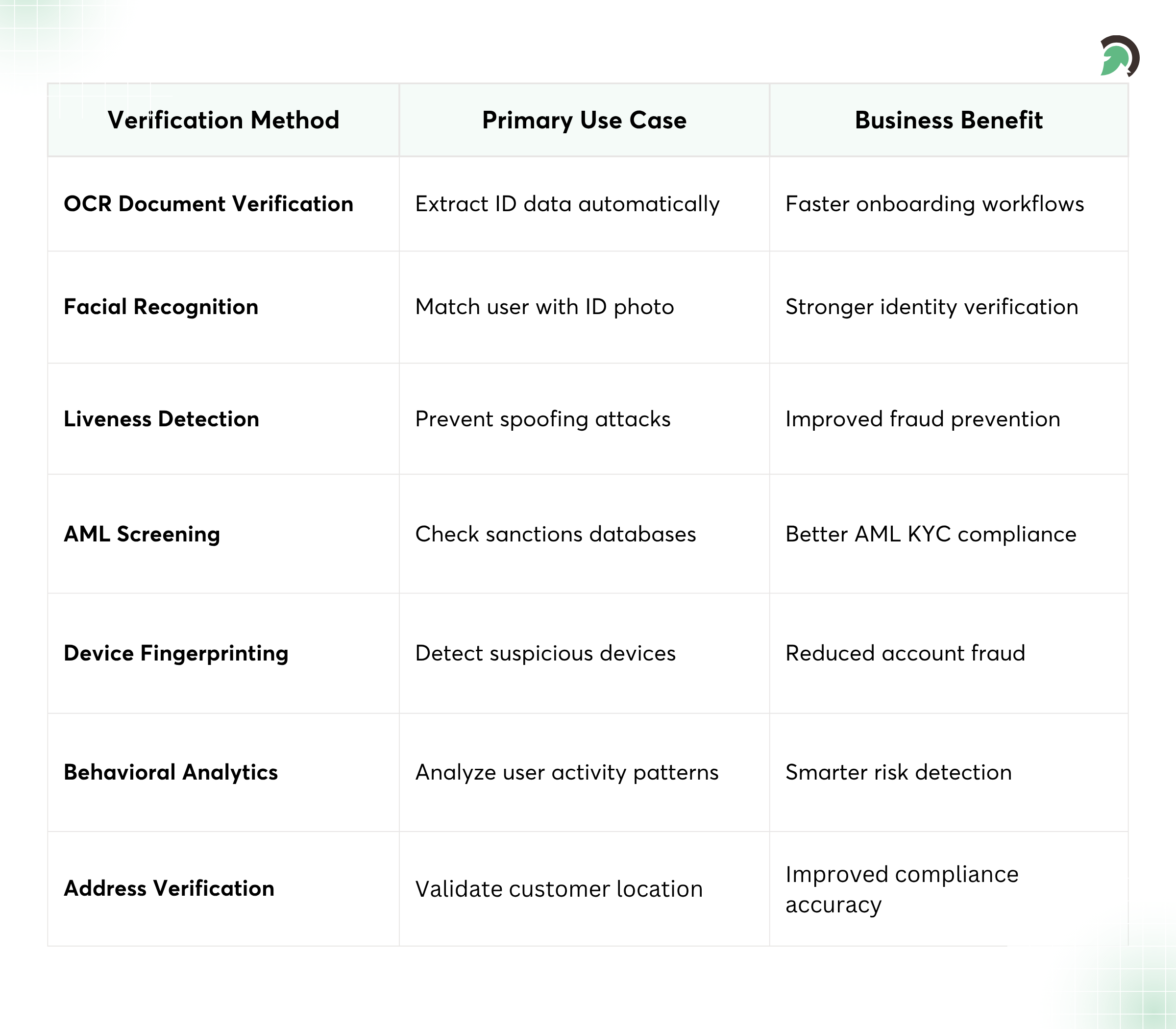
Advanced Identity Verification Systems in Fintech
Step-by-Step KYC Automation Workflow
Understanding the KYC workflow is essential for designing efficient onboarding experiences.
Step 1: User Registration
The onboarding process begins when a customer creates an account using:
- Phone number
- Social login
- Mobile application registration
Basic customer details are collected during this stage.
Step 2: Document Upload
Customers upload identity documents through secure mobile or web interfaces.
Accepted documents typically include:
- Passport
- Driver’s license
- National ID
- Address proof
Modern digital onboarding systems optimize this process using mobile camera capture and real-time document quality checks.
Step 3: OCR-Based Data Extraction
OCR engines extract customer information automatically from uploaded documents.
The system validates:
- Document authenticity
- Image clarity
- Data completeness
- Expiration status
This significantly reduces manual review time.
Step 4: Biometric Identity Verification
Customers may be asked to:
- Take a selfie
- Record a short video
- Complete liveness verification
The system compares the live image against the document photo to confirm identity ownership.
Step 5: AML and Sanctions Screening
The onboarding platform checks customer information against:
- Global sanctions databases
- PEP lists
- AML watchlists
- Fraud databases
This is a critical component of AML KYC compliance workflows.
Step 6: Risk Assessment
AI-based risk engines analyze:
- Customer location
- Device information
- Behavioral patterns
- Transaction intent
- Fraud indicators
The system generates a risk score to determine onboarding approval requirements.
Step 7: Manual Review for Exceptions
Applications flagged as suspicious are routed to compliance teams for manual review.
Common reasons for escalation include:
- Blurry documents
- Data mismatches
- High-risk geographies
- Suspicious biometric activity
Step 8: Approval and Account Activation
Once verification is completed successfully, the customer gains access to the platform.
This may include:
- Bank account activation
- Wallet creation
- Trading access
- Lending approvals
Many Digital Wallet App platforms rely heavily on automated KYC for instant onboarding.
Step 9: Continuous Monitoring
KYC does not end after onboarding. Modern fintech platforms perform ongoing monitoring to detect:
- Suspicious transactions
- Identity changes
- Fraud patterns
- Compliance risks
Continuous monitoring strengthens long-term security and regulatory compliance.
Quick Stat:
According to Deloitte, automated digital onboarding systems can reduce customer verification time from several days to just a few minutes.
Major Challenges in KYC Automation
Although automation provides significant advantages, implementing scalable KYC systems comes with several operational and technical challenges.
Regulatory Compliance Complexity
Different countries have different KYC and AML regulations. Fintech companies operating globally must adapt workflows based on:
- Local compliance laws
- Data privacy requirements
- Reporting obligations
- Customer verification standards
Maintaining compliance across multiple regions can become highly complex.
Identity Fraud and Deepfake Attacks
Digital fraud techniques continue to evolve rapidly.
Modern attackers use:
- AI-generated identities
- Deepfake videos
- Synthetic customer profiles
- Forged documents
This makes advanced fraud prevention KYC capabilities essential for modern fintech platforms.
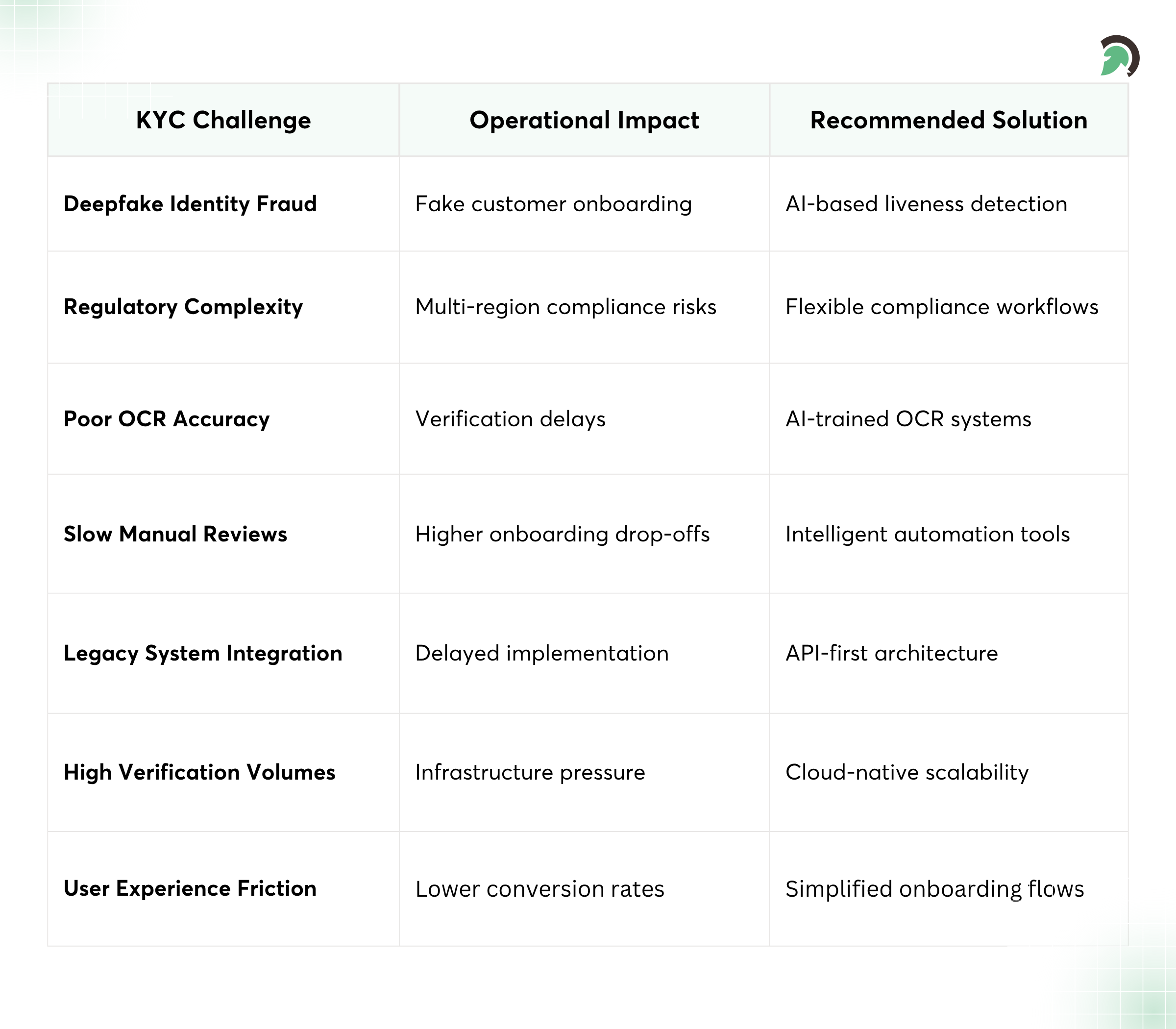
Fintech KYC Compliance and Automation Challenges
Balancing Security and User Experience
Strict verification processes can increase onboarding friction.
If onboarding becomes too complicated:
- Users may abandon registration
- Conversion rates may decline
- Customer acquisition costs may rise
Fintech companies must balance compliance requirements with seamless onboarding experiences.
Integration Complexity
KYC systems often require integration with:
- Core banking systems
- Payment gateways
- Government APIs
- AML screening providers
- CRM platforms
Integration challenges can slow implementation timelines and increase operational complexity.
OCR and Data Accuracy Issues
Poor-quality document uploads can reduce OCR accuracy.
Challenges include:
- Blurry images
- Incomplete documents
- Different document formats
- Multilingual identity documents
Verification systems must continuously improve extraction accuracy through AI training.
Scalability and Infrastructure Challenges
As fintech platforms grow, onboarding volumes increase significantly.
Scalable infrastructure is required to:
- Process large verification requests
- Handle concurrent onboarding sessions
- Maintain response speed
- Secure sensitive customer data
This is where strong Fintech software development practices become critical.
System Design of an Automated KYC Platform
Building a scalable KYC infrastructure requires a carefully designed architecture.
Frontend Layer
The frontend onboarding interface should support:
- Mobile onboarding
- Secure document upload
- Real-time validation
- Biometric capture
- User-friendly verification flows
User experience plays a major role in onboarding completion rates.
Backend Services Layer
Backend systems manage:
- Workflow orchestration
- User sessions
- Verification logic
- Compliance processing
- Notification systems
Microservices architecture is commonly used for scalability and flexibility.
Verification Engine
The verification engine acts as the core intelligence layer.
It includes:
- OCR processing
- Facial recognition
- Liveness detection
- Fraud scoring
- AI-based risk analysis
This engine powers real-time identity validation workflows.
Compliance Layer
The compliance layer manages:
- AML screening
- Audit trails
- Regulatory reporting
- PEP verification
- Ongoing monitoring
Strong logging mechanisms are critical for audit readiness.
Data Security Infrastructure
KYC platforms manage highly sensitive financial and identity information.
Security measures include:
- End-to-end encryption
- Role-based access control
- Secure APIs
- Encrypted cloud storage
- Multi-factor authentication
Robust Financial software development standards are essential for maintaining customer trust.
Third-Party Integration Layer
Modern onboarding platforms integrate with:
- Banking APIs
- Government databases
- Credit bureaus
- Fraud detection services
- Payment processors
API-first architecture improves scalability and future integration flexibility.
Emerging Trends in KYC Automation
The future of automated KYC is evolving rapidly due to advancements in AI and digital identity technologies.
AI-Powered Risk Intelligence
AI-powered risk intelligence enables fintech platforms to identify potential fraud risks before suspicious activity occurs.
Continuous Identity Verification
KYC in the future will not only rely on one-off onboarding verification but also on continuous identification.
Behavioral Biometrics
Behavioral analysis can identify unusual customer activity based on:
- Typing patterns
- Device behavior
- Navigation habits
- Transaction activity
Decentralized Identity Systems
Blockchain-based digital identity systems may eventually reduce dependency on repetitive KYC verification processes.
Generative AI for Compliance Automation
Generative AI can help automate:
- Compliance reporting
- Risk analysis
- Audit preparation
- Fraud investigation workflows
The increasing role of AI in Fintech will continue to reshape compliance operations across financial services.
Also Read: AI in Financial Services Use Cases Benefits and the Future of Intelligent Finance
Quick Stat:
According to PwC, over 52% of financial services organizations are actively investing in AI in Fintech initiatives to strengthen compliance, fraud detection, and customer onboarding automation.
Industries Using Automated KYC Solutions
KYC automation is widely used across the fintech and financial services sectors to verify users faster, reduce fraud risks, and meet compliance requirements.
- Digital Banking: Banks use automated KYC for instant account opening, customer verification, payment security, and ongoing AML KYC compliance.
- Digital Wallet Platforms: Every modern Digital Wallet App needs secure identity verification to prevent fake accounts, reduce fraud, and enable safe digital transactions.
- Lending Platforms: Lending platforms have implemented automated KYC for purposes such as borrower identification, loan suitability, risk assessment, and compliance. Automated KYC is widely integrated into Lending Software Development to streamline borrower verification, risk assessment, and compliance workflows.
- Cryptocurrency Exchanges: Crypto exchanges rely on KYC AML Automation to verify users, monitor high-risk transactions, and comply with financial regulations.
- Insurance Platforms: Insurtech platforms use digital onboarding systems to verify policyholders, streamline policy issuance, and simplify claims verification.
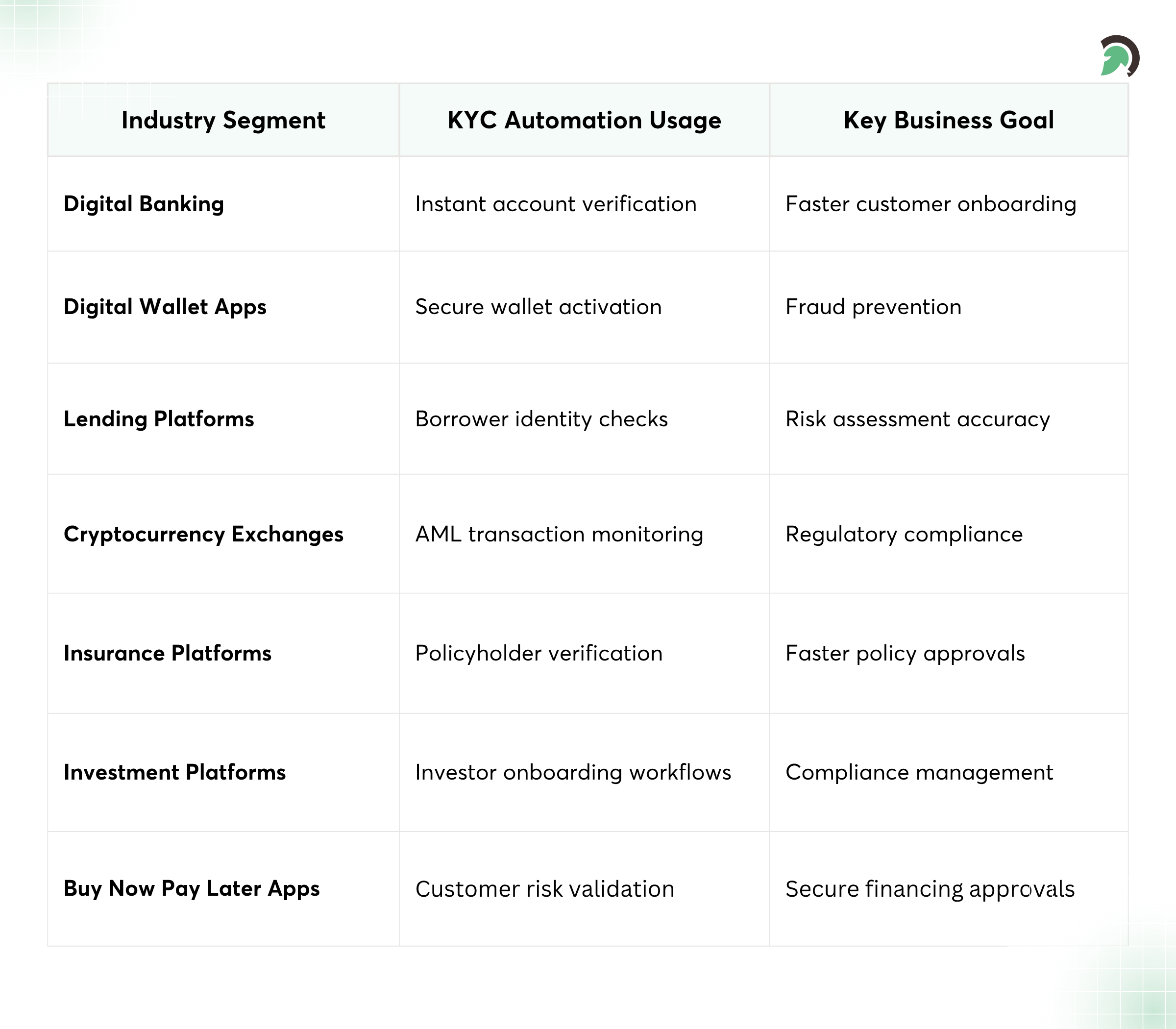
Industries Adopting KYC Automation in Fintech
Best Practices for Building Secure KYC Systems
- Implement Multi-Layer Verification: Use multiple verification methods such as document validation, biometrics, AML screening, and behavioral analysis to improve identity verification accuracy and strengthen fraud prevention KYC processes.
- Prioritize Mobile-First Onboarding: Optimize mobile onboarding with simplified document uploads, selfie verification, and real-time validation to improve usability and conversion rates.
- Maintain Strong Audit Trails: Store detailed verification logs, approval records, and compliance actions to support AML KYC compliance, regulatory reporting, and fraud investigations.
- Use AI for Continuous Monitoring: Leverage AI-driven monitoring to detect suspicious transactions, unusual behavior, and fraud risks even after customer onboarding is completed.
- Keep Compliance Rules Updated: Design automated KYC systems that can quickly adapt to changing regulations, sanctions lists, and regional compliance requirements.
- Secure Sensitive Customer Data: Protect customer information using encryption, role-based access controls, secure APIs, and cloud security best practices to maintain trust and platform security.
Conclusion
As the fintech ecosystem expands quickly, it is crucial to adopt a process that enables organizations to verify their customers safely and efficiently. Manual onboarding processes can no longer support the speed, scalability, and compliance demands of modern financial services. With this in mind, the significance of KYC automation fintech solutions should not be underestimated. Fintech companies that utilize the latest technologies related to KYC, like AI-based identity verification tools, biometrics, or automated AML checks, will gain significant advantages in compliance efficiency, fraud prevention, and customer onboarding speed. At the same time, it takes smart planning to design secure and efficient onboarding processes. Building scalable KYC systems means considering factors related to compliance, fraud prevention, scalability of infrastructure, and user experience.
With innovations like AI, behavioral biometrics, and decentralized identity technologies, future onboarding processes will become smarter, more secure, and more user-friendly. Businesses that invest in intelligent KYC automation today will be better prepared to build trusted, compliant, and scalable fintech platforms. With expertise in Fintech software development and Financial software development, EvinceDev helps businesses develop secure KYC automation systems, digital onboarding platforms, and custom fintech applications built for long-term growth.