Key Takeaways
- RAG Connects AI With Business Knowledge: It helps AI use current, private, and business-specific information instead of relying only on training data.
- RAG Fits Knowledge-Heavy Workflows: It adds the most value where a response or decision depends on finding the right information first.
- Retrieval Quality Shapes the Answer: Better sources, chunking, indexing, and retrieval generally lead to more relevant and grounded responses.
- RAG Is Not Always Necessary: Direct APIs, database lookups, search, or automation may be better for simpler and more deterministic tasks.
- Workflow Needs Should Drive the Architecture: The right solution depends on whether the business needs knowledge retrieval, reasoning, action, or a combination of all three.
AI can answer a lot of questions. The problem starts when the answer depends on information the model does not already know.
A support policy changed last week. A product manual sits in a private knowledge base. A compliance rule is buried in a PDF. A customer request depends on data spread across several systems. This is where Retrieval-Augmented Generation, or RAG, becomes useful.
Instead of expecting an AI model to know everything, RAG gives it a way to retrieve the right information at the moment it is needed. But that raises a more practical question for businesses: where does RAG actually fit inside a workflow, and when is it the right solution at all? This guide breaks down how RAG works, where it adds value, and where a simpler approach may be better.
Quick Stat:
Stanford’s 2025 AI Index found that 78% of surveyed organizations were using AI, while 71% reported using generative AI in at least one business function. As AI moves deeper into business workflows, access to reliable company-specific knowledge becomes increasingly important.
What Is RAG?
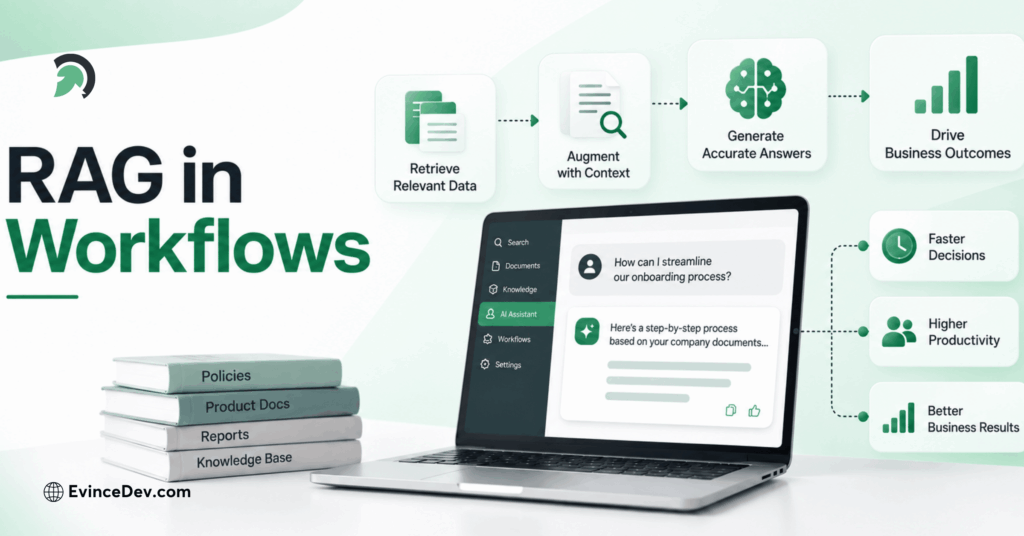
Retrieval-Augmented Generation (RAG) is an AI approach that retrieves relevant information from external sources before a large language model generates a response. It helps AI use current, private, or business-specific knowledge instead of relying only on training data. RAG fits best where a workflow needs accurate information before answering a question, making a decision, or taking the next step effectively.
What RAG Is, and What It Is Not
Retrieval-Augmented Generation, or RAG, is an AI approach that helps a language model use relevant external information while generating a response.
Instead of relying only on what the model learned during training, a RAG system can pull information from sources such as:
- company policies
- product documentation
- technical manuals
- knowledge bases
- internal documents
- databases and business systems
When a user asks a question, the system retrieves the most relevant information and provides it to the model as additional context. The model then uses that information to generate a more relevant and business-specific answer.
At a high level, RAG combines three things:
Retrieval: Find the information related to the question.
Augmentation: Add that information to the model’s context.
Generation: Produce an answer using the retrieved context.
This makes RAG especially useful when the information is private, specialized, frequently updated, or spread across multiple sources.
Quick Stat:
In Google Cloud research, 40% of surveyed executives said their organizations were looking to use techniques such as RAG to ground AI models in trusted data.
What RAG Is Not
RAG is not a vector database, search engine, fine-tuned model, or AI agent. Those technologies may support or work alongside a RAG system, but RAG’s main role is simpler: retrieve relevant knowledge and give it to the model when it needs to generate a response.
How RAG Actually Works
How RAG Uses Embeddings and Retrieval to Improve LLM Answers
RAG works through a sequence of steps that prepare business knowledge, retrieve the right information, and use that information to generate a relevant response.
Step 1: Connect the Knowledge Sources
Purpose: Give the system access to approved business information.
Process: Connect sources such as policies, PDFs, product documentation, knowledge bases, support articles, contracts, databases, SharePoint, Google Drive, and other approved repositories.
Result: A trusted collection of business knowledge that the RAG system can access.
Step 2: Break the Content Into Chunks
Purpose: Make large documents easier to search accurately.
Process: Divide documents into smaller sections called chunks. For example, a 150-page handbook can be separated into individual sections covering different policies or topics.
Result: Smaller, focused pieces of content that can be retrieved more precisely.
Step 3: Index the Information
Purpose: Make the prepared content searchable.
Process: Store the chunks in a search index. In many RAG systems, embeddings represent the meaning of each chunk numerically, while metadata such as source, date, region, or access permissions can also be added.
Result: A searchable knowledge index that can quickly surface relevant information.
Step 4: Receive the User Question
Purpose: Identify what information the user needs.
Process: The system receives a question or request, such as:
“Can this customer receive a replacement after 45 days?”
The request becomes the basis for finding relevant information.
Result: A query that can be matched against the indexed knowledge.
Step 5: Retrieve Relevant Information
Purpose: Find the knowledge most closely related to the question.
Process: The system searches the available information using methods such as vector search, keyword search, full-text search, hybrid search, filters, or reranking.
For the replacement question, it might retrieve:
- the current replacement policy
- regional rules
- product-specific exceptions
Result: A focused set of information relevant to the user’s request.
Step 6: Add the Retrieved Context
Purpose: Give the language model the information it needs to answer accurately.
Process: The system combines the user’s question with the retrieved information and sends both to the LLM.
For example:
Customer question + replacement policy + applicable exceptions + instructions
Result: An enriched prompt containing business-specific context.
Step 7: Generate the Response
Purpose: Turn the retrieved knowledge into a useful answer.
Process: The LLM interprets the user’s question together with the retrieved context and generates a response.
For example:
“The standard replacement window is 30 days, but this product category qualifies for the extended 60-day policy. The customer may therefore still be eligible.”
Result: A contextual response grounded in relevant business information, with source references where needed.
Where RAG Fits Into a Business Workflow
RAG fits into a workflow when a person or system needs relevant information before it can answer a question, make a decision, or move to the next step.
Think of RAG as a knowledge layer inside the workflow.
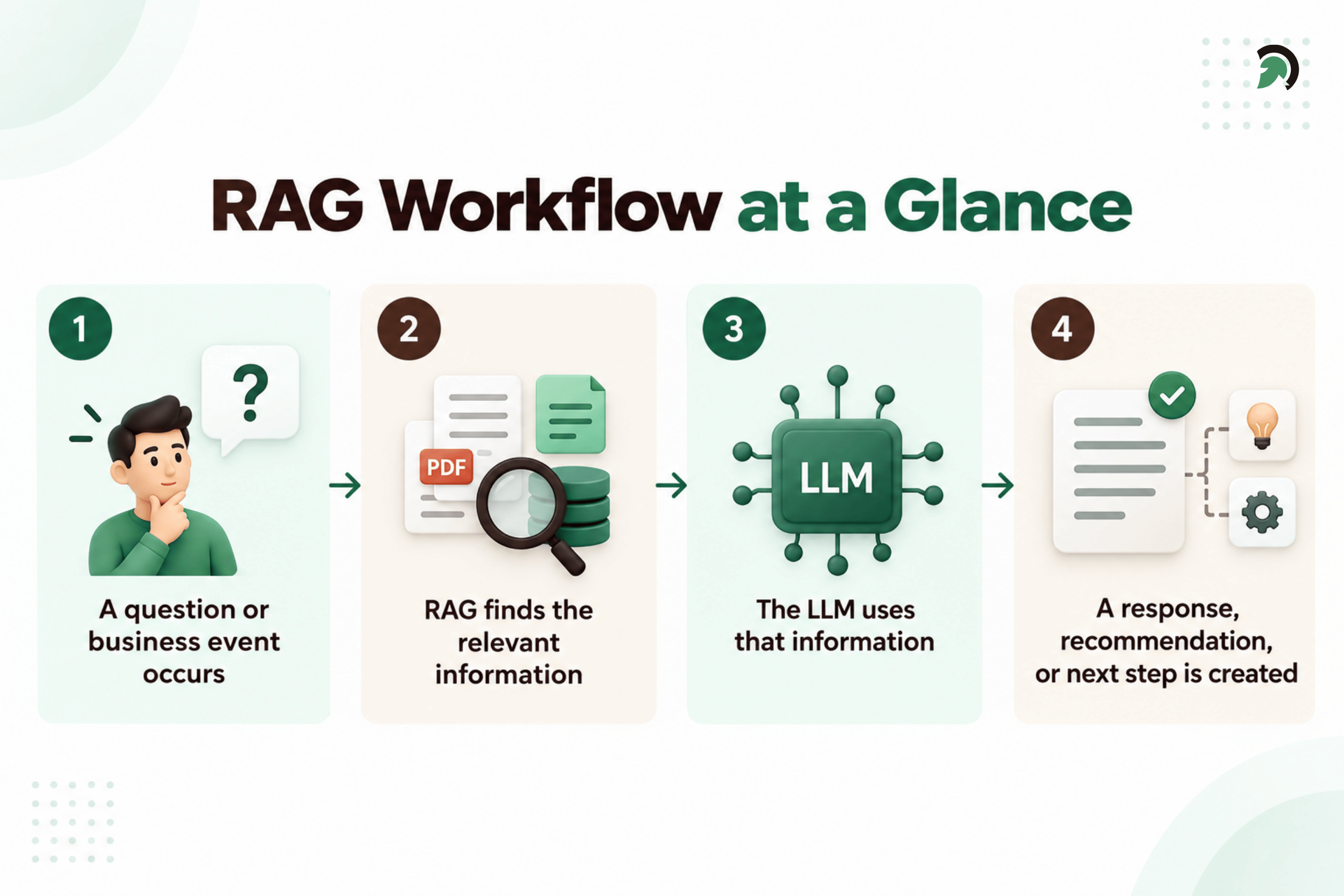
RAG Architecture and Workflow in Four Simple Steps
RAG usually fits in three common situations:
Before a Decision
RAG can retrieve policies, records, manuals, or historical information that a person or system needs before making a decision.
Before a Response
RAG can retrieve product information, support policies, procedures, or troubleshooting content before an AI assistant answers a customer or employee question.
Inside a Larger Workflow
RAG can also support one step in a broader process.
For example:
Customer requests a refund → RAG retrieves the refund policy → LLM explains eligibility → the workflow continues
RAG provides the knowledge needed at that point. Other systems, employees, automations, or AI agents can handle the action that follows.
The simplest way to think about it is:
If the workflow needs the right information before it can continue, RAG may have a role.
Where RAG Shows Up Across Industries
RAG is useful wherever people need to find and interpret information spread across documents, policies, records, or knowledge systems. The use case changes by industry, but the role of RAG stays largely the same.
Quick Stat:
Atlassian’s 2025 State of Teams research, based on 12,000 knowledge workers and 200 executives, found that teams waste 25% of their time searching for answers.
Healthcare Intake
An intake coordinator may need to confirm which documents or facility requirements apply to a referral. RAG can retrieve relevant intake guidelines, referral requirements, and operational procedures, then help summarize the information for review.
Value: Faster access to the right information without replacing clinical judgment.
Manufacturing Support
A technician may encounter an equipment issue that requires information buried across manuals and service documentation. RAG can retrieve relevant equipment manuals, troubleshooting guides, maintenance procedures, and service bulletins.
Value: Less time spent searching through technical documentation and faster access to troubleshooting guidance.
Logistics Operations
A shipment delay or exception may require employees to review several sources before deciding what to do next. RAG can retrieve relevant manifests, carrier information, shipping procedures, and exception-handling rules.
Value: Faster investigation and clearer guidance for the next operational step.
Retail and eCommerce
A customer or support agent may need answers about products, returns, shipping, warranties, or order policies. RAG can retrieve product documentation, return policies, shipping rules, support content, and other relevant business information.
Value: More consistent answers without requiring teams to search across multiple systems manually.
Financial Services
Employees may need to review internal policies, product documentation, compliance guidance, or operating procedures before handling a customer request. RAG can retrieve the relevant information and present the most useful context for review.
Value: Faster access to business and compliance information during complex customer or operational workflows.
Human Resources
Employees often have questions about leave, benefits, onboarding, workplace policies, or internal procedures. RAG can retrieve the relevant handbook sections, HR policies, benefits documentation, and internal guidance.
Value: Faster answers to routine employee questions while reducing the need to search through multiple documents.
Insurance and Compliance
Employees may need to determine which policy, procedure, or regulatory guidance applies to a specific case. RAG can retrieve relevant policy documents, internal procedures, case records, and regulatory material.
Value: Easier access to the right information without manually searching across multiple systems.
When You Do Not Need RAG
RAG is not necessary for every AI workflow. A simpler approach may be better when:
- the model already has the information it needs
- a database or API can return the exact answer
- the process follows fixed rules
- the knowledge base is small and rarely changes
- the real need is automation, not information retrieval
- the workflow requires guaranteed accuracy and human validation
Use RAG when the main challenge is finding and using the right knowledge, not just because AI is involved.
Decision Checklist: Does Your Workflow Need RAG?
Before adding RAG, look at the point in your workflow where information is needed. The goal is to understand whether retrieval is actually the missing piece.
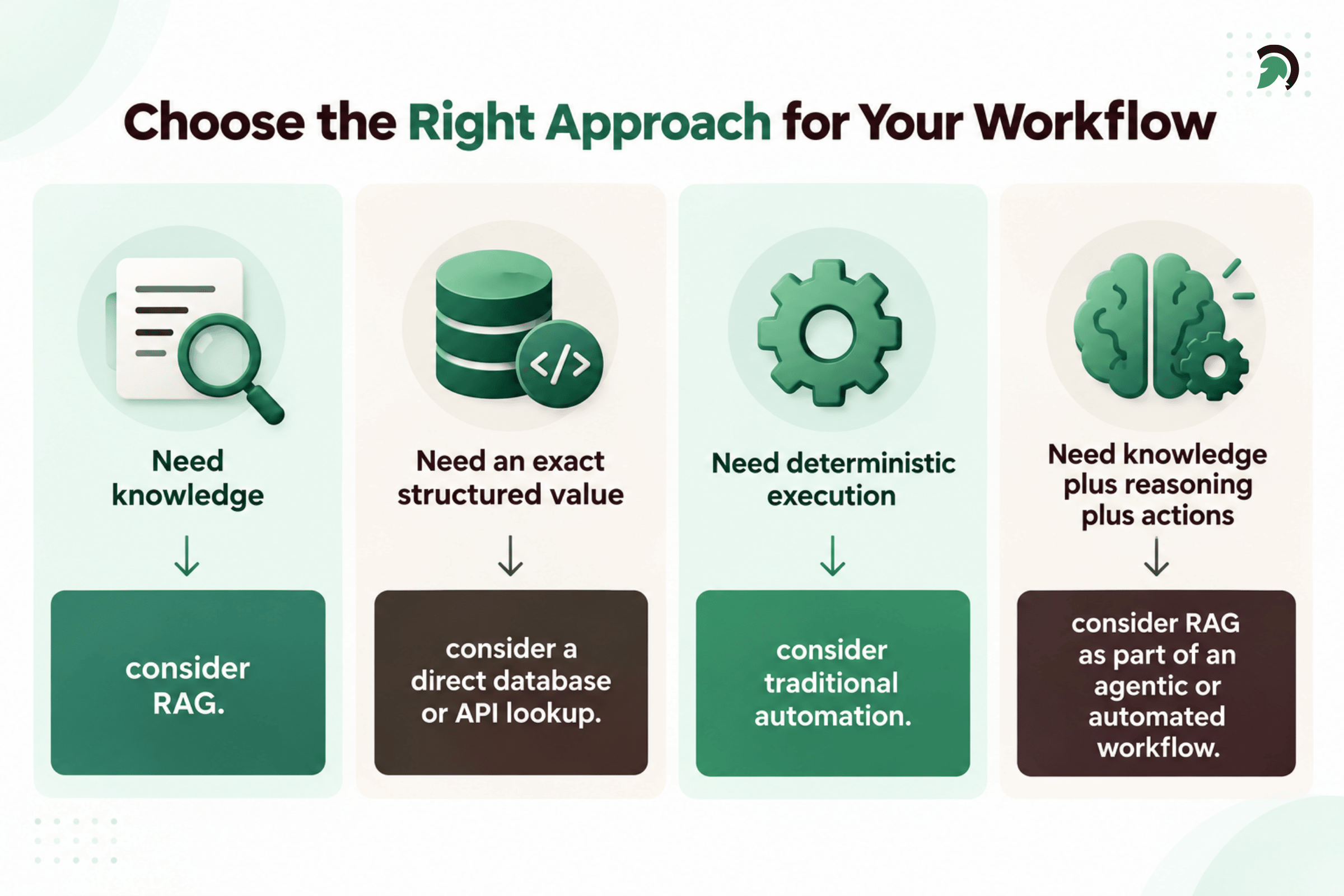
When to Use RAG, APIs, Automation, or AI Agents
Ask these questions:
- Does the workflow rely on information the base AI model may not know?
This could include internal, private, specialized, or recently updated information. - Is that information spread across multiple sources?
For example, policies, manuals, support tickets, knowledge bases, or internal documents. - Does the user need the information to be interpreted, summarized, compared, or explained?
If yes, RAG can be more useful than a simple search result. - Would a direct API or database lookup be insufficient?
If a single structured field gives the answer, RAG may be unnecessary. - Does the workflow need this knowledge before a response or decision can happen?
This is often the clearest sign that RAG may have a role. - Does the next step require action after the answer is generated?
If yes, RAG may still be useful, but it will likely need to work with automation, APIs, or an AI agent.
Quick Verdict
If the main challenge is finding and interpreting the right knowledge, RAG is worth considering. If the main challenge is retrieving one exact value or executing a fixed action, a simpler approach may be better.
Bottom Line
RAG is most useful when a workflow depends on finding, understanding, and applying the right information before a response, decision, or next step can happen. It is not the default answer for every AI use case, and in many situations a direct API, database lookup, search tool, or automation may be more appropriate. The real value comes from identifying where knowledge is slowing a process down, where teams are repeatedly searching across disconnected sources, or where AI needs reliable business context before it can respond effectively.
EvinceDev helps businesses evaluate, design, and implement AI solutions around these real workflow needs. From RAG-based knowledge systems and generative AI applications to AI agents, automation, and enterprise integrations, our focus is on choosing the right architecture, connecting the right data, and building solutions that fit existing systems and business processes. If RAG is one of the approaches you are considering, the next step is to evaluate whether retrieval is genuinely the missing layer in your workflow and what supporting architecture is needed around it.