
Key Takeaways
- Business Value Comes First: An AI pilot must solve a clearly defined problem and deliver measurable operational or financial value.
- Production Data Changes Performance: Clean pilot data rarely reflects the incomplete, inconsistent, and restricted data found in real business environments.
- A Demo Is Not a Production System: Production AI requires scalable architecture, security, monitoring, integrations, fallback controls, and reliable error handling.
- Workflow and Ownership Drive Adoption: AI must fit redesigned business processes, have clear owners, and support users within the systems they already use.
- Scale Gradually and Measure Continuously: Controlled rollout, structured evaluation, cost tracking, and ongoing monitoring reduce risk when moving an AI pilot to production.
An AI pilot can look successful in a meeting room and still fail completely in the real world.
The model may generate accurate responses, the demo may impress stakeholders, and the early results may appear promising. But once the solution is exposed to live data, real users, existing systems, security requirements, and production-scale demand, the gaps begin to show.
This is where many AI initiatives lose momentum. The challenge is not proving that AI can perform a task once. It is making that capability reliable, secure, scalable, cost-effective, and useful enough to support everyday business operations.
Moving an AI pilot to production requires far more than a working prototype. It demands the right data foundation, clear business value, strong architecture, workflow integration, governance, monitoring, and ownership.
This blog explains why so many promising AI pilots remain stuck in experimentation and what businesses must address to turn them into dependable, production-ready systems.
Quick Stat:
According to a McKinsey report, nearly two-thirds of organizations have not yet started scaling AI across the enterprise, even though 88% report using AI in at least one business function.
Why AI Pilots Stall
What Is an AI Pilot?
An AI pilot is a small-scale implementation used to test whether an AI use case is technically feasible, useful, and worth expanding. It usually focuses on one business process, a limited dataset, and a small group of users so the team can evaluate the idea under controlled conditions.
For example, a company may test whether an AI assistant can answer questions from internal documents, classify support requests, detect unusual transactions, or summarize legal files. The pilot helps assess model accuracy, data quality, integration requirements, user value, and possible operational risks.
Its purpose is to reduce uncertainty before a larger investment is made and determine whether the organization is ready to move the AI pilot to production. However, a successful pilot is not the same as a production system. Full deployment still requires scalable architecture, secure data access, monitoring, governance, workflow integration, and reliable performance under real-world conditions.
Expert Perspective
Bridging from proof of concept to implementation is a common challenge across industries. We build fantastic AI tools, but deploying them requires significant work beyond their initial training.
Andrew Ng, Founder of DeepLearning.AI and Adjunct Professor at Stanford University
AI Pilot vs. Production AI System
The difference between a successful pilot and a production system is much larger than many teams initially expect.
Expert Perspective:
An AI pilot should be treated as a structured learning phase, not a smaller version of the final product. Its purpose is to test assumptions about data, model performance, workflow fit, user value, and operational risk before production investment begins.
Hiren Daraji, Dept. Head – Microsoft, EvinceDev
| AI Pilot | Production AI System |
| Uses limited or prepared data | Uses live and continuously changing data |
| Supports a small group of users | Must support business-wide usage |
| Operates under controlled conditions | Must handle unexpected inputs and failures |
| May depend on manual support | Requires reliable automation and monitoring |
| Focuses mainly on model performance | Must also address security, cost, integration, and governance |
| Proves technical feasibility | Delivers measurable business outcomes |
| Can tolerate occasional errors | Requires defined quality and risk thresholds |
Moving an AI pilot to production therefore requires more than connecting a model to an application. It requires a complete technical and operational system around the model.
Quick Stat:
According to McKinsey, only around one-third of organizations report that they have begun scaling their AI programs beyond experimentation and initial pilots.
Why Most AI Pilots Never Reach Production
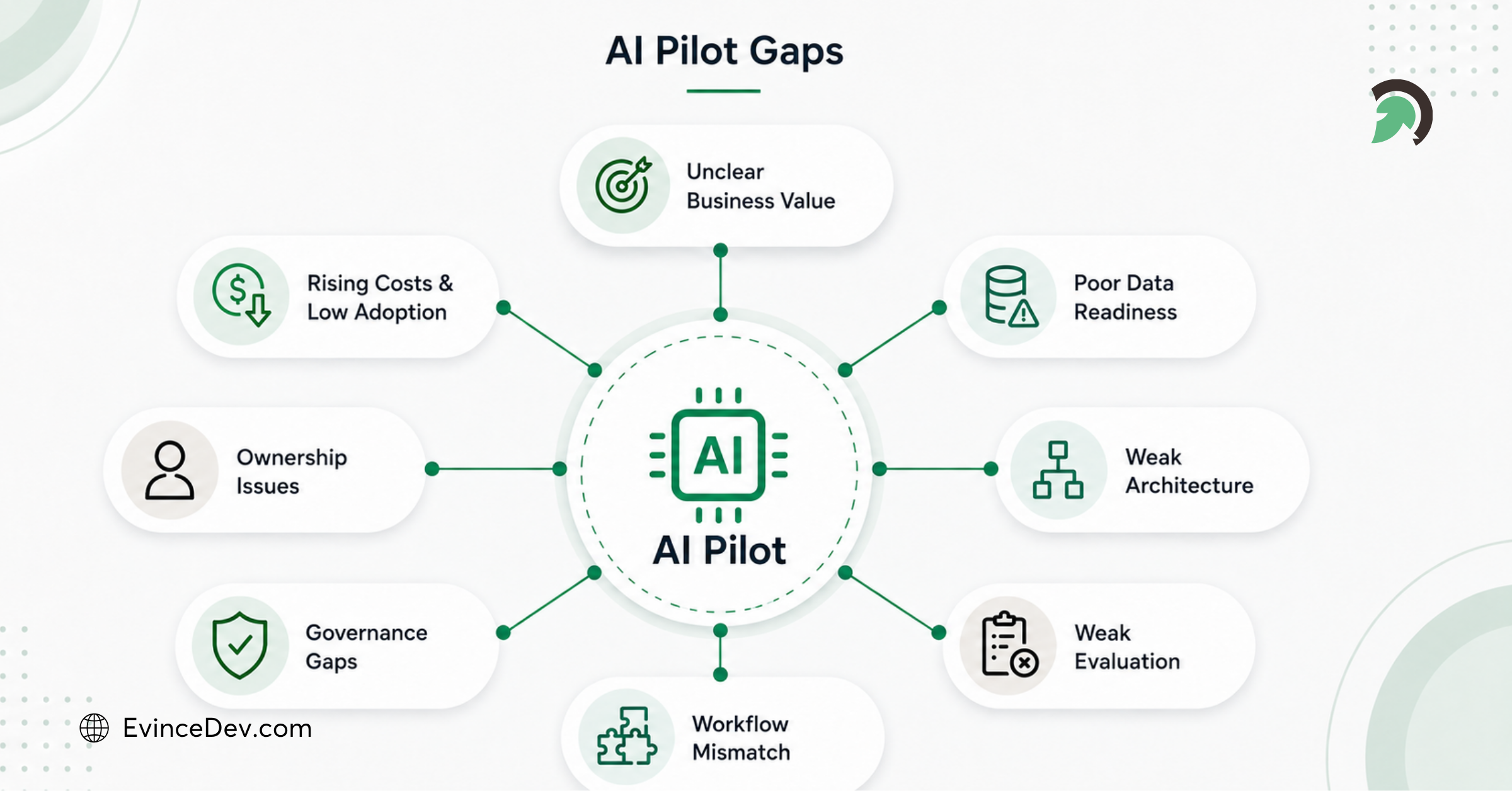
Several factors can stop an AI initiative from progressing beyond experimentation. Some relate to technology, while others involve business value, data, ownership, governance, cost, and user adoption. In most cases, the model itself is not the main problem. The wider business and technical environment is simply not ready to support it.
1. The Pilot Does Not Address a Measurable Business Problem
Many AI projects begin with interest in a model or technology rather than a clearly defined business need. A company may build a chatbot, recommendation system, or document assistant without deciding which process it should improve, who will use it, or what result would justify further investment.
Why it blocks production: Leadership cannot connect the pilot to lower costs, reduced risk, faster operations, or higher revenue. This is one of the most common causes of AI pilot failure.
A stronger pilot begins with a measurable objective, such as reducing document-review time, improving lead prioritization, shortening support resolution time, or identifying more high-risk transactions.
Expert Perspective:
The strongest AI pilots begin with an operational target, not a model choice. If the team cannot define the process baseline, expected improvement, and decision criteria, the pilot is unlikely to earn production investment.
- Hiren Daraji, Dept. Head – Microsoft, EvinceDev
2. The Pilot Uses Data That Does Not Reflect Reality
Pilots are often tested with small, carefully selected, or manually cleaned datasets. This helps the model perform well during demonstrations but may hide the complexity of real business data.
Production data often contains missing fields, duplicate records, conflicting information, inconsistent formats, incomplete metadata, poor-quality documents, and access restrictions. It may also be distributed across several systems.
Why it blocks production: When teams start moving an AI pilot to production, the model may struggle to access the required information consistently, causing its output quality to decline. Data pipelines, validation, permissions, governance, and continuous updates then become necessary.
3. The Pilot Was Built as a Demo, Not a Real System
A pilot is normally designed to prove feasibility quickly. It may use temporary infrastructure, hard-coded logic, manual file uploads, basic authentication, and limited error handling.
These shortcuts are acceptable during experimentation, but they do not support live business operations.
Why it blocks production: A real system requires scalability, secure access, monitoring, audit trails, testing environments, cost controls, backup processes, and fallback mechanisms. Effective AI solutions development must account for these requirements early, or the pilot may need to be substantially rebuilt.
Expert Perspective:
A pilot tests whether the AI can perform the task. Production tests whether the entire system can perform it repeatedly under real data, real users, failures, security controls, and cost constraints.
- Hiren Daraji, Dept. Head – Microsoft, EvinceDev
4. The Model Performs Well in Testing but Becomes Unreliable in Real Use
A model may perform strongly on a limited test set but struggle with incomplete, ambiguous, unusual, or previously unseen inputs.
This is particularly risky with generative AI because inaccurate answers may still sound confident.
Why it blocks production: A few successful demonstrations are not enough to justify moving an AI pilot to production. The solution must be tested for accuracy, relevance, consistency, hallucinations, latency, operating cost, edge cases, and failure scenarios.
Teams should also define acceptable confidence thresholds and decide when human review is required.
5. The Existing Workflow Was Never Redesigned for AI
Many organizations add AI to an existing process without first examining whether that process is efficient, clearly defined, or suitable for automation. The pilot may improve one activity, such as document classification, content generation, or data retrieval, while manual handoffs, repeated approvals, disconnected systems, and unclear decision paths remain unchanged.
Why it blocks production: AI cannot deliver meaningful operational value when it is placed on top of a broken or inefficient workflow. Before moving an AI pilot to production, teams must define which tasks AI will perform, where human review is required, how exceptions will be handled, and how information should move through the complete process.
Expert Perspective
AI rarely creates meaningful value when it is placed on top of an inefficient workflow. The process must be redesigned around decision points, human review, exception handling, and system handoffs before automation can scale.
Hiren Daraji, Department Head – Microsoft, EvinceDev
6. The Solution Does Not Fit Existing Workflows
Many pilots operate as standalone tools. Employees may need to open another application, upload documents, copy the response, and manually enter the result into a CRM, ERP, ticketing platform, or internal system.
Why it blocks production: Successful AI production deployment depends on reducing work, not adding more steps. If the solution does not fit existing systems and processes, employees are less likely to use it consistently.
The AI capability should retrieve relevant context, return results in the right place, and reduce unnecessary manual effort.
7. Security, Privacy, and Compliance Are Considered Too Late
Pilot teams often focus on model accuracy first and postpone security or compliance reviews until deployment approaches.
Before moving an AI pilot to production, the organization must understand what information is shared with the model, where it is processed, who can access it, how long it is retained, and whether sensitive prompts or outputs are logged.
Why it blocks production: Late security reviews may reveal gaps in permissions, auditability, data residency, retention, or vendor controls. Fixing these issues can delay approval or require significant architectural changes.
This risk is especially important in financial services, healthcare, legal services, and government environments.
8. No Team Owns the Solution After the Pilot
Many pilots are led by innovation teams, consultants, or small technical groups. Once the demonstration is complete, responsibility becomes unclear.
A production system needs ongoing ownership for monitoring performance, managing costs, responding to failures, approving model changes, maintaining integrations, and reviewing feedback.
Why it blocks production: Without one accountable business owner and one technical owner, decisions become slow and fragmented. This can delay enterprise AI adoption and leave the pilot stuck between departments.
Quick Stat:
IBM found that 72% of leading AI organizations report full alignment between the C-suite and IT leadership on what is required to achieve AI maturity.
9. Production Costs Were Not Estimated Properly
A pilot may look affordable because it supports only a few users and processes a limited number of requests. At scale, the cost structure can change substantially.
Production expenses may include model usage, cloud infrastructure, vector databases, data storage, document processing, monitoring, evaluation, security, human review, engineering support, and maintenance.
Why it blocks production: If the total operating cost is higher than the value the solution creates, leadership may stop the rollout. Before scaling AI projects, businesses should test realistic usage volumes and estimate costs under production conditions.
Model routing, caching, batch processing, prompt optimization, smaller models, and improved retrieval can help control expenses.
10. Users Do Not Trust or Understand the System
Technical performance does not automatically lead to adoption.
Employees may not know when to trust the output, how the answer was produced, or who is accountable when the system is wrong. They may also find the interface difficult or receive inconsistent responses.
Why it blocks production: A production-ready AI solution delivers value only when people use it correctly and consistently. Low trust, unclear responsibilities, and limited transparency can prevent adoption even when the underlying model performs well.
Users should be able to review, correct, or escalate questionable outputs where appropriate.
11. The Organization Tries to Scale Too Quickly
A successful pilot can create pressure for an immediate organization-wide rollout. However, moving directly from a small experiment to a large deployment introduces too many users, systems, workflows, and risks at once.
Why it blocks production: Large-scale issues become harder to identify and correct when too many variables are introduced together. A safer approach is to move the AI pilot to production gradually, starting with one workflow, department, user group, document type, or customer segment.
This phased release gives the team time to measure real performance, resolve operational issues, and improve the system before expanding it further.
Quick Stat:
Bain found that 40% of AI pilots in software development were moving to production at scale, while only about 20% to 33% were scaling in areas such as customer service, sales, marketing, and knowledge work.
12. The Business Process and Organization Are Not Ready for AI
Some companies add AI to an outdated or inefficient workflow without first redesigning how the work should be performed. The pilot may automate individual tasks, but it does not fix duplicated approvals, unclear responsibilities, disconnected systems, or unnecessary manual steps.
Why it blocks production: Production AI often affects budgets, roles, decision authority, security, and compliance. If departments cannot agree on ownership, workflow changes, or acceptable risk, the project may stall even when the technology works.
Warning Signs Your AI Pilot Is Not Ready for Production
An AI initiative may not be ready to scale if:
- Results depend on manually cleaned data
- The model has only been tested on successful examples
- Accuracy thresholds have not been defined
- Cost per transaction is unknown
- Security teams have not reviewed the architecture
- No owner has been assigned
- Users must leave their normal workflow
- Failure scenarios have not been tested
- There is no monitoring or alerting
- Human review rules are unclear
- Production data access has not been approved
- The solution cannot explain or trace important outputs
These warning signs do not necessarily mean the project should be canceled. They indicate that more preparation is required before deployment.
How to Move an AI Pilot Into Production
A structured process can help reduce the gap between experimentation and implementation.
Step 1: Define the Business Outcome
Identify the exact process being improved, the intended users, the expected result, and the metrics that will determine success.
Step 2: Assess Data Readiness
Evaluate data quality, ownership, accessibility, privacy, formats, permissions, and update frequency.
Step 3: Design the Production Architecture
Plan integrations, security, databases, infrastructure, APIs, observability, fallback logic, and scalability before final development.
Step 4: Build an Evaluation Framework
Create representative test cases and measure quality, risk, latency, cost, and failure behavior.
Step 5: Add Human Oversight
Define which actions the AI can perform independently and which require review or approval.
Step 6: Integrate With Existing Systems
Place the AI capability inside existing applications and workflows wherever possible.
Step 7: Run a Controlled Production Release
Release the system to a limited but real group of users and monitor performance under actual operating conditions.
Step 8: Monitor and Improve Continuously
Track output quality, errors, usage, adoption, costs, security events, and business impact. Use these findings to improve the model, prompts, retrieval process, and user experience.
Successful AI model deployment is an ongoing operational process, not a one-time technical release.
AI Production Readiness Checklist
Before moving an AI pilot to production, confirm that:
- The business problem is clearly defined
- Success metrics are measurable
- Production data is available and reliable
- The architecture can support expected usage
- Security and access controls are implemented
- Accuracy and confidence thresholds are established
- Human review requirements are documented
- Failure and edge cases have been tested
- The system fits existing workflows
- Costs have been estimated at scale
- Monitoring and alerts are active
- Business and technical owners are assigned
- A phased rollout plan is ready
Bottom Line
Most AI pilots do not fail because the underlying technology is incapable. They fail because the surrounding business, data, technical, and operational requirements were not addressed early enough.
Moving an AI pilot to production requires reliable data, measurable business value, secure architecture, workflow integration, structured evaluation, human oversight, cost planning, continuous monitoring, and clear ownership.
EvinceDev helps businesses bridge this gap by turning validated AI concepts into secure, scalable, and production-ready solutions aligned with real workflows and business goals. Companies that plan for production readiness from the beginning are more likely to transform AI experiments into dependable systems that work safely, consistently, and cost-effectively at scale.