Key Takeaways
- POS Software: POS software helps retail and fintech businesses manage payments, sales, inventory, and reports.
- Payment Flows: Modern POS systems support cards, wallets, UPI, QR payments, refunds, and secure settlements.
- Retail POS Tech: Retail POS platforms improve checkout speed, inventory tracking, customer data, and store operations.
- FinTech POS Use: Fintech POS solutions connect payments with lending, BNPL, merchant tools, and financial insights.
- Cloud POS Role: Cloud POS systems help businesses manage multiple locations, remote access, and real-time data.
- Mobile POS App: Mobile POS development enables flexible payments through smartphones, tablets, and field devices.
- POS Future AI: AI, automation, contactless payments, and fintech integrations are shaping the future of POS.
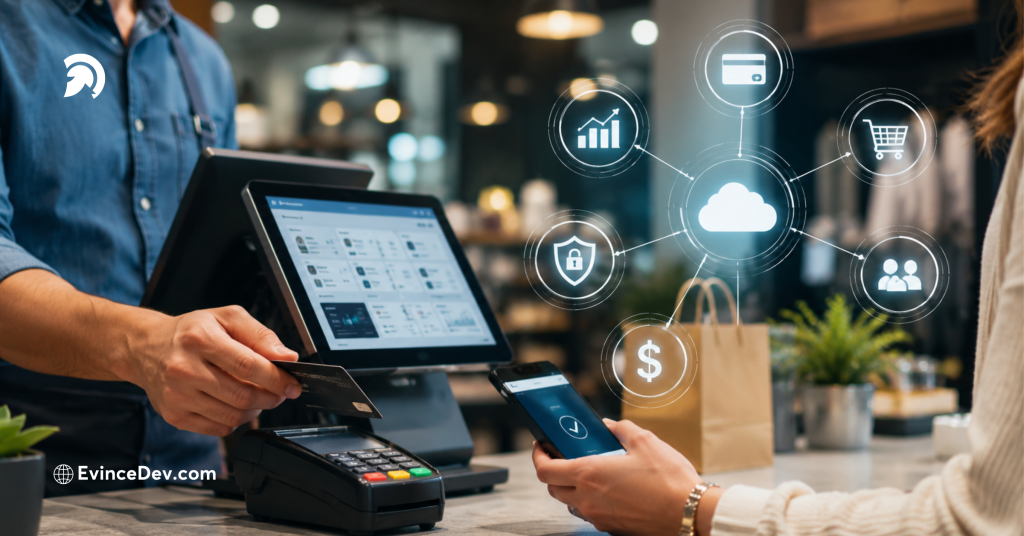
The way businesses handle transactions has evolved significantly over the past decade. What started as simple billing systems has now transformed into intelligent, connected platforms that power entire business operations. Today, POS systems are not just checkout tools; they are central to managing sales, customer data, inventory, and financial workflows.
This shift has created a growing demand for POS payment software development and fintech software development, especially among retail and fintech businesses looking to build scalable, secure, and feature-rich platforms. Whether it is a multi-store retail chain or a fintech startup enabling digital payments, POS systems are now critical to delivering seamless transaction experiences.
In this blog, we will explore how modern POS systems work, what goes into building them, key features, technologies, and how businesses can leverage them for growth.
Quick Stat:
According to Grand View Research, the global POS software market was valued at $17.13 billion in 2025 and is projected to reach $38.82 billion by 2033, growing at a CAGR of 10.8%. This growth reflects the rising adoption of digital payment technologies, cloud-based retail systems, and advanced POS platforms across industries.
What Is POS Payment Software?
A POS (Point of Sale) system is a combination of software and hardware that allows businesses to process transactions, manage sales, and track operations in real time.
A modern POS payment system typically includes:
- Transaction processing tools
- Inventory management modules
- Customer relationship management features
- Reporting and analytics dashboards
- Integration with payment gateways and financial services
Unlike traditional systems, modern POS solutions are cloud-driven, mobile-friendly, and integrated with multiple business functions.
Why POS Software is Critical for Retail and FinTech Businesses?
Retail Perspective
For retail businesses, POS systems act as the operational backbone. They help:
- Manage inventory across locations
- Enable faster checkout experiences
- Track customer purchase behavior
- Support omnichannel sales
This is why retail POS system development has become a priority for businesses looking to scale operations and improve customer experience.
FinTech Perspective
For fintech companies, POS systems go beyond transactions. They enable:
- Payment processing and settlements
- Financial data tracking
- Embedded financial services like lending and BNPL
- Integration with banking systems
This is where fintech POS solutions play a major role in bridging the gap between payments and financial services.
Key Features of Modern POS Payment Software
Core Features
Modern POS systems are designed to handle a wide range of business operations:
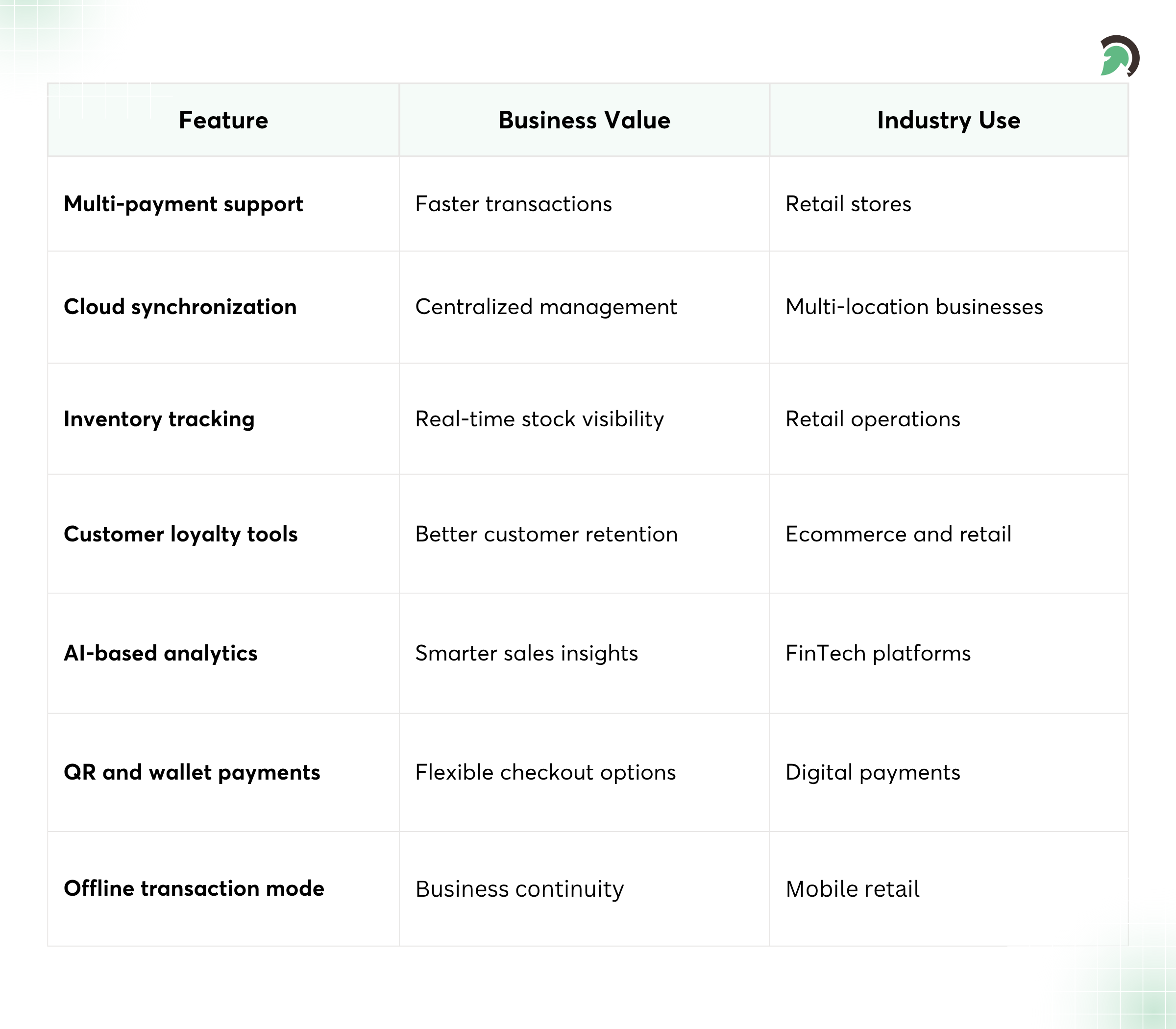
- Multi-payment support (cards, UPI, wallets, QR)
- Inventory tracking and stock management
- Order and billing management
- Customer data and loyalty programs
Advanced Capabilities
To stay competitive, businesses are now adopting advanced features such as:
- Omnichannel synchronization across online and offline stores
- Real-time reporting through financial dashboards
- AI-based sales insights and recommendations
- Offline transaction capabilities for low-connectivity environments
These features make POS systems more than just transactional tools; they become strategic assets for growth.
POS Payment Software Features for Retail and FinTech
POS Payment Software Development: How It Works
Building a modern POS system requires a structured development process that balances business needs, payment security, usability, and scalability. POS payment software development usually involves the following stages:
- Requirement Analysis: Identify business goals, transaction workflows, user roles, device needs, payment methods, and third-party integration requirements.
- UI/UX Design: Design simple and intuitive interfaces for cashiers, store managers, admins, and customers to ensure faster checkout and smoother operations.
- Backend Development: Build a secure and scalable backend to manage transactions, inventory, customer data, reports, refunds, and integrations.
- Payment Integration: Connect the POS system with payment gateways and payment processing systems to support cards, wallets, UPI, QR payments, and other digital payment methods.
- Testing and Compliance: Test the system for speed, security, accuracy, device compatibility, and compliance with payment and data protection standards.
- Deployment and Scaling: Launch the POS platform, monitor performance, fix issues, and optimize it for higher transaction volumes, new locations, and future features.
This step-by-step process helps businesses build reliable, secure, and future-ready POS solutions that can support daily operations and long-term growth.
POS System Architecture Explained
A modern POS system follows a cloud-based, API-driven architecture.
Key Components
- Frontend interface (web or mobile)
- Backend servers handling transactions
- Cloud database for data storage
- Integration layer for external services
Payment Flow
- Customer initiates payment
- The POS system sends a request to the gateway
- Payment is authorized
- The transaction is recorded in the system
- Data updates in real time
Offline Mode
Advanced systems store transactions locally and sync data when connectivity is restored.
Security Layers
- Data encryption
- Tokenization
- Role-based access control
This architecture ensures performance, scalability, and reliability.
FinTech Integration in POS Software
Modern POS systems are deeply integrated with fintech digital solutions and services, helping businesses manage payments, settlements, reporting, and financial workflows from a single platform.
- Payment Gateway Integration: Supports card payments, UPI, digital wallets, QR payments, and other secure transaction methods.
- Embedded Finance: Enables value-added services such as BNPL, lending, instant settlements, and flexible payment options.
- Merchant Tools: Allows businesses to manage transactions through merchant payment portals, track payment status, handle refunds, and generate reports.
- Financial Insights: Provides real-time financial dashboards to monitor sales, revenue, settlements, transaction trends, and business performance.
These capabilities are driving the adoption of fintech POS solutions across retail, fintech, hospitality, and service-based industries.
Types of POS Systems
Different businesses need different POS systems based on their operations, payment needs, and scalability goals.
- Retail POS: Designed for stores, supermarkets, and retail chains to manage billing, inventory, discounts, returns, and sales reports.
- Mobile POS: Runs on smartphones or tablets, making mobile POS development useful for pop-up stores, delivery teams, and field sales.
- Cloud POS: Hosted online, cloud POS software helps businesses access data remotely, manage multiple locations, and scale with flexibility.
- Self-Service POS: Used in kiosks and automated checkout systems to reduce wait times and improve customer convenience.
- FinTech POS: Built with payment gateways, digital wallets, instant settlements, BNPL, merchant portals, and financial analytics.
Each type supports different business use cases, so the right choice depends on your industry, transaction volume, and integration needs.
Market Insight:
According to Global Growth Insights, around 72% of businesses have adopted cloud-based POS systems to improve scalability, centralized management, and real-time operational visibility. This shift shows why cloud POS software is becoming a preferred choice for retail and fintech businesses managing multi-location operations.
Benefits of POS Software for Businesses
Implementing a POS system helps businesses simplify daily operations, improve transaction accuracy, and deliver a smoother customer experience. A modern POS platform does more than process payments; it connects sales, inventory, customer data, and financial workflows into one system.
Key benefits include:
- Faster and more accurate transactions: POS software reduces manual billing errors, speeds up checkout, and supports multiple payment methods for smoother sales.
- Improved customer experience: Businesses can offer faster service, personalized offers, loyalty rewards, and flexible payment options.
- Real-time inventory tracking: Stock levels update automatically after every sale, helping businesses avoid overselling, stockouts, and manual inventory gaps.
- Better decision-making through analytics: POS systems provide sales reports, customer insights, and financial dashboards that help business owners track performance and identify growth opportunities.
- Increased revenue through integrated financial services: Retailers and fintech companies can add value through digital wallets, BNPL, lending, instant settlements, and other fintech-enabled services.
For fintech companies, POS systems also create new revenue opportunities through transaction fees, merchant services, embedded finance, and value-added financial products.
Quick Stat:
According to Juniper Research, contactless payment transactions are expected to reach $18.1 trillion globally by 2030, more than doubling from 2025 levels. This growth is pushing businesses to adopt faster, safer, and more flexible POS systems that support contactless cards, wallets, QR payments, and mobile transactions.
Challenges in POS Software Development
While POS systems offer strong business value, building a reliable and scalable solution requires careful technical planning. Since these platforms handle payments, customer data, inventory, and real-time transactions, even small issues can impact business operations.
Key challenges include:
- Ensuring data security and compliance: POS systems must protect sensitive payment and customer data through encryption, tokenization, secure authentication, and compliance-ready architecture.
- Managing real-time synchronization: Sales, inventory, refunds, and customer data need to sync instantly across stores, devices, warehouses, and online platforms.
- Handling complex third-party integrations: A POS solution often connects with payment gateways, accounting tools, CRM systems, loyalty platforms, ERP software, and ecommerce stores.
- Supporting multiple devices and platforms: The system should work smoothly across desktops, tablets, mobile devices, barcode scanners, receipt printers, and payment terminals.
- Maintaining performance during peak hours: Retail and fintech businesses need POS systems that can process high transaction volumes without delays, downtime, or data loss.
Addressing these challenges requires strong expertise in POS payment software development, secure architecture, and long-term scalability planning.
Build vs Buy POS Software
Choosing between building and buying POS software depends on your business goals, budget, timeline, and scalability needs. Both options can work well, but the right choice depends on how much control and customization your business requires.
When to Build
Building custom POS software is a better choice when:
- You need custom features: Your business requires unique workflows, advanced integrations, multi-location management, or industry-specific functionality.
- You want full control over data and workflows: Custom development gives you better ownership over customer data, transaction flows, reporting, and backend operations.
- You plan to scale or innovate: If you want to add fintech features, expand into new markets, or build a differentiated payment experience, custom POS development offers more flexibility.
When to Buy
Buying ready-made POS software may be suitable when:
- You need a quick solution: Off-the-shelf POS tools can be deployed faster with limited setup.
- Your requirements are standard: If you only need basic billing, inventory, and reporting, a pre-built solution may be enough.
- The budget is limited: Ready-made POS platforms typically require less upfront investment than custom development.
Custom-built solutions are ideal for businesses looking for long-term differentiation, especially in fintech, enterprise retail, and large-scale multi-location operations.
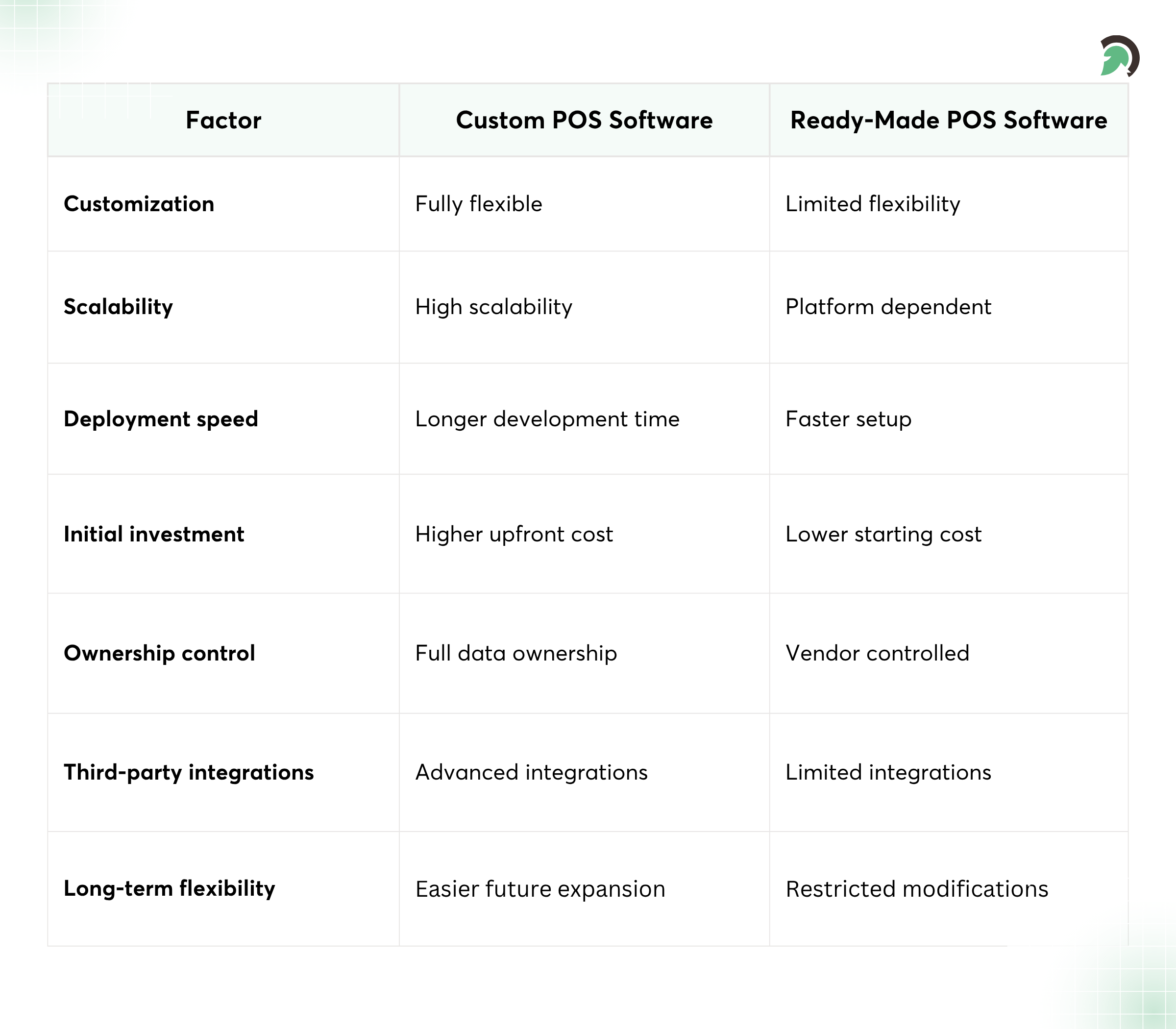
Comparing Custom and Prebuilt POS Platforms
How to Choose the Right POS Development Partner
Selecting the right POS development partner is critical to building a secure, scalable, and business-ready solution. The right team should understand both retail workflows and fintech requirements, spanning payment processing, compliance, and long-term platform growth.
Look for:
- Experience in fintech software development: Choose a partner with strong knowledge of digital payments, financial workflows, settlements, and secure transaction handling.
- Expertise in payment integrations: The team should be able to integrate payment gateways, wallets, cards, UPI, BNPL, and other payment methods smoothly.
- Strong portfolio in POS systems: Review their past work in POS, retail platforms, mobile payment apps, or merchant-facing solutions to assess their technical capability.
- Ability to scale and support long-term growth: A reliable partner should build with future expansion in mind, including multi-location support, advanced analytics, new integrations, and ongoing maintenance.
A dependable POS development partner ensures smoother planning, faster execution, secure deployment, and continuous support after launch.
Future of POS in Retail and FinTech
POS systems are evolving from basic payment tools into complete business platforms that connect sales, inventory, customer engagement, analytics, and financial operations. As retail and fintech businesses continue to digitize, POS platforms will become more intelligent, integrated, and adaptable.
Future trends include:
- AI-driven personalization: With AI in Fintech, POS systems will use customer data, purchase history, and behavior patterns to offer personalized recommendations, loyalty rewards, and targeted promotions.
- Deeper fintech integrations: Businesses will increasingly connect POS platforms with digital wallets, instant settlements, lending, BNPL, and other embedded finance services.
- Subscription-based models: POS platforms may support recurring revenue models through tools like subscription billing software, helping businesses manage renewals, memberships, and automated payments.
- Unified commerce ecosystems: Future POS systems will connect in-store, online, mobile, and marketplace sales into one centralized platform for smoother operations.
As businesses continue to digitize, POS systems will play a central role in shaping customer experiences, improving financial visibility, and supporting long-term business growth.
Conclusion
The role of POS systems has evolved from simple transaction tools into powerful platforms that support business growth, operational efficiency, and better customer experiences. For retail and fintech businesses, the right POS solution can help streamline payments, improve visibility, and unlock new revenue opportunities through connected fintech digital solutions.
With the rising demand for customization, scalability, and secure integrations, POS payment software development and fintech software innovation have become strategic priorities for businesses looking to stay competitive in a digital-first market.
By focusing on the right features, technologies, and integrations, businesses can build POS systems that support both present needs and future growth. With experienced technology partners like EvinceDev, organizations can turn complex POS requirements into scalable, secure, and business-ready solutions.