Key Takeaways
- Smarter Forecasting: AI helps predict demand more accurately and reduce stockouts, overstocking, and planning errors.
- Faster Deliveries: AI supports route optimization, real-time tracking, and last-mile planning to improve delivery speed.
- Better Inventory Control: AI helps businesses maintain the right stock levels across warehouses and fulfillment centers.
- Lower Operational Costs: AI can reduce fuel usage, equipment downtime, manual errors, and unnecessary logistics expenses.
- Stronger Supply Chain Visibility: AI gives teams better insight into shipments, suppliers, inventory, risks, and customer delivery updates.
A delayed shipment, an unexpected stockout, or one wrong demand forecast can affect the entire supply chain. For logistics-driven businesses, even small delays can increase costs, slow down fulfillment, and impact customer trust.
Today, logistics and supply chain operations are under constant pressure. Customers expect faster deliveries, businesses need better inventory accuracy, transportation costs keep changing, and supplier delays can disrupt even well-planned operations. Manual planning alone is no longer enough to manage this level of complexity.
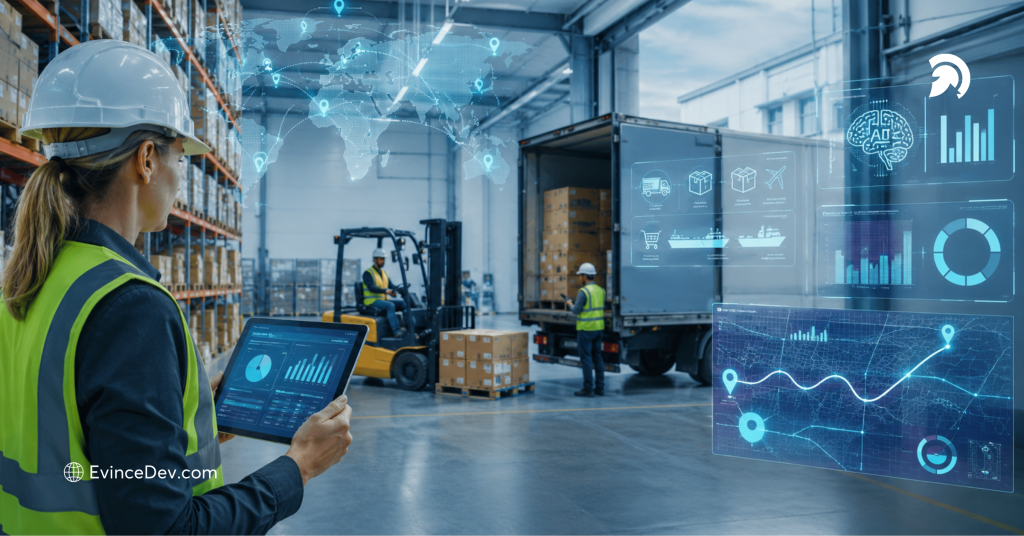
This is where AI in logistics and supply chain management is becoming highly valuable. AI helps businesses predict demand, optimize routes, manage inventory, automate warehouse tasks, track shipments, detect risks, and make faster decisions using real-time data.
As part of our AI use cases series, this blog explores how AI is used across logistics and supply chain operations. We will cover key use cases, business benefits, implementation steps, KPIs, challenges, best practices, and the future scope of AI in this space.
Quick Stat:
Gartner’s 2024 survey of 419 supply chain leaders found that AI, including machine learning and generative AI, ranked as the top investment areas in digital supply chain strategies.What Is AI in Logistics and Supply Chain Management?
AI in logistics and supply chain management refers to using artificial intelligence to improve the planning, sourcing, storage, movement, tracking, and delivery of goods. It helps teams make smarter decisions by analyzing large volumes of operational data and identifying patterns that may be hard to find manually.
In simple terms, AI helps businesses answer important operational questions, such as:
- How much stock will be needed next month?
- Which delivery route is faster and more cost-effective?
- Which supplier may cause delays?
- Which warehouse should hold more inventory?
- Which vehicle or machine needs maintenance before it fails?
AI is not only about robots or automation. Its bigger value lies in prediction, optimization, visibility, and decision support. Traditional logistics systems often depend on fixed rules and manual decisions, while AI-powered systems can learn from data and improve recommendations over time.
This allows logistics and supply chain teams to move from reactive operations to proactive planning.
Expert View:
Oliver Facey, Senior Vice President of Global Network Operations Programs at DHL Express, has highlighted logistics as one of the industries actively applying AI to improve key business functions. This reinforces why AI is becoming more relevant across delivery planning, warehouse operations, and last-mile execution.
Why Logistics and Supply Chain Businesses Need AI
Logistics and supply chain businesses deal with many moving parts. A delay from a supplier, carrier, warehouse, customs process, or delivery route can affect the entire customer experience.
The role of AI in logistics and supply chain management is to help businesses manage this complexity with better forecasting, faster decision-making, and real-time operational insights.
Common challenges include:
- Sudden changes in customer demand
- Faster delivery expectations
- Rising transportation and fuel costs
- Warehouse inefficiency
- Supplier delays and disruptions
- Manual planning errors
- Limited shipment visibility
- Overstocking or stockouts
For example, demand can rise suddenly because of seasonal trends, promotions, local events, or changing customer behavior. If a business cannot forecast demand correctly, it may either run out of stock or hold too much inventory. Both situations create cost and customer experience problems.
Delivery expectations have also changed. Customers want faster shipping, accurate delivery timelines, and regular updates. Businesses can no longer depend on generic delivery estimates or delayed status updates.
AI helps businesses manage these challenges by giving teams better visibility, predictive insights, and practical recommendations before problems become serious.
Quick Stat:
MHI’s 2025 Annual Industry Report found that 55% of supply chain leaders are increasing technology and innovation investments, and 60% plan to spend more than $1 million. This reflects how strongly businesses are prioritizing digital supply chain improvements.
How AI Works Across Logistics and Supply Chain Operations
AI works by collecting, connecting, and analyzing data across logistics and supply chain operations. This data can come from sales platforms, inventory systems, warehouse management systems, transportation systems, GPS devices, fleet tools, supplier portals, customer orders, weather updates, traffic data, and IoT sensors.
Once this data is connected, AI can identify patterns and make predictions. It can predict which deliveries may be delayed, recommend when to reorder inventory, suggest better delivery routes, detect early signs of equipment failure, and flag risky suppliers.
AI becomes more useful when it is integrated with existing business systems. Many companies already use ERP, WMS, TMS, CRM, ecommerce platforms, fleet management tools, and other operational systems. When AI works with these systems, insights become part of daily operations rather than remaining separate from the workflow.
This is why AI should not be seen as a standalone tool. It works best when it supports the systems, teams, and decisions that already exist inside the business.
Expert View:
The best starting point for AI in logistics is not always automation. It is decision improvement. Businesses should first identify where teams repeatedly make high-impact decisions, such as reorder timing, route changes, stock transfers, supplier selection, or delivery prioritization. These decision bottlenecks often create better AI opportunities than simply automating repetitive tasks.
- Dharmesh Patt, CTO, EvinceDev
Top AI Use Cases in Logistics and Supply Chain Management
AI is helping logistics and supply chain businesses forecast demand, optimize inventory, plan better routes, automate warehouse tasks, track shipments, manage supplier risks, and improve customer communication. These are some of the most practical AI use cases every business should know in logistics and supply chain management, especially for companies looking to reduce delays, lower costs, improve visibility, and build more resilient operations.
The strongest value of AI comes from solving real operational problems. In logistics and supply chain management, these problems often include demand changes, stock imbalance, delivery delays, warehouse inefficiency, supplier risks, rising transportation costs, and lack of real-time visibility.
Expert View:
AI becomes more useful when planning data and execution data are connected. Demand forecasts, inventory movement, warehouse performance, fleet activity, and supplier reliability should not be analyzed separately. When these data points are connected, AI can show not only what may happen, but also what action the business should take next.
- Swapnil Sawant, Senior Software Engineer at Microsoft Dept., EvinceDev
Below are the key use cases businesses can consider.
1. Demand Forecasting
Demand forecasting helps businesses predict how much demand they may see for specific products, regions, or time periods. This is important because inaccurate demand planning can lead to stockouts, overstocking, missed sales, and higher storage costs.
AI analyzes historical sales, seasonality, promotions, customer behavior, weather patterns, and external market signals to forecast demand more accurately. For example, if a product usually sells more during a holiday season or in a specific location, AI can help the business prepare inventory before demand increases.
This is one of the most important AI use cases in supply chain operations because it directly affects purchasing, production, inventory, and fulfillment.
Business impact: Better procurement planning, fewer stockouts, reduced overstocking, improved cash flow, and stronger customer satisfaction.
2. Inventory Optimization
Inventory optimization helps businesses keep the right amount of stock in the right location. Poor inventory planning can increase storage costs, delay fulfillment, or leave customers waiting for products that are unavailable.
AI studies product movement, demand patterns, reorder history, warehouse capacity, and sales velocity to recommend ideal stock levels and reorder points. It can also suggest where inventory should be placed so products are closer to customers or high-demand regions.
For example, if a product sells faster in one city, AI can recommend moving more stock to a nearby fulfillment center. This reduces delivery time and improves customer experience.
Business impact: Lower storage costs, better product availability, faster fulfillment, reduced dead stock, and improved inventory turnover.
3. Route Optimization
Route optimization helps logistics teams plan faster and more cost-effective delivery routes. Manually planned or fixed routes often fail to account for traffic, weather, road closures, delivery windows, vehicle capacity, and driver availability.
AI evaluates real-time and historical route data to recommend better delivery paths. It can also adjust routes when road conditions change during the day. This makes route optimization one of the most practical applications of AI in supply chain and logistics because it directly affects cost, speed, and customer satisfaction.
For example, if a route becomes congested, AI can suggest a different delivery sequence to reduce delays and improve driver productivity.
Business impact: Faster deliveries, lower fuel costs, better fleet utilization, improved on-time delivery rates, and reduced transportation costs.
4. Warehouse Slotting and Space Optimization
Warehouse slotting focuses on placing products in the right locations inside a warehouse. When fast-moving items are stored far from packing areas or commonly ordered products are placed far apart, workers spend more time walking and order processing slows down.
AI reviews product demand, picking frequency, product size, storage needs, and warehouse layout to recommend better product placement. Fast-moving products can be placed closer to dispatch zones, while products often ordered together can be stored near each other.
This improves the flow of warehouse operations without requiring a complete redesign of the facility.
Business impact: Faster picking and packing, better space utilization, fewer warehouse errors, improved labor productivity, and faster order processing.
5. Warehouse Automation
Warehouse automation helps reduce repetitive manual work and improve fulfillment speed. This is especially useful for businesses handling large order volumes, seasonal spikes, multiple warehouses, or complex product catalogs.
AI supports automated picking, sorting, scanning, packing, product inspection, and workforce planning. Computer vision can help read labels, inspect packages, detect damaged goods, and improve quality checks before dispatch.
In more advanced warehouses, AI-powered robots can move goods, assist workers, and automate repetitive tasks. However, even without robotics, AI can still improve warehouse efficiency through better task planning and decision support.
Business impact: Higher warehouse productivity, reduced manual errors, faster fulfillment, better order accuracy, and lower operational workload.
6. Predictive Maintenance for Fleet and Equipment
Logistics operations depend on vehicles, forklifts, conveyor belts, scanners, warehouse machines, and cold storage equipment. If any of these assets fail suddenly, it can delay deliveries, increase repair costs, and disrupt operations.
AI helps predict equipment issues before they cause breakdowns. It studies sensor data, temperature, vibration, usage patterns, fuel performance, engine behavior, and maintenance history to identify early warning signs.
For example, if a truck engine shows unusual temperature or vibration, AI can alert the maintenance team before the vehicle breaks down. This allows teams to schedule maintenance at the right time instead of reacting after failure.
Business impact: Less downtime, lower maintenance costs, fewer delivery delays, better equipment performance, and longer asset life.
7. Real-Time Shipment Tracking and ETA Prediction
Customers and businesses both want better shipment visibility. It is no longer enough to say that an order is “on the way.” Customers want to know where the order is, when it will arrive, and whether there is any delay.
AI improves shipment tracking by using GPS data, traffic conditions, weather, carrier updates, historical delivery patterns, and route performance. It can predict more accurate delivery times and update them when conditions change.
For example, if a truck is delayed because of traffic or weather, AI can update the ETA and help the business inform the customer early. This reduces uncertainty and improves trust.
Business impact: More accurate ETAs, better customer communication, fewer support queries, faster issue resolution, and improved delivery transparency.
8. Supplier Risk Management
Suppliers play a major role in supply chain performance. If a supplier delays materials, provides poor-quality goods, changes pricing suddenly, or faces a regional disruption, the entire operation can be affected.
AI helps businesses monitor supplier performance and detect risks early. It can analyze past delays, quality records, delivery reliability, pricing trends, location-based risks, and external disruption signals.
For example, if a supplier has repeatedly delayed shipments over the last few months, AI can flag that supplier as a risk. The business can then prepare backup suppliers or adjust procurement plans.
Business impact: Better supplier selection, early risk detection, reduced disruption impact, stronger procurement planning, and improved supply chain resilience.
9. Demand and Supply Matching
Demand and supply matching helps businesses align customer demand with available inventory, supplier capacity, production schedules, and logistics resources.
When demand and supply are not aligned, companies may face emergency shipments, excess production, unused inventory, or delayed fulfillment. AI connects demand forecasts with available stock, procurement timelines, supplier capacity, warehouse resources, and delivery planning.
For example, if demand is expected to rise in one region, AI can recommend moving inventory closer to that region before the demand spike happens. This helps businesses stay prepared instead of reacting late.
Business impact: Better resource planning, reduced emergency shipments, lower waste, improved service levels, and more stable operations.
10. Automated Document Processing
Logistics involves a large volume of documents, including invoices, delivery receipts, purchase orders, customs forms, bills of lading, supplier contracts, and freight documents. Manual document processing can take time, increase errors, and slow down approvals.
AI document processing in logistics helps extract, validate, organize, and process document data automatically. It can read details from documents, match invoices with purchase orders, validate delivery receipts, flag missing information, and speed up approval workflows.
For example, AI can check whether invoice details match delivery records and purchase orders. If there is a mismatch, it can alert the team for review.
Business impact: Faster approvals, fewer manual errors, lower administrative workload, improved compliance support, and faster payment and order processing.
11. Fraud and Anomaly Detection
Supply chains can face fraud, errors, and suspicious activities. These may include fake delivery claims, invoice mismatches, inventory leakage, route deviations, duplicate payments, or unusual supplier behavior.
AI can detect unusual patterns across billing, shipment, inventory, route, supplier, and transaction data. It can flag activities that do not match normal behavior.
For example, if a delivery vehicle frequently deviates from approved routes or a supplier invoice shows unusual pricing changes, AI can alert the operations team.
Business impact: Lower fraud risk, reduced operational losses, better accountability, stronger process control, and improved audit readiness.
12. Cold Chain Monitoring
Cold chain logistics is used for temperature-sensitive goods such as food, medicines, vaccines, chemicals, and some cosmetics. If the right temperature is not maintained, products may become damaged, unsafe, or non-compliant.
AI analyzes temperature, humidity, location, equipment health, and shipment condition data. It can detect risks in real time and alert teams before goods are damaged.
For example, if a refrigerated truck’s temperature starts rising, AI can notify the team immediately. This allows quick action before product quality is affected.
Business impact: Reduced spoilage, better product safety, improved compliance, fewer damaged shipments, and better quality control.
13. Last-Mile Delivery Optimization
Last-mile delivery is the final stage of delivery from a fulfillment center or local hub to the customer. It is often the most expensive and customer-sensitive part of logistics.
AI helps assign orders to drivers, optimize delivery sequences, predict delays, manage delivery windows, and support real-time rescheduling.
For example, if a customer is unavailable during a delivery window, AI can help reschedule the delivery or adjust the route to reduce failed attempts. This improves both efficiency and customer experience.
Business impact: Lower last-mile delivery costs, faster deliveries, higher delivery success rates, better customer experience, and fewer failed delivery attempts.
14. AI-Powered Customer Support and Delivery Communication
Customers often contact support teams to ask about shipment status, delivery delays, returns, and rescheduling. If support teams handle every query manually, response times increase and operational costs go up.
AI chatbots and virtual assistants can answer order-related questions, provide delivery updates, support return requests, and help customers track shipments. These systems can reduce repetitive queries while allowing human agents to focus on more complex issues.
For example, a customer can ask, “Where is my order?” and the AI assistant can provide a real-time update without involving a support agent.
Business impact: Fewer support tickets, faster customer responses, better delivery experience, lower support costs, and improved customer satisfaction.
Quick Summary of AI Use Cases in Logistics and Supply Chain
| AI Use Case | What It Helps With | Business Impact |
| Demand forecasting | Predicting future demand | Fewer stockouts and better planning |
| Inventory optimization | Managing stock levels | Lower inventory cost and better availability |
| Route optimization | Planning better delivery routes | Faster delivery and reduced fuel cost |
| Warehouse slotting | Improving product placement | Faster picking and better space use |
| Warehouse automation | Automating warehouse tasks | Higher productivity and fewer errors |
| Predictive maintenance | Preventing asset breakdowns | Less downtime and lower repair cost |
| Shipment tracking | Improving delivery visibility | More accurate ETAs |
| Supplier risk management | Detecting supplier issues | Fewer disruptions |
| Document processing | Automating logistics paperwork | Faster approvals and fewer errors |
| Fraud detection | Identifying unusual activity | Lower operational losses |
| Cold chain monitoring | Protecting temperature-sensitive goods | Reduced spoilage and better compliance |
| Last-mile optimization | Improving final delivery | Better delivery success rate |
| Customer support | Automating shipment communication | Better customer experience |
Benefits of AI in Logistics and Supply Chain Management
The benefits of AI in logistics and supply chain management go beyond automation. AI helps businesses improve planning, reduce costs, strengthen visibility, and make better decisions across the entire supply chain.
Some of the major benefits include:
- Reduced logistics costs: AI helps lower fuel usage, idle time, unnecessary trips, excess inventory, and manual effort.
- Better demand planning: Businesses can plan procurement, production, and inventory based on predicted demand instead of guesswork.
- Faster order fulfillment: AI improves warehouse slotting, route planning, picking, packing, and stock placement.
- Improved inventory accuracy: Teams can maintain the right stock levels across warehouses, stores, and fulfillment centers.
- Greater supply chain visibility: Businesses can track shipments, suppliers, inventory, and delivery risks more accurately.
- Fewer delivery delays: AI can predict disruptions and recommend faster corrective action.
- Reduced equipment downtime: Predictive maintenance helps prevent sudden vehicle and equipment failures.
- Better customer experience: Customers receive more accurate ETAs, timely updates, and faster deliveries.
Overall, AI in supply chain management helps businesses operate with greater speed, accuracy, and resilience.
Quick Stat:
McKinsey reported that a major building products distributor improved fill rates by 5% to 8% by using an AI-enabled supply chain control tower to manage inventory levels and identify issues earlier.
AI in Logistics and Supply Chain: Industry Examples
Different industries use AI in logistics in different ways, depending on their products, operations, compliance needs, and customer expectations.
- Retail and ecommerce: AI helps forecast demand, place inventory closer to customers, optimize fulfillment, reduce returns, and improve last-mile delivery.
- Manufacturing: AI supports raw material planning, supplier risk management, production scheduling, equipment maintenance, and distribution planning.
- Healthcare and pharmaceuticals: AI helps with medicine availability, urgent delivery planning, cold chain monitoring, compliance tracking, and inventory accuracy.
- Food and beverage: AI supports demand prediction, spoilage reduction, temperature monitoring, expiry management, and delivery planning.
- Automotive: AI helps manage parts availability, supplier coordination, production planning, inventory visibility, and global logistics.
- Third-party logistics: AI helps 3PL companies improve route planning, shipment tracking, warehouse productivity, fleet utilization, and customer reporting.
Many AI in supply chain management companies are also focusing on industry-specific solutions because each sector has different data, delivery, inventory, and compliance requirements.
How to Choose the Right AI Use Case for Your Business
Businesses should not try to implement every AI use case at once. The better approach is to start with one clear business problem and choose a use case that can create measurable value.
If transportation cost is high, route optimization may be the best starting point. If stockouts are frequent, demand forecasting or inventory optimization may be more useful. If warehouse productivity is low, warehouse slotting or automation may create better results. If paperwork slows operations, automated document processing can be a practical first step.
Before choosing a use case, businesses should evaluate:
- Which process has the highest cost?
- Where do delays happen most often?
- Which tasks are still manual?
- Where is reliable data already available?
- Which use case can show measurable results fastest?
- Which use case directly improves customer experience?
This is also where AI consulting services can help. A consulting partner can assess current systems, identify data gaps, prioritize use cases, and create a practical implementation roadmap.
Quick Stat:
Gartner found that only 23% of supply chain organizations had a formal AI strategy, even among companies that had already deployed AI. This shows why businesses need a clear roadmap before scaling AI across logistics and supply chain operations.
Steps to Implement AI in Logistics and Supply Chain Management
Businesses often ask how to use AI in logistics without disrupting existing operations. The best approach is to start small, validate results, and scale gradually.
Step 1: Identify the Business Problem
Start by defining the exact problem AI should solve. This could be delayed deliveries, high fuel costs, poor inventory visibility, inaccurate demand forecasting, warehouse inefficiency, supplier delays, or equipment breakdowns.
Step 2: Review Available Data
AI needs reliable data from systems such as ERP, WMS, TMS, CRM, fleet platforms, ecommerce tools, supplier portals, GPS systems, and IoT sensors. This step also helps identify data gaps or disconnected systems.
Step 3: Select a Focused AI Use Case
Choose one practical use case to begin with, such as demand forecasting, route optimization, inventory optimization, predictive maintenance, shipment tracking, or document automation.
Step 4: Run a Pilot Project
Test AI on a smaller scale before applying it across the full supply chain. The pilot can focus on one warehouse, route, region, product category, fleet group, or process.
Step 5: Integrate AI with Existing Systems
AI insights should connect with daily workflows and current logistics and supply chain management software, such as ERP, WMS, TMS, CRM, fleet systems, customer portals, or supplier platforms.
Step 6: Train Teams and Define Ownership
Teams should know how to use AI insights, when to review recommendations, and who is responsible for final decisions. This helps improve adoption and accountability.
Step 7: Track KPIs and Improve Continuously
Measure AI performance using KPIs such as forecast accuracy, on-time delivery rate, fuel usage, fulfillment time, stockout rate, equipment downtime, and customer satisfaction.
For businesses with unique workflows, custom AI development can be useful because ready-made tools may not fully match their data, systems, and operational processes.
KPIs to Measure AI Success in Logistics and Supply Chain
To understand whether AI is working, businesses should measure clear KPIs before and after implementation. These KPIs should connect directly with the use case being implemented.
Common KPIs include:
- Forecast accuracy
- On-time delivery rate
- Order fulfillment time
- Inventory turnover
- Stockout rate
- Warehouse picking accuracy
- Transportation cost per order
- Fuel consumption
- Equipment downtime
- Delivery ETA accuracy
- Return rate
- Customer satisfaction score
- Supplier delivery performance
- Order accuracy
For example, if a business implements route optimization, it should measure delivery time, fuel usage, on-time delivery rate, driver productivity, and transportation cost per order. If the business implements inventory optimization, it should track stockout rate, inventory turnover, storage cost, fulfillment speed, and product availability.
The goal is not just to use AI, but to connect AI with measurable business outcomes.
Challenges of Using AI in Logistics and Supply Chain
AI can create strong business value, but implementation also comes with challenges. These challenges are manageable, but businesses need to plan for them before scaling AI across operations.
- Data quality: AI needs clean, accurate, and connected data. If data is scattered across systems or contains errors, predictions may not be reliable.
- Integration complexity: AI often needs to connect with ERP, WMS, TMS, CRM, fleet tools, supplier platforms, and customer-facing systems.
- Upfront investment: AI may require investment in cloud infrastructure, software development, sensors, integrations, and team training.
- Employee adoption: Teams may need time to trust AI recommendations, especially if they are used to manual planning.
- Security and compliance: Supply chain data may include customer details, supplier information, shipment records, financial data, and operational insights.
- Continuous monitoring: AI is not a one-time setup. Models need updates, performance checks, and improvements as business conditions change.
With the right roadmap, these challenges can be reduced through better planning, system integration, team training, and continuous optimization.
Best Practices for Implementing AI Use Cases in Logistics
Businesses can improve their success by following a practical implementation approach. The focus should be on solving one meaningful problem first, measuring the results, and then scaling gradually.
Important best practices include:
- Start with one clear business problem.
- Choose a use case with measurable value.
- Use clean and reliable data.
- Integrate AI with existing systems and workflows.
- Keep human oversight for critical decisions.
- Run a pilot before full implementation.
- Define KPIs from the beginning.
- Train teams to use AI insights effectively.
- Monitor model performance continuously.
- Focus on both cost reduction and customer experience.
Companies that need tailored solutions can work with partners offering AI development services to build systems that fit their processes, data sources, and long-term goals.
Future of AI in Logistics and Supply Chain Management
The future of AI in logistics and supply chain operations will be shaped by smarter, more connected, and more predictive systems.
Generative AI will support supply chain planning by helping teams summarize reports, ask questions about operational data, create planning scenarios, and identify risks faster.
Digital twins will allow businesses to create virtual models of their supply chains. These models can help test demand shifts, supplier delays, route disruptions, and cost changes before making real-world decisions.
Autonomous delivery will continue to develop through AI-powered vehicles, drones, and delivery robots for selected logistics operations.
Warehouses will become smarter with AI-powered robotics, computer vision, automated picking, intelligent workforce planning, and real-time inventory systems.
Sustainable logistics will also become a major focus. AI can help reduce fuel usage, optimize loads, improve route planning, and support lower-emission operations.
Predictive risk management will become more important as businesses look for early warning signals across global supply chains.
Conclusion
AI is becoming a key part of modern logistics and supply chain operations. From demand forecasting and inventory optimization to route planning, warehouse automation, predictive maintenance, supplier risk management, and customer communication, AI helps businesses improve speed, visibility, accuracy, and resilience.
The best approach is not to implement every use case at once. Businesses should start with one high-impact problem, check data readiness, run a pilot, measure results, and scale gradually.
As supply chains become more complex, AI will help businesses move from reactive decisions to smarter and more proactive operations. Companies that adopt the right AI use cases can reduce costs, improve delivery performance, strengthen customer experience, and build more resilient supply chains.
EvinceDev helps businesses plan and build AI-powered solutions that align with their operational goals, existing systems, and long-term growth needs. Whether it is demand forecasting, route optimization, warehouse automation, or custom AI implementation, the right development approach can help logistics and supply chain companies turn AI use cases into measurable business outcomes.