
Key Takeaways
- HIPAA Basics: HIPAA compliance protects mental health data through strict privacy and security rules.
- Core Features: Secure chat, video, login, and records are core features in mental health apps.
- Data Security: Encryption, access control, and audit logs help secure sensitive patient data.
- User Trust: Strong privacy measures help build trust among patients, providers, and partners.
- Compliance Needs Mental health apps must meet HIPAA requirements across data, access, and storage.
- Telehealth Ready: HIPAA ready apps support virtual therapy, remote care, and secure communication.
- Future Trends: AI, monitoring, and personalization are shaping secure mental health platforms.
HIPAA-compliant mental health app development is no longer a niche requirement. It is becoming a basic expectation for any business building digital mental healthcare products. As more patients turn to mobile apps and virtual platforms for therapy, counselling, and emotional wellness support, the responsibility to protect their personal health information becomes much greater.
Mental health data is deeply personal. It can include therapy notes, diagnoses, medication details, progress updates, and private conversations between patients and care providers. If that information is not handled securely, the consequences go far beyond technical issues. It can damage trust, create legal exposure, and affect patient safety.
That is why building a mental health app today means thinking beyond user interface and convenience. A HIPAA-ready platform must be designed with privacy, security, and reliability from the beginning. Whether you are launching a therapy app, a behavioral care platform, or a telehealth product, compliance should be part of the product strategy, not something added later.
This guide explains the key features, technical requirements, and practical considerations involved in building a secure and scalable mental health app.
What is HIPAA Compliance in Mental Health App Development?
Understanding HIPAA Basics
HIPAA, short for the Health Insurance Portability and Accountability Act, is a US law that sets rules for protecting sensitive patient health information. In simple terms, it defines how healthcare organisations and technology providers should collect, store, access, and share medical data.
For mental health apps, that protection is especially important because the data involved is often highly sensitive. A compliant platform must make sure that only authorised users can access patient information and that every action involving that data is handled securely.
This usually includes:
- Protecting therapy records and session notes
- Securing communication between patients and providers
- Controlling who can view, edit, or share information
- Maintaining logs of important system activity
PHI, or Protected Health Information, can include names, contact details, diagnoses, prescriptions, appointment history, and treatment notes. If your app handles this kind of data, compliance is not optional.
Why HIPAA Matters for Mental Health Apps
Mental health apps deal with a level of personal trust that many other digital products do not. Patients often share private emotions, behavioral patterns, trauma history, and treatment information through these platforms. That makes security and privacy central to the user experience.
HIPAA compliance for mental health apps helps in several ways:
- It protects highly sensitive patient data
- It reduces the risk of legal and financial penalties
- It supports trust between patients and providers
- It strengthens the credibility of the product in the market
From a business perspective, secure mental health app development also improves long-term product quality. Teams that build with compliance in mind usually create stronger systems, better access controls, and clearer operational processes.
Key Components of a HIPAA Compliant Mental Health App
A HIPAA-ready app is not defined by one feature. It is built through multiple layers of protection working together. These safeguards help ensure that patient information stays secure across the platform.
Administrative Safeguards
Administrative safeguards focus on how the organization manages privacy and security internally. These are often the policies and processes behind the product.
Examples include:
- Regular risk assessments
- Internal security policies
- Staff training on data handling
- Clearly defined access permissions
- Incident response planning
These measures matter because even the best software can fail if the team behind it does not follow secure practices.
Physical Safeguards
Physical safeguards protect the actual devices and infrastructure used to access or store data. This is especially important for healthcare organizations with internal staff, devices, or on-site systems.
This can include:
- Secured office access
- Protected servers and hardware
- Device-level controls
- Workstation usage policies
Even in cloud-first products, physical security still matters because systems are accessed through real devices in real environments.
Technical Safeguards
Technical safeguards are the most visible part of HIPAA-compliant healthcare app development. These are the protections built directly into the software.
Common examples include:
- Encryption in transit and at rest
- Role-based access control
- Secure login systems
- Automatic session timeout
- Audit logs
- Activity monitoring
These controls form the technical backbone of a secure mental health app and help meet HIPAA requirements for healthcare apps more effectively.
Essential Features of a HIPAA Ready Mental Health App
A good mental health app should feel simple for the user, but behind that simplicity, there must be strong security and thoughtful workflow design. The best products combine usability with compliance rather than treating them as separate goals.
Patient-Side Features
Patients expect digital mental health tools to be easy to use, especially when they are already under stress or seeking help during emotionally difficult moments. That means the product should reduce friction without compromising safety.
Important patient-side features often include:
- Secure account registration and login
- Profile and medical history management
- Appointment scheduling and reminders
- Encrypted chat or messaging
- Secure video consultation access
- Progress tracking or journaling tools
In HIPAA-compliant mental health app development, these features need to be designed with careful attention to privacy. Even something as simple as a notification or login flow should be reviewed through a compliance lens.
Therapist-Side Features
Providers need more than communication tools. They need systems that support their daily clinical workflow without adding unnecessary complexity.
Useful therapist-side features may include:
- Patient dashboards
- Session notes and documentation
- Calendar and appointment controls
- Treatment progress tracking
- Secure communication tools
- Follow-up management
In behavioral healthcare app development, therapist workflows should feel practical and efficient. If a platform creates too much friction for care providers, adoption becomes harder, even if the product is technically sound.
Admin Panel Features
The admin panel is where compliance, operations, and product oversight often come together. This layer is especially important for clinics, startups, and organisations managing multiple users and access levels.
Common admin features include:
- User and role management
- Audit log visibility
- Reporting and analytics
- Compliance tracking
- Billing or subscription management
- System activity monitoring
A strong admin layer improves control and supports reliability as the platform grows.
Advanced Features
Many mental health platforms are now moving beyond basic scheduling and video calls. They are adding intelligent and personalized features to improve engagement and outcomes.
These can include:
- AI-assisted assessments
- Mood tracking
- Symptom monitoring
- Wearable integrations
- Personalized content or care suggestions
These features can add real value, but only when they are implemented carefully. In teletherapy app development, innovation should never weaken security standards or introduce unnecessary data risk.
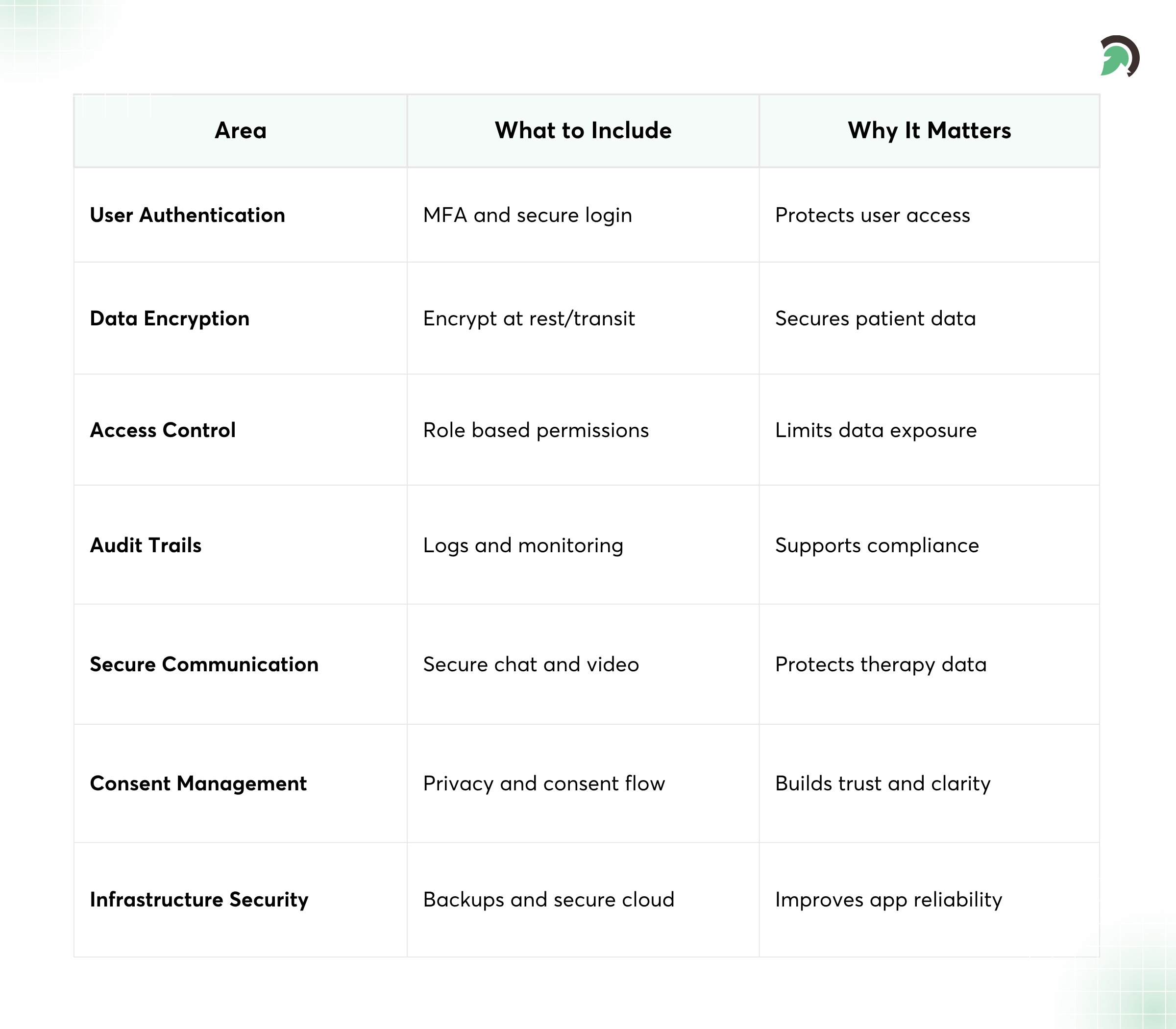
Mental Health App HIPAA Readiness Checklist
Technical Requirements for HIPAA Compliance
Compliance depends heavily on technical execution. It is not enough to state that a platform is secure. The product must be built with specific technical controls that support privacy, resilience, and traceability.
Data Encryption
Encryption is one of the most important security requirements in any HIPAA-ready mental health app. It helps protect data when it is being stored and when it is being transferred across systems.
This means:
- Encrypting stored patient records
- Securing chat and video communication
- Using secure transport protocols for APIs and data exchange
Without proper encryption, sensitive information becomes much easier to expose during attacks or system failures.
Secure Authentication
Authentication should go beyond just a username and password. Mental health apps need stronger access controls to reduce the risk of unauthorised entry.
Good practices include:
- Multi-factor authentication
- Strong password policies
- Role-based permissions
- Session timeout controls
These features are essential in secure mental health app development because they help limit exposure even when one part of the system is compromised.
Data Storage and Backup
Data security is not only about access. It is also about continuity. Healthcare platforms must be able to recover from outages, errors, or unexpected incidents without losing critical patient information.
This often requires:
- HIPAA-compliant cloud storage
- Secure database configuration
- Automated backup systems
- Disaster recovery planning
Reliable storage architecture supports both compliance and long-term operational trust.
Audit Trails and Monitoring
Every healthcare app that manages sensitive information should maintain clear records of system activity. Audit trails help organizations understand who accessed data, when actions were taken, and whether suspicious activity occurred.
Monitoring tools can support:
- Access history tracking
- Login anomaly detection
- Suspicious behavior alerts
- Incident investigation
These capabilities are especially important for teams managing large volumes of protected data across patients, providers, and administrators.
Technology Stack for HIPAA Compliant App Development
The technology stack you choose affects much more than performance. It also influences security, integration flexibility, maintenance effort, and future scalability.
A modern mental health platform may use:
Frontend Technologies
- React, Angular, or Vue for web applications
- Flutter or React Native for mobile apps
Backend Technologies
- Node.js, Python, or Java-based frameworks
- Secure API-driven architecture
- Cloud Platforms
- AWS, Azure, or Google Cloud with compliance-ready services
APIs and Integrations
- Secure video APIs such as WebRTC or Twilio
- EHR or EMR integrations
- Payment and scheduling integrations
The goal is not simply to pick popular tools. It is to build a stack that supports secure delivery, smooth user experience, and sustainable product growth. That is why experienced mental health software development services focus not only on features, but also on system design choices that reduce risk over time.
Step-by-Step Development Process
A secure mental health app should be built through a clear and structured process. Compliance works best when it is addressed throughout development rather than checked only near launch.
Step 1: Requirement Analysis
Start by identifying user needs, care workflows, business goals, and compliance scope. This stage helps the team understand what kind of app is being built and what level of data protection is required.
Step 2: UI/UX Design
The interface should be simple, calming, and accessible. Mental health products need thoughtful design because users may already be under emotional stress when using the app.
Step 3: Secure Development
Security measures should be built into the codebase from the start. This includes encryption, access control, secure APIs, and data handling logic.
Step 4: Integration
Third-party tools such as video platforms, payment systems, or EHR connectors should be evaluated carefully. Not every integration is suitable for handling protected health information.
Step 5: Testing and Compliance Checks
This stage should include:
- functional testing
- performance testing
- security testing
- compliance reviews
- access control validation
Step 6: Deployment and Maintenance
Launch is not the finish line. Ongoing monitoring, regular updates, and continuous compliance reviews are essential for platform stability.
Custom mental health app development is most successful when teams treat the product as a long-term healthcare system, not just a software release.
Common Challenges in HIPAA Ready App Development
Building a secure mental health platform comes with real complexity. Teams often face technical, regulatory, and workflow challenges at the same time.
Some of the most common issues include:
- Translating HIPAA rules into actual product decisions
- Balancing security with ease of use
- Integrating with older healthcare systems
- Maintaining secure communication across channels
- Supporting growth without weakening controls
These are not small implementation details. They directly affect product quality, compliance readiness, and user confidence.
Cost of Developing a HIPAA-Ready Mental Health App
The cost of building a compliant mental health platform depends on the product scope, complexity, and security requirements. Basic apps cost less, but advanced platforms with video, messaging, provider dashboards, analytics, and compliance controls require more investment.
Typical cost areas include:
- UI and UX design
- Frontend and backend development
- Cloud infrastructure
- Compliance implementation
- Third-party integrations
- Testing and maintenance
Healthcare app development costs tend to increase when the platform includes advanced security controls, high-availability requirements, and multiple user roles. While that raises the budget, it also improves reliability and reduces risk later.
Best Practices for Building HIPAA Compliant Mental Health Apps
Teams building mental health products should focus on practical best practices rather than only high-level compliance claims.
A few proven approaches include:
- Collect only the patient data you truly need
- Choose vendors and APIs carefully
- Document access rules clearly
- Run regular security reviews
- Train internal teams on secure workflows
- Keep compliance and engineering aligned throughout the project
HIPAA compliance for mental health apps is not a one-time milestone. It is an ongoing discipline that supports quality, trust, and long-term product resilience.
Future Trends in Secure Mental Health App Development
Mental health technology is evolving quickly. Products are becoming more personalized, more data-driven, and more integrated with broader care ecosystems.
Key trends include:
- AI-guided support tools
- Predictive behavioral analytics
- Remote monitoring integrations
- Personalized treatment journeys
- Stronger privacy-first infrastructure
Future Ready Mental Health Apps Start Here
The platforms that stand out in the future will not just offer more features. They will offer smarter care experiences while continuing to protect sensitive user data.
How to Choose the Right Development Partner
The right development partner can make a major difference in both product quality and compliance readiness. Building in healthcare requires more than coding ability. It requires domain knowledge, technical discipline, and a strong understanding of risk.
When evaluating a partner, look for:
- Experience in healthcare or mental health products
- Familiarity with HIPAA requirements
- Secure architecture expertise
- Strong design and engineering process
- Clear communication and documentation
A capable mental health app development company should be able to explain not just what they build, but why those decisions support security, scalability, and compliance.
Conclusion
Building a HIPAA-ready mental health app is not just a technical exercise, it is a responsibility that directly impacts patient trust, care quality, and long-term platform credibility. From secure data handling and compliant architecture to user-centric features like teletherapy and progress tracking, every element must align with strict healthcare regulations while delivering a seamless experience.
As mental health services continue to shift toward digital platforms, the demand for secure, scalable, and compliant applications will only grow. Organizations that invest in privacy-first design and robust compliance frameworks today will be better positioned to scale responsibly and build lasting user confidence.
Partnering with an experienced healthcare app development team can make this journey more efficient and reliable. At EvinceDev, we help healthcare providers and startups translate complex compliance requirements into practical, high-performing digital solutions. If you are planning to build or upgrade a mental health platform, now is the time to explore solutions that balance innovation with regulatory integrity.