

Key Takeaways:
- AI Cuts Workload: AI reduces manual documentation time, helping clinicians focus more on patient care instead of repetitive note writing tasks.
- Faster Note Creation: AI enables real-time transcription and draft generation, speeding up clinical notes completion and reducing delays.
- Improves Accuracy: AI-assisted documentation captures session details more consistently, reducing errors and improving clinical record quality.
- Better Compliance: Structured AI-generated notes help meet documentation standards, improving audit readiness and regulatory compliance.
- Real-Time Support: AI tools assist during sessions with live transcription and smart suggestions, reducing post-session workload pressure.
- EHR Integration: AI documentation systems integrate with EHRs, ensuring seamless workflows without manual copy-paste processes.
- Enhances Care Time By reducing documentation effort, AI allows clinicians to spend more meaningful time with patients and improve care outcomes.
Behavioral health documentation has always been essential, but the way it is done has not kept pace with the demands of modern care. Clinicians still spend significant time writing progress notes, updating treatment plans, and managing detailed records, often after long sessions. What should support care delivery often turns into an additional workload that slows teams down and affects consistency.
As patient volumes grow and compliance expectations become stricter, traditional documentation methods are no longer enough. Manual notes, repetitive templates, and delayed entries create gaps in accuracy, increase administrative pressure, and make audit readiness more challenging. In a fast-moving healthcare environment, documentation needs to be as responsive as the care itself.
This is where AI for behavioral health documentation is changing the landscape. By introducing real-time transcription, structured note generation, and intelligent assistance, AI helps transform documentation from a manual task into a streamlined workflow. It is not just about saving time. It is about improving accuracy, supporting compliance, and allowing clinicians to focus more on patient care while maintaining high-quality clinical records.
How AI is Transforming Behavioral Health Documentation
Behavioral healthcare has always required careful, patient-centered documentation, but the workload around notes has expanded dramatically. Many clinicians aren’t arguing that documentation matters. They’re arguing that the process is too slow, too manual, and too easy to get wrong under real-world time pressure.
The Growing Need for Smarter Documentation
Here’s what’s driving the shift toward smarter documentation:
- Increasing documentation burden in behavioral healthcare: Notes, progress updates, treatment plan updates, risk statements, and billing documentation all stack up.
- Time spent on clinical notes vs patient care: Clinicians often juggle documentation after sessions when they’re already tired and already behind.
- Compliance, accuracy, and audit pressures: Missing details, inconsistent phrasing, or incomplete histories can become an operational headache during review cycles.
- Role of digital transformation in healthcare: EHR adoption improved storage and retrieval, but it also increased the number of required clicks, fields, and handoffs.
AI in behavioral healthcare targets the bottleneck: converting what clinicians already know from the session into structured, high-quality notes faster without turning documentation into a separate full-time job.
What is AI-Powered Clinical Notes Automation
AI-powered clinical notes automation uses machine learning and language technologies to help clinicians generate, structure, and finalize documentation. The goal isn’t to “replace” clinical judgment. The goal is to reduce friction, capture details accurately, and support consistent note quality.

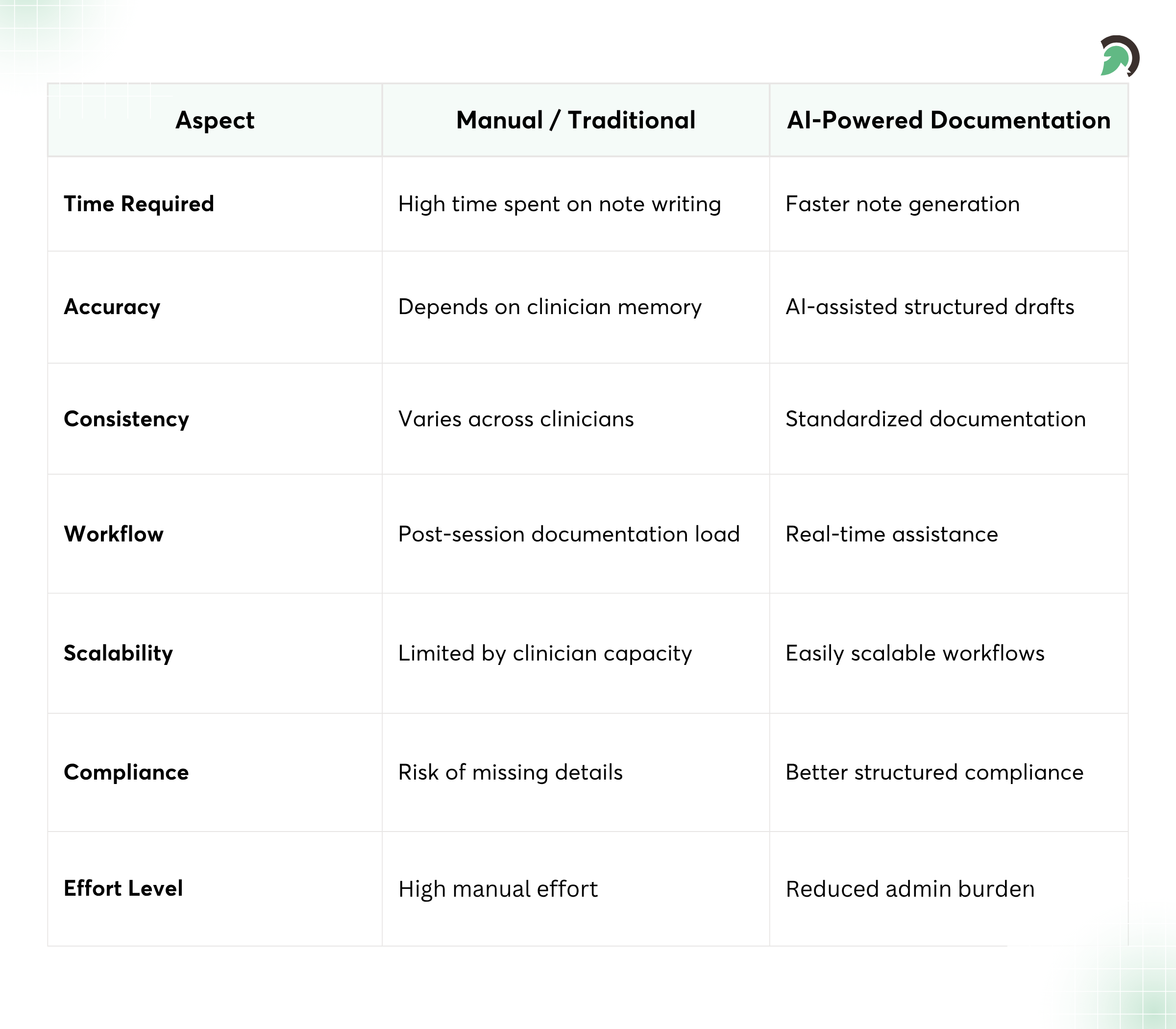
To make the concept concrete, consider the differences:
- Manual notes: Clinicians type everything themselves, which is flexible but time-consuming and harder to standardize.
- Template-based notes: Templates help with standardization but can lead to repetitive wording, gaps, or notes that don’t capture the nuances of the actual session.
- AI-driven notes: AI clinical documentation systems analyze session input (often including transcription and contextual signals) to draft structured notes that accurately reflect what was discussed.
In real-time use, AI-assisted tools can help during the session. For example, AI-powered clinical notes can transcribe what the clinician and patient say and then suggest a draft summary or structured fields for the clinician to quickly review and edit.
Technologies Powering AI Documentation
Several technologies work together to turn speech and session context into documentation-ready outputs:
- Natural Language Processing (NLP): Interprets text, intent, and clinical language patterns.
- Speech-to-text and voice recognition: Captures spoken content and converts it into written transcripts.
- Machine learning models for context understanding: Help the system maintain meaning across sentences, identify relevant topics, and support structured summarization.
- AI-based summarization engines: Draft concise, clinician-friendly notes based on session content and configured documentation standards.
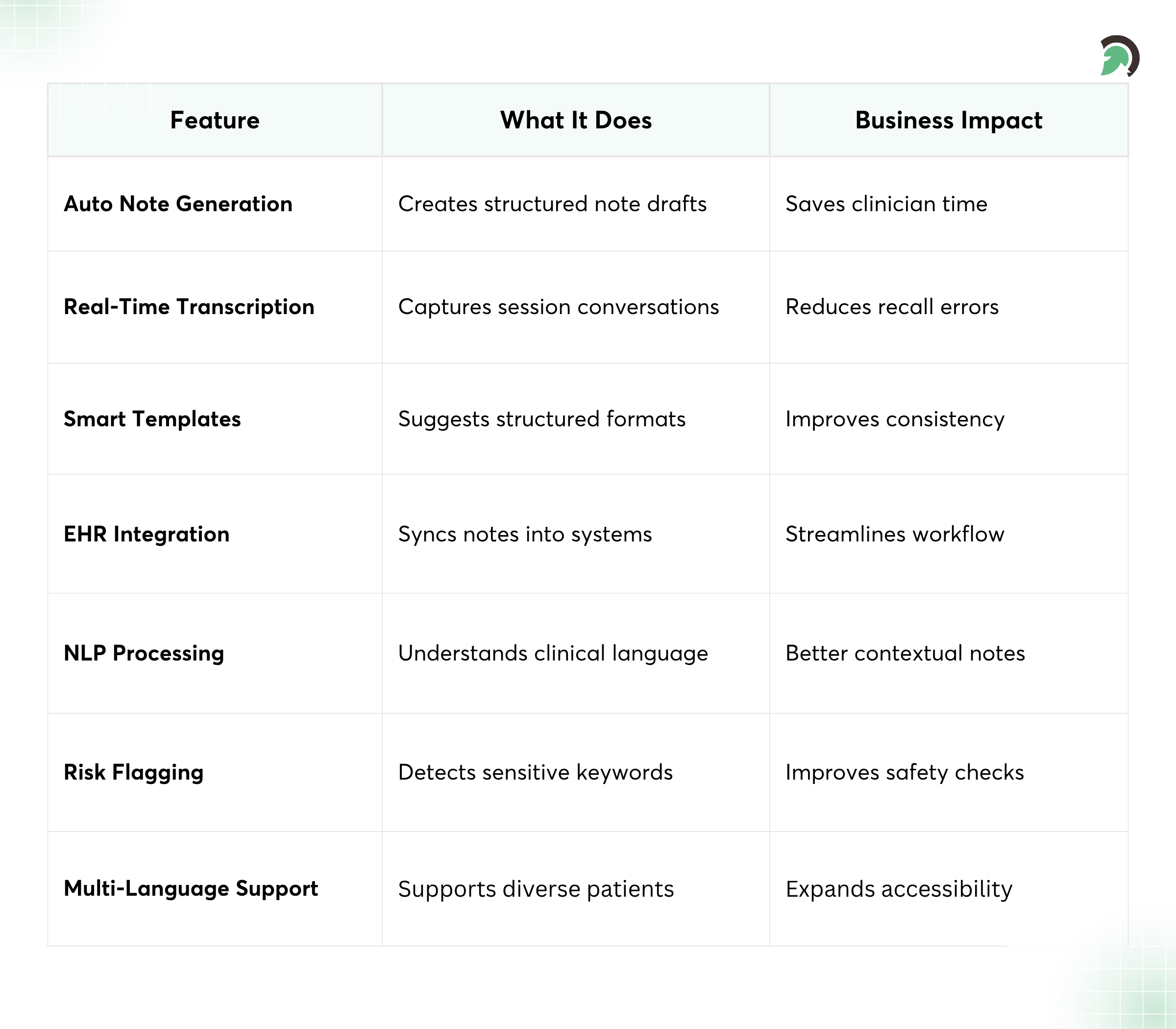
Key Features of AI Documentation Systems
When teams evaluate behavioral health documentation software, the “demo effect” can be strong, so it helps to focus on the operational features that matter most.
- Automated clinical note generation: First drafts that follow your documentation approach (progress notes, assessments, intake summaries).
- Real-time transcription during sessions captures details as they happen, reducing recall gaps later.
- Structured templates with smart suggestions: Prompts for missing fields while keeping language aligned with the session.
- EHR integration for seamless workflows: Drafts can flow into your EHR without requiring clinicians to copy and paste across systems.
Advanced Functional Capabilities
The best systems don’t stop at “write a paragraph.” They support behavioral healthcare’s unique documentation needs, including risk documentation and structured clinical thinking.
- Behavioral pattern recognition: Helps highlight recurring themes mentioned across sessions (as configured by the clinic’s documentation standards).
- Risk alerts and flagging: Can surface safety-related language and prompt the clinician to confirm or expand required sections.
- Multi-language support: Supports transcription and draft generation across languages when your intake and patient population require it.
- Voice-enabled documentation tools: Reduce typing load by letting clinicians review and refine with voice or quick edits.
Use Cases in Behavioral Healthcare
AI-powered clinical notes automation isn’t a single workflow. It’s a set of practical use cases that map to real charting needs.
- Therapy session documentation: Session summaries, interventions used, patient responses, and next steps.
- Psychiatric evaluations and assessments: Structured domains, history capture support, and documentation consistency prompts.
- Progress notes and treatment plans: Measurable progress, barriers, and updated treatment goals.
- Intake documentation automation: Draft intake summaries, reduce manual transcription, and speed up initial chart setup.
Typical Workflow with AI
Let’s walk through a typical session workflow so you can picture exactly where time is saved and where human review remains essential.
- Session recording (secure and compliant): Capture is done with appropriate safeguards aligned to your security policies.
- AI transcription and structuring: The system converts speech to text and drafts structured note sections.
- Clinician review and editing: The clinician validates clinical accuracy and adds missing context.
- Final storage in EHR: The finalized note is stored through the normal EHR workflow.
This is often where the “trust” factor is built: clinicians see a draft that’s close, then confirm clinical meaning and completeness.
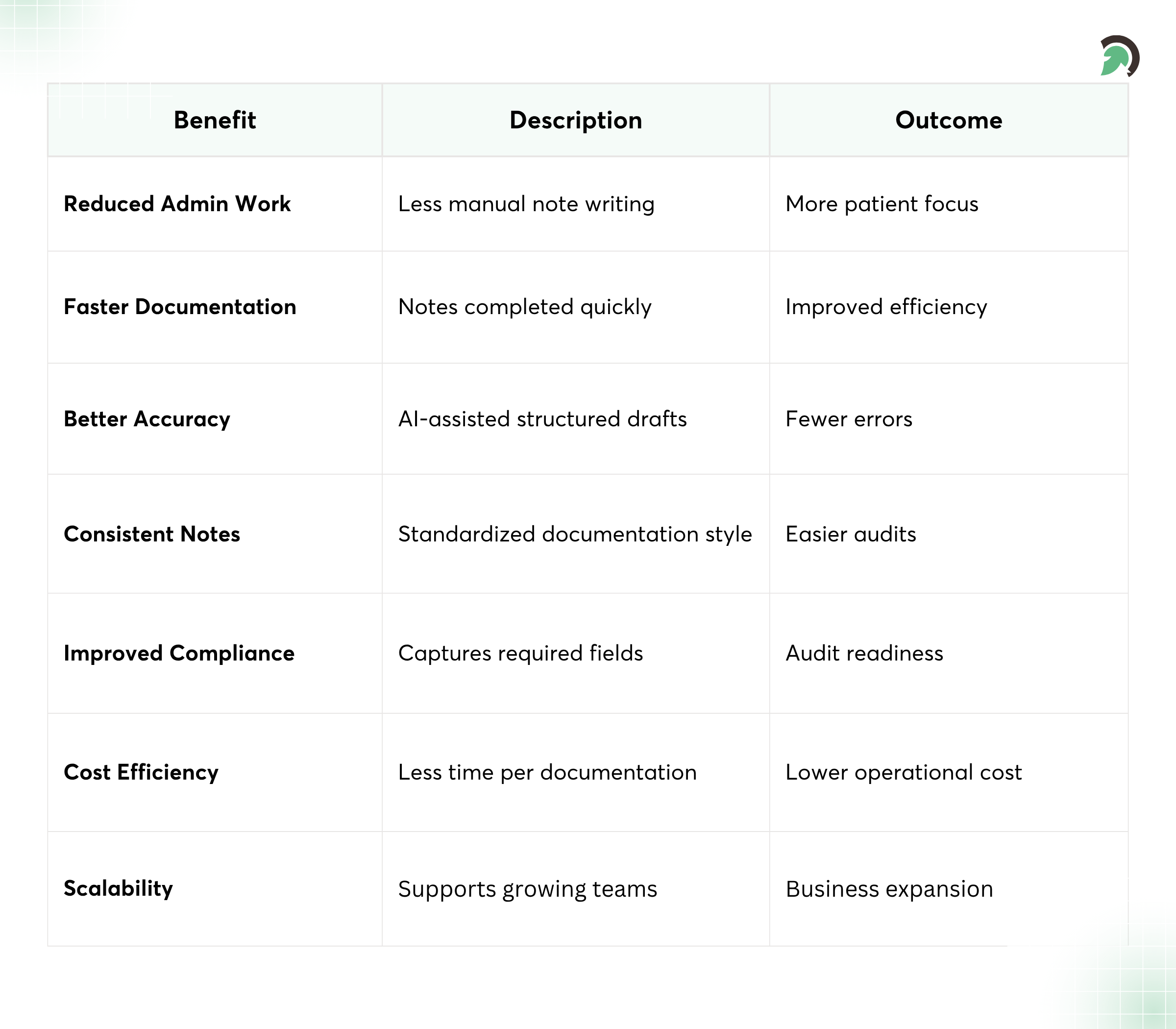
Benefits of AI in Clinical Documentation
The most valuable outcome isn’t “cool AI.” It’s measurable improvements in daily operations and clinical documentation quality.
- Reduced administrative workload for clinicians: Less time spent typing, formatting, and hunting for details after sessions.
- Improved accuracy and consistency: More consistent note structure and fewer missing elements.
- Faster documentation turnaround: Notes are easier to complete within the required time windows.
- More time for patient engagement: Fewer post-session catch-up hours means more patient-centered time.
Operational and Business Impact
AI for behavioral health documentation also affects downstream operational performance:
- Faster billing and reimbursement cycles: Timely note completion supports more predictable revenue timing.
- Better compliance and audit readiness: Structured documentation can be easier to retrieve, review, and standardize.
- Cost efficiency and scalability: Teams can scale clinical documentation capacity without a proportional increase in headcount.
- Improved healthcare delivery outcomes: When documentation doesn’t steal attention, clinicians can spend more time on care.
Challenges and Considerations
It’s also important to be honest about what can go wrong. AI clinical documentation systems are powerful, but they need the right process, governance, and implementation strategy.
- Data privacy and security concerns: Voice data and patient data must be protected end-to-end.
- Integration with existing healthcare systems: EHR workflows can be complex; poor integration leads to workarounds.
- Accuracy and bias in AI outputs: Transcription errors, context mistakes, or biased language can occur if not monitored and improved.
- Adoption resistance from clinicians: If clinicians don’t trust the draft quality or the workflow feels disruptive, usage drops.
How to Address These Challenges
These are practical ways to reduce risk while increasing adoption:
- Strong compliance frameworks (HIPAA, GDPR): Implement privacy-by-design and a documented governance framework.
- API-based integration strategies: Use well-defined integration points to preserve your current workflows.
- Continuous AI model improvement: Monitor error patterns, update models, and refine prompting or templates.
- Training and onboarding for staff: Teach clinicians how to review drafts efficiently and where the system works best.
Compliance and Security in AI Documentation
If you’re evaluating behavioral healthcare software development or selecting a vendor, security should be a core decision, not a box-checking exercise.
Patient data protection matters because AI for behavioral health documentation often touches sensitive voice data, mental health histories, and real-time session content.
Best Practices
- Role-based access control: Limit who can view or export transcripts and drafts.
- End-to-end encryption: Protect data in transit and at rest.
- Audit trails and monitoring: Track access, changes, and system actions for review and accountability.
- Secure cloud infrastructure: Use environments designed for healthcare-grade security and reliability.
When these controls are implemented correctly, automated clinical documentation becomes both safer and easier to manage during audits.
Future Trends in AI Documentation
AI isn’t standing still, and behavioral healthcare is a high-value domain for next-step innovation.
- Real-time AI assistants in therapy sessions: Prompts that support documentation decisions without breaking clinician flow.
- Emotion-aware documentation systems: Systems that help capture affective language patterns (with clinician validation to avoid overreach).
- Integration with telehealth platforms: Session capture and transcription aligned with virtual visit workflows.
- AI-driven decision support: Not replacing clinical judgment, but offering structured checklists and documentation completeness assistance.
How to Choose the Right AI Solution
If you’re comparing options, don’t focus only on transcription speed or “note generation” screenshots. Evaluate the end-to-end workflow: input quality, draft quality, clinician review, and EHR output.
Here’s what matters most when you’re looking for behavioral health documentation software that can handle the realities of clinical documentation automation.
Key Evaluation Questions
- Is the solution HIPAA compliant? Confirm compliance posture and documented safeguards.
- How secure is patient data handling? Look for encryption, access controls, and audit trails.
- Does it support clinician review? The best systems make review fast, not cumbersome.
- Can it scale with organizational needs? Evaluate throughput, multi-site support, and customization capabilities.
- Does it support clinical notes automation-3 and EHR integration? Seamless workflows reduce workarounds and improve consistency.
Conclusion
AI for behavioral health notes is reshaping how documentation fits into daily clinical workflows. Instead of being a time-consuming task at the end of the day, documentation is becoming a more seamless, real-time process that supports both accuracy and efficiency. By combining transcription, structured note generation, and intelligent assistance, AI helps reduce administrative pressure while improving consistency and compliance.
As behavioral healthcare continues to evolve, the focus will shift toward systems that not only document care but also actively support better outcomes. Organizations that adopt AI-driven documentation early will be better positioned to scale operations, maintain audit readiness, and enhance clinician satisfaction without compromising care quality.
If you are exploring ways to improve documentation workflows or planning to implement clinical notes automation, it is important to evaluate solutions that align with your operational and compliance needs. Teams like EvinceDev can help design and implement tailored approaches that fit real-world clinical environments. The goal is simple: make documentation feel like support rather than a burden, while enabling better care delivery.