Key Takeaways
- Choosing the Right Partner: Select a company that understands your business goals, users, workflows, and technical needs.
- Defining Clear Project Requirements: Outline features, budget, timeline, integrations, and security expectations before vendor evaluation.
- Evaluating Technical Capabilities: Review expertise in cloud, APIs, mobile apps, AI, automation, and scalable architecture.
- Prioritizing Security and Quality: Check secure coding, testing, data protection, access control, and compliance-aware development practices.
- Understanding the Delivery Process: Look for clear discovery, design, development, QA, deployment, communication, and support workflows.
- Focusing on Long-Term Value: Choose a partner based on reliability, transparency, scalability, and post-launch support, not pricing alone.
The right software partner can turn a business idea into a scalable digital product. The wrong one can turn the same idea into delayed timelines, rising costs, technical debt, and a product that never fully supports the business.
For many US businesses, software is now directly connected to growth, customer experience, operational efficiency, data security, and competitive advantage. Whether you are modernizing legacy systems, building an internal platform, launching a customer-facing application, or integrating business-critical tools, the company you choose will influence far more than development quality.
Today, businesses do not just need developers who can write code. They need a partner who can understand business goals, map workflows, recommend the right architecture, manage delivery risks, and build software that can scale with future needs.
That is where Custom software development services become valuable. With the right development partner, businesses can transform complex requirements into secure, reliable, and scalable digital solutions. This guide explains how to choose the right Custom software development company, what factors to evaluate, which questions to ask, and what red flags to avoid before making a decision.
Quick Stat:
According to the Project Management Institute (PMI), organizations that undervalue project management waste an average of 10.4% of every dollar invested due to poor project performance, highlighting the importance of selecting experienced software development partners.
Why Choosing the Right Software Development Partner Matters
Software is no longer just an operational support tool. For many businesses, it is connected to revenue, customer experience, internal productivity, and competitive advantage. A poorly built application can slow-down teams, frustrate customers, create security risks, and increase long-term maintenance costs.
On the other hand, a well-planned custom software solution can help a business:
- Automate repetitive workflows
- Improve customer and employee experience
- Connect disconnected systems
- Strengthen data visibility and reporting
- Support business growth and scalability
- Reduce dependency on generic off-the-shelf tools
- Improve operational efficiency
This is why selecting a Custom development company should not be treated as a simple vendor hiring decision. It should be approached as a strategic partnership.
Quick Stat:
According to the Standish Group CHAOS Report, only about 31% of software projects are completed on time, on budget, and with the planned features, making vendor selection a critical success factor.
Why US Businesses Invest in Custom Software
Many companies start with ready-made software because it is faster to adopt and easier to launch. However, as business needs become more specific, off-the-shelf tools often create limitations. They may not support unique workflows, advanced integrations, industry-specific requirements, or future scalability.
Custom software gives businesses more control over how their digital systems work. Instead of forcing teams to adjust their processes around generic tools, custom applications are designed around specific business operations.
Custom software is especially useful when a business needs:
- A platform built around unique workflows
- Integration with CRM, ERP, payment, analytics, or third-party systems
- Better control over user roles and permissions
- Industry-specific security or compliance considerations
- Scalable architecture for future growth
- Automation across departments
- A better customer-facing digital experience
This is one reason Custom software development services are widely used by businesses in healthcare, fintech, logistics, retail, manufacturing, SaaS, education, and professional services.
How to Choose the Right Custom Software Development Company
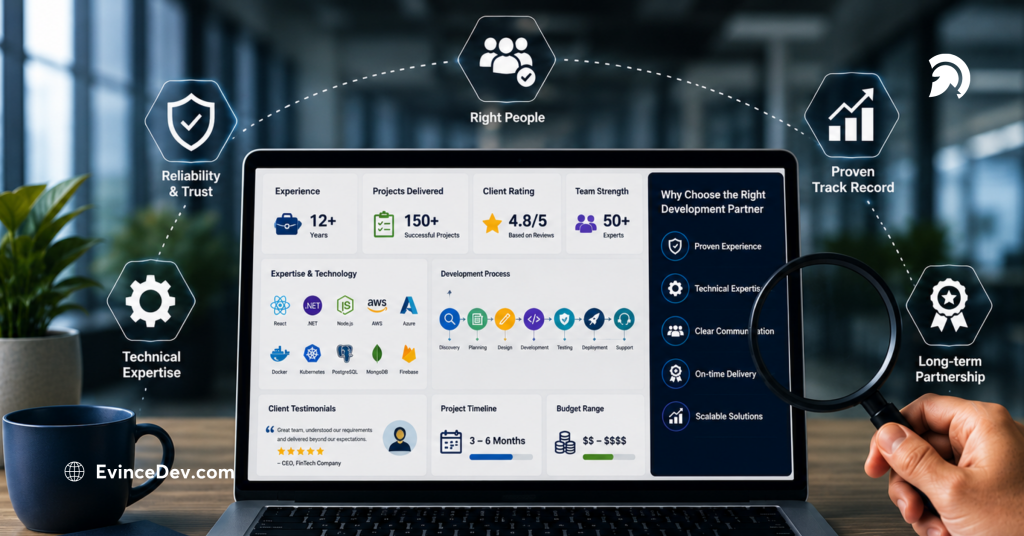
- Define Your Business Goals First: Before you evaluate the vendors, clearly define what you need from the software. Identify the business problem, target users, features, workflows, budget, timeline, security needs, etc. Clarity across these parameters helps the development partner recommend the right direction and prevent unnecessary scope changes.
- Look Beyond Coding Skills: A good partner should understand your business context, not just your technical requirements. Look for a team that can support business analysis, product strategy, UI/UX planning, architecture, quality assurance, deployment, and long-term maintenance.
- Review Industry Experience: Industry experience helps a company understand your workflows, user expectations, and operational challenges faster. Check whether they have worked on similar projects, handled relevant integrations, or supported compliance-focused requirements in your industry.
- Evaluate Technical Expertise: Check if the company knows its way around the tech your project needs: frontend, backend, cloud, APIs, mobile apps, AI, automation, and scalable architecture. They should fit both present and future needs, too.
- Assess Security and Compliance Practices: Security should be an integral part of the development process from day one. Check and examine how they handle secure coding, access control, encryption, API security, testing, data protection, audit logs, as well as compliance-related practices.
Quick Stat:
IBM’s Cost of a Data Breach Report found that the global average cost of a data breach reached $4.88 million in 2024, emphasizing the importance of secure software development practices.
- Understand the Development Process: A structured process keeps delays and quality issues at bay. So, its advised to look for an approach that can support everything you need, from discovery, design, architecture, QA, deployment, feedback management, reporting to post-launch support.
- Review Portfolio and Case Studies: Past work can show how well a company solves real business problems. Review case studies for project complexity, industries served, technologies used, integrations delivered, scalability needs, and measurable outcomes.
- Evaluate Team Structure: Understand who will work on your project and how responsibilities are divided. A strong team may include business analysts, project managers, solution architects, designers, developers, QA engineers, DevOps engineers, and support specialists.
- Compare Pricing Models Carefully: Do not select a partner based only on the lowest estimate. Compare what is included in the proposal, such as QA, documentation, project management, deployment, support, and long-term maintenance. Value matters more than the initial price.
- Check Reviews and References: Client feedback helps validate reliability, communication, and delivery quality. Review testimonials, third-party ratings, case studies, and references to understand how the company performs during real projects.
- Ask the Right Questions Before Hiring: Before signing a contract, ask about similar projects, timelines, scope changes, security practices, QA process, source code ownership, documentation, communication, support, and bug-fixing after launch. Clear answers show transparency and maturity.
What to Evaluate When Comparing Software Development Companies
| Evaluation Area | What to Look For | Why It Matters |
| Business Understanding | Discovery workshops, requirement analysis, consulting approach | Ensures the solution aligns with business goals |
| Technical Expertise | Relevant technologies, cloud, integrations, AI capabilities | Supports scalability and long-term growth |
| Industry Experience | Similar projects and domain knowledge | Reduces learning curve and project risks |
| Security Practices | Secure coding, testing, access controls | Protects sensitive business and customer data |
| Development Process | Agile methodology, communication, reporting | Improves transparency and project delivery |
| Team Structure | Architects, developers, QA, DevOps | Ensures access to the right expertise |
| Pricing Model | Clear scope and transparent costs | Prevents unexpected expenses |
| Client References | Reviews, testimonials, case studies | Validates reliability and delivery quality |
| Post-Launch Support | Maintenance, updates, enhancements | Supports long-term software success |
What Are the Common Mistakes That You Should Avoid?
Many businesses make avoidable mistakes when selecting a development partner. Being aware of these mistakes can help you make better decisions.
- Choosing Based Only on Price: Low cost may seem attractive, but poor architecture, weak testing, and unclear communication can increase long-term expenses.
- Skipping Discovery: Starting development without proper discovery can lead to missed requirements, scope creep, and rework.
- Ignoring Security: Security should be part of planning, development, testing, and deployment.
- Not Reviewing the Team: You should know who will manage and build your software.
- Overlooking Post-Launch Support: Software needs updates, monitoring, bug fixes, performance improvements, and feature enhancements after launch.
- Not Clarifying Ownership: Make sure your agreement clearly defines source code ownership, documentation access, intellectual property rights, and handover expectations.
Are There Any Red Flags to Watch For?
Not every vendor is the right fit. Watch for signs that may indicate future problems.
Red flags include:
- Unrealistically low pricing
- Guaranteed timelines without discovery
- No clear development process
- Weak or vague portfolio
- Poor communication during early discussions
- No dedicated project manager
- Limited testing process
- No security discussion
- Lack of documentation practices
- No post-launch support model
If a company promises everything quickly and cheaply without understanding your business needs, proceed carefully.
What a Strong Software Development Partnership Looks Like
A strong software partnership is built on clarity, trust, communication, and shared accountability. The right partner will not simply take instructions and deliver code. It will help you think through business goals, technical risks, product decisions, and future scalability.
A strong partner should:
- Understand your business objectives
- Communicate clearly and regularly
- Provide realistic estimates
- Document requirements and decisions
- Recommend scalable technical solutions
- Prioritize security and quality
- Test thoroughly before release
- Support your software after launch
- Help you plan future improvements
The best Custom software development services create long-term value by helping businesses build reliable digital products that evolve with their needs.
Why Partnering with the Right Company Supports Long-Term Growth
Custom software is rarely a one-time project. As your business grows, your software may need new features, better integrations, performance improvements, security updates, or modernization. This is why long-term support capability matters.
A reliable custom software development company can keep your app growing post-launch. They’ll track its performance, fix bugs, and add new features based on user feedback. Plus, they help adapt the app as your business evolves.
For firms aiming to transform digitally, these services support larger goals too, like moving to the cloud, automating workflows, updating old systems, integrating AI, and making decisions with data.
How EvinceDev Helps Businesses Build Custom Software Solutions
EvinceDev helps businesses plan, design, develop, and modernize custom software solutions aligned with business goals, technical requirements, and long-term scalability needs. With experience across industries and digital platforms, EvinceDev supports clients through discovery, UI and UX design, custom application development, integration, testing, deployment, and ongoing support.
Our approach focuses on building practical, secure, and scalable software solutions that help businesses improve workflows, enhance customer experience, and support future growth. From enterprise platforms to web and mobile applications, EvinceDev works with businesses that need dependable Custom software development services backed by structured delivery and technical expertise.
Conclusion
Choosing the right software development partner goes beyond comparing costs. You gotta look at their business sense, technical skills, security measures, industry knowledge, communication style, team structure, development processes, and post-launch support too.
The perfect partner makes turning your ideas into reality smooth and easy. They’ll challenge assumptions, lower tech risks, recommend upgrades, and ensure the software fits your business needs, even post-launch. For US firms, an ideal fit has a good grasp on both tech and desired business results. Whether it’s revamping operations, creating new digital products, or boosting customer experience, custom software development can help you build something scalable, secure, and in line with your big-picture goals.