

Key Takeaways:
- Renewals Matter: Renewals are revenue events. Monitor failures, queues, and cron to prevent silent churn.
- Queue Health: Keep Action Scheduler clean, indexed, and monitored to avoid backlogs and delays.
- Stop Double Charges: Use idempotency, locking, and state checks to prevent duplicate renewals and charges.
- Harden Webhooks: Verify signatures, handle duplicates, and log events to avoid incorrect subscription states.
- Build Dunning: Add retries, emails, grace periods, and easy payment updates to recover failed renewals.
- UX Drives Retention: Self-serve updates, clear billing dates, and invoices reduce support load and churn.
Subscriptions are often marketed as predictable revenue engines. With a properly configured WooCommerce Subscription setup, once a customer subscribes, revenue is expected to be recognized automatically in each billing cycle. For WooCommerce businesses, this promise is appealing, especially as subscriptions expand beyond SaaS into memberships, digital content, education, and B2B services.
However, many teams only discover the fragility of subscription systems after production issues surface. Revenue drops without obvious causes. Customers complain about billing inconsistencies. Support teams struggle to explain what went wrong because the failures are not always visible.
Typical warning signs look like this:
- Renewals fail without triggering alerts
- Cron jobs do not execute on time
- Customers are charged twice during retries
- Webhooks update subscriptions inconsistently
- Access is removed even though the payment eventually succeeds
This guide is for WooCommerce store owners, technical leads, and product teams running subscriptions at scale, or planning to. If you process recurring payments, deal with failed renewals, or rely on automated billing, this article will help you avoid revenue leakage. So, keep reading to see how WooCommerce subscriptions work internally, what typically breaks as volume grows, and how to build reliable renewal and dunning flows.
Why This Matters: Subscription Reliability Is a Revenue Problem
Subscription systems magnify small inefficiencies. A single failed renewal might feel insignificant, but when the same issue repeats across hundreds or thousands of customers every month, the financial impact compounds quickly.
A large portion of subscription churn is involuntary. Customers do not cancel because they are dissatisfied, but because payments fail due to expired cards, temporary bank issues, or authentication requirements. Without structured recovery flows, these customers disappear silently.
For WooCommerce businesses, unreliable subscriptions affect more than monthly recurring revenue. They increase support costs, introduce refund and chargeback risk, damage customer trust, and make revenue forecasting unreliable. Over time, leadership confidence in the subscription model itself begins to erode.
This is why subscription architecture should be treated as core business infrastructure, not as a plugin configuration task, but as a strategic priority in professional WooCommerce development.
Understanding How WooCommerce Subscriptions Are Structured
To design reliable subscription systems, it is essential to understand how WooCommerce models them internally.
Most subscription stores start with the WooCommerce Subscriptions extension (commonly called the WooCommerce subscription plugin), which provides the core building blocks: subscription products, order renewal creation, saved payment methods, and renewal scheduling.
Every subscription begins with a parent order. This initial order creates the subscription record and captures the first payment. The subscription object represents the ongoing agreement and stores billing schedules, current status, and references to the saved payment method.
For each billing cycle, WooCommerce generates a renewal order. These renewal orders are real WooCommerce orders, not background records. They move through order states, interact with payment gateways, generate invoices, and affect reporting and customer communication.
Subscriptions also operate through a defined lifecycle. States such as active, on-hold, pending cancellation, cancelled, and expired are not informational labels. They determine whether renewals are scheduled, whether retries occur, and whether customer access is granted.
Many production issues originate from incorrect or poorly timed state transitions, especially during failed payment scenarios.
Subscription Architecture: How Renewals Actually Work
WooCommerce does not process renewals in real time. Instead, renewals are handled asynchronously through Action Scheduler, a background job system.
At a high level, a renewal follows this path:
- A scheduled renewal date is reached
- Action Scheduler triggers a background job
- A renewal order is created
- The payment gateway is called using the stored token
- Payment succeeds or fails
- Subscription state is updated
- Follow-up actions, such as emails or retries, are scheduled
This architecture allows WooCommerce to scale, but it also introduces complexity. Background jobs can be delayed, executed twice, or overlap with webhook-driven updates from payment gateways. Whether you are running subscriptions on WooCommerce or evaluating Shopify eCommerce for recurring billing, the underlying challenge remains the same: asynchronous execution needs careful engineering to avoid missed or duplicated renewals.
One of the most common architectural mistakes is relying on WP-Cron for renewal execution. WP-Cron depends on site traffic, which makes it unreliable for time-sensitive billing workloads. Production-grade subscription systems almost always replace WP-Cron with a server-level cron setup to ensure renewals and retries run predictably.
Concurrency and Payment Safety at Scale
As subscription volume grows, concurrency becomes unavoidable. Multiple processes may attempt to act on the same subscription simultaneously.
This typically happens when scheduled renewals overlap with webhook events, retry logic overlaps with manual interventions, or gateway-side retries collide with merchant-side retries.
Without safeguards, these overlaps lead to duplicate charges or a corrupted subscription state.
Reliable systems enforce payment safety through idempotency and locking. Each billing cycle must be charged at most once, regardless of how many times a renewal job or webhook is triggered. This requires explicit checks, careful state validation, and defensive design.
Tokenization plays a central role here. WooCommerce does not store card data. Instead, payment gateways store tokens associated with customer profiles. WooCommerce references these tokens during renewals, so gateway behavior directly affects retry and failure handling.
Understanding where gateway responsibility ends and merchant responsibility begins is critical when designing safe subscription systems.
Webhooks: A Necessary Source of Uncertainty
Webhooks are how payment gateways asynchronously notify WooCommerce of payment events. They are essential for subscription systems but inherently unreliable.
Webhooks may arrive late, be duplicated, or arrive out of order. A resilient system assumes all of these scenarios are possible and designs accordingly.
A production-ready webhook layer typically includes:
- Signature verification to ensure authenticity
- Idempotent processing to prevent duplicate effects
- State-aware updates to avoid overwriting newer data
- Logging for traceability and debugging
Treating webhooks as guaranteed, ordered events is one of the fastest ways to introduce subtle subscription bugs.
WooCommerce Subscriptions API Integration
For advanced workflows, integrating the WooCommerce Subscriptions API is essential. Businesses often connect subscriptions to CRMs, ERP systems, membership tools, learning platforms, or custom dashboards.
API integrations must:
- Respect subscription state changes
- Handle webhook timing differences
- Remain idempotent
- Avoid triggering duplicate renewals
Without proper API design, integrations can unintentionally override subscription states or create billing inconsistencies. Strong WooCommerce web development practices ensure API-driven automation does not compromise billing reliability.
For businesses comparing platforms, it is important to note that subscription reliability challenges exist across ecosystems. Whether working on WooCommerce store development or Shopify eCommerce development, recurring billing systems require infrastructure thinking, not just plugin configuration. The difference often lies in the level of architectural control and customization your eCommerce development services partner can provide.

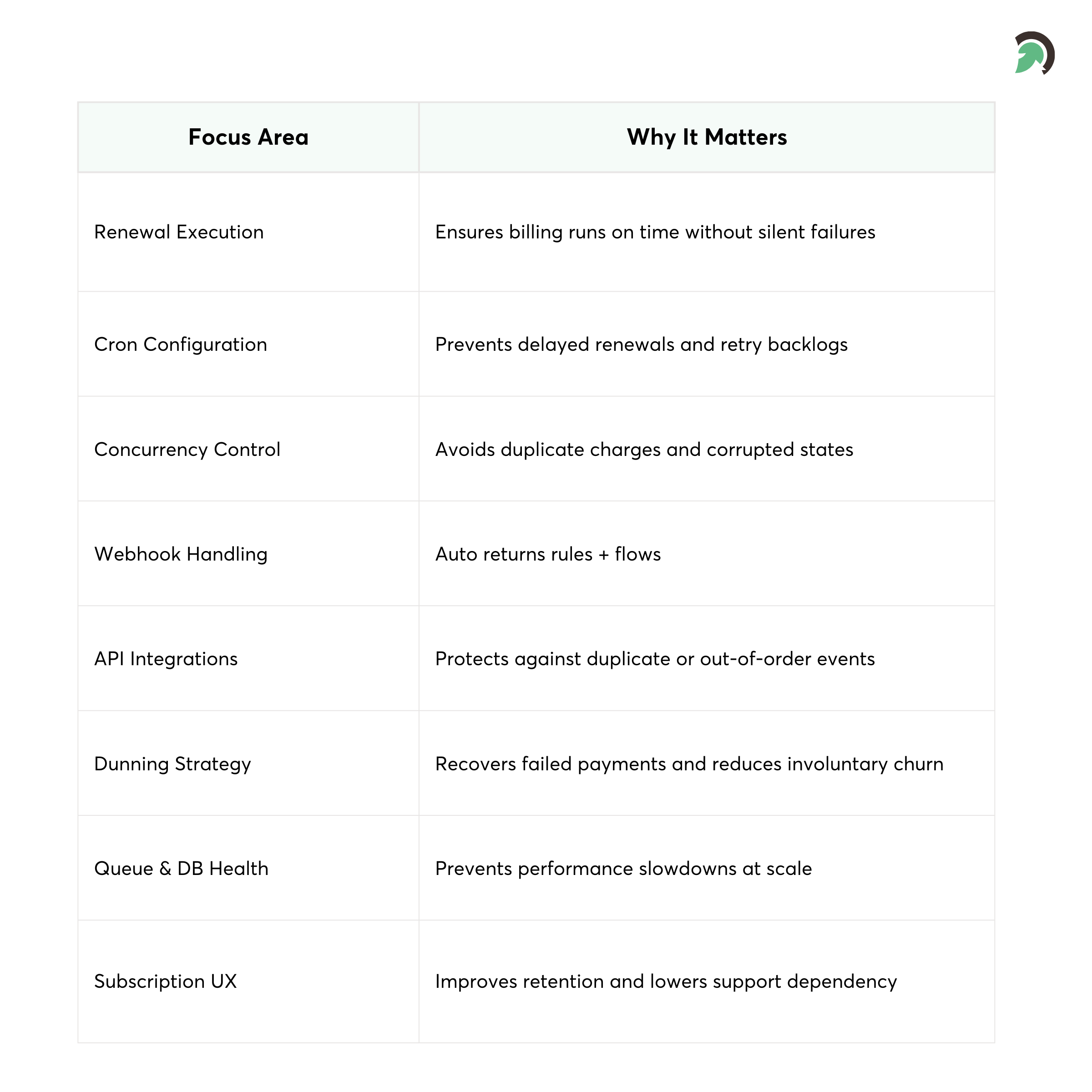
Scaling WooCommerce Subscriptions Without Revenue Loss
Scaling subscriptions is not about adding servers. It is about reducing unpredictability.
As renewal volume increases, pressure builds in specific areas: Action Scheduler tables grow, renewal jobs cluster around the same time windows, database queries slow down, and gateway rate limits become visible.
Most successful scaling efforts focus on a few high-impact levers:
- Replacing WP-Cron with system cron
- Cleaning and indexing Action Scheduler tables
- Staggering renewal schedules to avoid load spikes
- Isolating renewal processing from non-critical background jobs
At a larger scale, teams introduce monitoring dashboards, queue backlog alerts, and operational playbooks for renewal incidents. Subscriptions require observability. Without it, failures remain invisible until customers complain.
Quick Stat:
Action Scheduler is designed to handle very high volumes of scheduled jobs, and has been observed handling 50,000+ queued jobs while sustaining 10,000+ jobs per hour (including payments and order creation)
Dunning Flows: Recovering Revenue That Would Otherwise Be Lost
Not all failed payments represent lost customers. Many failures are temporary and recoverable, but only if the system is designed to recover them.
Dunning is the structured process of handling failed payments through retries, customer notifications, and controlled access changes. Without dunning, subscriptions often move directly to cancellation or suspension, even when customers are willing to pay.
A practical dunning flow usually includes:
- Moving the subscription to a recoverable state after the first failure
- Scheduling retries based on failure type
- Notifying customers with clear instructions
- Providing an easy path to update payment methods
- Applying access rules consistently during a grace period
The goal is not aggressive collection, but frictionless recovery. Customers tolerate payment issues when communication is clear, and recovery is simple.
Measuring dunning performance is essential. Recovery rate, time to recovery, and involuntary churn provide direct insight into how well the system protects revenue.
Quick Stat:
WooCommerce Subscriptions includes an Automatic Failed Payment Retry system, but it is disabled by default. When enabled, it applies configured retry rules after a renewal failure, and once rules are exhausted (or not applicable), the renewal is marked as failed.
WooCommerce Subscription Best Practices
Implementing subscriptions is straightforward. Operating them reliably at scale is not. Over time, certain patterns consistently separate stable subscription systems from fragile ones.
Below are the best practices that matter most in production environments.
1. Treat Renewals as Critical Infrastructure
Renewals are not background tasks. They are recurring revenue events.
- Replace WP-Cron with server-level cron for predictable execution
- Monitor Action Scheduler queue health and backlog
- Alert on renewal failure rate spikes
- Log renewal attempts and outcomes clearly
If renewals are not monitored like payment gateways or checkout flows, failures go unnoticed until churn increases.
2. Design for Idempotency and Concurrency
Subscription systems must assume retries, duplicate webhook events, and overlapping processes.
- Ensure each billing cycle can only be charged once
- Prevent duplicate renewal order creation
- Make webhook handlers idempotent
- Validate subscription state before applying updates
This protects customers from double charges and prevents corrupted subscription states.
3. Implement Structured Dunning
Do not let failed payments immediately become cancellations.
- Categorize soft vs hard declines
- Schedule retries intelligently
- Communicate clearly with customers
- Provide frictionless payment update flows
- Use grace periods where appropriate
A well-structured dunning flow can significantly reduce involuntary churn and recover revenue that would otherwise be lost.
4. Optimize Database and Queue Health
As subscription volume grows, data growth becomes a scaling constraint.
- Clean up completed scheduled actions regularly
- Add appropriate database indexes
- Avoid unnecessary order meta bloat
- Stagger renewal schedules to prevent traffic spikes
Performance tuning should happen before scale exposes weaknesses.
5. Prioritize Subscription UX
Customer experience directly impacts retention.
- Make subscription status and renewal dates visible
- Simplify payment updates
- Clearly explain proration during plan changes
- Allow self-service cancellation and modifications
Good UX improves recovery rates and reduces support dependency.
6. Monitor the Metrics That Matter
Subscription businesses should track more than just MRR.
Key operational metrics include:
- Renewal success rate
- Failed payment rate
- Recovery rate from retries
- Involuntary churn
- Average time to payment recovery
Without measurement, optimization is guesswork.
Security, Compliance, and Trust
Subscription systems operate at the intersection of payments, customer data, and long-term customer relationships. That makes security and compliance foundational requirements, not optional add-ons you “improve later”. A single weakness in how renewals, tokens, or webhooks are handled can lead to unauthorized charges, account compromise, disputes, and loss of customer trust that is hard to regain.
At a practical level, a secure subscription setup usually depends on a few non-negotiables:
- Tokenized payments only, so sensitive card data never touches your servers
- Secure webhook handling, including signature verification and strict event validation
- Replay protection and idempotency, so duplicate or delayed gateway events cannot create duplicate charges or incorrect state changes
- Careful logging practices, so you can debug failures without accidentally storing sensitive data in logs, order notes, or monitoring tools
Compliance adds another layer. In many regions, recurring payment regulations and authentication requirements (such as strong customer authentication flows) introduce edge cases in which renewals may require additional customer action or payment mandates must be stored and referenced correctly. Gateways handle parts of this, but your subscription logic still needs to manage the states, messaging, and retries in a compliant way.
When businesses overlook these areas, the consequences are rarely small. Security and compliance failures can trigger legal exposure, financial penalties, elevated chargebacks, and reputational damage. More importantly, they weaken the trust that makes recurring billing viable in the first place.
Quick Stat:
ECB reporting shows SCA-authenticated card transactions have consistently lower fraud rates than non-SCA transactions, and fraud rates can be ~10× higher when the counterparty is outside the EEA.
Customer Experience Is Part of the Architecture
Technical reliability is essential, but it does not guarantee subscription success on its own. In recurring commerce, customers interact with billing repeatedly. That means friction compounds over time, just like revenue does.
Strong WooCommerce subscription management depends heavily on customer experience. When customers can easily view their subscription status, update payment methods, change plans, or cancel without friction, retention improves and support overhead drops.
Customers expect clarity and control. At a minimum, they should be able to:
- Clearly see their current plan, billing amount, and next renewal date
- Update payment methods quickly without contacting support
- Understand proration during upgrades or downgrades
- View past invoices and renewal history
- Pause, cancel, or modify subscriptions without confusion


When these expectations are not met, even minor payment issues escalate. A temporary card decline can feel like a system failure if the recovery path is unclear. A poorly explained proration charge can appear to be overbilling. An inaccessible account page can prompt customers to cancel rather than resolve the issue.
Good subscription UX directly strengthens dunning performance. It reduces recovery time, increases successful payment updates, and lowers support dependency. More importantly, it reinforces trust. When customers understand what happened, what will happen next, and how to resolve issues in a few clicks, they are far more likely to stay subscribed.
In subscription systems, user experience is not a cosmetic layer. It is part of the revenue architecture itself.
Common Pitfalls That Undermine Subscription Systems
Most long-term subscription issues are not caused by a single major technical failure. They come from small assumptions made early, when volume is low, and everything appears stable. Those shortcuts work for a while, but subscriptions are inherently repetitive, so even minor gaps get amplified with each billing cycle.
A few assumptions show up repeatedly in failing subscription implementations:
- Assuming plugins handle scale automatically
Plugins provide functionality, but they do not guarantee production reliability. Scaling requires infrastructure choices, queue tuning, database hygiene, and monitoring that extend beyond plugin defaults. - Treating failed payments as unavoidable churn
Many payment failures are temporary, and a large portion can be recovered with well-timed retries, clear notifications, and frictionless payment update flows. Without dunning, recoverable revenue turns into silent churn.
- Relying on WP-Cron in production
WP-Cron is traffic-dependent, making its renewal and retry behavior unpredictable. Even small delays can cause backlog spikes, late renewals, and inconsistent customer experiences during billing windows.
- Ignoring webhook duplication and timing issues
Gateways can send duplicate or delayed webhook events. If webhook processing is not idempotent and state-aware, subscriptions can flip to incorrect statuses, renewals can be inconsistently marked, and customers may see mismatched billing and access states. - Treating subscriptions like one-time purchases
One-time checkout flows tolerate occasional retries and manual fixes. Subscriptions do not. They require repeatable, automated, failure-tolerant workflows that remain correct over months and years.
These assumptions often hold during the first few hundred subscriptions. But as volume increases, failures start compounding: queues fall behind, payment issues increase, state inconsistencies become harder to debug, and support load rises sharply. Fixing the architecture later is always possible, but it is much easier and cheaper to build with these realities in mind from the start.
Bottom Line
WooCommerce subscriptions can absolutely power serious recurring-revenue businesses, but they perform best when treated as a long-term financial system, not just a checkout feature. Resilient architecture ensures renewals run predictably even under peak loads; disciplined operations keep queues, cron, and database growth under control; and intelligent recovery flows turn failed payments into recoverable events rather than permanent churn.
When teams invest in these foundations early, they gain more than technical stability. They protect MRR, reduce involuntary churn, lower support volume, and build customer trust through consistent billing and clear recovery journeys. As subscription volume grows, this maturity becomes the difference between steady scale and constant firefighting. This is also the kind of subscription engineering and optimization work that experienced partners like EvinceDev typically support through advanced WooCommerce development services in USA and global eCommerce engagements. When recurring revenue becomes mission-critical, and the business needs reliability it can forecast on.