
eCommerce customers no longer compare your store only with competitors in your niche. They compare it with the best shopping experiences they have had anywhere online. Marketplaces, D2C brands, and digital-first retailers now set the benchmark for relevance, speed, and personalization. Yet many WooCommerce stores still show the same products, the same prices, and the same offers to every visitor. This is where AI personalization for WooCommerce changes the game.
Instead of static logic and generic merchandising, AI personalization allows WooCommerce stores to adapt in real time to each shopper. It tailors product recommendations, pricing strategies, search results, and upsell offers based on actual customer behavior and intent. The result is a shopping experience that feels curated rather than crowded.
In this guide, we explore how WooCommerce AI personalization works in practice, where it delivers the most business value, and how businesses can implement it as part of a scalable eCommerce AI personalization strategy.
Market Insight:
McKinsey research found that companies that excel at personalization generate 40% more revenue from personalization than average performers, showing how meaningful the upside can be when personalization is done well.
Why AI Personalization Matters for WooCommerce Growth?
Personalization is no longer a nice-to-have feature. It has become a direct revenue lever for eCommerce businesses.
Research consistently shows that:
- Shoppers are significantly more likely to buy when products are relevant to their interests and intent.
- Personalized recommendations drive measurable increases in average order value and repeat purchases.
- Poor search and product discovery are among the top reasons for cart abandonment.
- Blanket discounts erode margins without guaranteeing conversions.
For WooCommerce stores, this creates a clear challenge. Default personalization features rely on basic rules and static relationships. They do not adapt as customer behavior changes, and they do not scale well with large catalogs or diverse audiences.
eCommerce AI personalization solves this by using data to learn what works, adjust continuously, and align personalization decisions with business goals such as revenue growth, margin protection, and customer lifetime value.
Quick Stat:
According to a McKinsey & Company report, 71% of consumers now expect personalized interactions from brands, while 76% feel frustrated when personalization is missing. For WooCommerce stores that rely on static product displays and generic offers, this gap between expectations and experience directly impacts engagement, conversions, and long-term loyalty.
What AI Personalization Means for WooCommerce Stores?
AI personalization in WooCommerce refers to the use of machine learning models and data-driven logic to tailor the shopping experience at an individual or segment level. Instead of hard-coded rules, AI systems learn patterns from customer interactions and use those insights to drive decisions across the storefront.
A well-designed eCommerce personalization strategy for WooCommerce typically combines:
- Customer behavior data, such as browsing, search, cart, and purchase history
- Product data, including attributes, categories, pricing, and inventory
- Contextual signals such as device, location, traffic source, and session intent
- Business constraints like margins, stock levels, and promotional priorities
From Rule-Based Logic to Data-Driven Personalization
Traditional WooCommerce personalization relies on predefined rules. For example, showing related products based on category, or offering a discount after a fixed number of visits. While this works at a basic level, it fails to capture nuance.
Data-driven personalization eCommerce replaces static logic with systems that learn from behavior. Instead of assuming what a customer wants, AI models analyze what similar customers actually did. Over time, the system improves its predictions without constant manual tuning.
This shift enables true customer behavior-based personalization, where experiences evolve dynamically based on real engagement patterns.
How AI Personalization Impacts Conversion and Growth
When personalization is driven by data rather than assumptions, the impact is measurable:
- Higher conversion rates due to improved relevance
- Increased average order value through smarter upsells and bundles
- Better engagement and lower bounce rates from improved discovery
- Stronger retention driven by personalized post-purchase journeys
This is why WooCommerce personalization development is increasingly seen as a growth investment rather than a technical enhancement.
AI Product Recommendations for WooCommerce
Product recommendations are often the first place WooCommerce stores experiment with personalization. However, most default setups rely on simple relationships that do not reflect actual buying behavior.
AI product recommendations woocommerce systems go beyond “related products” by learning from how customers browse, compare, and purchase.
Recommendations can be surfaced across multiple touchpoints:
- Homepage and category pages
- Product detail pages
- Cart and checkout
- Email and post-purchase flows
Behavior-Based and Predictive Recommendation Models
Modern recommendation engines analyze:
- Browsing paths and dwell time
- Add-to-cart and removal behavior
- Purchase frequency and order composition
- Similarity between customers and products
Using customer behavior-based personalization, AI models can predict which products a shopper is most likely to engage with next. These predictions continuously improve as more data is collected.
Recommendation Engines for Large and Complex Catalogs
As product catalogs grow, simple recommendation logic breaks down. Variants, attributes, bundles, and seasonal products introduce complexity that static systems cannot efficiently manage.
For businesses with large inventories, AI-based recommendation engines become a necessity. This is especially true in enterprise WooCommerce development, where scale, performance, and accuracy are critical.
Custom Recommendation Logic vs Plugin Based Solutions
Plugins offer a quick start, but they often come with limitations:
- Limited data inputs
- Minimal control over ranking logic
- Performance issues at scale
- Lack of alignment with business goals
Custom WooCommerce development allows businesses to design recommendation logic that reflects their specific products, customers, and margins. This flexibility is essential for long-term success in personalization.
AI-Driven Dynamic Pricing and Personalized Offers
Pricing is one of the most sensitive areas of personalization. While many businesses hesitate to change base prices dynamically, AI-driven pricing strategies often focus on personalized offers rather than fluctuating list prices.
This is where WooCommerce dynamic pricing development plays a key role.
Personalized Pricing Based on Customer Segments
AI enables pricing strategies based on defined segments, such as:
- New vs returning customers
- VIP or loyalty members
- Wholesale or B2B buyers
- Geographic or channel-based segments
Personalized pricing WooCommerce approaches allow businesses to reward high-value customers without undermining overall price integrity.
Using AI to Optimize Discounts and Offers in Real Time
Instead of applying blanket discounts, AI can evaluate:
- Likelihood of conversion
- Price sensitivity of the customer
- Margin impact of the offer
- Inventory and demand signals
This data-driven personalization eCommerce approach ensures that discounts are targeted, timely, and aligned with profitability goals.
AI-Powered Search and Product Discovery in WooCommerce
Search is often the highest-intent interaction on an eCommerce site. Yet, the default WooCommerce search struggles with relevance, synonyms, and understanding of intent.
WooCommerce search customization powered by AI transforms search from a basic lookup tool into a conversion engine.
Personalized Search Results and Intent-Based Ranking
AI-powered search systems analyze:
- Query context and intent
- User preferences and history
- Popularity and conversion performance of products
With personalized search WooCommerce, results are ranked not just by keyword match, but by likelihood to convert for that specific user.
Improving Product Discovery with AI Models
AI models also enhance discovery through:
- Intelligent autocomplete and suggestions
- Better handling of zero-result queries
- Smarter filtering and faceting
- Learning-to-rank systems that adapt over time
These improvements are core to effective eCommerce AI personalization, especially for stores with diverse or technical product ranges.
AI-Based Upsells and Cross-Sells for Higher AOV
Upselling and cross-selling are most effective when they feel helpful rather than intrusive. AI ensures relevance by understanding context and intent.
This makes WooCommerce personalization development critical for increasing average order value without harming user experience.
AI Driven Cart, Checkout, and Order Bump Upsells
AI can evaluate cart contents, customer history, and price sensitivity to suggest:
- Complementary products
- Compatibility-based add-ons
- Low-friction order bumps
These experiences often require custom WooCommerce development to integrate seamlessly into cart and checkout flows.
Post Purchase Upsells Using Customer Behavior Data
Post-purchase personalization extends the relationship beyond checkout. AI-driven systems can trigger:
- Personalized follow-up offers
- Replenishment reminders
- Cross-category recommendations
All powered by customer behavior based personalization models that learn from lifecycle patterns.
How AI Personalization Is Implemented in WooCommerce?
Effective AI personalization requires more than installing a plugin. It involves a structured technical approach that balances flexibility, performance, and scalability.
A typical implementation includes:
- Data collection from WooCommerce events and user interactions
- Centralized data processing and feature engineering
- AI models for recommendations, pricing, and ranking
- Real-time decision engines
- Frontend integration via APIs and hooks
Data Architecture for WooCommerce AI Personalization
Key data sources include:
- Browsing and clickstream events
- Search queries and filters
- Cart and order history
- Product attributes and inventory data
Clean, well-structured data is the foundation of reliable personalization.
AI Models for Recommendations, Pricing, and Search
Different use cases require different models, such as:
- Collaborative filtering for recommendations
- Predictive models for offer optimization
- Learning-to-rank models for search
Continuous training and experimentation ensure sustained performance.
Integrating AI Models with WooCommerce Frontend
Integration typically involves:
- APIs for real-time inference
- Caching layers for performance
- Theme and plugin hooks for delivery
- Monitoring and fallback mechanisms
This is where experienced WooCommerce development services become critical.
AI Personalization Implementation Checklist for WooCommerce
To help businesses plan their personalization journey, many teams start with a simple, structured checklist that ensures nothing critical is missed before implementation.

AI Personalization Checklist for WooCommerce
- Define clear goals and success metrics (conversion rate, AOV, revenue per visitor)
- Ensure clean data tracking for key events (product views, search, cart, checkout, purchases)
- Validate product and customer data quality (attributes, variants, availability, identifiers)
- Identify high-impact use cases first (recommendations, search ranking, cart upsells)
- Decide between a plugin-based setup or custom AI development based on scale and complexity
- Review technical architecture, integrations, and fallback logic
- Plan for performance, caching, and scalability under peak traffic
- Set up A/B testing and ongoing measurement to optimize results over time
This checklist helps teams move from experimentation to a scalable, results-driven AI personalization strategy.
When to Choose AI Personalization Over Standard WooCommerce Setup?
Not every store needs AI personalization on day one. However, certain signals indicate it is time to invest.
Signs Your WooCommerce Store Needs Custom AI Development
Common indicators include:
- High traffic but stagnant conversion rates
- Large or complex product catalogs
- Diverse customer segments with different needs
- Heavy reliance on discounts to drive sales
Integrating AI Personalization with Existing WooCommerce Architecture
AI personalization can be layered onto existing setups, including:
- Custom themes
- Third-party plugins
- Headless WooCommerce architectures
Experienced WooCommerce development services ensure smooth integration without disrupting operations.
What Are the Common Pitfalls in WooCommerce AI Personalization Projects?
Many WooCommerce personalization efforts fall short because the strategy and setup are treated as “set and forget,” or built on weak data and untested assumptions. The most common mistakes include:
- Treating personalization as a one-time setup: Customer preferences, inventory, and seasonality change, so recommendations and offers need ongoing tuning.
- Ignoring data quality and tracking: Missing or inconsistent events (search, clicks, add-to-cart, purchases) and messy product attributes lead to poor personalization results.
- Over-personalizing without business rules: Personalization needs guardrails for margin, stock availability, and eligibility; it can hurt profitability and trust.
- Failing to test and iterate: Without A/B testing or holdout groups, it’s hard to prove impact or improve performance over time.
- Neglecting performance and scalability: Heavy scripts, slow APIs, and inefficient queries can slow pages and reduce conversions, especially on mobile.

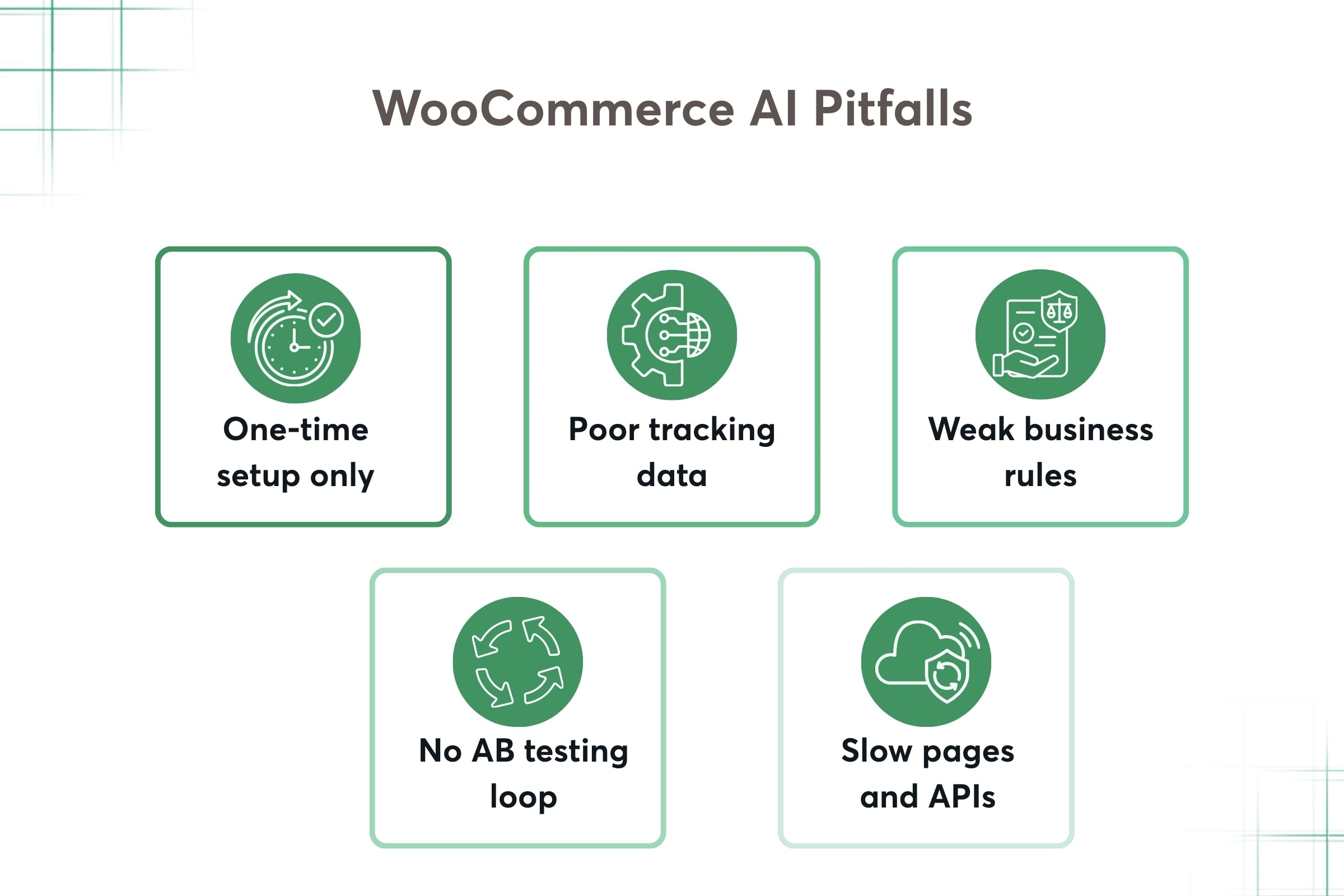
Avoid these pitfalls by focusing on solid tracking, clear business constraints, regular testing, and a scalable implementation.
Why Businesses Choose EvinceDev for AI Personalization?
Successful personalization sits at the intersection of strategy, data science, and platform expertise. Businesses choose EvinceDev for its ability to deliver across all three.
Strategy, AI Engineering, and WooCommerce Expertise
EvinceDev combines:
- Deep understanding of eCommerce personalization strategy
- Proven AI development services
- End-to-end WooCommerce store development services
- Scalable and secure WooCommerce development services
This integrated approach ensures that AI personalization delivers measurable business value.
Conclusion
AI personalization for WooCommerce is no longer experimental. It is a proven growth lever for eCommerce businesses seeking higher relevance, better conversions, and sustainable revenue growth.
From recommendations and pricing to search and upsells, AI personalization for WooCommerce enables stores to move beyond static experiences and deliver tailored journeys at scale. When implemented strategically, it transforms WooCommerce from a transactional platform into a personalized commerce engine.
For businesses ready to invest in the future of eCommerce, working with an experienced WooCommerce development company in usa can accelerate results and reduce risk. EvinceDev supports this journey with end-to-end WooCommerce personalization development, combining AI engineering, data-driven strategy, and custom WooCommerce development services to build scalable personalization that fits your catalog, customers, and business goals.