

Key Takeaways:
- Chatbots as Core Infrastructure: They now support intake, triage, scheduling, and follow-up, not just FAQs.
- Telemedicine Drives Adoption: Scaled virtual care depends on automation for efficient workflows and consistent experiences.
- Safety and Compliance First: Clinical validation, guardrails, and privacy controls are essential for trust.
- Integrations Unlock Value: EHR and telemedicine connectivity reduce manual work and improve continuity.
- Monitoring Ensures Reliability: Ongoing analytics and reviews keep performance accurate and up to date.
Healthcare is evolving rapidly due to digital innovation. Patients expect convenient access to care, faster communication, and personalized health support. Meanwhile, healthcare providers are balancing rising patient loads, operational inefficiencies, regulatory complexity, and workforce shortages. An AI chatbot for healthcare is playing a growing role in this transformation, helping organizations modernize patient interactions and streamline service delivery.
AI chatbots are no longer a futuristic concept. They’ve become a strategic tool for hospitals, clinics, telemedicine platforms, and digital health startups. As part of modern healthcare app development, these systems improve patient engagement, reduce administrative burden, and enhance continuity of care.
This in-depth guide explores how healthcare chatbots work, where they deliver the most value, what technologies power them, and how organizations can deploy them responsibly.
Quick Stat:
Teladoc Health and Becker’s annual telehealth benchmark survey noted that the 2024 study, reflecting plans for 2025, was the first in which 100% of respondents either already offered virtual care or planned to offer it by year-end. This reinforces why healthcare organizations are investing in scalable digital support like chatbots.
What Are Healthcare Chatbots, And How Do They Work?
Healthcare chatbots are AI-powered conversational systems that interact with users via text or voice interfaces. They are designed to understand patient queries, interpret intent, and provide contextual responses aligned with medical knowledge and defined clinical pathways.
A medical AI chatbot goes beyond simple FAQ automation. It can support clinical workflows by collecting structured information, guiding patients through symptom assessments, and providing relevant health education. These systems typically combine natural language processing, machine learning models, and curated medical knowledge bases.
At a technical level, a healthcare chatbot includes:
- An NLP engine for intent recognition and entity extraction
- A dialogue management framework that controls conversation flow
- Secure APIs for integration with hospital systems
- A validated medical knowledge base reviewed by clinicians
- Encryption and compliance controls to protect patient data
Unlike general-purpose bots, healthcare chatbots must operate within strict safety and regulatory frameworks. Their design must prioritize accuracy, transparency, and safe escalation to human professionals when needed.
Why Do Healthcare And Telemedicine Workflows Need AI-Driven Support?
Healthcare systems worldwide face systemic inefficiencies. Administrative tasks consume valuable clinical time. Appointment scheduling, patient registration, insurance verification, and follow-up communication often require manual intervention. At the same time, telemedicine has expanded access to care, but virtual consultations require structured intake processes and consistent patient engagement between appointments.
AI chatbot development for healthcare addresses these workflow gaps by automating repetitive processes and creating standardized digital touchpoints. Instead of waiting on hold or filling out lengthy forms manually, patients can interact with conversational interfaces that guide them step-by-step.
For providers, this translates into:
- Reduced call center volume
- Faster intake processing
- Improved documentation accuracy
- More time allocated to complex clinical cases
For patients, it means improved accessibility, reduced waiting times, and round-the-clock support.
Where Do Chatbots Add The Most Value In Care Delivery?
Healthcare chatbots have an impact throughout the entire patient journey, from initial contact to long-term care management.

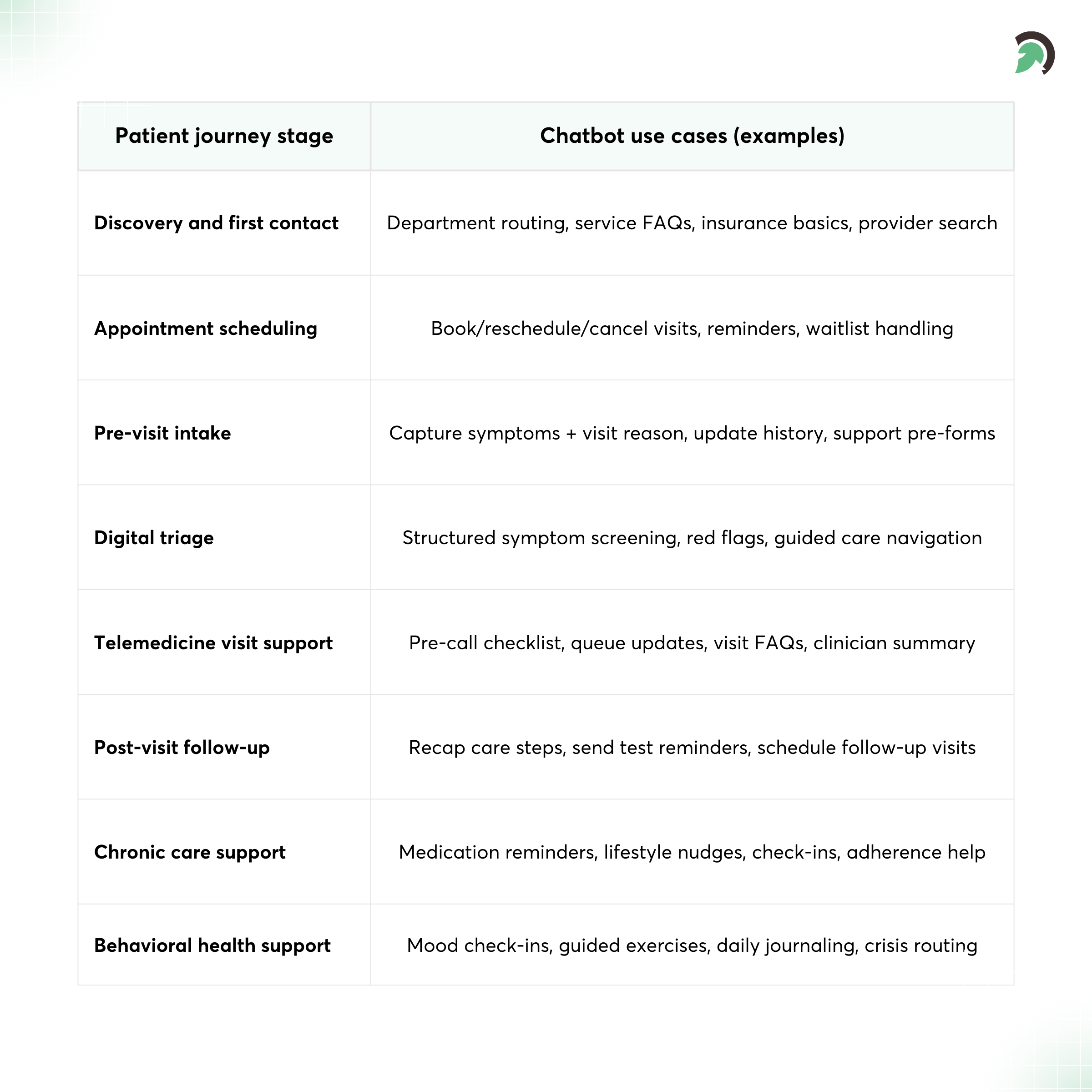
-
Symptom Assessment And Digital Triage
One of the most recognized applications is symptom intake. Patients describe their symptoms, and the chatbot asks structured follow-up questions to determine severity and urgency. While not a replacement for diagnosis, such systems can provide guidance on whether immediate medical attention is required or whether a scheduled consultation is appropriate.
Safety is critical in this context. Effective triage systems incorporate red-flag detection, risk-scoring logic, and immediate-escalation pathways.
-
Appointment Scheduling And Administrative Automation
Administrative inefficiency remains a major challenge in healthcare operations. Chatbots can manage appointment booking, cancellations, reminders, and pre-visit form collection without human intervention. By automating these workflows, organizations reduce staff workload and minimize missed appointments.
-
Chronic Disease Management And Medication Adherence
Long-term conditions such as diabetes, hypertension, and cardiovascular diseases require ongoing monitoring. An AI patient support chatbot can send medication reminders, collect health updates, and provide lifestyle guidance tailored to patient needs. Continuous digital engagement improves adherence and supports better health outcomes over time.
-
Post-Discharge Follow-Up
Hospital discharge does not mark the end of care. Patients often require monitoring during recovery. Chatbots can conduct structured check-ins, gather symptom updates, and alert providers to early warning signs. This proactive engagement can reduce avoidable readmissions and improve patient confidence.
-
Mental Health And Behavioral Support
In behavioral healthcare software development, conversational tools are increasingly used to support therapy programs. Chatbots can guide users through evidence-based exercises, mood-tracking routines, and stress-management techniques. While they do not replace licensed therapists, they expand access and provide supplementary support between sessions.
-
Telemedicine Workflow Enhancement
A telemedicine chatbot supports patients before, during, and after virtual consultations. Prior to appointments, it can gather medical history and documentation. After consultations, it can reinforce care instructions, send reminders, and schedule follow-ups.
These capabilities are often embedded into platforms delivered through telemedicine app development services, ensuring seamless digital care experiences.
What Types Of Healthcare Chatbots Do Organizations Typically Build?
Healthcare chatbots differ in complexity and risk profile.
Rule-based systems rely on predefined decision trees. They are predictable, easier to validate, and suitable for administrative or low-risk informational use cases.
AI-driven systems use advanced language models to interpret open-ended inputs. They provide more natural conversations but require strong safety controls.
Hybrid systems combine structured logic with AI flexibility, offering both reliability and adaptability.
A comprehensive healthcare virtual assistant may integrate additional capabilities such as voice recognition, multilingual communication, accessibility features, and wearable device integration. Some systems are patient-facing, while others assist clinicians with documentation and workflow automation.
What Technologies Power Reliable Healthcare Chatbots?
Reliable healthcare chatbots are built on a layered architecture that prioritizes accuracy, privacy, and seamless integration with clinical workflows. Instead of relying on a single model, most production systems combine structured logic, validated content, and controlled AI capabilities to keep responses safe and consistent.
Natural Language Understanding And Context
Natural language processing helps the chatbot understand what the user is trying to do and extract meaningful details. In healthcare, that typically includes:
- Intent detection (booking, symptoms, medication questions, follow-up support)
- Entity extraction (symptoms, duration, medications, allergies, conditions)
- Context management to avoid repeating questions and to keep the intake structured
Dialogue Management And Workflow Orchestration
A dialogue manager guides the user through step-by-step flows such as symptom intake, registration, appointment booking, or post-visit follow-ups. It also controls:
- When to ask clarifying questions
- How to handle incomplete answers
- When to escalate to a clinician or support team
Knowledge Base And Safe Response Generation
To reduce misinformation risk, healthcare chatbots commonly use:
- Curated knowledge bases reviewed by medical teams
- Retrieval-based responses that pull approved answers
- Guardrails that block unsafe topics and trigger human handoff for high-risk scenarios
If generative AI is used, it is typically constrained and grounded in verified content rather than open-ended medical advice.
Security And Compliance Foundations
Because the chatbot may handle sensitive patient data, the stack usually includes:
- Encryption in transit and at rest
- Role-based access control for staff tools
- Audit logs and consent capture
- Data minimization and retention controls
Integration And Interoperability
Healthcare chatbots become far more useful when connected to real systems, such as scheduling, telemedicine modules, and EHR platforms. Interoperability standards like HL7 and FHIR help ensure structured data exchange so that collected information flows cleanly into clinical workflows.
Conversational AI healthcare solutions must balance innovation with reliability. Robust testing, content governance, and system monitoring are essential components of this balance.
How Do Teams Ensure Safety, Compliance, And Ethical Use?
Healthcare AI solutions must adhere to strict regulatory requirements. Compliance with privacy laws such as HIPAA and GDPR is mandatory in many regions. This involves secure data storage, encrypted communication, role-based access control, and documented patient consent.
Ethical considerations are equally important. AI systems must avoid biased responses, clearly communicate their limitations, and provide transparent escalation pathways. Continuous oversight ensures that models remain aligned with medical standards and ethical guidelines.
Trust is the foundation of digital healthcare adoption. Without clear safeguards, patient confidence can quickly erode.
What Does The Development Lifecycle Look Like In Practice?
Building a healthcare chatbot is best approached as a structured product lifecycle with clear clinical, technical, and compliance checkpoints.
Scope, Goals, And Risk Definition
The process starts by defining what the chatbot will do and how clinically sensitive it is. An appointment-scheduling bot typically poses lower risk than a triage assistant, so its validation and governance requirements differ. Teams also set success metrics early, such as reduced call volume, faster intake, or improved adherence to follow-up.
Clinical And Compliance Alignment
Before design and development move forward, clinicians and compliance stakeholders help define:
- Approved use cases and boundaries
- Escalation rules and red flag scenarios
- Consent, privacy, and data handling requirements
This step ensures the chatbot supports care safely and aligns with regulatory expectations.
Conversation Design And User Experience
UX teams design flows that feel clear, empathetic, and easy to complete, especially for patients under stress. This includes tone guidelines, structured intake formats, accessibility considerations, and smooth handoff to humans when needed.
Build And System Integration
Development focuses on secure architecture, role-based access controls, logging, and integrations with core systems, including scheduling, telemedicine modules, and EHR workflows. Many teams offering medical app development services integrate the chatbot into broader patient apps or portals to keep the experience unified rather than fragmented across tools.
Testing And Validation
Testing in healthcare must go beyond basic QA. It often includes:
- Clinical validation of flows and outputs
- Security testing, including penetration testing
- Usability testing with real user groups
- Performance testing under expected traffic loads
Deployment, Monitoring, And Continuous Improvement
After launch, ongoing monitoring is essential to maintain safety and quality. Teams track conversation outcomes, escalation accuracy, user drop-off points, and system performance. Updates are made through controlled releases, with periodic clinical reviews and compliance checks to keep the chatbot aligned with evolving guidelines.
How Should Success And ROI Be Measured?
Measuring impact requires both operational and clinical perspectives.
Operationally, organizations may track reductions in call center workload, improved intake speed, and appointment utilization rates. Clinically, improvements may be observed in medication adherence, patient follow-up compliance, and reduced readmissions.
Patient experience metrics such as satisfaction scores and engagement rates provide further insight into system effectiveness. Financially, automation contributes to cost efficiency while maintaining service quality.
Quick Stat:
Doximity found 24% of all patients preferred virtual visits when possible, rising to 41% among those who used telemedicine in the past year and 55% among those with 3+ telemedicine visits, which makes patient engagement a practical success metric for virtual care programs.
What Challenges And Limitations Should Teams Plan For?
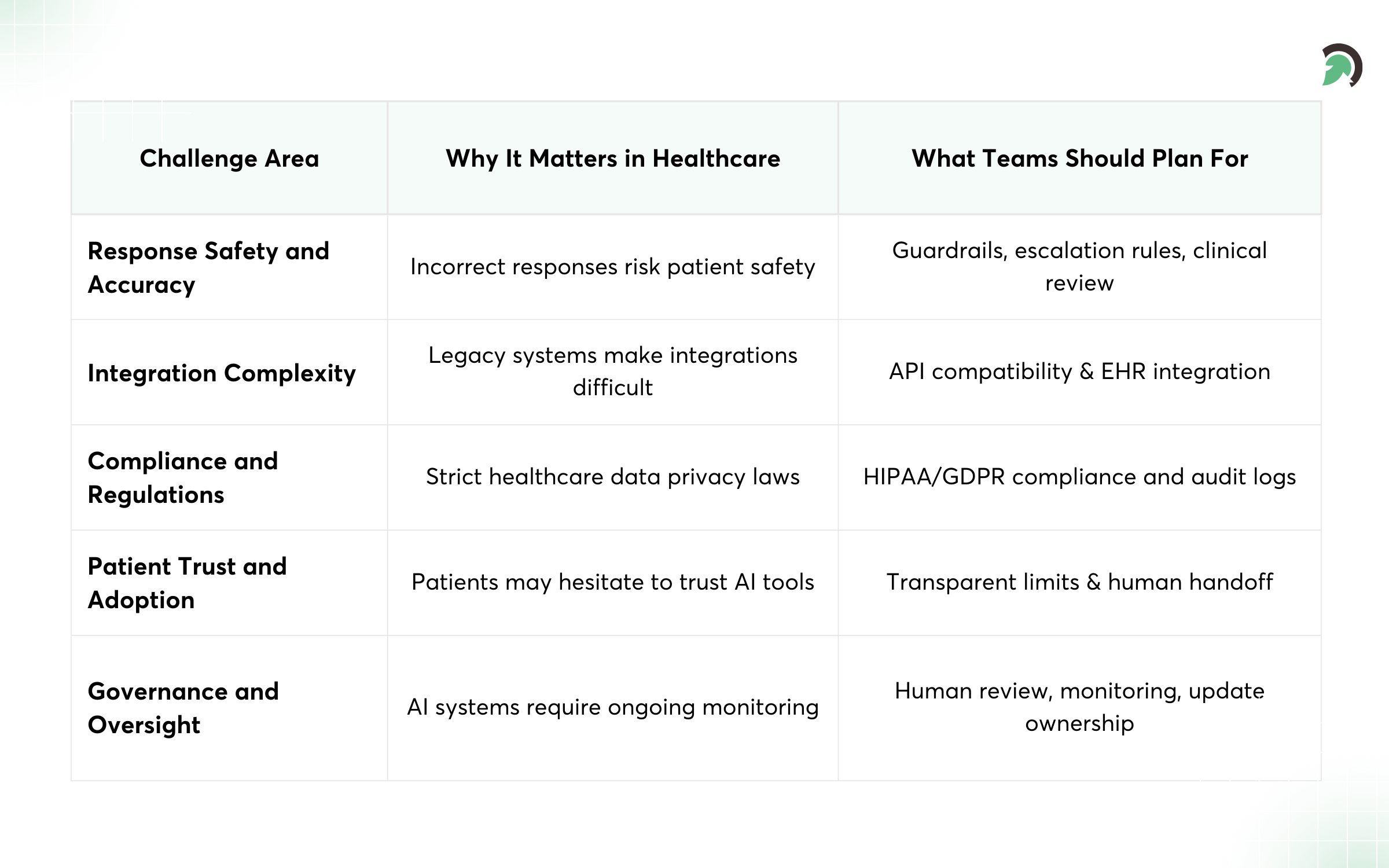
Healthcare chatbot development comes with real-world constraints that teams should plan for early. The most common challenges typically fall into five areas:
Response Safety And Accuracy
AI systems must be tightly controlled to reduce the risk of incorrect or misleading outputs. This usually requires:
- Strong guardrails and scoped responses
- Clear escalation rules for urgent or ambiguous cases
- Clinician reviewed content and periodic updates
Integration Complexity
Connecting a chatbot to existing hospital or clinic systems can be demanding, especially with older infrastructure. Common pain points include:
- Inconsistent data formats across systems
- Limited or outdated APIs
- Workflow dependencies across scheduling, billing, and EHR platforms
Compliance And Regulatory Uncertainty
Healthcare regulations evolve, and AI-related guidance is still maturing in many regions. Teams should be prepared for:
- Privacy and consent requirements (data handling, retention, access controls)
- Auditability and documentation expectations
- Ongoing compliance reviews as rules change
Patient Trust And Adoption
Even a well-built chatbot can fail if patients do not trust it. Adoption improves when the system:
- Clearly explains what it can and cannot do
- Uses simple, empathetic language
- Offers a quick path to human support when needed
Governance And Human Oversight
Chatbots should support clinical teams, not replace clinical judgment. Sustainable deployments include:
- Human-in-the-loop review for sensitive scenarios
- Monitoring for performance drift and edge cases
- Defined ownership for updates, incident response, and quality control
The table below highlights key challenges organizations face when developing and deploying healthcare chatbots.

How Is Telemedicine Accelerating Chatbot Adoption?
Telemedicine has reshaped digital care delivery by making virtual consultations a routine option across many specialties, from primary care and dermatology to mental health and chronic disease follow-ups. As usage grows, providers face a new operational challenge: delivering the same quality of care remotely without increasing clinician workload or creating fragmented patient experiences. That is why telemedicine platforms increasingly rely on structured, automated workflows to keep virtual care efficient, consistent, and safe.
This is where chatbots become a natural fit. They help standardize the steps around a virtual visit, so clinicians can focus on medical decision-making while patients receive faster, clearer guidance. Telemedicine app development services often include chatbot functionality because it reduces friction at every stage of the journey.
Quick Stat:
A CDC National Health Statistics Report found that 80.5% of office-based physicians used telemedicine in 2021, up from 16.0% in 2019, showing how quickly telemedicine became embedded in routine care delivery.
Before the consultation, chatbots can handle pre-visit tasks such as:
- Capturing symptoms and visit reasons in a structured format
- Collecting medical history updates, allergies, and medication lists
- Uploading reports or images and confirming consent
- Directing patients to the right specialty or appointment type
During the consultation workflow, chatbots can support operational flow by:
- Sharing a summarized intake note with the clinician
- Helping manage virtual queue status and basic FAQs
- Triggering escalation paths if the patient reports urgent symptoms
After the consultation, chatbots strengthen continuity of care by:
- Reinforcing care instructions and next steps in simple language
- Sending medication, test, and follow-up reminders
- Collecting patient feedback and post-visit symptom updates
- Flagging warning signs that may require clinician review
By covering these routine touchpoints end to end, chatbots improve provider productivity, reduce drop-offs in patient journeys, and create a more responsive telemedicine experience. This combination of convenience, efficiency, and continuity is a major reason chatbot adoption is accelerating alongside the growth of virtual care.
Quick Stat:
According to the American Medical Association’s Physician Practice Benchmark data, 71.4% of physicians reported using telehealth weekly in 2024, up from 25.1% in 2018 and only slightly below the 79.0% reported in 2020, indicating that virtual care has stabilized at a much higher baseline than pre-pandemic levels.
What Trends Will Shape The Future Of Healthcare Chatbots?
The future of healthcare chatbots is closely linked to personalization and integration. Advanced systems are beginning to analyze patient history and contextual data to provide tailored recommendations. Integration with wearable devices enables continuous health tracking.


Emerging innovations include multimodal interactions that support text, voice, and image inputs. AI-assisted documentation tools may further reduce clinician workload.
As healthcare ecosystems mature, chatbots will become intelligent digital companions embedded within comprehensive health platforms rather than isolated tools.
Should You Build A Chatbot In-House Or Adopt An Existing Solution?
The decision between building and buying depends on organizational priorities. Custom development offers greater flexibility and data control but requires technical expertise and regulatory readiness. Vendor solutions may accelerate deployment while limiting customization.
Strategic planning should consider long-term scalability, compliance requirements, and integration complexity before making this decision.
Conclusion
Healthcare chatbots sit at the intersection of technology and patient care, supporting everything from digital triage and chronic condition management to behavioral health engagement and telemedicine enablement. As part of modern healthcare digital solutions, these systems help organizations streamline operations, improve patient responsiveness, and extend care access beyond traditional settings. When built with strong governance, clinician-reviewed workflows, and privacy-first design, they enable safer and more efficient digital care delivery.
As digital health continues to evolve, conversational systems will become a core layer in scalable, patient-centered care delivery and broader healthcare digital solutions strategies. Teams looking to implement these solutions can partner with EvinceDev for end-to-end support, including strategy, compliant chatbot development, secure integrations, and broader digital health product delivery aligned with medical app development and telemedicine platforms.