
Key Takeaways:
- Smarter Forecasts: AI improves demand accuracy using real time signals, reducing stockouts and overstock risk.
- Leaner Inventory: Dynamic safety stock lowers excess inventory while protecting service levels.
- Faster Replenishment: Automated reorder decisions reduce delays and free planners for strategic tasks.
- Optimized Logistics: AI improves routing, carrier choice, and ETA accuracy to cut freight costs.
- Better Visibility: Control tower insights detect risks early and recommend corrective actions.
- Data Is Critical: Clean, connected data ensures reliable AI outputs and decision confidence.
- Measurable ROI: AI links operational gains to revenue growth, margin lift, and cost savings.
Retail supply chains are under pressure from every direction: unpredictable demand, shorter delivery expectations, frequent promotions, rising logistics costs, and sudden disruptions. For many retailers, traditional planning methods built on historical averages and fixed reorder rules no longer keep shelves stocked or costs controlled. This is where AI supply chain optimization is transforming operations, acting as a practical decision engine that improves demand forecasting, positions inventory strategically, automates replenishment, optimizes fulfillment, and helps retailers respond faster to real world constraints.
In this blog, we will take a deep dive into how artificial intelligence transforms retail supply chains, breaking down each stage through clear, question based sections to help you identify opportunities, prioritize high impact use cases, and build a structured implementation roadmap.
What Does Retail Supply Chain Optimization With AI Mean?
Retail supply chains are built to do one thing exceptionally well: move the right products to the right customers at the right time. But the modern retail environment makes that goal harder than ever. Demand swings quickly, promotions reshape buying patterns overnight, customers expect fast delivery with accurate promises, and disruptions are now a normal part of operations.
Retail Supply Chain Optimization With Artificial Intelligence is the practice of using AI to improve the decisions that drive supply chain performance, including forecasting, inventory planning, replenishment, warehousing, fulfillment, logistics, and returns. Retailers typically implement this through a mix of platforms and AI supply chain software development tailored to their data, workflows, and operational constraints. Instead of relying on static rules and manual planning, AI helps retailers predict what is likely to happen and recommend the appropriate action, faster and at scale.
This blog walks through the most important areas where AI creates measurable supply chain improvements, and how retailers can implement these capabilities without turning it into a never-ending transformation program.
Quick Stat:
According to a 2025 survey of supply chain leaders, 64% say AI and Generative AI capabilities are important or very important when evaluating new technology investments, and 94% plan to use AI for decision support in areas including demand forecasting and predictive inventory planning.
Why Does Retail Supply Chain Optimization Matter More Than Ever?
Retail is a high-volume, low-margin business. Even small mistakes are expensive. A stockout is not just one missed transaction; it can become a lost customer. Overstock is not only excess inventory but also capital locked up, higher storage costs, and future markdowns.
Optimization matters because supply chains are interconnected. A forecasting error becomes a replenishment problem. A replenishment issue becomes a warehouse rush. A warehouse rush becomes late shipments. Late shipments increase customer support costs and reduce loyalty.
AI matters because it can make these decisions more accurate and more responsive, using real-time signals and learning from outcomes.
How Is Artificial Intelligence Different From Traditional Supply Chain Analytics?
Traditional retail planning systems often rely on fixed logic: reorder when inventory reaches a threshold, forecast based on past averages, and allocate inventory using static ratios. Those methods can work in stable scenarios, but they struggle when demand is volatile, promotions are frequent, and fulfillment spans multiple channels.
AI differs in five practical ways:
- It learns patterns from many signals, not only sales history
- It captures nonlinear relationships, like how promotions interact with weather or local events
- It updates and improves as new data arrives
- It supports prescriptive decisions, not only reporting
- It enables exception-based workflows, so humans focus on what truly needs attention
In simple terms, traditional analytics explains what happened. AI helps predict what will happen and recommends what to do next.

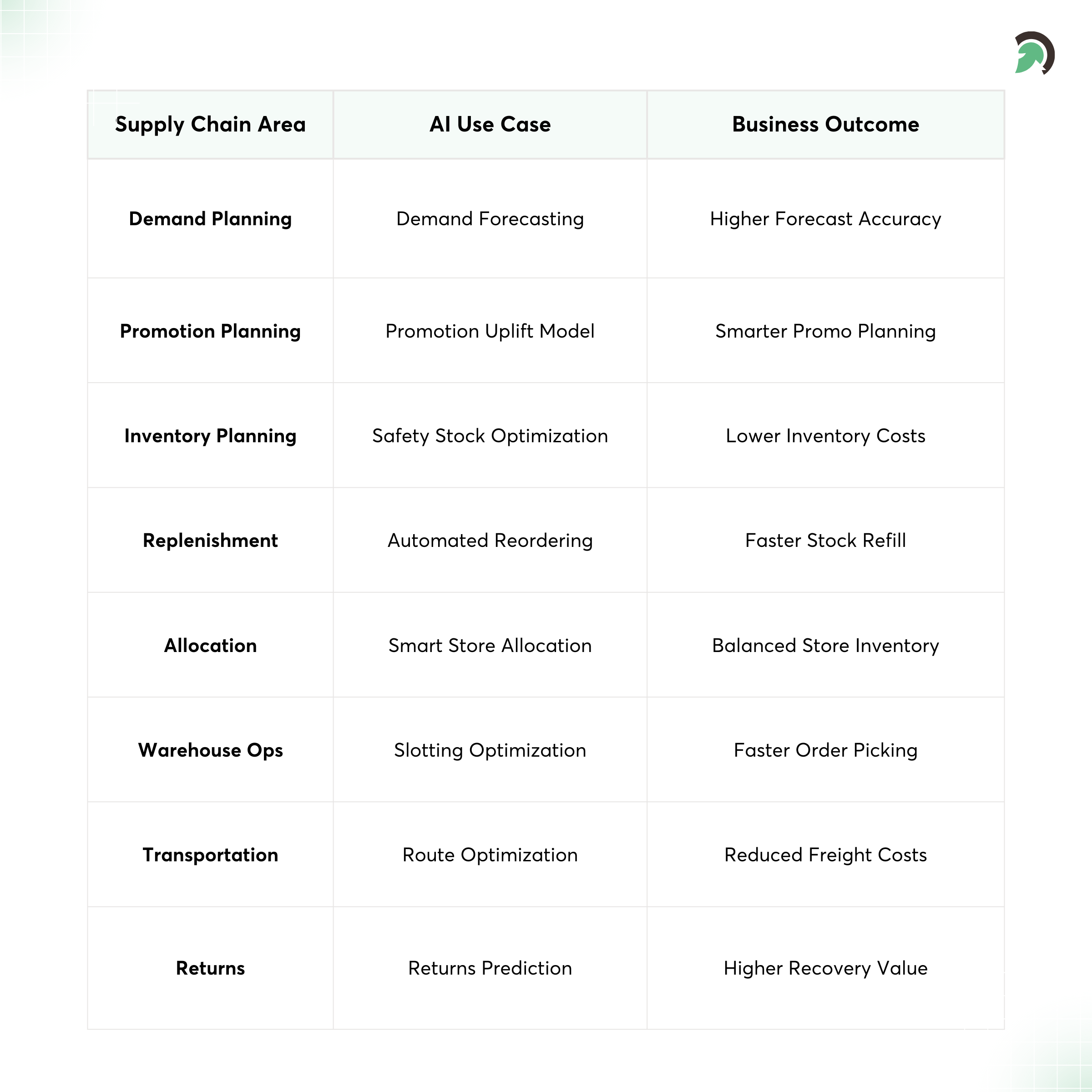
How Can AI Improve Demand Forecasting In Retail?
Demand forecasting is the foundation of every other decision in the supply chain. When forecasts are wrong, inventory placement becomes wrong, replenishment becomes reactive, and service levels suffer.
AI forecasting models improve accuracy by learning from:
- Seasonality and trend patterns at multiple levels
- Promotions, discounts, and marketing campaigns
- Price changes and elasticity differences by region
- Weather, holidays, and local events
- Channel mix shifts between store and ecommerce
- Product substitution effects when items go out of stock
A major advantage of AI is its ability to perform probabilistic forecasting. Instead of a single forecast number, it can provide a range, which is extremely useful for setting safety stock and planning for uncertainty.
This way, the retail demand forecasting solutions results in fewer stockouts, lower overstock, and better alignment between demand planning and procurement.
How Can AI Predict Promotion Impact And Demand Spikes More Accurately?
Promotions are one of the biggest reasons retailers get forecasting wrong. The same discount can produce different outcomes depending on store location, timing, competitor behavior, and customer segment.
AI helps by modeling:
- Uplift, the true incremental demand created by a promotion
- Cannibalization, when promoted items reduce sales of similar items
- Halo effects, when promotions increase sales of related products
- Price elasticity, to estimate how demand changes as price changes
- Event effects, such as festivals, sports events, or school seasons
This matters operationally because promotion planning is not just marketing. It is inventory, labor, and logistics planning. When promotion uplift is modeled correctly, retailers can pre-position stock intelligently and reduce both missed sales and emergency shipments.
How Can AI Help Retailers Decide The Right Assortment For Each Store?
Assortment planning is the decision of what products to carry, where, and in what depth. Many retailers still use broad assortments that are only lightly adjusted by region, which often leads to slow movers in some stores and stockouts in others.
AI improves assortment planning by:
- Clustering stores by demand behavior and customer profiles
- Personalizing assortments for micro markets
- Predicting substitution behavior, which items customers choose when their first option is missing
- Identifying complement relationships, which items tend to sell together
- Guiding new store assortment decisions using similarity modeling
The benefits include higher shelf productivity, fewer deadstock situations, and a smoother replenishment process because the assortment is better aligned with local demand.
How Does AI Make Inventory Optimization More Practical And More Accurate?
Inventory is one of the biggest balance sheet items for retailers. Too much inventory increases cost and markdown risk. Too little inventory loses revenue.
AI helps optimize inventory by improving three core inputs:
- Demand uncertainty
- Lead time uncertainty
- Service level targets
It enables dynamic safety stock that changes based on volatility and lead-time predictions that consider variability rather than relying on a single average.
More advanced approaches optimize inventory across the entire network, not just at a single node. That means deciding how much buffer sits in central DCs, regional DCs, and stores, based on cost and service impact.
So, the result of Inventory optimization AI is often a rare win-win: higher availability with lower total inventory. In practice, many teams adopt inventory optimization software to automate safety stock, reorder points, and multi-location buffer planning based on real-time demand and lead-time variability.
How Can Automated Replenishment Reduce Planner Workload And Improve Availability?
Replenishment is the process by which forecasts and inventory rules result in actual purchase orders and transfer orders. In many retailers, replenishment still depends on manual reviews and static min-max logic. That model breaks when you manage thousands of SKUs and need a faster response.
AI-driven replenishment systems can:
- Trigger reorder recommendations automatically
- Adjust quantities based on real-time sales and inventory
- Respect constraints such as MOQs, truck capacity, store receiving limits, and supplier lead times
- Allocate limited inventory to the locations where it will have the highest impact
- Surface exceptions so planners focus on true risks
The biggest shift here is not replacing planners. It is moving planners from repetitive tasks to high-value oversight. To operationalize recommendations, models must connect into purchasing through secure ERP integration services.
How Can AI Reduce Stockouts Without Creating More Overstock?
Stockouts and overstock look like opposite problems, but they usually come from the same few causes: inaccurate forecasting, delayed replenishment, poor allocation across stores and channels, and inventory that is “available on paper” but not actually sellable due to damage, misplacement, or timing gaps.
What Does AI Do To Prevent Stockouts?
-
Predict Stockout Risk Early
AI models track sales velocity, current inventory, inbound shipments, and lead time variability to flag which SKUs and locations are likely to run out soon.
-
Detect Demand Shifts Faster
Instead of waiting for weekly reports, AI can spot sudden spikes caused by promotions, weather, local events, or viral trends and adjust replenishment signals quickly.
-
Recommend Reallocation Before It Is Too Late
If one store is overstocked while another is running low, AI can suggest store-to-store transfers, DC rebalancing, or alternate fulfillment options to protect availability.
What Does AI Do To Control Overstock?
-
Identify Excess Inventory Early
AI estimates whether an item will sell through at full price based on demand trends, seasonality, and the remaining selling window.
How Can AI Improve Warehouse Execution and Accuracy?
Warehouses are where supply chain strategies turn into operational reality. When execution slows down or errors increase, fulfillment costs rise and customer experience suffers.
AI improves warehouse performance across planning, execution, and automation.
AI driven warehouse optimization can:
- Optimize slotting so fast moving SKUs are placed in high access zones
- Improve pick path routing to reduce travel time per order
- Group orders intelligently for batch and wave picking
- Forecast workload to align labor scheduling with demand
- Detect anomalies such as repeated mispicks or damage hotspots
Computer vision adds another layer of intelligence inside the warehouse.
It supports:
- Automated cycle counting and shelf scanning
- Damage detection during receiving and packing
- Parcel dimensioning and weight validation
- Safety monitoring and compliance tracking
In more advanced environments, robotics such as goods to person systems and guided vehicles reduce repetitive labor and increase throughput consistency. Computer vision and robotics become scalable with the right warehouse automation solutions.
The result is lower cost per order, higher picking accuracy, faster fulfillment speed, and improved operational control across the warehouse network.
How Does AI Support Omnichannel Fulfillment Like BOPIS And Ship From Store?
Omnichannel fulfillment introduces complex decisions: which node should fulfill the order, what inventory should be reserved, and what delivery promise can be made with confidence.
AI helps optimize:
- Order sourcing between DCs and stores
- Split shipment decisions when needed
- Promise date accuracy based on processing time and carrier performance
- Profit-aware fulfillment, balancing margin with shipping cost and service level
The benefit is a better customer experience and lower fulfillment costs, because the system chooses the best path for each order rather than using a single generic rule for all orders.
How Can AI Optimize Last Mile Routes And Improve ETA Accuracy?
Last-mile delivery is expensive and highly visible to customers. Late delivery creates customer dissatisfaction and increases “where is my order?” queries. For many retailers, the quickest wins come from deploying an AI-powered logistics automation solution that improves routing, dispatch decisions, and delivery reliability using real-time constraints.
AI optimizes the last mile by:
- Building constraint-aware routes
- Predicting traffic and congestion patterns
- Dynamically rerouting when conditions change
- Improving ETA predictions based on historical delivery performance
Accuracy is key. Customers prefer a reliable promise over an optimistic one that fails.
How Can AI Reduce Transportation Costs Beyond Route Planning?
Transportation optimization is not only about routes. It is also about how you design and run the network.
AI supports:
- Load building and shipment consolidation
- Carrier selection based on performance by lane
- Cross-docking strategies
- Network design simulations for DC placement and service tradeoffs
These decisions can reduce cost to serve while maintaining service levels, especially for retailers operating across wide geographies.
How Can AI Improve Cold Chain And Perishable Supply Chains?
Perishables and cold chain categories introduce constraints that traditional planning models often handle poorly.
AI helps by:
- Predicting spoilage risk and remaining shelf life
- Optimizing replenishment frequency for fresh goods
- Recommending markdown timing to reduce waste
- Detecting cold chain breaks using sensor data
This improves freshness, reduces waste, and protects brand trust in categories where quality is non-negotiable.
How Can AI Enable Real-Time Supply Chain Visibility And Faster Decisions?
Visibility is not just tracking. It is knowing what is at risk and what action to take.
AI-powered visibility systems can:
- Detect anomalies such as delayed lanes or warehouse slowdowns
- Predict disruptions using patterns rather than waiting for failure
- Recommend mitigation actions such as reroutes or reallocations
- Support centralized control tower operations
This is where supply chain teams stop reacting and start preventing.
Quick Stat:
According to McKinsey & Company, AI-powered supply chain control towers can improve fill rates by 5 percent to 8 percent while reducing logistics costs by 5 percent to 20 percent.
How Can AI Predict Supplier Risk And Improve Supplier Performance Management?
Suppliers can be a hidden source of variability. Even when average lead times look acceptable, variability can break service levels.
AI helps by analyzing:
- Lead time variability and trends
- Fill rate consistency
- Quality defect patterns
- External risk indicators
Retailers can then decide when to buffer, dual source, renegotiate terms, or adjust order timing.
How Can Scenario Planning Help Retailers Stay Resilient During Disruptions?
Disruptions are no longer exceptional. Scenario planning and simulations help retailers decide what to do when conditions change fast.
AI-powered scenario planning can simulate:
- Demand surges
- Supplier shutdowns
- Carrier capacity shortages
- Warehouse constraints
And it can recommend actions like inventory rebalancing, temporary policy changes, or SKU prioritization based on margin and service impact.
How Can AI Make Returns And Reverse Logistics More Profitable?
Returns can erode margins quickly, especially in apparel and ecommerce.
AI improves returns by:
- Predicting return likelihood by product and customer segment
- Detecting fraud patterns
- Optimizing routing decisions for returned goods
- Improving recovery by choosing the best resale or liquidation path
With the right system, reverse logistics becomes value recovery rather than pure cost.
How Can AI Support Sustainability And Waste Reduction In Retail?
AI supports sustainability by reducing inefficiencies that create waste:
- Over-ordering that leads to markdowns and disposal
- Excess transportation miles through poor routing
- Packaging waste through suboptimal packing choices
- Food waste via better perishables planning
It also supports measurement, helping retailers track emissions and waste across the network to make sustainability operational rather than only aspirational.
What Data Do Retailers Need To Implement AI In Supply Chain Optimization?
AI does not work in isolation. It depends entirely on the quality, consistency, and integration of data flowing across the retail ecosystem. The more connected and reliable the data, the more accurate and actionable the AI outcomes.
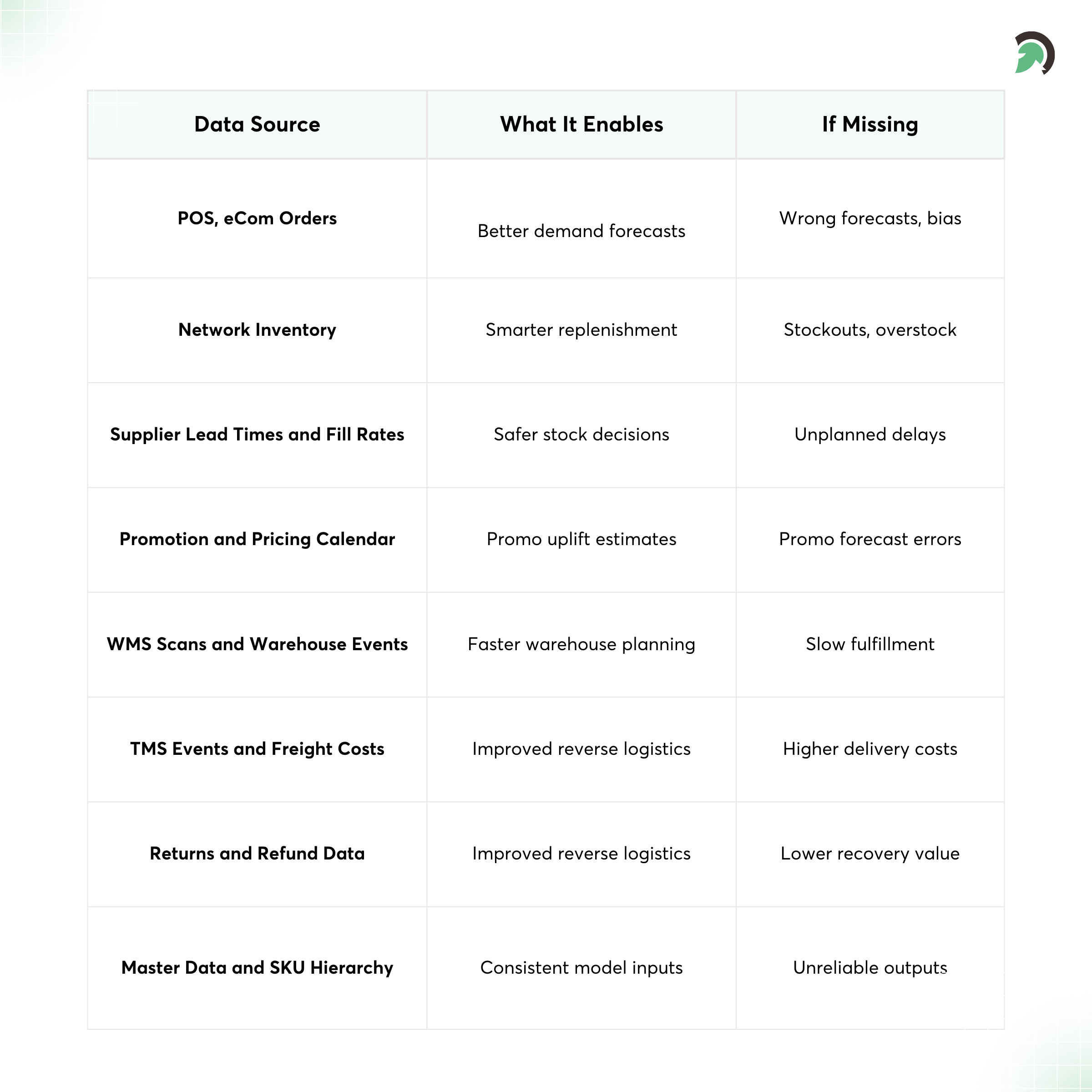
At a minimum, retailers need access to several core data domains:
-
POS Sales And Ecommerce Orders
Granular transaction-level data across stores and digital channels forms the backbone of demand forecasting. This should include timestamps, quantities, pricing, discounts, and channel identifiers. Without clean demand signals, even the most advanced models will struggle.
-
Inventory Across Stores, Distribution Centers, And In Transit
Accurate visibility into on-hand, reserved, damaged, and in-transit inventory is critical. AI models rely on real inventory positions to make replenishment, allocation, and fulfillment decisions.
-
Supplier Orders, Lead Times, And Fill Rates
Understanding supplier reliability and variability enables better safety stock calculations and risk prediction. Historical purchase order data helps models learn patterns in lead time fluctuations and partial shipments.
-
Warehouse Events And Operational Scans
Receiving scans, pick confirmations, pack times, and dispatch timestamps provides insight into operational performance. These signals help improve fulfillment predictions and warehouse optimization.
-
Transportation Events And Costs
Shipment tracking events, delivery confirmations, freight invoices, and lane-level cost data are essential for route optimization, ETA prediction, and transportation cost modeling.
-
Promotions, Pricing, And Marketing Calendars
AI must know when demand spikes are driven by business decisions. Linking promotional calendars and pricing changes to sales data significantly improves forecasting accuracy.
-
External Data, Such As Weather And Events
Weather conditions, local festivals, sports events, and macroeconomic signals can all influence buying behavior. External data enhances demand sensing and risk detection.
Above all, the biggest enabler is strong master data. Consistent SKU definitions, standardized location hierarchies, accurate units of measure, and clean transaction definitions ensure that AI systems are not trained on conflicting or ambiguous information. Many AI projects fail not because of modeling complexity, but because a foundational data discipline is missing.
Quick Stat:
Many retailers still struggle with inventory visibility. In fact, according to a report from Gitnux, 62 percent report inventory inaccuracies exceeding 10 percent due to poor visibility, underscoring why better data integration and AI-driven monitoring systems are critical for reliable supply chain decisions.
How Should Retailers Build A Scalable AI Architecture For Supply Chains?
A scalable AI architecture is less about complexity and more about reliability, integration, and operational impact. The goal is to ensure that predictions flow seamlessly into real decisions.
A practical architecture typically includes:
-
Data Pipelines For Ingesting And Standardizing Data
Automated pipelines extract data from ERPs, WMSs, TMSs, POS systems, and external sources. These pipelines clean, transform, and harmonize data to make it analytics-ready.
-
A Warehouse Or Data Lake For Storage And Analytics
A centralized environment allows teams to analyze historical trends, build models, and maintain a single source of truth across departments.
-
Feature Engineering For Reusable Signals
Reusable features such as seasonality indicators, demand volatility scores, promotion flags, and lead time variability metrics help standardize model development across use cases.
-
Model Training And Evaluation Pipelines
Automated training workflows ensure models are retrained periodically and evaluated against defined accuracy and bias metrics.
-
Real-Time or Batch Model Serving Into Workflows
Predictions and recommendations must feed directly into systems such as replenishment engines, order management systems, or warehouse planning tools.
-
Monitoring For Drift, Data Quality, And KPI Impact
Ongoing monitoring ensures models remain accurate as demand patterns shift. Drift detection and KPI tracking help identify when retraining or recalibration is required.
The most important principle is operationalization. AI cannot remain a dashboard insight. It must integrate into systems that execute actions, such as generating purchase orders, reallocating inventory, or updating fulfillment rules. Without workflow integration, AI becomes an advisory tool instead of a performance driver.
Should You Build Or Buy AI Supply Chain Solutions?
There is no single right answer. Most retailers decide based on speed to value, differentiation needs, and internal capability.
- Buy when you need proven results quickly for standard functions like demand planning, replenishment, and basic planning workflows. Platforms reduce rollout risk and come with ready-made processes.
- Build when your supply chain is a competitive advantage or you need deep customization, such as unique fulfillment models, proprietary demand signals, specialized constraints like perishables, or tight integration into internal systems.
- Hybrid is common: use enterprise tools for core processes, then add custom AI for areas like better forecasting, smart inventory allocation, and exception management.
Retailers evaluating AI supply chain solutions often begin with a focused assessment. EvinceDev helps enterprises define architecture, data readiness, and phased implementation strategy.
How Can Retailers Measure ROI From AI Supply Chain Optimization?
AI must demonstrate tangible business value. Measuring ROI requires connecting operational improvements to financial outcomes.
Key KPIs include:
- Stockout rate and estimated lost sales
- Inventory turns and days on hand
- Forecast accuracy and forecast bias
- Fill rate and OTIF performance
- Cost to serve per order or per unit
- Warehouse productivity metrics
- Transportation cost per shipment
- Return recovery value
- Waste reduction in perishable categories
However, measurement must go beyond surface metrics. Retailers should establish a baseline period, compare performance before and after implementation, and, where possible, use control groups to isolate AI impact from seasonality or market changes.
The strongest ROI narratives translate operational gains into revenue growth, margin improvement, reduced working capital, or cost savings. That financial linkage ensures executive support and sustained investment.
What Are The Most Common Reasons AI Supply Chain Projects Fail?
Most failures are not due to algorithm limitations. They stem from organizational and operational gaps.
Common pitfalls include:
- Poor Master Data And Inconsistent Definitions
If SKU codes differ across systems or inventory states are unclear, model outputs become unreliable. - Siloed Teams With Misaligned Incentives
Forecasting, replenishment, marketing, and operations often operate independently. Without shared KPIs, AI recommendations may conflict with departmental goals. - Lack Of Trust And Weak Change Management
Planners may resist automated recommendations if the system does not explain its reasoning clearly. - Models Not Integrated Into Operational Workflows
If predictions are not connected to execution systems, they remain unused insights. - No Monitoring And Governance
Without drift detection and performance tracking, models degrade silently as demand patterns evolve.
Retailers succeed when AI is treated as a decision-support system, backed by process redesign, clear ownership, and continuous monitoring, rather than as an isolated analytics experiment.
How Is Generative AI Changing Retail Supply Chain Operations?
Generative AI introduces a new layer focused on reasoning, explanation, and communication. Retailers deploying AI copilots across planning and operations often rely on secure generative AI development services to integrate large language models with internal ERP, WMS, TMS, and analytics systems while maintaining data access controls and governance.

It can:
- Summarize daily exceptions and highlight priority actions
- Provide conversational access to supply chain data
- Draft operational reports automatically
- Help planners explore root causes faster
- Explain why a recommendation was generated
This significantly reduces the cognitive load on planners and managers. Instead of manually reviewing multiple dashboards, teams can interact with supply chain intelligence through natural language queries and automated summaries.
In many cases, generative AI becomes the fastest path to productivity improvement because it enhances decision clarity and accelerates coordination across teams.
When Does Reinforcement Learning Make Sense For Retail Inventory And Pricing?
Reinforcement learning is powerful but requires maturity in both data and simulation capability.
It works best when:
- You can simulate decisions safely before deploying them
- Constraints such as service levels, capacity, and budget are clearly defined
- Historical data is rich enough to create realistic training environments
- Rollout can be gradual with guardrails and oversight
This approach is especially useful for dynamic pricing, markdown timing, and replenishment policies in highly uncertain environments.
Because reinforcement learning involves experimentation, strong governance and risk management are essential before deploying at scale.
How Do AI Use Cases Differ Across Grocery, Fashion, Electronics, And D2C?
AI optimization is not identical across retail categories because constraints and customer expectations differ.
- Grocery: Focuses heavily on perishables forecasting, freshness management, waste reduction, and cold chain integrity.
- Fashion: Requires trend forecasting, size curve optimization, and markdown timing to manage seasonal risk.
- Electronics: Emphasizes allocation under supply constraints, high-value inventory control, and fraud detection.
- D2C Brands: Prioritize fulfillment routing, promise accuracy, and agile scaling with lean operational teams.
Understanding category-specific priorities helps retailers focus on AI initiatives that solve their most pressing operational challenges.
How Can You Get Started With AI Supply Chain Optimization Without Overcomplicating It?
The best starting point is a focused, high-impact problem such as:
- Forecasting for a volatile category
- Stockout prediction for top revenue SKUs
- Replenishment automation for a region
- Fulfillment sourcing optimization for ecommerce
Start small, integrate into workflow, measure impact, and scale to adjacent areas. This phased approach makes it easier to prioritize and scale retail supply chain AI solutions without disrupting daily operations.
And if you need a partner to design, build, and integrate these systems, EvinceDev supports retailers with end-to-end software development for AI-powered supply chain solutions. Whether it’s custom AI development for retail or integrating models into existing ERP, WMS, TMS, and OMS environments, we focus on production-ready systems that drive measurable outcomes.