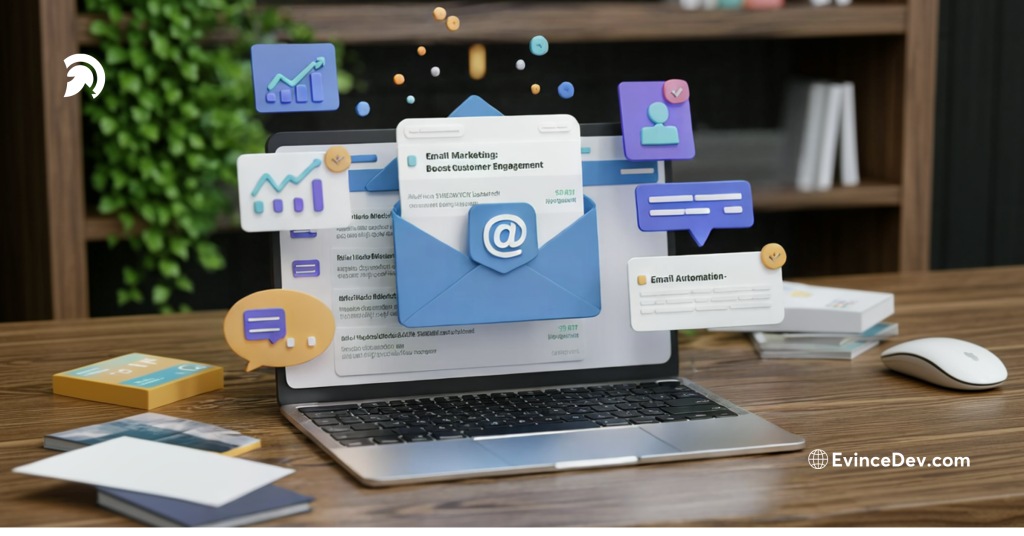
Email marketing remains one of the most effective channels in the modern Digital Marketing landscape. While new platforms continue to emerge, email consistently delivers strong ROI, direct audience access, and measurable business results. It gives brands a dependable way to communicate with prospects and customers in a space they check regularly.
Unlike social media or advertising, email marketing allows businesses to have more control over how they connect with their audience. This is why email marketing is very useful for brands that need to have long-term relationships.
In this guide, you’ll learn how email marketing works, why it matters, and how to use it strategically to improve engagement, conversions, and customer loyalty.
Quick Stat:
According to Litmus, email marketing delivers an average ROI of $36 for every $1 spent, making it one of the most cost-effective ways to build relationships, drive conversions, and retain customers.
What Is Email Marketing?
Email marketing is a Digital Marketing channel used to send targeted messages to a group of subscribers. These messages can educate users, promote products or services, announce updates, or guide readers toward a specific action.
At its best, email marketing is not just about sending messages. It is about delivering the right content to the right audience at the right time. Businesses use it to stay visible, build trust, and move users through the customer journey in a more personalized way.
It is commonly used to:
- Build relationships with leads and customers
- Promote products, services, or offers
- Drive engagement, conversions, and repeat business
Modern email marketing focuses heavily on personalization, automation, and relevance rather than generic mass sending.
A Brief History of Email Marketing
Email marketing has evolved from a simple communication method into a highly strategic business tool. In its early days, brands used email mostly for bulk promotional messages, often with little targeting or personalization.
As inboxes became more crowded, businesses had to become more thoughtful about how they used email. This led to the rise of segmentation, automation, and behavior-based campaigns. Over time, better tools and analytics helped marketers send more relevant messages and measure performance more accurately.
Key phases in its evolution include:
- Early mass email campaigns with limited targeting
- Introduction of segmentation and personalization
- Rise of automation and lifecycle campaigns
- AI-supported and data-driven campaigns today
Today, email marketing is deeply connected with broader Digital Marketing efforts and plays a major role in customer communication.
Why Email Marketing Is Important for Businesses
Email marketing continues to be essential because it combines efficiency, control, and scalability. It allows businesses to stay connected with their audience without relying entirely on external platforms or changing algorithms.
One of its biggest strengths is that it supports every stage of the customer journey. Businesses can use email to attract leads, nurture interest, drive sales, and retain customers after purchase. This makes it one of the few channels that can contribute to both short-term and long-term goals.
Key benefits include:
- Direct communication with an owned audience
- High return on investment compared to many other channels
- Scalable campaigns without major cost increases
- Strong support for retention and repeat engagement
When used well, email marketing helps brands stay relevant and top of mind.
Quick Stat:
According to Statista, email has over 4.5 billion users worldwide, making it one of the most widely used communication channels.
Advantages and Disadvantages of Email Marketing
Email marketing offers several clear advantages, but it also comes with challenges that businesses need to manage carefully. Understanding both sides helps set realistic expectations and leads to better execution.
Advantages
- Cost-effective compared to many paid acquisition channels
- Highly scalable for growing businesses
- Supports personalization and segmentation
- Performance is easy to track and optimize
Disadvantages
- Inbox competition is high
- Deliverability issues can affect reach
- Campaigns need regular testing and refinement
The key is to treat email as a channel that requires strategy and maintenance. When approached properly, its benefits usually far outweigh its limitations.
How Email Marketing Works (Step-by-Step Process)
Email marketing follows a structured workflow that helps businesses plan, send, and improve campaigns over time. The process usually starts with building a subscriber list and ends with performance analysis and optimization.
Once contacts are collected, they are grouped into segments based on behavior, interests, or customer stage. Content is then created for those segments and sent using an Email marketing platform. After launch, results are measured to understand what worked and what should be improved in future campaigns.
Core workflow:
- Build an email list through forms, lead magnets, or signups
- Segment your audience based on meaningful criteria
- Create relevant and engaging content
- Use an Email marketing platform to manage delivery
- Launch your email marketing campaign
- Track results and optimize future sends
This cycle is what makes email marketing both measurable and scalable.
Types of Email Marketing Campaigns
There are different Types of email Marketing campaigns, and each one serves a specific purpose. Rather than relying on one format, successful brands use multiple campaign types to support different stages of the customer journey.
Welcome emails help introduce the brand and set expectations. Promotional emails are designed to drive action, while newsletters keep audiences informed and engaged over time. Transactional emails provide important updates, and automation helps maintain communication without manual effort.
Common types include:
- Welcome emails: Introduce your brand and start the relationship
- Promotional emails: Highlight offers, launches, or limited-time deals
- Newsletter emails: Share insights, updates, and useful content
- Transactional emails: Confirm purchases, orders, or account activity
- Drip campaigns: Deliver automated nurturing sequences over time
- Re-engagement emails: Bring inactive users back into the funnel
Using the right campaign type at the right time improves both user experience and performance.
Understanding the Email Marketing Funnel
Email marketing works best when it aligns with the customer journey. The email marketing funnel helps businesses understand what kind of message to send based on where the user currently stands.
At the top of the funnel, the goal is awareness and education. In the middle, emails help users compare options and build trust. Near conversion, messaging becomes more action-focused. After purchase, email supports retention, loyalty, and upselling.
Funnel stages:
- Awareness: Educational and introductory emails
- Consideration: Product-focused, trust-building content
- Conversion: Offers, demos, or action-driven emails
- Retention: Loyalty emails, updates, and personalized follow-ups
Mapping campaigns to these stages creates a more intentional and effective communication flow.
What Is an Email Marketing Platform (ESP)?
An Email marketing platform is a software solution that helps businesses create, send, automate, and analyze email campaigns. Without a reliable platform, managing subscribers, scheduling sends, and measuring results becomes difficult at scale.
These platforms are designed to simplify execution while improving targeting and efficiency. They allow marketers to organize contact lists, build templates, automate workflows, and monitor key performance indicators from one place.
Key features usually include:
- Automation workflows
- Audience segmentation
- Analytics and reporting
- Email design templates
The right Email marketing platform should support both your current needs and future growth.
Building an Email List (Best Practices)
A strong email list is the foundation of effective email marketing. However, success comes from attracting the right subscribers, not just collecting a large number of addresses. Quality always matters more than volume.
The best lists are built organically through forms, offers, lead magnets, and other permission-based methods. This ensures that subscribers actually want to hear from your brand, which improves engagement and reduces spam complaints.
Effective ways to build a list:
- Offer lead magnets like ebooks, discounts, or exclusive content
- Use website signup forms in visible locations
- Create dedicated landing pages for email capture
Best practices:
- Use double opt-in to confirm intent
- Avoid buying email lists
- Clean inactive users regularly
A clean, permission-based list leads to stronger deliverability and better campaign results.
Email Marketing Strategy: Step-by-Step
A good Email marketing strategy gives direction to your campaigns and ensures that email activity supports larger business goals. Without a clear strategy, businesses often send emails inconsistently or without a strong purpose.
The process starts with defining what success looks like. That may mean more leads, more sales, better customer retention, or stronger engagement. From there, businesses need to understand their audience, select the right campaign types, and create a realistic sending plan.
Key steps:
- Define your goals, such as sales, retention, or engagement
- Understand your audience’s needs and behaviors
- Choose the right campaign types for each objective
- Plan content themes and sending frequency
- Track KPIs and optimize over time
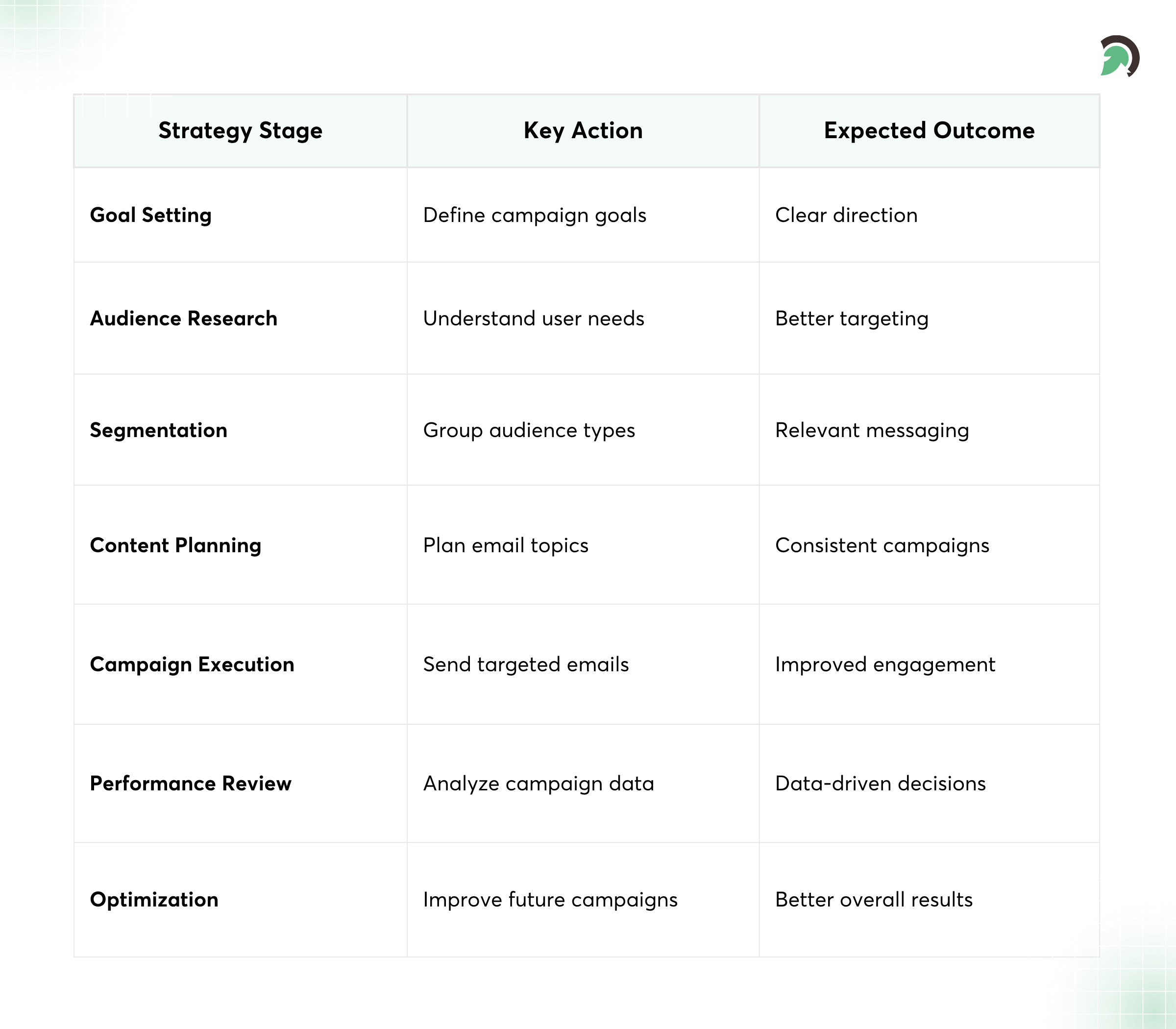
How to Structure an Effective Email Marketing Strategy
A structured strategy makes email marketing more consistent, targeted, and effective.
Email Segmentation and Personalization
Segmentation and personalization are two of the biggest reasons email marketing performs so well. Instead of sending the same message to everyone, businesses can tailor communication to smaller audience groups and even individual users.
Segmentation helps organize subscribers by traits such as demographics, location, purchase history, or engagement level. Personalization builds on that by adapting the message, content, and offer to suit the recipient more closely.
Segmentation can be based on:
- Demographics
- User behavior
- Purchase history
Personalization techniques include:
- Dynamic content blocks
- Personalized product recommendations
- Behavior-based follow-up emails
These methods improve relevance, which often leads to stronger open rates, clicks, and conversions.
Email Marketing Automation
Automation helps businesses scale email communication without losing relevance. Instead of sending every message manually, brands can create workflows that trigger emails based on actions or timing.
This is especially useful for welcome sequences, abandoned cart reminders, post-purchase follow-ups, and lead nurturing campaigns. Automation improves consistency while saving time for the Email marketing team, allowing them to focus more on planning and optimization.
Common automation workflows:
- Welcome series
- Cart abandonment reminders
- Lead nurturing sequences
Benefits of automation:
- Saves time and effort
- Improves timing and consistency
- Supports growth without manual overload
Automation is now a core part of modern Digital Marketing because it combines efficiency with personalization.
How to Write High-Converting Emails
High-converting emails are clear, relevant, and easy to act on. Good email writing starts with understanding the audience and knowing exactly what the email is trying to achieve. Every part of the message should support that goal.
The subject line should earn attention, the opening should create interest, and the body should quickly communicate value. Strong emails also use a clear call-to-action so readers know what to do next.
Key elements of effective emails:
- A compelling subject line
- Clear, focused messaging
- One primary call-to-action
- Mobile-friendly formatting
Practical Email marketing tips like keeping copy concise, using natural language, and emphasizing user benefits can improve campaign performance significantly.
Email Templates and Real Examples
Templates make email creation faster and more consistent. They help businesses maintain a recognizable brand style while reducing the effort needed to build campaigns from scratch every time.
They are especially useful for recurring communication, such as newsletters, promotional emails, onboarding sequences, and event reminders. Good templates also support readability by organizing content in a clear and logical way.
Common template types:
- Promotional emails
- Newsletters
- Onboarding emails
What makes a good template:
- Clean layout and spacing
- Clear hierarchy of content
- Strong and visible CTA
Well-built templates improve both efficiency and user experience.
Email Marketing Tools and Platforms
There are many Email marketing tools available today, ranging from beginner-friendly solutions to advanced enterprise systems. The right choice depends on your goals, audience size, workflows, and reporting needs.
Some tools focus on ease of use, while others offer deeper automation, integrations, and customization. Businesses should look for tools that can support not only current campaigns but also future expansion.
Typical features include:
- Campaign creation and scheduling
- Automation and segmentation
- Reporting and analytics
When choosing a tool, consider:
- Business size and growth plans
- Budget and pricing model
- Feature depth and ease of use
Choosing the right tools can make execution smoother and improve campaign performance over time.
Email Marketing Integration with CRM and Other Channels
Email becomes more powerful when it connects with the rest of your marketing ecosystem. Integrating email with CRM systems, analytics tools, and other channels allows businesses to create more personalized and coordinated experiences.
With stronger data integration, brands can better understand customer behavior and send more relevant messages. This also supports more consistent communication across platforms, which is especially important in multi-channel strategies.
Benefits of integration:
- Better targeting and personalization
- Unified customer data
- Improved user experience
Common integrations include:
- CRM platforms
- Social media tools
- Analytics systems
Integration turns email into a more informed and connected channel.
Email Deliverability: How to Avoid Spam Filters
Deliverability determines whether your emails actually reach the inbox. Even strong content will underperform if technical and list quality issues prevent emails from being delivered properly.
Several factors influence deliverability, including sender reputation, authentication setup, engagement quality, and list hygiene. Businesses need to actively monitor these areas if they want consistent results.
Key factors that affect deliverability:
- Sender reputation
- Email authentication, such as SPF and DKIM
- Subscriber list quality
Best practices:
- Avoid spam-heavy language
- Remove inactive or invalid contacts
- Monitor engagement and bounce trends
Strong deliverability protects the performance of every campaign you send.
Email Marketing Metrics You Should Track
Tracking performance is one of the biggest strengths of email marketing. It allows businesses to understand what resonates with their audience and where improvements are needed.
Different metrics tell different parts of the story. Some measure visibility, others measure engagement, and some reflect business impact. Together, they help marketers make smarter decisions over time.
Important metrics include:
- Open rate
- Click-through rate
- Conversion rate
- Bounce rate
- Unsubscribe rate
- ROI
Regular reporting makes it easier to improve strategy, refine content, and optimize future campaigns.
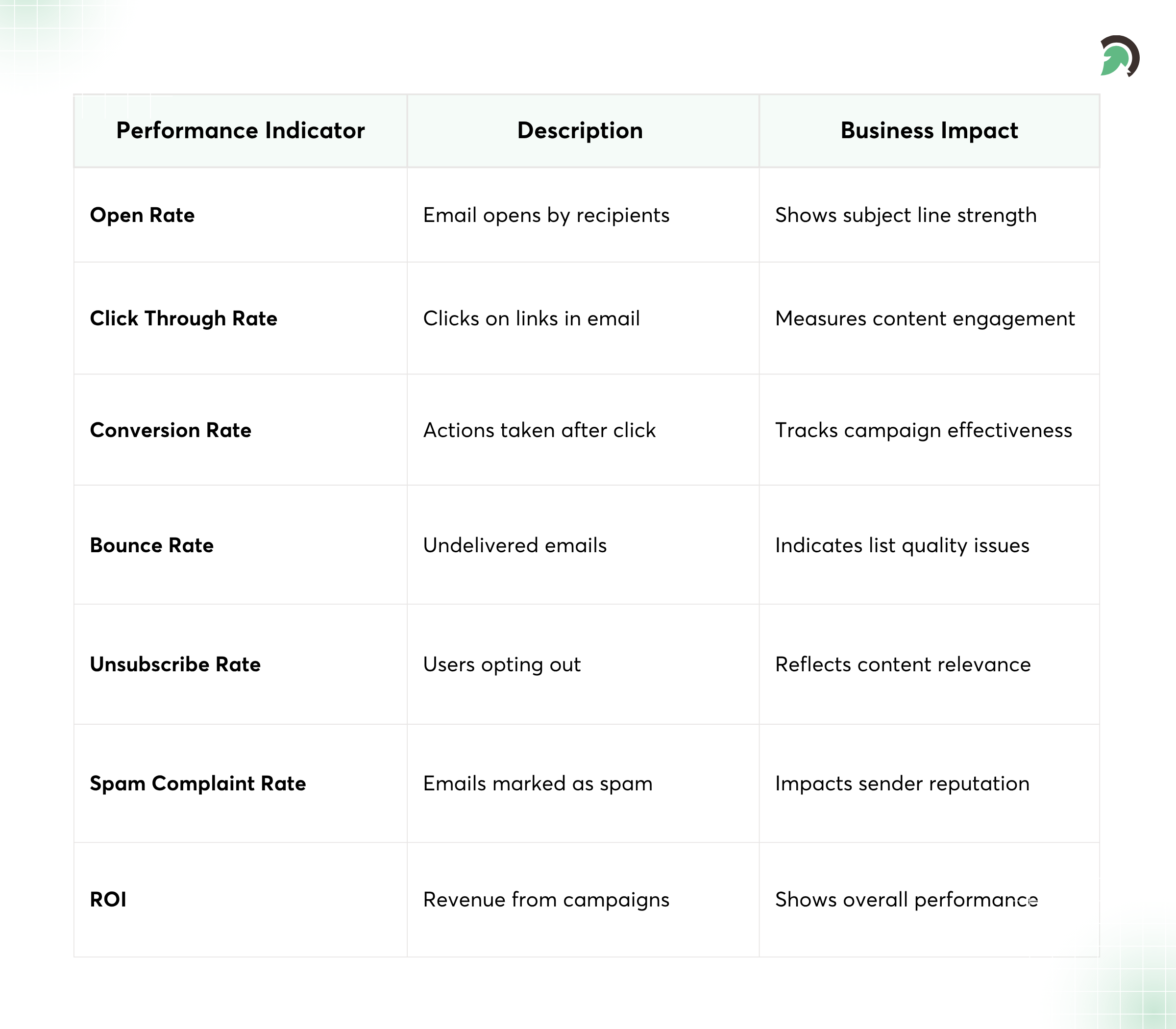
Core Metrics for Email Campaign Performance
Email Marketing Cost and Pricing
Email marketing is generally more affordable than many other channels, especially when considering its long-term return. Most tools offer tiered pricing, allowing businesses to start with basic plans and grow into more advanced features.
Costs can vary based on the size of your list, the level of automation needed, and whether advanced reporting or integrations are included. Even so, the channel is widely regarded as cost-effective because it supports both acquisition and retention.
Cost usually depends on:
- Number of subscribers
- Features and automation level
- Reporting and integration needs
This makes email a practical option for both small businesses and larger teams.
Common Email Marketing Mistakes to Avoid
Many email campaigns underperform not because the channel is weak, but because the execution is poor. Common mistakes often reduce engagement, hurt deliverability, and weaken trust over time.
Businesses frequently send irrelevant emails, overlook segmentation, or fail to analyze campaign performance. Others email too often or use weak subject lines that do not create enough interest.
Common mistakes include:
- Sending irrelevant or generic content
- Ignoring segmentation
- Using weak subject lines
- Over-emailing subscribers
- Failing to review performance data
Avoiding these issues can immediately improve the effectiveness of your campaigns.
Email Marketing Best Practices
Strong email marketing results usually come from doing the basics well and improving consistently over time. Best practices help businesses stay focused on quality, relevance, and user experience.
While strategies may vary, there are a few habits that almost always lead to better performance.
Helpful best practices include:
- Keep a consistent sending schedule
- Test subject lines, formats, and CTAs
- Personalize where it adds value
- Optimize emails for mobile devices
- Clean your list regularly
Strengthen Email Marketing With Proven Best Practices
These practices support stronger engagement and more sustainable results.
Email Marketing Examples and Use Cases
Email marketing works across a wide range of industries because it can be adapted to different business models and audience needs. The same core channel can be used for promotions, onboarding, support, retention, and relationship building.
For example, e-commerce brands use email to recover carts and promote products, while SaaS businesses often use it for onboarding and feature adoption. B2B companies rely on email for lead nurturing and education, while service brands use it to maintain ongoing communication.
Examples include:
- E-commerce: promotions and cart recovery
- SaaS: onboarding and product updates
- Fintech: alerts and customer notifications
- B2B: lead nurturing and relationship building
Its flexibility is one of the biggest reasons email continues to perform so well.
Conclusion
Email marketing remains one of the most practical and powerful channels for building relationships, increasing engagement, and driving business growth. It supports the entire customer journey, from first interaction to long-term retention, while offering strong control and measurable outcomes.
With the right strategy, tools, and execution, businesses can create email campaigns that are not only effective in the short term but also valuable over time. Whether your goal is lead generation, conversion, or retention, email marketing remains a smart and scalable investment. If you are looking to strengthen your email marketing efforts, EvinceDev can help with strategy, campaign planning, automation, template design, and performance-focused execution tailored to your business goals.