

Key Takeaways:
- Fintech Is Reshaping Finance: Technology is changing how financial services are delivered, making them faster, more accessible, and more user-focused.
- Development Goes Beyond Apps: Fintech software development includes platforms, integrations, compliance systems, and backend infrastructure, not just customer-facing products.
- Security and Compliance Are Essential: Strong data protection, fraud prevention, and regulatory readiness are core to building trusted fintech products.
- Custom Solutions Create Long-Term Value: Tailored fintech products offer better scalability, flexibility, and business alignment than generic software.
- The Right Strategy Drives Better Outcomes: Success in fintech depends on choosing the right technology, development process, and expert partner from the start.
Financial services are undergoing a major digital shift. From the way people pay for goods to how businesses assess risk and stay compliant, technology is changing how the financial world operates. Users now expect instant transactions, seamless mobile experiences, and highly secure platforms. This shift has pushed financial institutions, startups, and enterprises to invest heavily in smarter digital products.
At the center of this shift is FinTech software development, which helps businesses create digital solutions that are fast, secure, and scalable. From digital banking systems to lending platforms and payment ecosystems, FinTech is helping organizations improve efficiency and deliver better customer experiences.
This blog explains what FinTech software development means, why it matters, what types of solutions it includes, and what businesses should consider before building one. The goal is to keep the content useful for both industry leaders and general readers looking to understand the space more clearly.
Quick Stat:
According to the Mordor Intelligence report, the global fintech market is projected to grow from $320.81 billion in 2025 to $652.80 billion by 2030, at a 15.27% CAGR.
Why Is FinTech Growing So Fast?
The growth of FinTech is not happening by chance. It is being driven by a mix of customer expectations, new technologies, and industry-wide pressure to modernize financial services.
A few major factors are accelerating this growth:
- Digital-first behavior; Consumers and businesses increasingly prefer managing finances online instead of relying on traditional branches or paper-heavy processes.
- Demand for speed: Real-time payments, faster approvals, and instant account access have become basic expectations.
- Mobile adoption: Smartphones have made financial services more accessible, especially for users who expect banking and payments on the go.
- Open banking and APIs: Financial providers can now integrate with third-party tools more efficiently, enabling more connected and flexible services.
- Shift toward cashless ecosystems: Digital payments, mobile wallets, and online transactions are replacing traditional cash-based systems in many markets.
This rising demand is pushing organizations to invest in modern FinTech software solutions that can help them stay relevant, improve service delivery, and scale with confidence.
Quick Stat:
According to KPMG, global fintech investment reached $116 billion in 2025, signaling a strong recovery and continued investor confidence in the fintech sector.
What Is FinTech Software Development?
FinTech software development is the process of designing, building, and maintaining digital products that deliver financial services through technology. These products may be created for banks, lenders, insurers, investment firms, payment companies, or startups entering the financial space.
It can include the development of:
- Mobile applications
- Web applications
- Enterprise financial platforms
- APIs and backend systems
- Compliance and risk tools
- Data analytics systems
Unlike traditional financial systems, which are often slow to update and difficult to scale, modern FinTech products are built to support:
- Faster transactions
- Better user experience
- Stronger data security
- Easier integrations
- High transaction volumes
In practical terms, FinTech software development covers everything from customer-facing apps to the infrastructure that supports financial transactions behind the scenes.
Common examples include:
- Mobile banking applications
- Investment and trading platforms
- Lending and underwriting systems
- Insurance claim management tools
- Payment gateways and money transfer apps
This is why financial software development today goes far beyond digitizing a manual process. It is about building secure and intelligent systems that improve how money is stored, moved, borrowed, invested, and protected.
Quick Stat:
According to the McKinsey report, FinTechs accounted for $150 billion to $205 billion of the global banking sector’s net revenue in 2022 and are projected to grow at about three times the overall banking industry’s growth rate through 2028.
What Types of Fintech Software Solutions Are Available?
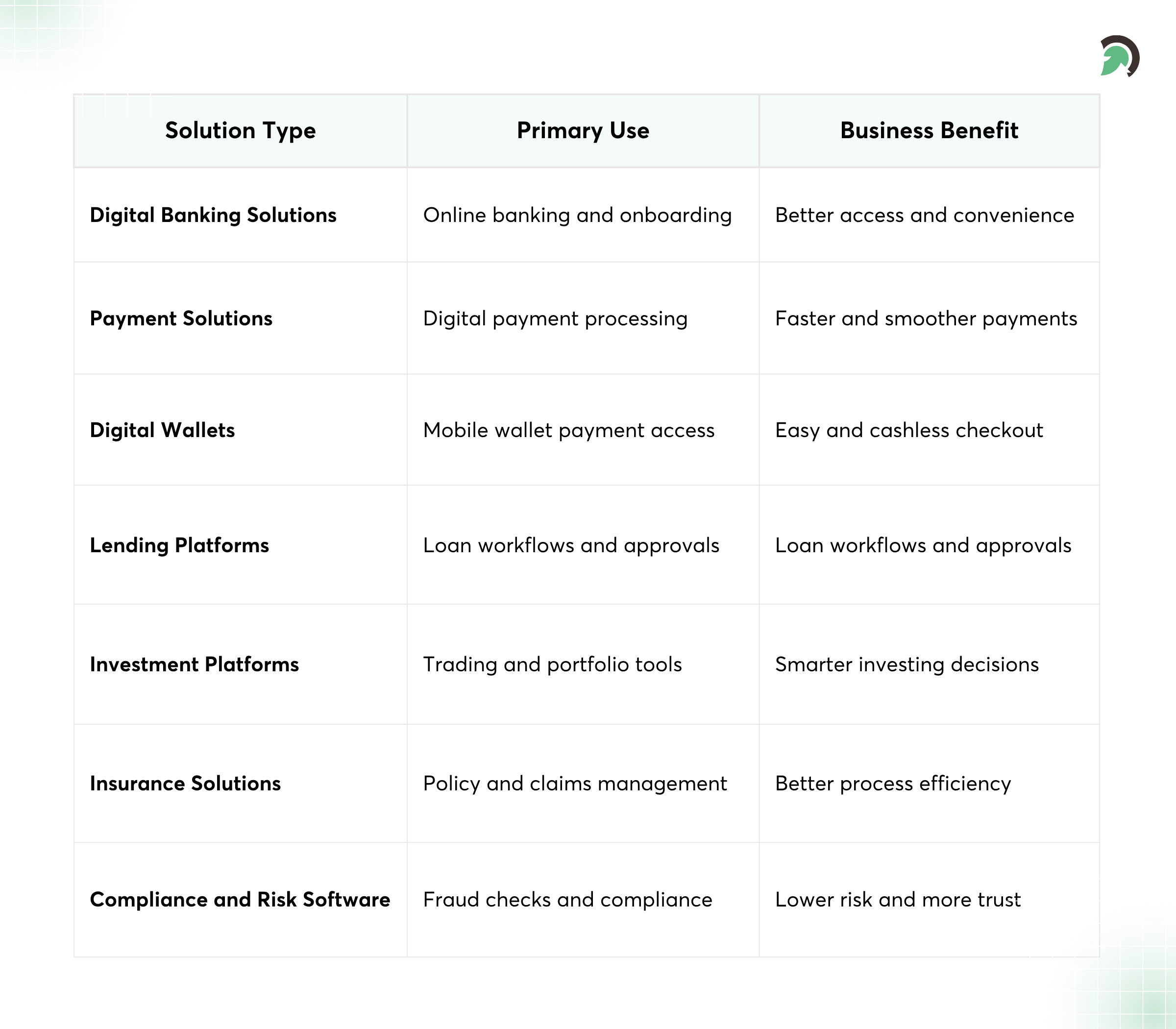
FinTech is a broad space, and not every solution serves the same purpose. Some products are built for consumers, while others focus on enterprise operations, regulatory processes, or financial infrastructure.
Below are the most common categories of FinTech software.
Digital Banking Solutions
These solutions help banks and financial institutions offer services digitally. They often include:
- Online banking portals
- Account management dashboards
- Customer onboarding systems
- Transaction history and reporting features
Payment Solutions
Payment products are among the most visible examples of FinTech innovation. Many companies invest in payment system development to improve how users send, receive, and process money.
Examples include:
- Payment gateways
- Merchant payment systems
- Peer-to-peer payment apps
- Cross-border payment platforms
Digital Wallets
Businesses building consumer payment ecosystems often focus on digital wallet development to offer fast and convenient payment experiences.
These solutions may include:
- Mobile wallets
- Stored-value wallets
- Contactless payment systems
- QR-code payment experiences
Lending and Credit Platforms
These products help lenders streamline loan processing, automate underwriting, and assess borrower eligibility more accurately.
They often include:
- Loan origination systems
- Credit scoring engines
- Underwriting workflows
- Borrower management portals
Investment and Wealth Management Tools
These platforms support investors, wealth advisors, and fintech companies offering modern portfolio services.
Examples include:
- Trading apps
- Robo-advisors
- Portfolio tracking dashboards
- Financial planning tools
Insurance Technology Solutions
Insurance-focused fintech products improve policy management, claims processing, and risk analysis.
These may include:
- Policy administration systems
- Claims management platforms
- Premium calculators
- Customer self-service portals
Compliance and Risk Solutions
Security and trust are central to fintech. That is why many businesses invest in fintech risk management software and compliance-driven systems.
These can include:
- Fraud monitoring platforms
- Identity verification systems
- Transaction monitoring tools
- Regulatory reporting systems
KYC and AML Tools
For organizations handling onboarding and compliance, KYC AML automation software plays a major role in reducing manual work while improving verification accuracy.
What Features Make FinTech Applications Effective?
A FinTech product is not successful just because it works. It must also be secure, easy to use, and capable of handling financial operations without delays or errors.
The strongest products usually combine practical user features with advanced backend capabilities.
Essential Features
- Secure authentication: Users expect strong login protection, often including biometric login or multi-factor authentication.
- Account management: Customers should be able to view balances, update details, manage cards, and track activities easily.
- Real-time transactions: Payments, transfers, and account updates need to happen with speed and accuracy.
- Notifications and alerts: Instant transaction updates improve transparency and help users detect suspicious activity quickly.
Advanced Features
- Fraud detection: Intelligent systems can monitor behavior and flag unusual activity before it becomes a serious risk.
- Analytics and reporting: Businesses and users benefit from insights that help them understand spending, revenue, or transaction trends.
- API integrations: Modern platforms rely on APIs to connect with banks, payment providers, identity services, and analytics tools.
- Scalable cloud infrastructure: FinTech systems need to support traffic spikes, large datasets, and high transaction volumes without performance issues.
A good FinTech product balances convenience with trust. That balance is what makes FinTech app development especially important in a market where users are highly sensitive to both usability and security.
FinTech Application Development
FinTech application development focuses on building user-facing digital products that allow people and businesses to interact with financial services more efficiently. These applications may be mobile-first, web-based, or built across multiple platforms, depending on the business model.
A strong FinTech application is usually shaped by three priorities:
- Ease of use
- Security
- Performance
For example, a lending app must make it easy for users to submit documents and track loan status, while also protecting financial data and processing information accurately. A digital banking app must feel simple for the user, but behind the scenes, it needs strong architecture and secure integrations.
This is where FinTech development services become valuable. The right development approach helps businesses create apps that are not only functional but also scalable and aligned with long-term product goals.
FinTech Platform Development
While applications are often focused on end users, FinTech platform development usually supports broader ecosystems. A platform may serve multiple types of users, enable integrations, and power multiple services from one centralized environment.
A FinTech platform can support:
- Customers
- Internal teams
- Financial institutions
- Vendors
- Compliance stakeholders
Examples of FinTech platforms include:
- Lending marketplaces
- Banking-as-a-service environments
- Payment orchestration systems
- Enterprise wealth management systems
These platforms often require more complex architecture because they must support integrations, permissions, workflows, reporting, and large-scale transaction processing. This is why platform development usually demands a deeper focus on backend design, API infrastructure, and long-term scalability.
Technology Stack Used in FinTech
The technology stack behind a FinTech product directly affects performance, flexibility, and security. The right stack depends on the product type, the expected scale, compliance needs, and the integrations required.
Frontend Technologies
These tools shape the user interface and user experience:
- React
- Angular
- Vue.js
Backend Technologies
These frameworks and languages support business logic, data handling, and system performance:
- Node.js
- Java
- Python
- .NET
Databases
FinTech systems often require a combination of structured and flexible data storage:
- PostgreSQL
- MySQL
- MongoDB
Cloud Infrastructure
Cloud services help FinTech products scale while maintaining system reliability:
- AWS
- Microsoft Azure
- Google Cloud
Advanced Technologies
Depending on the use case, FinTech teams may also use:
- Artificial intelligence and machine learning
- Blockchain frameworks
- Big data processing tools
- Real-time analytics engines
Technology choices should not be made only for speed of development. In FinTech, they must also support compliance, security, and future scalability.
What Does the FinTech Development Process Look Like?
A reliable FinTech development process is one of the biggest factors behind product quality and long-term success. Since FinTech solutions deal with sensitive data, transactions, and regulations, the process needs to be more structured than a typical software project.
1. Requirement Analysis
This stage defines what the product needs to achieve. Teams gather business goals, user expectations, market context, and technical requirements.
2. Planning and Compliance Review
Before development begins, it is important to identify legal and security requirements. This step reduces risk and prevents costly redesign later.
3. UI and UX Design
Design teams create user journeys, wireframes, and interfaces that simplify complex financial tasks for users.
4. Development and Integrations
This is where the product is built. Core modules, APIs, databases, and third-party integrations are developed and connected.
5. Testing
Testing in FinTech must go beyond functionality. It usually includes:
- Security testing
- Performance testing
- Compliance checks
- Integration testing
- User acceptance testing
6. Deployment
Once the product is ready, it is launched in a production environment with the required infrastructure and monitoring in place.
7. Maintenance and Optimization
After launch, continuous support is needed to fix issues, improve features, adapt to regulations, and strengthen security.
A clear development lifecycle is essential for any company planning custom FinTech software development, especially when the goal is to build a product that can evolve over time.
Why Are Compliance and Security So Important in FinTech?
In FinTech, trust is everything. A single breach, failed transaction, or compliance gap can damage reputation and create major legal and financial consequences. That is why FinTech compliance and security cannot be treated as an afterthought.
Security priorities in FinTech include:
- Data encryption
- Secure APIs
- Role-based access control
- Multi-factor authentication
- Continuous monitoring
Compliance priorities often include:
- KYC and AML checks
- Data privacy rules
- Payment security standards
- Recordkeeping and audit readiness
- Fraud prevention procedures
The exact regulations vary by geography and business model, but the principle remains the same: FinTech products must be built to protect users, data, and transactions from the start.
For businesses, this means compliance and security should shape product architecture, workflows, and testing, not just legal documentation.
Benefits of Custom FinTech Software Development
Off-the-shelf products may work for some needs, but they often fall short when businesses want flexibility, differentiation, or deeper control. That is why many organizations choose custom FinTech software development instead.
The biggest benefits include:
- Tailored functionality: Custom systems are designed around specific business models, workflows, and customer needs.
- Better scalability: Businesses can expand the platform as transaction volume, users, or services grow.
- Stronger control over security: Teams can build security layers based on exact compliance and operational needs.
- Competitive advantage: Unique features and workflows help a company stand out in a crowded market.
- Flexible integration options: Custom systems can connect more effectively with internal tools, external providers, and legacy platforms.
For growing businesses, custom development often creates more long-term value than generic software that limits innovation.
What Challenges Come With Financial Software Development?
Despite its potential, FinTech development comes with serious complexity. Building a successful product requires technical depth, compliance awareness, and a clear business strategy.
Some of the most common challenges include:
- Regulatory complexity: Different countries and product categories have different rules, which can affect product design and timelines.
- High security expectations: Financial data is highly sensitive, so even small vulnerabilities can create major risks.
- Legacy system integration: Many financial organizations still depend on older systems that are difficult to connect with modern tools.
- Performance requirements: FinTech products often need to process large volumes of transactions without delay.
- User trust: People expect financial products to be stable, transparent, and easy to use.
These challenges are exactly why businesses should approach FinTech as a specialized discipline rather than a standard software category.
What Factors Influence the Cost of FinTech Development?
The total investment required for a FinTech product can vary widely depending on the business model, feature set, compliance requirements, and product scale.
Some of the biggest cost drivers include:
- Product complexity
- Number of integrations
- Security and compliance requirements
- Platform choice
- Team expertise
- Ongoing maintenance needs
For example, a basic MVP may require a much smaller investment than an enterprise-grade lending or banking platform with multiple integrations and strict compliance controls. Businesses planning a project should also think beyond launch costs and consider long-term support, optimization, and infrastructure costs tied to FinTech development cost.

What Trends Are Shaping the Future of FinTech?
The FinTech market continues to evolve, and businesses that understand emerging trends are better positioned to build relevant and future-ready solutions.
Key trends include:
- Artificial intelligence in finance: AI is being used for fraud detection, underwriting, personalization, and financial insights.
- Embedded finance: Non-financial platforms are integrating payment, lending, and insurance capabilities directly into user experiences.
- Open banking: API-driven ecosystems are enabling better collaboration and product innovation across financial services.
- Blockchain and digital assets: Distributed technologies continue to influence payments, identity, and transaction transparency.
- Automation in compliance and risk management: More businesses are investing in systems that reduce manual work while improving regulatory accuracy.
These trends are shaping not only the future of products but also the strategic direction of FinTech businesses worldwide.
How Do You Choose the Right FinTech Development Partner?
Choosing a development partner is one of the most important decisions in any FinTech initiative. A capable partner does more than build software. They help shape product direction, reduce risk, and support long-term growth.
When evaluating a partner, look for:
- Proven FinTech project experience
- Strong understanding of compliance and security
- Ability to build scalable systems
- Experience with third-party integrations
- Clear communication and delivery processes
The right partner should understand both the technical and business sides of FinTech. That balance is what allows a product to succeed in a competitive and highly regulated industry.
Conclusion
FinTech has moved far beyond being a fast-growing technology segment. It now plays a central role in how modern financial services are delivered, improved, and scaled. Across banking, lending, payments, insurance, and investment, businesses are adopting digital systems to meet rising customer expectations and operate with greater speed and efficiency.
At the heart of this shift is FinTech software development, helping organizations build secure, scalable, and user-friendly solutions tailored to modern financial needs. Whether the objective is to launch a payment platform, improve internal operations, or create a new financial product, the right development approach can shape long-term business success.
For companies entering this space, the opportunity is not just to digitize financial services, but to do it in a way that strengthens trust, supports compliance, and adapts to future market demands.
At EvinceDev, we help businesses turn FinTech ideas into reliable digital solutions through strong architecture, compliance-aware development, and scalable engineering practices. From customer-facing applications to enterprise platforms, our team focuses on building technology that supports real business goals.