

Key Takeaways
- AI in RegTech: AI enhances compliance by automating processes, improving risk detection, and enabling faster decision-making across systems.
- Faster Compliance: AI-powered tools reduce manual effort, speed up onboarding, and streamline compliance workflows for better efficiency.
- AML Optimization: AI helps reduce false positives in AML monitoring, allowing teams to focus on high-risk alerts and improve accuracy.
- Real-Time Risk: AI enables real-time monitoring of transactions and behavior, helping businesses detect risks before they escalate.
- Smart KYC Flow: AI simplifies KYC with automated verification, data extraction, and continuous monitoring of customer risk profiles.
- Audit Readiness AI ensures better audit preparedness by automating evidence collection and maintaining detailed compliance records.
Regulatory compliance has become more complex, data-heavy, and time-sensitive than ever. Financial institutions, fintech companies, insurers, healthcare businesses, and enterprises operating across multiple jurisdictions must constantly respond to changing laws, rising customer expectations, fraud risks, cybersecurity threats, and audit demands.
Traditional compliance models are no longer enough. Manual reviews, disconnected spreadsheets, legacy rule-based systems, and delayed reporting create operational bottlenecks. They also make it difficult for businesses to detect risk early, prove compliance, and scale confidently.
This is where AI-powered RegTech solutions are changing the way organizations manage compliance. By combining regulatory technology with artificial intelligence, businesses can automate routine checks, analyze large volumes of data, detect suspicious activity faster, and build more proactive compliance operations.
Instead of treating compliance as a reactive function, organizations can use AI to make it continuous, predictive, and embedded into everyday workflows.
This blog covers what AI-powered RegTech solutions are, why businesses need them, how AI transforms the compliance lifecycle, key use cases, major benefits, implementation challenges, platform selection criteria, success metrics, and the future of AI in RegTech.
Quick Stat:
According to IBM, the average cost of a data breach reached $4.45 million globally in 2023, reinforcing the need for strong compliance and data governance.
What Are AI-Powered RegTech Solutions?
RegTech, or regulatory technology, refers to software and digital systems that help businesses meet regulatory requirements more efficiently. It includes tools for KYC, AML, fraud detection, reporting, audit management, transaction monitoring, sanctions screening, and regulatory change management.
When artificial intelligence is added to RegTech, these systems become more intelligent and adaptive. AI-powered RegTech solutions leverage machine learning, natural language processing, predictive analytics, automation, and intelligent document processing to enable faster, more accurate compliance decisions.
In simple terms, AI in RegTech helps organizations move beyond static rule-based checks. Instead of relying solely on predefined conditions, AI models can identify patterns, flag anomalies, analyze unstructured documents, and continuously improve as new data arrives.
This makes AI-driven regulatory technology especially valuable in industries where risk patterns change quickly and compliance requirements are strict.
Why Businesses Need AI in RegTech?
Compliance teams today are expected to manage growing regulatory complexity, faster customer onboarding, advanced fraud risks, and stronger audit expectations, often with limited resources.
At the same time, many organizations still rely on fragmented systems. Customer data, transaction records, audit evidence, and risk reports may sit across different platforms, making it difficult to build a complete view of compliance risk.
AI in RegTech helps address these challenges by connecting data, analyzing it at scale, and identifying the risks that need immediate attention. Instead of manually reviewing thousands of alerts, compliance teams can use AI models to prioritize high-risk cases and reduce unnecessary manual effort.
However, AI should not replace human judgment. Strong AI for regulatory compliance works best when it supports compliance experts by providing faster insights, greater accuracy, and clearer decision-making.
Quick Stat:
According to Gartner, poor data quality costs organizations an average of $12.9 million per year, highlighting the financial impact of inaccurate and inconsistent data.
How AI Transforms the Compliance Lifecycle
AI can support every stage of the compliance lifecycle, from monitoring and interpretation to detection, action, and reporting.
1. Monitoring
AI can continuously monitor customer activity, transactions, documents, communications, and regulatory updates. This allows businesses to identify risks earlier instead of waiting for periodic reviews.
For example, AI-driven compliance solutions can monitor transactions in real time and flag unusual activity based on behavior, transaction size, geography, customer history, and risk profile.
2. Interpretation
Regulatory documents are often long, technical, and difficult to interpret. Natural language processing can help scan new regulations, extract obligations, summarize changes, and map requirements to internal policies.
This is especially useful for multinational companies that must track changes across several jurisdictions.
3. Detection
Machine learning models can detect suspicious patterns that traditional rule-based systems may miss. These patterns may include unusual payment behavior, identity inconsistencies, fraud signals, or suspicious relationships between entities.
RegTech AI solutions improve detection by learning from historical cases and adapting to new risk indicators.
4. Action
Once a risk is detected, automation can route the case to the right team, assign priority, trigger workflows, request missing documents, or escalate issues for review.
This reduces delays and ensures that compliance teams focus on the most important cases first.
5. Reporting and Evidence
Compliance is not just about doing the right checks. It is also about proving that those checks were performed correctly.
AI-enabled regulatory technology software can generate reports, maintain audit trails, document decision logic, and support evidence collection. This improves audit readiness and regulatory transparency.
Key Use Cases of AI-Powered RegTech Solutions
AI-powered RegTech solutions support multiple compliance functions by improving speed, accuracy, and risk visibility. Some of the most important use cases include:
1. KYC and Customer Onboarding
AI helps automate identity verification, document checks, customer risk profiling, and data extraction. It also supports perpetual KYC by continuously monitoring customer risk instead of relying only on one-time onboarding checks.
2. AML and Transaction Monitoring
AI-driven compliance solutions can analyze transaction patterns, detect suspicious behavior, reduce false positives, and prioritize high-risk alerts. This helps compliance teams investigate potential money laundering risks more efficiently.
Quick Stat:
According to UNODC, the estimated amount of money laundered each year globally is 2% to 5% of global GDP, or $800 billion to $2 trillion.
3. Sanctions and Watchlist Screening
AI improves name matching, entity resolution, adverse media checks, and ownership analysis. This makes sanctions screening more accurate, especially when dealing with spelling variations, incomplete data, or complex entity structures.
4. Regulatory Change Management
AI for regulatory compliance can scan regulatory updates, summarize key changes, classify them by relevance, and map them to internal policies or business processes. This helps organizations respond faster to new requirements.
5. Fraud Detection
AI can detect anomalies across transactions, devices, locations, customer behavior, and historical activity. This is especially useful in fintech software development, where businesses need secure yet seamless digital experiences.
Quick Stat:
According to ACFE’s 2024 Report to the Nations, organizations lose an estimated 5% of revenue to fraud each year.
6. Compliance Audits
AI supports automated evidence collection, control testing, gap identification, and audit-ready reporting. This helps organizations reduce audit preparation time and move toward continuous compliance monitoring.
7. Data Privacy and Governance
AI can identify sensitive data, classify records, monitor access, detect privacy risks, and support governance workflows. This is increasingly important as organizations handle larger volumes of customer and financial data.
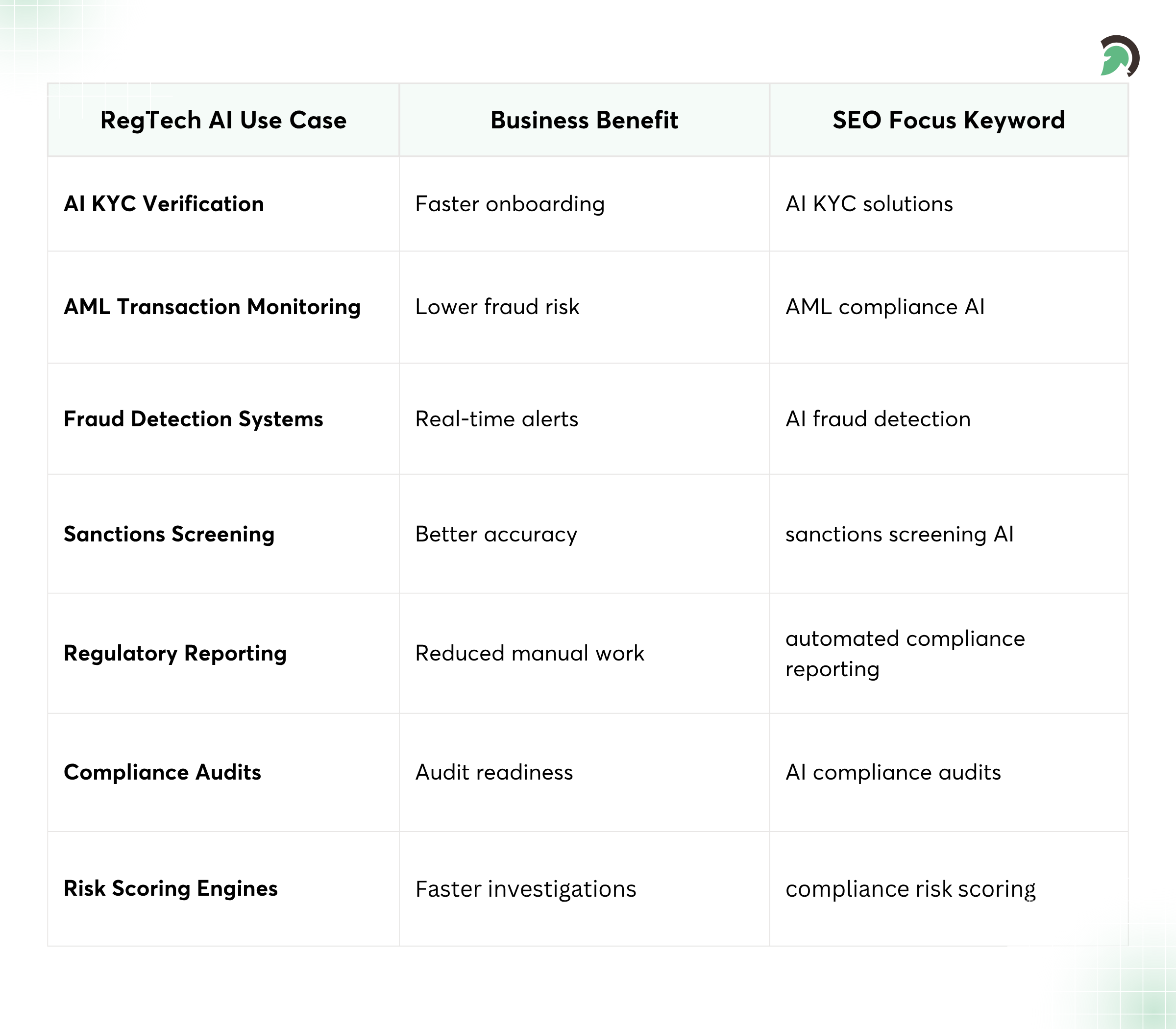
Benefits of AI-Powered RegTech Solutions
- Greater Efficiency: AI reduces manual effort by automating repetitive compliance tasks. This allows compliance teams to spend more time on analysis, investigation, and strategic risk management.
- Faster Risk Detection: AI models can process large volumes of data in real time. This helps organizations detect suspicious activity faster and respond before risks escalate.
- Lower False Positives: One of the biggest advantages of RegTech AI solutions is improved alert quality. By analyzing context and behavior, AI can reduce unnecessary alerts and help analysts focus on high-priority cases.
- Better Regulatory Readiness: AI can maintain detailed logs, reports, and evidence trails. This makes it easier to demonstrate compliance during audits or regulatory reviews.
- Improved Customer Experience: Fast and accurate compliance checks can reduce onboarding friction. Customers can be verified more quickly without compromising risk controls.
- Stronger Scalability: As businesses grow, compliance workloads increase. AI-powered RegTech solutions allow organizations to scale monitoring, reporting, and risk detection without increasing manual work at the same rate.
Challenges Businesses Must Address
AI offers significant advantages, but successful adoption requires careful planning.
Data Quality
AI depends on accurate, complete, and well-structured data. Poor data quality can lead to inaccurate risk scores, missed alerts, or unfair outcomes. Before implementing AI-driven compliance solutions, organizations must assess data sources, remove duplicates, standardize formats, and establish governance rules.
Explainability
Regulators and internal stakeholders need to understand how compliance decisions are made. If an AI model flags a transaction or assigns a risk score, the organization should be able to explain why.
Explainable AI is therefore essential in compliance environments.
Model Drift
AI models can become less accurate over time as customer behavior, fraud tactics, or regulatory expectations change. Businesses must monitor model performance and retrain models when needed.
Privacy and Security
Compliance systems often process sensitive customer and financial data. Strong encryption, access controls, data minimization, and privacy safeguards are essential.
Legacy System Integration
Many organizations still operate legacy banking, payment, or enterprise systems. Integrating modern regulatory technology software with older infrastructure can be complex.
This is where experienced compliance software development and integration teams can help.
Human Oversight
AI should support human decision-making, not replace accountability. Compliance teams must remain involved in reviewing high-risk cases, approving decisions, and managing exceptions.
What to Look for in an AI RegTech Platform
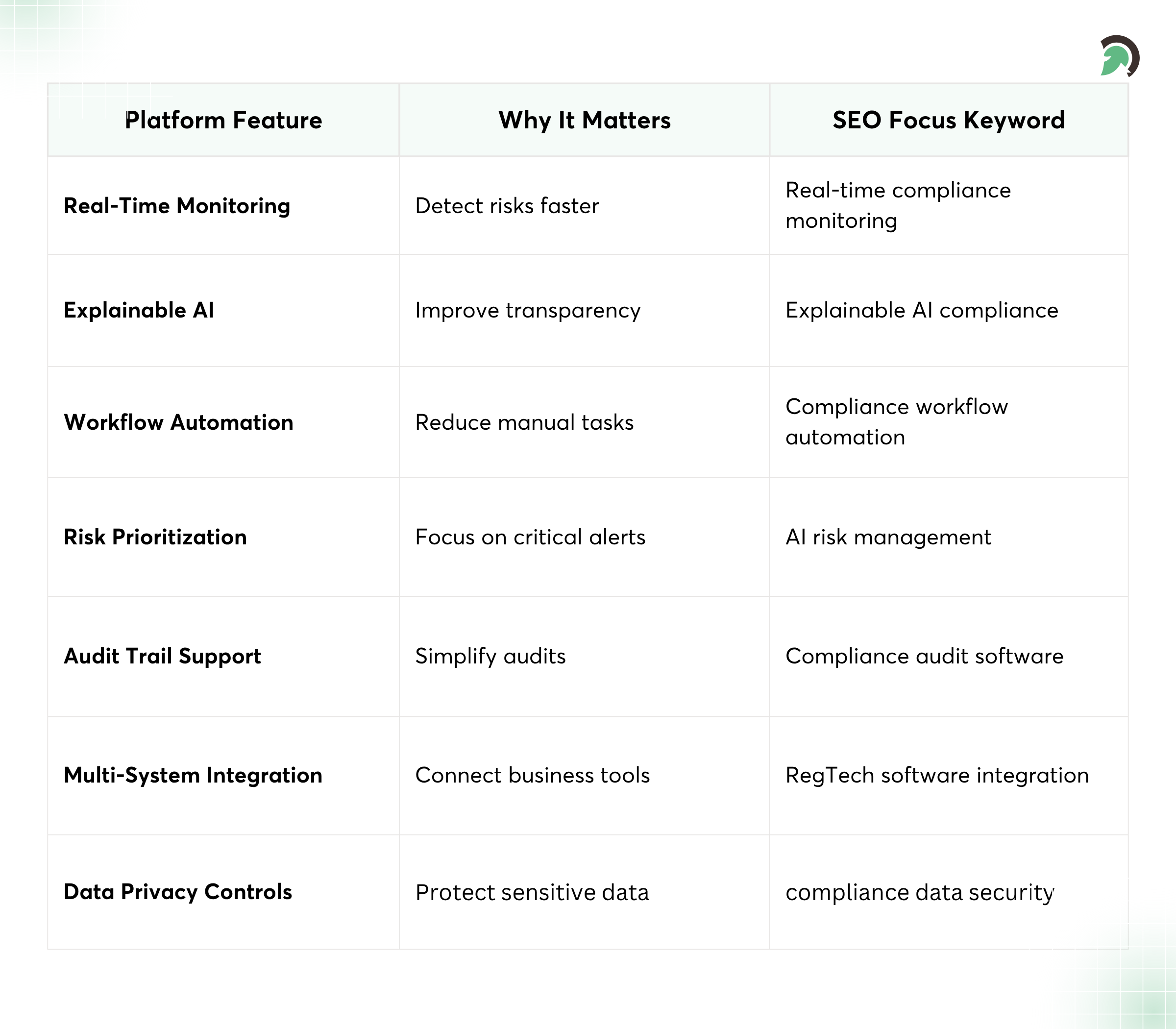
When evaluating AI-powered RegTech solutions, businesses should look beyond basic automation and focus on whether the platform can support long-term compliance maturity. A strong AI RegTech platform should not only detect risks but also explain decisions, integrate with existing systems, support audit readiness, and adapt as regulations evolve.
Key capabilities to look for include:
- Real-time monitoring capabilities for transactions, customer activity, and regulatory changes
- Explainable AI and transparent decision logic to support regulatory confidence
- Strong data governance, including data quality, lineage, access control, and validation
- Flexible workflow automation for case management, approvals, escalations, and reporting
- Seamless integration with existing banking, fintech, CRM, ERP, payment, and data systems
- Audit trail and reporting features that make it easier to prove compliance
- Risk scoring and alert prioritization to help teams focus on high-risk cases first
- Human review and escalation controls for accountability and informed decision-making
- Security and privacy compliance to protect sensitive financial and customer data
- Support for multiple regulatory requirements across markets and jurisdictions
- Scalable architecture that can handle growing data volumes, users, and compliance workflows
- Configurable dashboards and analytics for better visibility into compliance performance
For companies with unique workflows, custom RegTech software development services may be more effective than off-the-shelf tools. Custom solutions allow businesses to align compliance logic, integrations, reporting, risk models, and user experience with their specific operating model. They also make it easier to build specialized features for KYC, AML, fraud detection, regulatory reporting, or internal audit processes.
How to Implement AI-Powered RegTech Solutions Successfully?
Step 1: Identify Compliance Pain Points
The first step is to identify where compliance teams face the most friction. This may include slow onboarding, excessive AML alerts, manual reporting, audit delays, or poor visibility into risk.
Step 2: Assess Data Readiness
Businesses should review their data quality, availability, ownership, and governance. AI models perform best when data is consistent, accessible, and reliable.
Step 3: Select a High-Impact Use Case
Rather than trying to transform everything at once, organizations should begin with a focused use case. For example, they may start with AML alert prioritization, automated document review, or regulatory change tracking.
Step 4: Build Governance Early
Governance should not be added after deployment. Businesses should define model validation processes, review responsibilities, documentation standards, and escalation rules from the beginning.
Step 5: Integrate With Existing Systems
AI-powered compliance tools should connect with customer databases, transaction systems, case management tools, reporting platforms, and audit systems.
Step 6: Measure Results
Success should be measured using clear metrics such as false-positive reduction, onboarding time, alert review time, audit preparation effort, and compliance cost savings.
Step 7: Scale Gradually
Once the pilot proves successful, businesses can expand AI capabilities across other compliance areas.
Metrics to Measure Success
To evaluate the impact of AI-driven compliance solutions, organizations should track both operational and risk-related metrics.
Important metrics include:
- Reduction in false positives
- Average alert resolution time
- Customer onboarding time
- Cost per compliance review
- Number of automated checks
- Audit preparation time
- Suspicious activity detection accuracy
- Regulatory change response time
- Manual effort saved
- Compliance breach reduction
These metrics help businesses understand whether their investment in AI for regulatory compliance is producing measurable value.
The Future of AI in RegTech
The future of AI in RegTech will be shaped by greater automation, stronger governance, and more intelligent decision support.
AI compliance assistants may help teams summarize regulations, draft internal policies, prepare reports, and answer compliance questions. Predictive analytics will allow organizations to identify emerging risks before they become major issues.
We can also expect more focus on AI governance. As organizations use AI more widely, they will need tools to manage model risk, bias, explainability, and accountability.
In the long term, AI-driven regulatory technology will become a core part of digital operations, especially for financial institutions and fintech companies that need to move quickly while staying compliant.
Conclusion
Compliance is no longer a back-office function that only reacts to regulatory pressure. It is now a strategic capability that affects customer trust, operational efficiency, risk management, and business growth.
AI-powered RegTech solutions help organizations modernize compliance by automating repetitive tasks, improving risk detection, reducing false positives, and strengthening audit readiness. However, successful adoption requires more than technology. Businesses must also invest in data quality, governance, explainability, integration, and human oversight.
As regulatory complexity continues to grow, companies that adopt intelligent and well-governed RegTech AI solutions will be better positioned to manage risk, scale operations, and stay ahead of change. Businesses looking to build tailored financial compliance software, regulatory technology software, or risk management platforms can partner with EvinceDev for custom fintech software development, compliance software development, and RegTech software development services.