

Key Takeaways:
- Visibility First: SEO improves search visibility and attracts new users through intent aligned content and technical optimization.
- Conversions Matter: CRO focuses on turning existing traffic into leads and sales by reducing friction and confusion.
- SEO Performance Signals: SEO success is measured through rankings, organic traffic growth, and authority across targeted keywords.
- CRO Performance Signals: CRO success is tracked through conversion rate, bounce reduction, and revenue per visitor metrics.
- SEO Execution Areas: SEO relies on keyword research, structured content, internal linking, and credibility building signals.
- CRO Execution Areas: CRO improves landing pages using testing, clearer CTAs, and smoother user journeys.
- Growth Multiplier Effect: SEO fills the pipeline while CRO increases yield, improving overall digital marketing efficiency.
- Shared Data Advantage: CRO behavior data informs SEO content decisions, while SEO intent data improves CRO messaging.
You can rank on page one and still feel stuck. Traffic rises, dashboards look busy, but revenue barely moves. That happens when SEO is treated as the finish line instead of the entry point. Real growth comes from pairing visibility with conversion thinking, so every visit has a clear path to action. SEO brings the right people in, CRO builds the trust and clarity that turns those visits into leads and sales. Together, they create a performance system that makes results more predictable and budget spending more efficient.
Read this blog to learn the difference between SEO and CRO, when to prioritize each, and how to align both to turn traffic into consistent conversions.
What SEO Does and What It Does Not Do
SEO (search engine optimization) improves your website’s visibility in organic search results. It helps you gain visibility for queries your audience is already searching for. That visibility can reduce your reliance on paid advertising and compound value over time, especially when you consistently publish useful content and improve site performance.
However, SEO does not automatically turn visitors into customers. A high ranking can bring large traffic spikes, but if your landing pages are unclear, slow, or untrustworthy, users will leave quickly. That is why SEO should be measured beyond traffic alone. You should connect it to pipeline and revenue performance whenever possible.
What SEO typically improves
- Organic visibility for valuable search queries
- Website discoverability across top-of-funnel and mid-funnel intent
- Long-term authority in your niche
- Click-through rate when snippets are well written
Where SEO alone can fall short
- Visitors land but do not take action
- Pages rank for broad intent that does not convert
- Traffic grows but leads remain inconsistent
- Slow pages and unclear messaging reduce engagement
Core Components of SEO That Influence Conversion Outcomes
Good SEO is not just keyword placement. It includes how your pages load, how content is structured, and how well the page matches user intent. Those same factors also influence conversion outcomes. That is why the best SEO strategy supports a strong seo conversion rate naturally.
On-page SEO
On-page SEO is about making each page understandable, relevant, and easy to scan. When done well, it supports both rankings and decision-making.
Key on-page elements include:
- Clear page titles aligned with search intent
- Headings that structure the page logically
- Content that answers questions quickly, then adds depth
- Internal links that guide users to next steps
Technical SEO
Technical SEO improves crawlability and performance, but it also affects trust and patience. Users are less likely to convert when a page feels slow or unstable.
Technical priorities include:
- Fast loading pages and stable layouts
- Mobile-first usability
- Clean indexing and site structure
- Security best practices like HTTPS
Quick Stat:
In Google’s “Milliseconds Make Millions” research, a 0.1-second improvement in site speed was associated with an average lift of around 8% in conversions for retail sites and around 10% for travel sites, with an 8.4% increase in conversions for retail consumers specifically.
What CRO Is and Why It Changes Revenue Faster
CRO (conversion rate optimization) improves what happens after users arrive. It is a structured process for reducing friction, improving clarity, and increasing trust, thereby enabling more visitors to complete the desired action. That action might be booking a call, submitting a form, requesting a demo, or purchasing a product.
Unlike SEO, CRO can deliver faster improvements by optimizing what you already have. Instead of waiting for rankings to climb, CRO improves the efficiency of existing traffic and reduces waste from marketing spend.
Common CRO goals
- Increase leads from the same traffic volume
- Improve checkout completion or form submission rates
- Reduce bounce rate by improving first impressions
- Increase revenue per visitor through better messaging and flow
CRO elements that move the needle
- Strong value proposition above the fold
- Clear primary CTA and supporting CTA placement
- Trust signals like testimonials, case studies, and security cues
- Simplified journeys that reduce distractions
SEO vs CRO: The Real Difference in Focus
The simplest way to understand SEO vs. CRO is to look at what each aims to improve.
SEO improves acquisition. CRO improves outcomes.
SEO wins when your pages rank and attract qualified visits. CRO wins when those visits turn into real business results. If you invest in one without the other, growth becomes unstable.
A practical comparison
SEO focuses on:
- Search visibility and traffic quality
- Keyword positioning and content relevance
- Technical readiness for crawling and indexing
CRO focuses on:
- User behavior, clarity, and trust
- Conversion flow, friction reduction, and persuasion
- Testing, measurement, and iterative improvements
Quick Stat:
Backlinko’s study of 4 million Google results reports the #1 organic listing averages a 27.6% CTR, which is why SEO creates the opportunity, and CRO determines how much value you capture from it.
The table below highlights the core differences between SEO and CRO to clarify how each contributes to growth.
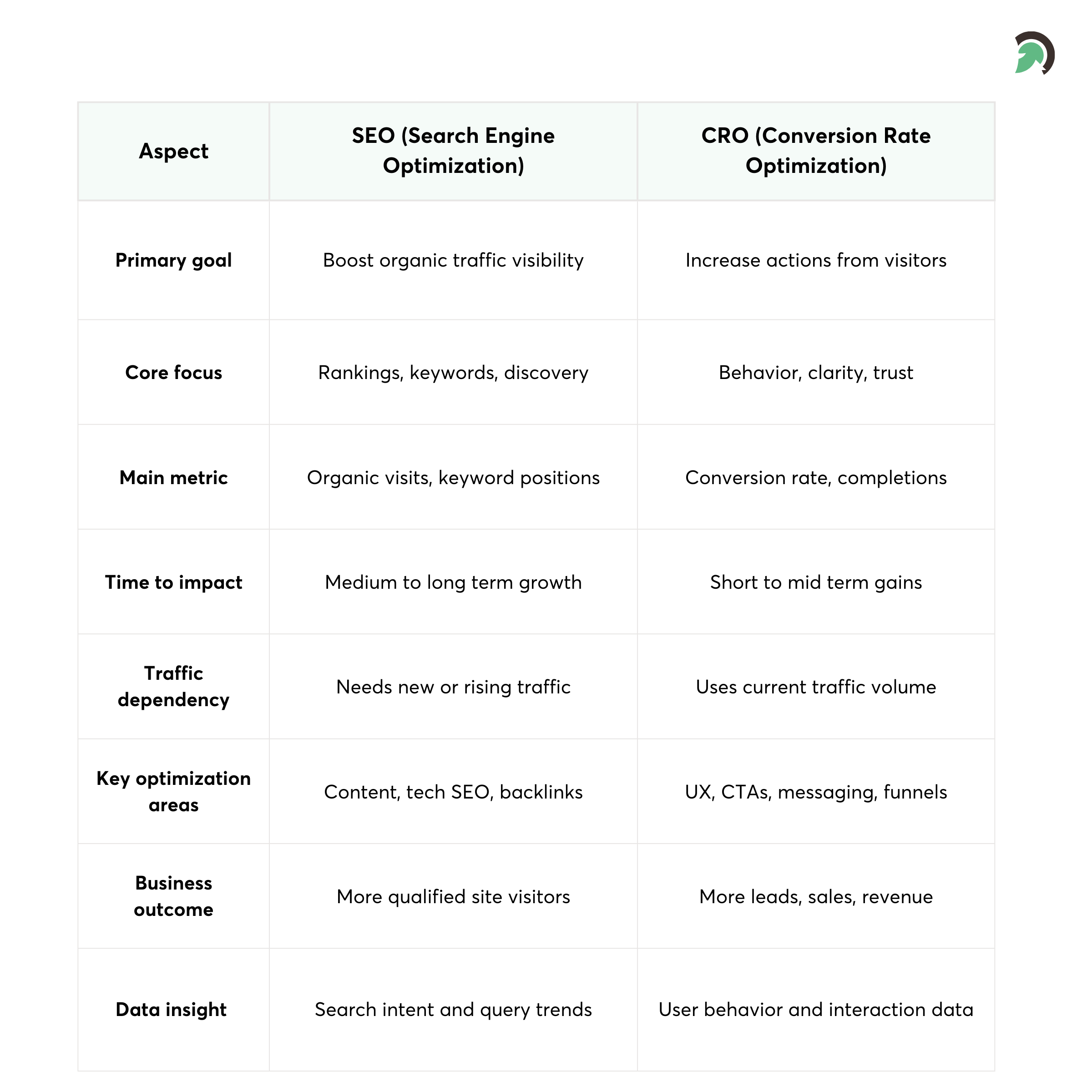
While these differences are clear, real performance gains happen when SEO and CRO are aligned into a single growth strategy.
Why SEO and CRO Perform Best Together
If SEO is driven by the wrong intent, conversion rates will be weak. If CRO is strong but traffic is low, growth will be capped. When the two are aligned, you get a multiplier effect.
A good way to think about it is this: SEO fills the pipeline, and CRO increases yield. That is why businesses that combine both tend to scale faster and more profitably than those focused on rankings alone.
How SEO supports CRO
CRO supports SEO by improving page experience, clarity, and performance, which, in turn, can drive organic performance through better intent alignment, faster page load times, higher click-through rates, and improved user satisfaction.
SEO helps CRO when:
- Content matches what users expected from the search result
- Landing pages answer intent quickly and clearly
- Pages bring mid-funnel traffic that is ready to act
- Internal links guide users toward high-conversion pages
How CRO supports SEO
CRO supports SEO because better experiences lead to stronger engagement signals. When users stay longer, interact more, and bounce less, those outcomes often correlate with improved performance over time and better results from your digital marketing efforts.
CRO improvements that also help SEO include:
- Faster page speed and improved mobile usability
- Clearer structure and scannability
- Better content alignment with user intent
- Reduced friction that improves time on page
Quick Stat:
Google’s Search Central documentation recommends aiming for these Core Web Vitals thresholds as performance targets: LCP within 2.5 seconds, INP under 200 ms, and CLS under 0.1. These benchmarks are a useful way to align technical SEO work with real user experience and conversion outcomes.
SEO Conversion Optimization: The Best Way to Stop Wasting Traffic
SEO conversion optimization is not a buzzword. It is a practical operating model in which every SEO decision is evaluated by its conversion impact. That means ranking pages are built like landing pages, while landing pages are treated as SEO content assets.
This approach is especially valuable when you are investing in content, local targeting, and competitive keywords as part of a broader digital marketing strategy. It ensures the work you publish does more than bring visits. It creates outcomes.
What SEO conversion optimization looks like in practice
- Targeting keywords by intent, not volume alone
- Designing pages to answer questions and guide actions
- Using proof and trust elements near key decision points
- Improving internal linking toward conversion-focused pages
Signals that you need better SEO conversion optimization
- Rankings improve but lead volume stays flat
- High traffic pages have poor engagement metrics
- Visitors land on blog content but never reach service pages
- Forms are too long and drop-offs are high
When You Should Prioritize SEO vs CRO
Most businesses need both, but the order can depend on current performance.
If you have low traffic and weak visibility, SEO should be prioritized first. If you already have traffic but poor lead volume, CRO can deliver faster impact. If you are scaling, combining them is usually the most profitable option.

Prioritize SEO when
- Your website has limited organic visibility
- You rely heavily on paid traffic to generate leads
- Your industry searches are competitive and high-intent
- Your content coverage is thin or outdated
Prioritize CRO when
- You have steady traffic but low conversions
- Drop-offs occur on forms, checkout, or demo booking
- Mobile conversion performance is weak
- Your offer is good but messaging is unclear
Choosing the Right Partner for SEO and CRO
Many teams hire one vendor for SEO and another for conversion work. The result is fragmented execution and inconsistent messaging. A stronger approach is finding a partner that treats both as one system.
If you are searching for an SEO services provider in USA, prioritize teams that can connect rankings to pipeline outcomes. A capable digital marketing agency should talk about conversion paths, intent mapping, and measurable results, not just traffic charts.
What to look for in a strong partner
- Keyword strategy tied to business outcomes
- Landing pages built for both rankings and conversion
- Transparent reporting that includes conversion impact
- Testing culture, not one-time optimizations
Conclusion
SEO and CRO are not alternatives. They are complementary levers that work best when planned and executed together. SEO earns attention by improving visibility, relevance, and intent alignment across search journeys, while CRO earns action by improving trust, clarity, usability, and overall user flow. When these two disciplines operate in isolation, growth becomes inconsistent and inefficient. When aligned, they create a system where traffic quality and on-page experience support each other naturally within modern digital marketing services.
For sustainable growth, businesses need a framework that attracts qualified traffic and converts it efficiently into measurable outcomes. That is the real value of seo conversion optimization, because it connects rankings to revenue and turns marketing into a predictable engine. At EvinceDev, we focus on building this alignment through intent-led SEO strategies, conversion-focused page design, and data-driven optimization that supports long-term performance.