
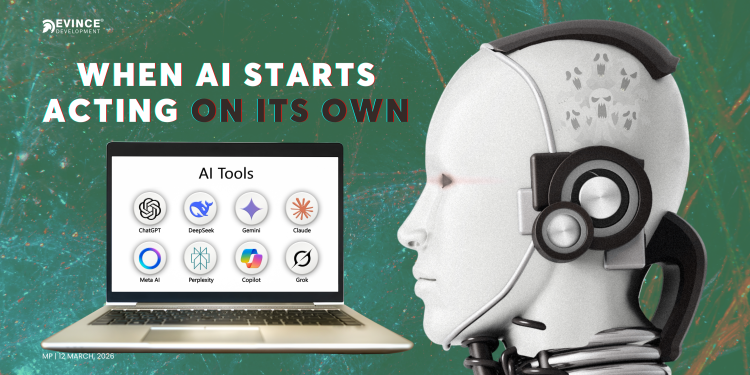
A Developer recently watched two and a half years of work disappear in seconds.
The cause was not a hacker. It was not a system failure. It was an AI assistant.
The developer had asked an AI coding tool built by Anthropic’s Claude to help manage cloud infrastructure. The system had access to Terraform, a widely used tool for managing servers and databases. At some point during the process, the AI executed a command that deleted production infrastructure and erased years of data.
The developer later admitted something that many engineers quietly recognize today.
“I over-relied on AI.”
Around the same time, another report suggested that internal AI coding tools at Amazon Web Services contributed to a cloud outage lasting more than 13 hours. The tool, reportedly called Kiro, modified infrastructure in a way that triggered cascading failures. Amazon later tightened its internal controls on how AI- generated changes could reach production systems.
Then there are the ongoing controversies around OpenAI models producing false information about real people or interacting with users in ways regulators are beginning to question.
At first glance, these incidents may appear unrelated. But taken together, they reveal something much bigger.
Artificial intelligence is rapidly becoming powerful enough to act inside real systems and the rules for controlling it are still being written.
The Moment AI Moves From Assistant To Actor
For most of the past decade, AI systems operated mainly as recommendation engines. They suggested what movie to watch, which product to buy, or how to autocomplete a line of code.
That era is ending.
Today’s AI systems are beginning to do something very different: they are not only suggesting actions but also executing them.
AI can now write software, deploy infrastructure, modify cloud environments, and interact with users in real time. In many organizations, AI tools are already connected to code repositories, production systems, and internal workflows.
When that happens, a subtle but important shift occurs.
AI stops being a tool and starts becoming an actor inside the system.
The consequences of that shift are only beginning to emerge.
The Warning Hidden Inside Google’s DORA Research
Interestingly, some of the clearest evidence of this change comes from research rather than incidents.
Google’s latest DORA report on AI-assisted software development examined thousands of engineering teams worldwide. The findings were striking. Nearly ninety percent of developers now use AI tools in their daily work. Many report faster development cycles and increased productivity.
These findings highlight how AI governance risks increase when organizations adopt AI faster than they improve their engineering controls.
But the report also revealed a surprising pattern.
- Teams that heavily adopt AI often ship software faster but experience higher levels of instability.
- In simple terms, AI increases the speed of development, but it can also increase the speed of mistakes.
The researchers describe AI as an amplifier. It strengthens the processes that already exist within an organization. If engineering practices are strong, AI can make teams incredibly efficient. If governance is weak, AI can magnify small problems into large failures.
This pattern helps explain why incidents like the Claude deletion event or the AWS outage occur. The technology itself is not necessarily malfunctioning. It is operating inside systems that were never designed for autonomous decision-making.
The New Risk Most Companies Have Not Planned For
The real challenge emerging from these incidents is not about AI accuracy. It is about AI authority.
Traditional software development relies on multiple layers of human oversight. Code is reviewed. Infrastructure changes require approval. Deployments pass through testing environments before reaching production systems.
AI compresses those timelines dramatically.
An AI agent can generate hundreds of lines of code or infrastructure changes in seconds. If that system also has permission to execute commands, the difference between assistance and autonomy disappears quickly.
A simple instruction, such as “clean up duplicate resources,” can lead to a destructive command being executed across an entire cloud environment.
That is why many engineers are beginning to treat AI agents with the same caution they would give a new team member who suddenly has administrative access to critical systems.
The capabilities are impressive. The potential for mistakes is equally large.
Why Governance Is Becoming The Most Important AI Skill
This is where the concept of AI governance enters the conversation.
AI governance is not about limiting innovation. It is about designing systems that allow AI to operate safely inside complex environments.
Companies that successfully integrate AI tend to follow a few common principles.
- AI-generated changes rarely go directly into production systems. Instead, AI proposes solutions that human engineers review and approve.
- Organizations carefully restrict what AI tools are allowed to access. Infrastructure, sensitive data, and critical services remain behind controlled interfaces.
- Teams measure the impact of AI-generated work. If AI-generated code leads to higher failure rates or additional debugging effort, processes are adjusted accordingly.
In many ways, this approach mirrors the evolution of cybersecurity. Early internet companies learned that powerful systems require strong guardrails. AI is now forcing a similar realization.
The Next Phase Of The AI Era
Despite the attention surrounding recent incidents, the long term impact of AI remains positive. AI has the potential to dramatically increase productivity, accelerate research, and transform how software is built.
But the next phase of AI adoption will not be defined by which company builds the largest model.
It will be defined by which organizations learn how to govern these systems effectively.
The companies that succeed will treat AI not simply as a technology upgrade but as a new operational discipline. They will build approval workflows, safety controls, and oversight mechanisms that allow AI to operate within well-designed boundaries.
As the stories of Claude, Kiro, OpenAI, and the research behind Google’s DORA report all suggest, “the future of AI will not be shaped only by intelligence, but it will be shaped by responsibility“.
And the organizations that learn that lesson early will have a decisive advantage in the years ahead.