


Key Takeaways:
- Marketing Metrics: Learn what marketing metrics mean, how they differ from KPIs, and why they matter for measuring real business impact.
- Why Metrics Matter: See why marketing metrics are essential for improving ROI, tracking performance, and guiding smarter marketing decisions.
- Core Metric Types: Explore the main types of marketing metrics, from acquisition and engagement to revenue, conversion, and retention.
- Top Metrics to Track: Discover the most important marketing metrics to monitor for visibility, engagement, conversions, and growth.
- Vanity vs Action: Understand the difference between vanity metrics and actionable metrics so you can focus on what drives results.
- Choosing Metrics: Learn how to choose the right marketing metrics based on business goals, funnel stages, and performance priorities.
- Channel-Based Metrics: Understand which marketing metrics matter most across SEO, paid ads, social media, and email marketing.
- Future of Metrics: See how AI, automation, and data-driven strategies are shaping the future of modern marketing measurement.
In today’s competitive digital landscape, marketing decisions cannot rely on intuition alone. Businesses invest across multiple channels, yet many struggle to identify what is actually driving results. This is where marketing metrics become essential.
While data is abundant, clarity is not. Many teams track metrics like traffic or impressions but fail to connect them to revenue and growth. The shift toward Modern Marketing Metrics is about focusing on what truly matters, not just what is easy to measure.
Whether you are working in-house or with a digital marketing agency, understanding the right metrics helps you:
- Measure campaign performance accurately
- Optimize marketing spend
- Improve customer acquisition and retention
- Drive measurable business growth
This guide will help you move beyond vanity metrics and build a performance-driven approach using the most relevant digital marketing metrics.
Quick Stat:
According to Salesforce’s State of Marketing report, 76% of marketers use data to drive decisions. This reinforces why tracking the right marketing metrics is essential for improving performance, allocating budget wisely, and connecting marketing efforts to real business outcomes.
What Are Marketing Metrics?
Marketing metrics are measurable indicators used to evaluate how well marketing efforts are performing. They help businesses understand whether campaigns are attracting attention, generating engagement, driving conversions, and contributing to growth.
Not every metric has the same value. Some are useful for context, while others are directly tied to results. For example, page views can show interest, but conversion rate shows whether that interest is turning into action. That is why marketers often separate general metrics from KPIs.
A simple distinction looks like this:
- Metrics track activity, such as clicks, impressions, or traffic
- KPIs track progress toward goals, such as leads, revenue, or customer acquisition
In Digital marketing, metrics act as a performance check. They show what is working, what needs improvement, and where the strategy should be adjusted. Without clear marketing metrics, campaigns become harder to evaluate and optimize.
Why Marketing Metrics Matter More Than Ever
Marketing has become more complex, which is exactly why marketing metrics matter more than ever. Businesses now operate across search, paid ads, social media, email, and content marketing, with each channel producing different types of data. Without a structured way to measure performance, it becomes difficult to understand which efforts are actually creating value.
A few major shifts have made metrics more important:
-
Marketing is now multi-channel
Most businesses no longer rely on a single platform. They engage audiences across multiple touchpoints, and each one contributes differently to the customer journey. Marketing metrics help bring these efforts into focus and make performance easier to evaluate across channels.
-
Customer acquisition is more expensive
As competition increases, brands cannot afford to invest heavily without understanding results. Strong digital marketing metrics help marketers assess cost efficiency, campaign quality, and whether spending is leading to meaningful outcomes.
-
Leadership expects proof of impact
Marketing teams are under more pressure to demonstrate business value. It is no longer enough to report reach or engagement alone. Teams are now expected to show how marketing influences:
- Leads
- Sales
- Customer value
- Retention
-
Better measurement leads to faster improvement
When teams track the right metrics, they can identify what is working, what needs adjustment, and where to invest next. As online marketing becomes more data-driven, the brands that measure well are usually the ones that improve faster.
In short, marketing metrics are no longer just useful for reporting. They are essential for making smarter decisions and driving consistent growth.
Quick Stat:
McKinsey reports that companies with faster growth generate 40% more of their revenue from personalization than slower-growing companies, highlighting how data-driven marketing decisions directly influence business outcomes.
Types of Marketing Metrics
The best way to understand performance is to look at marketing metrics across the full customer journey. Different metrics matter at different stages, and together they provide a more complete view of marketing effectiveness.
-
Acquisition Metrics
Acquisition metrics focus on how businesses attract new audiences. These numbers help marketers understand where traffic is coming from, how efficiently leads are being generated, and what it costs to bring new customers into the funnel.
Common examples include:
-
- Website traffic
- Cost per lead
- Customer acquisition cost
For businesses offering a digital marketing service, acquisition metrics are especially important because they show how efficiently growth campaigns are performing.
-
Engagement Metrics
Engagement metrics help measure how users interact with content, campaigns, or platforms. These indicators show whether the audience finds the messaging relevant enough to keep exploring.
Useful engagement metrics include bounce rate, average session duration, and pages per session. Strong engagement usually suggests that content quality, targeting, and user experience are aligned.
-
Conversion Metrics
Conversion metrics track the actions that matter most to the business, such as sign-ups, purchases, form submissions, or demo requests. These are some of the most important digital marketing metrics because they move beyond interest and show actual performance.
Key conversion metrics often include click-through rate, conversion rate, and lead-to-customer rate.
-
Revenue Metrics
Revenue metrics connect marketing performance with financial results. They are essential for understanding whether campaigns are not only active, but profitable.
This category often includes customer lifetime value, return on marketing investment, and revenue by channel. These marketing metrics are especially useful for long-term planning and budget allocation.
-
Retention Metrics
Retention metrics show how well a business keeps customers engaged after acquisition. This matters because retaining customers is often more cost-effective than constantly acquiring new ones.
Common retention metrics include churn rate, repeat purchase rate, and customer retention rate. In many cases, these numbers reveal whether Digital marketing efforts are supporting long-term customer relationships.
The Most Important Marketing Metrics to Track
There is no shortage of available data, but not every number deserves equal attention. The most valuable marketing metrics are the ones that help marketers make better decisions, improve performance, and connect marketing efforts to business outcomes.
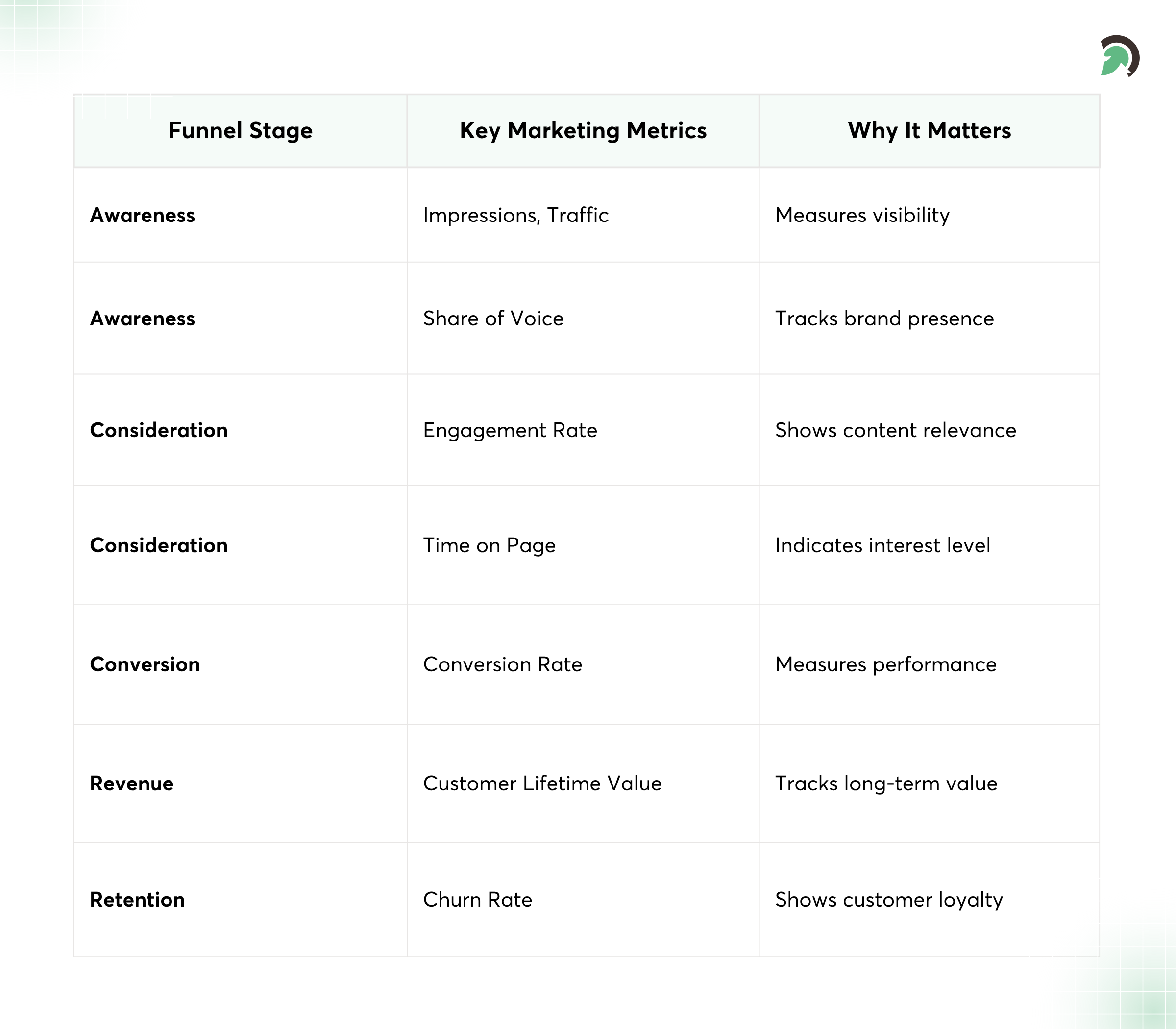
A practical way to look at this is by grouping metrics according to the stage of the customer journey.
Awareness Metrics
At the top of the funnel, awareness metrics help businesses understand how visible they are in the market. These metrics show whether a brand is reaching new audiences and expanding its presence.
Common awareness metrics include:
- Organic traffic
- Impressions
- Share of voice
These indicators are useful for measuring brand reach and overall visibility.
Engagement Metrics
As users move further into the journey, engagement metrics become more important. They help marketers understand whether audiences are interacting with content in a meaningful way.
Key engagement metrics include:
- Time on page
- Engagement rate
- Content interaction
- Email click-through rate
These metrics can reveal whether your messaging, content, and user experience are holding attention.
Conversion Metrics
When the goal shifts from attention to action, conversion-focused metrics become essential. These metrics help evaluate how effectively campaigns are turning interest into measurable results.
Important conversion metrics include:
- Click-through rate
- Conversion rate
- Cost per conversion
- Qualified leads
These are some of the most actionable indicators for campaign performance.
Financial Metrics
Financial metrics are critical because they show whether marketing performance is translating into sustainable growth. They help marketers understand efficiency, profitability, and long-term value.
Among the most useful digital marketing metrics in this category are:
- Customer acquisition cost
- Customer lifetime value
- Return on ad spend
These metrics are especially important when evaluating budget allocation and overall ROI.
Retention Metrics
Retention metrics should not be overlooked, since long-term growth depends on keeping customers engaged after acquisition. These indicators show whether customers continue to find value in the brand over time.
Key retention metrics include:
- Churn rate
- Repeat purchase rate
- Net promoter score
Strong retention often signals that marketing, customer experience, and brand value are well aligned.
A smart dashboard does not track everything. It tracks the marketing metrics that support better decisions and stronger growth.
Quick Stat:
According to Forrester, businesses can improve marketing efficiency by up to 30% using data, which makes it even more important to track the metrics that truly support better decisions.
Vanity Metrics vs Actionable Metrics
One of the most common problems in measurement is giving too much weight to numbers that do not actually help improve performance. This is where the difference between vanity metrics and actionable metrics becomes important.
Vanity metrics can make marketing look successful without showing real business impact. High follower counts, large page views, or strong post likes may create positive optics, but they do not always indicate whether campaigns are generating leads, revenue, or customer growth.
Actionable metrics are different. They help teams understand what is working and what needs to change. They can guide optimization, improve spending decisions, and support strategy.
A useful comparison looks like this:
- Vanity metrics: likes, followers, page views without conversions
- Actionable metrics: conversion rate, cost per acquisition, revenue per channel
Strong marketing metrics should do more than describe performance. They should help improve it.
How to Choose the Right Marketing Metrics
Choosing the right marketing metrics starts with clarity around goals. The best metrics are not the most detailed ones. They are the ones that align with what the business is trying to achieve.
If the goal is awareness, reach-based indicators will matter more. If the goal is lead generation or sales, then conversion and revenue metrics should take priority. If customer retention is the focus, loyalty and repeat-purchase indicators become more relevant.
It also helps to map metrics to the funnel:
- Awareness: impressions, traffic, reach
- Consideration: engagement rate, click-through rate, time on page
- Conversion: conversion rate, cost per acquisition, qualified leads
- Retention: repeat purchase rate, churn rate, customer lifetime value
Another important test is actionability. A metric should help answer a practical question, not just fill a dashboard. This is especially important when evaluating digital marketing metrics, where small shifts in performance can signal useful optimization opportunities.
Too many metrics can create clutter. A focused set usually leads to stronger decisions.
Marketing Metrics by Channel
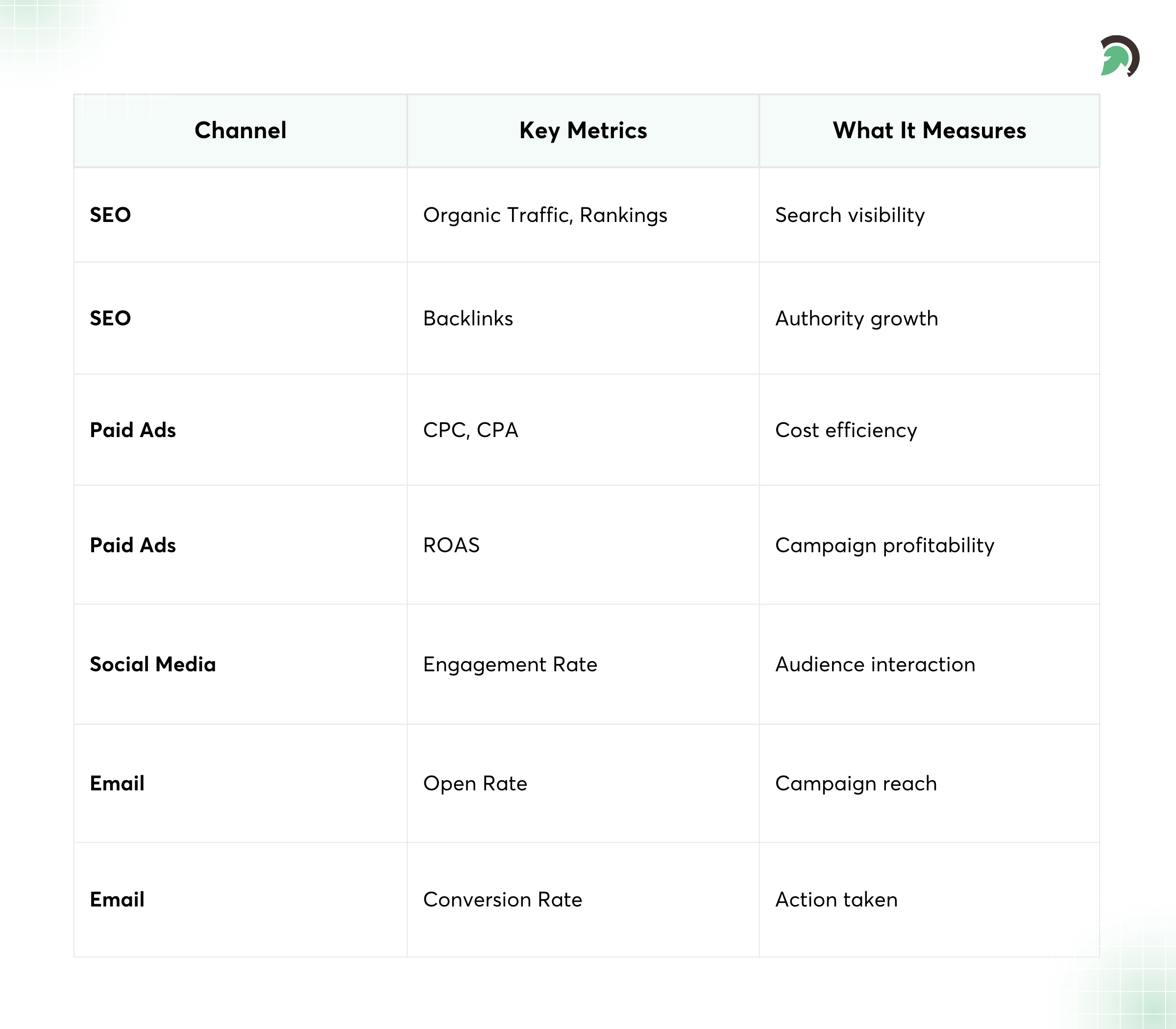
Different channels require different measurement approaches because each one supports a different part of the customer journey. While the specific metrics may vary, the goal remains the same: connect channel performance to business impact.
SEO Metrics
SEO is primarily focused on visibility and discoverability. The most useful metrics usually include:
- Organic traffic to measure how many users arrive through search
- Keyword rankings to track search visibility for target terms
- Backlink growth to understand authority and search strength
These digital marketing metrics help show whether your content and SEO efforts are improving search presence over time.
Paid Advertising Metrics
Paid campaigns are more performance-driven, so efficiency matters the most. Marketers typically track:
- Cost per click (CPC) to understand how much each visit costs
- Cost per acquisition (CPA) to measure the cost of gaining a customer or lead
- Return on ad spend (ROAS) to evaluate campaign profitability
These metrics make it easier to see whether paid campaigns are financially sustainable and delivering results.
Social Media Metrics
Social media performance is usually measured through a mix of reach and engagement. Common indicators include:
- Reach to understand audience exposure
- Engagement rate to measure interaction with content
- Traffic from social media to see whether posts are driving visits and actions
While likes and shares matter, the deeper focus should be on whether social content is supporting awareness, traffic, and audience growth.
Email Marketing Metrics
Email remains one of the most measurable channels in Digital marketing. The most important metrics often include:
- Open rate to measure subject line and audience interest
- Click-through rate (CTR) to track engagement with email content
- Conversion rate to understand how many users take action after clicking
Together, these metrics provide a clear picture of campaign response and overall effectiveness.
No matter the channel, the key is to track the metrics that reflect both performance and business value.
Tools to Track Marketing Metrics
Tracking marketing metrics effectively requires more than spreadsheets and manual reporting. While basic reporting may work for smaller efforts, modern marketing usually needs integrated tools that can collect, organize, and interpret data across multiple channels.
Some of the most commonly used tools include:
Google Analytics
Google Analytics is widely used to track:
- Website traffic
- User behavior
- Conversion paths
- Campaign performance
It helps marketers understand how visitors interact with a website and which channels are driving results.
CRM Platforms
CRM tools are essential for connecting marketing activity with business outcomes. They help teams track:
- Leads and pipeline movement
- Customer interactions
- Sales conversions
- Revenue contribution
This makes it easier to see how marketing efforts influence the customer journey beyond the first click.
SEO Tools
Platforms like Ahrefs and SEMrush support search-focused tracking by helping marketers monitor:
- Keyword rankings
- Backlink growth
- Organic visibility
- Content performance
These tools are especially useful for measuring long-term search performance and identifying optimization opportunities.
Automation and Reporting Dashboards
Many teams also rely on dashboards and automation platforms to bring data from multiple sources into one place. This helps create a more complete view of performance across campaigns, channels, and audiences.
A strong digital marketing service often uses this kind of setup to simplify reporting and improve decision-making.
The tool itself is only part of the process. Its real value lies in how clearly it helps teams interpret data, uncover insights, and take action.
Quick Stat:
According to Deloitte, data-driven companies are 2x more likely to make faster decisions, which shows why strong marketing metrics are essential for improving speed, clarity, and overall marketing performance.
Common Mistakes to Avoid
Even when businesses are actively measuring performance, they can still reduce the value of their reporting by focusing on the wrong things. One common mistake is tracking too many numbers at once. When dashboards become overloaded, it becomes harder to identify what is actually important.
Another issue is measuring engagement without linking it to outcomes. Engagement can be useful, but if it is not connected to conversions, revenue, or retention, it only tells part of the story. Inconsistent tracking is also a problem because it makes comparisons and trend analysis less reliable.
A few common mistakes include:
- Tracking too many low-value metrics
- Ignoring revenue impact
- Measuring channels in isolation
- Using weak attribution models
The best way to avoid these issues is to keep measurement focused, consistent, and tied to business goals.
The Future of Marketing Metrics
The future of marketing metrics is being shaped by smarter technology and more connected customer journeys. As marketing becomes more data-rich, businesses are moving away from isolated reporting and toward more unified performance measurement.
Artificial intelligence is already influencing how marketers analyze campaigns. Predictive analytics, automation, and real-time insights are helping teams identify patterns faster and respond more quickly. This is making measurement more proactive rather than purely historical.
At the same time, businesses are adopting Modern Marketing Metrics that connect awareness, engagement, conversion, revenue, and retention more clearly. This shift matters because customer journeys now span multiple channels, devices, and touchpoints. Static reporting is no longer enough.
The future of Digital marketing will depend on how well businesses can turn scattered data into clear, usable insight.
Conclusion
Strong marketing depends on more than activity alone. It depends on understanding what is working, why it is working, and how it contributes to real business outcomes. That is the real value of marketing metrics. They help businesses move beyond assumptions, evaluate performance with greater clarity, and make smarter decisions over time.
The shift toward Modern Marketing Metrics reflects a more practical approach to growth. Instead of chasing surface-level numbers, businesses are focusing on metrics that reveal visibility, engagement, performance, profitability, and customer loyalty. This allows marketing to become more measurable, accountable, and aligned with long-term business goals.
The most effective marketers are not the ones measuring everything. They are the ones focusing on the right digital marketing metrics, interpreting them correctly, and using them to improve strategy consistently. Whether you manage campaigns internally or rely on a digital marketing service, better measurement leads to stronger execution and better results.
At EvinceDev, this is exactly how we approach performance-driven growth through our digital marketing services. By combining strategy, execution, and meaningful measurement, we help businesses track what matters, optimize campaigns effectively, and build marketing systems that support sustainable growth. That is what makes marketing metrics so important in modern growth-focused marketing.