

Product content was once treated as a final step before publishing a product page. Today, eCommerce Product Content shapes how shoppers discover items, how quickly they compare options, and how confident they feel when deciding to buy. Customers search with clear intent, skim information quickly, and expect consistent details across all interactions with a product. This includes your direct-to-consumer site, marketplaces, retail partner pages, shopping ads, and social commerce.
The challenge is scale. Supplier feeds arrive with inconsistent formats, catalogs expand through variants and bundles, and each channel imposes its own rules, character limits, and required fields. When product content breaks, the impact is immediate. Search visibility drops, marketplace listings get suppressed, conversion rates decline, and returns increase due to unclear or missing details.
Generative AI is reshaping this landscape, making generative AI product content faster to produce, easier to standardize, and simpler to scale. Modern GenAI systems help ecommerce teams create, standardize, localize, and distribute product content at scale while maintaining accuracy and brand consistency.
This article explores where generative AI eCommerce drives the highest impact, how to build an end-to-end workflow that works in real operations, the guardrails required for safe deployment, and the metrics that reveal clear ROI.
Why Product Content Is an Underestimated Growth Lever for eCommerce Teams?
Product content is more than persuasive writing. It influences search ranking, product discovery, user trust, and return rates. When information is complete and consistently presented, shoppers navigate more quickly, engage more deeply, and feel more confident in their decisions.
Where Strong Content Creates Measurable Impact
- Search and discovery: Platforms rely on structured data, titles, and attributes to understand what you sell and when to surface your products.
- Evaluation and comparison: Clear specifications, bullets, and FAQs reduce uncertainty for customers who compare multiple items.
- Trust and consistency: Consistent content across channels reduces cognitive friction and helps customers feel secure in their purchase.
- Reduced returns: Accurate sizing, compatibility, and usage guidance set realistic expectations for buyers.
The Rise of Content Debt
As catalogs grow, many teams accumulate what can be called content debt. It appears in the form of:
- Missing attributes that break filters and navigation
- Weak or duplicate descriptions across related SKUs
- Outdated specifications and mismatched claims
- Different versions of truth across D2C, marketplaces, and partner feeds
GenAI helps teams treat content as an operational system rather than a one-time task, allowing them to generate, validate, improve, and scale consistently.
Quick Stat:
As per a global survey, 83 percent of shoppers said they would leave an eCommerce site if product information is insufficient, and 50 percent had abandoned a purchase in the previous six months for the same reason. Another 35 percent had returned a product because it did not match the expectations set by the content they saw.
What Generative AI Means for Commerce Teams?
Generative AI models create new content based on your inputs, templates, and constraints. In eCommerce, the best outcomes happen when AI is anchored in verified product data and guided by strict rules and structures.
What GenAI Can Handle Effectively for eCommerce Teams
- Generate: Titles, bullets, descriptions, FAQs, meta information, and supporting content.
- Transform: Rewrite for brand voice, compress for character limits, expand for richer pages, and adjust tone for channels.
- Enrich: Summarize manuals, extract specifications, detect inconsistencies, and propose missing attributes.
- Support multimodal needs: Generate alt text, captions, feature callouts, video scripts, and creative briefs that stay aligned with verified product truth.
When implemented as a system rather than a standalone tool, AI product content creation becomes the foundation for accuracy, scale, and consistency across the entire catalog.
What Does Product Content Creation Include in Modern eCommerce?
Product content includes both structured and unstructured elements. These work together across all channels to give customers a clear understanding of what they are buying.
Core Product Detail Page Elements
- Title, short description, long description, and key bullets
- Specifications and attributes such as dimensions, materials, compatibility, and warranty
- Size guides, care instructions, and FAQs
- Compliance details and required disclaimers
Supporting Elements That Drive Performance
- SEO layer: Meta titles, meta descriptions, headings, questions, and internal linking.
- Accessibility layer: Descriptive alt text and logical content structure.
- Channel layer: Rules and formatting for D2C, marketplaces, shopping feeds, and retail partners.
A strong GenAI approach uses templates and rules to bring consistency to all of these elements.
High Impact Use Cases: Where GenAI Is Transforming Product Content Creation
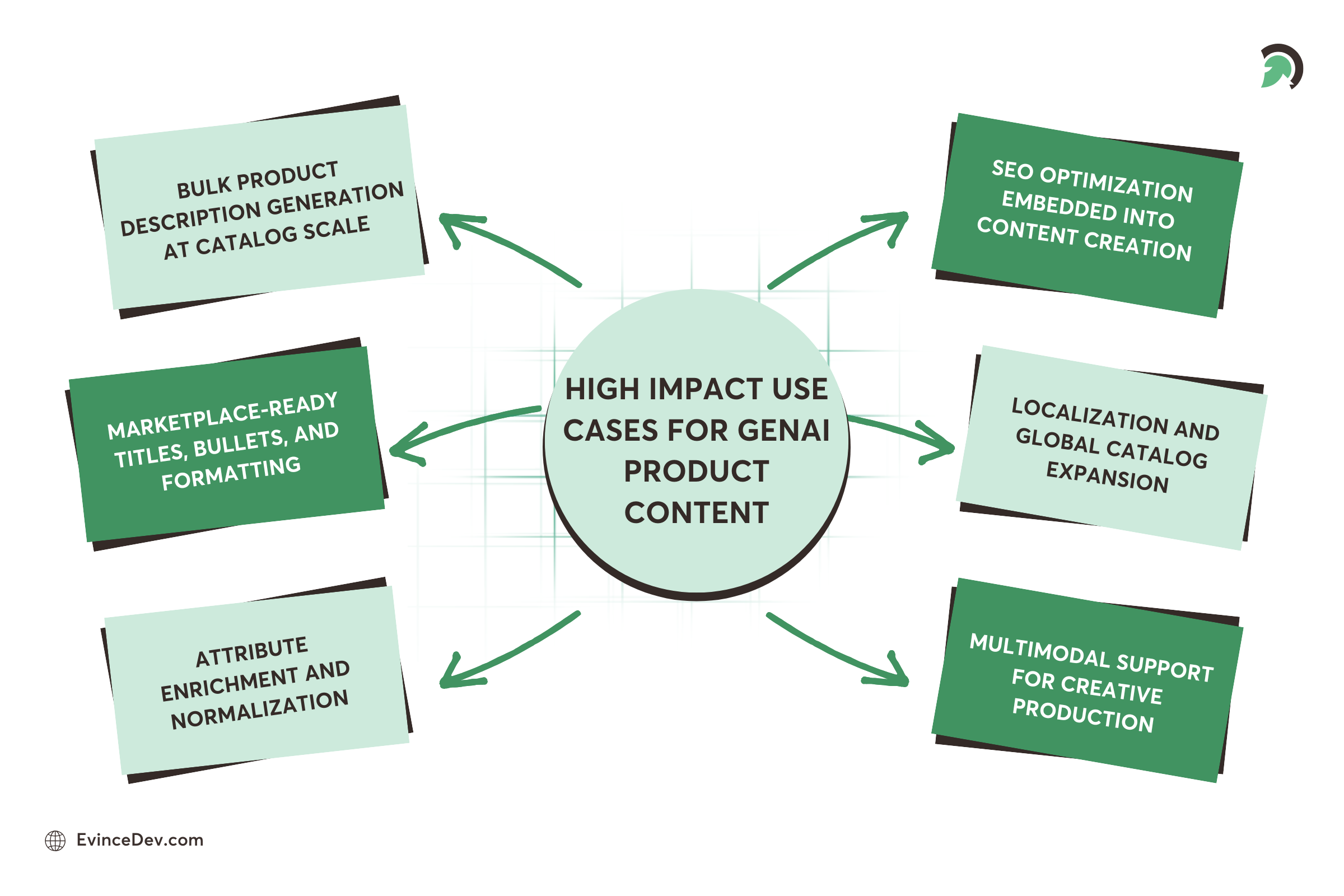
Bulk Product Description Generation at Catalog Scale
One of the fastest wins is generating complete content for large catalogs, especially long tail SKUs with thin or inconsistent details. Template-driven generation ensures every category includes the information customers care about.
Examples of category-focused templates:
- Fashion: Fit, fabric, feel, occasion, care instructions, and styling notes.
- Electronics: Compatibility, key specifications, what is included, setup guidance, and warranty terms.
- Home and furniture: Dimensions, materials, assembly details, placement guidance, and maintenance.
- Beauty and personal care: Usage instructions, ingredients, realistic benefits, and caution notes.
GenAI does the heavy lifting so teams can focus on improving product data, refining templates, and reviewing edge cases.
Titles, Bullets, and Marketplace-ready Formatting
Marketplaces enforce strict quality rules. Poor formatting or inconsistent structure can lead to suppressed listings.
GenAI helps teams produce:
- Titles with consistent structures, such as brand plus product type plus key features
- Bullets that prioritize benefits and clarity
- Condensed variants for character limits
- Channel-specific versions that maintain product truth
Attribute Enrichment and Normalization
Attributes control filters, search ranking, shopping feed performance, and customer confidence. Missing or inconsistent attributes quietly erode revenue.
GenAI assists teams by:
- Extracting specifications from manuals and supplier files
- Proposing missing attributes
- Normalizing units, ranges, and naming conventions
- Detecting conflicts between different sources of data
This improves both discoverability and customer comprehension.
SEO Optimization Embedded Into Content Creation
SEO fails when pages are thin, overly templated, or misaligned with search intent. Generative AI helps scale SEO by producing content that reflects real product features.
Key outcomes include:
- Metadata aligned with verified product data
- FAQ content that answers real buyer questions
- Updated content when search trends or product specifications change
- Differentiated variants for testing
Localization and Global Catalog Expansion
Localization requires more than translation. It must incorporate cultural norms, measurement units, language tone, compliance wording, and channel rules.
Best practices supported by GenAI include:
- Controlled vocabulary for category-specific terms
- Approved translations for key attributes
- Region-specific title and specification formats
- Human review for sensitive or regulated categories
Practical GenAI use cases for eCommerce content creation
Multimodal Support for Storytelling and Creative Production
GenAI can support creative teams by generating:
- Image captions and interactive callouts
- Alt text tied to verified product truth
- Short video scripts for demonstrations or unboxings
- Creative briefs for design and video teams
This allows teams to accelerate production without sacrificing accuracy.
Content Creation Is Only Half the Work: Syndication and Distribution at Scale
Often, teams improve their direct-to-consumer product detail pages but leave marketplace and partner listings unchanged. This inconsistency is noticeable to shoppers and can reduce trust.
GenAI supports a create once, adapt many approach, enabling ecommerce content automation across channels:
- Begin with a single source of truth in your PIM or ERP.
- Apply channel-specific templates and rules.
- Generate channel-ready versions without rewriting from scratch.
- Maintain audit trails and version control.
When distribution is integrated into the workflow, AI becomes a true content engine that supports every channel in real time.
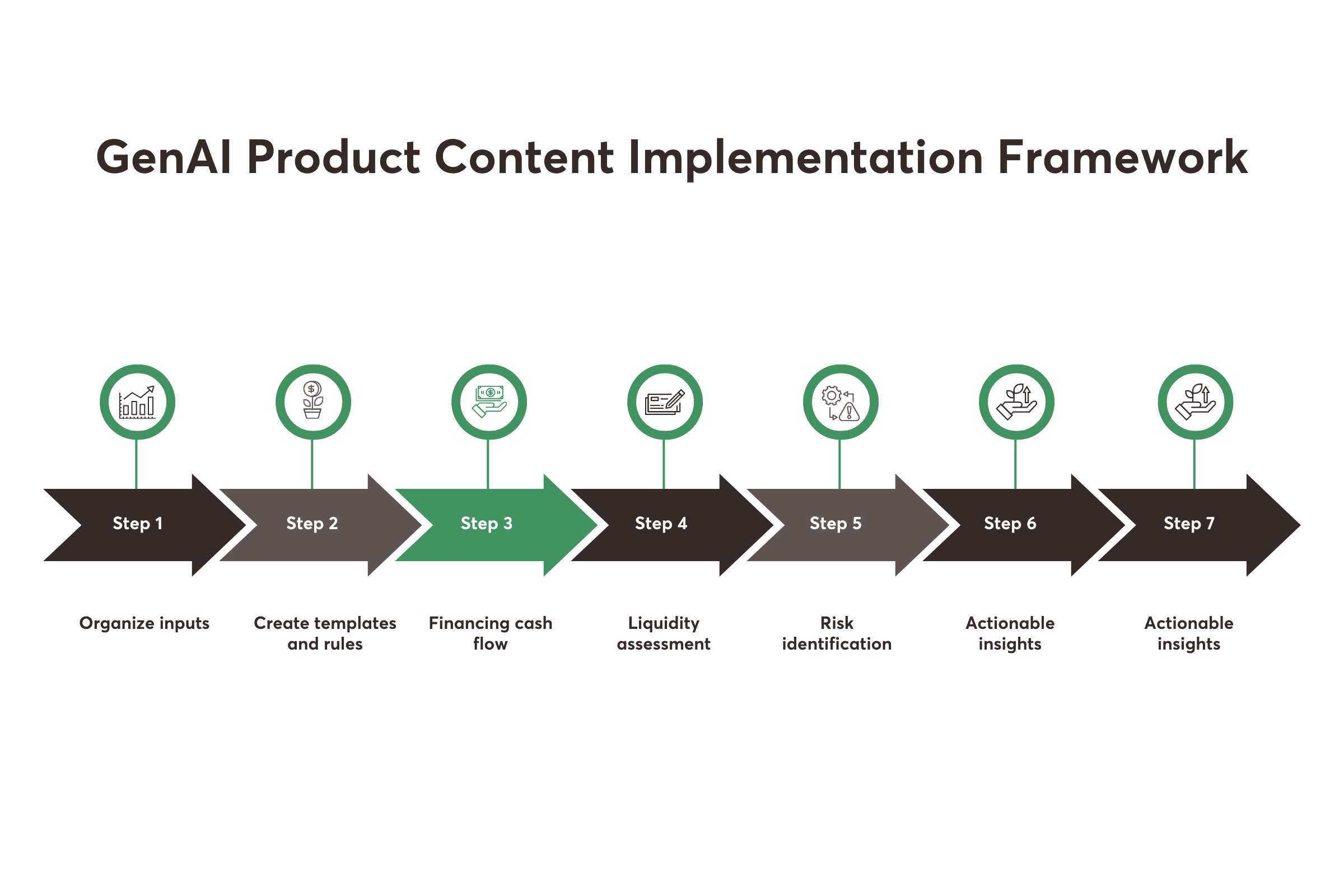
A Practical Implementation Framework for GenAI Product Content Creation
Step 1: Organize inputs
You will typically gather:
- PIM or ERP fields and category taxonomies
- Supplier feeds, manuals, and packaging information
- Brand voice guidelines with approved examples
- Claims and compliance policies
- Channel requirements for D2C and each marketplace
Step 2: Create templates and rules
Templates define:
- Section structure and mandatory elements
- Tone and vocabulary guidelines
- Length and formatting by channel
- Prohibited claims or restricted phrases
- Localization rules and unit conversions
Step 3: Generate drafts
Two modes work well:
- Batch generation for catalog refreshes and seasonal launches
- On-demand generation for new SKUs and urgent fixes
Step 4: Run quality gates
Checks should validate:
- Factual alignment with product data
- Duplicate or conflicting content across SKUs
- Compliance and claims safety
- Tone, language, and terminology alignment
- Localization correctness
Step 5: Apply focused human review
Teams do not need to review every item forever. Instead:
- Fully review initial templates and high-risk categories
- Transition to exception-based review as accuracy improves
GenAI Product Content Roadmap
Step 6: Publish and track versions
- Push updates to D2C and marketplaces
- Record version history and approval workflows
- Track which channels have been updated
Step 7: Optimize continuously
Use actual signals:
- Conversion rate and scroll depth
- Organic impressions and click-through rate
- Return reasons and customer inquiries
- Reviews that highlight confusion or missing details
Guardrails for Quality, Compliance, and Ethical Use
AI can scale mistakes as quickly as it scales output. Strong governance protects both the brand and the customer.
Key guardrails include:
- Grounding: Generate content only from approved and verified product data.
- Claims safety: Block unverified sustainability, performance, health, or certification claims.
- Brand voice control: Use example content, vocabulary lists, and approved templates.
- Intellectual property discipline: Avoid referencing competitor content. Maintain clarity on asset rights.
These guardrails support speed without compromising integrity.
Beyond Product Content: The Broader Impact Across Commerce
Once product content is accurate and consistent, it stops being just “website text” and turns into a foundational data layer for your entire ecommerce ecosystem. Clean, structured product information is what allows every other AI-powered eCommerce initiative to actually perform as promised.
Smarter Personalization and Recommendations
Most personalization engines struggle when product data is noisy or incomplete. When attributes are standardized and reliable, AI can:
- Build richer customer profiles based on real preferences such as fit, material, features, and use cases.
Recommend products that match the context of the session, for example, “office appropriate, wrinkle resistant, slim fit” instead of just “more shirts”. - Tailor messaging and content blocks on the page to highlight the benefits that align with a shopper’s past behavior.
The result is personalization that feels relevant instead of random, because it is driven by high-quality product truth rather than guesswork.
Better-Performing AI Assistants and Customer Support
Customer-facing AI assistants are only as good as the information they can safely rely on. When product content is well structured and centrally maintained, assistants can:
- Answer detailed questions about sizing, compatibility, materials, and usage based on verified attributes.
- Guide shoppers through comparisons between similar SKUs using consistent specification data.
- Reduce handoffs to human support for repetitive “what is the difference between these two” queries.
Clearer Merchandising, Pricing, and Assortment Decisions
Standardized product attributes turn your catalog into an analyzable dataset. Merchandising and revenue teams can:
- Slice performance by features such as material, color family, fit, capacity, or technical specification instead of looking only at category and brand.
- Identify gaps in the assortment when specific feature combinations are missing for key segments.
Run more meaningful tests, for example, price elasticity by feature set, or bundling strategies based on complementary attributes. - When attributes are inconsistent, these analyses are unreliable. When content is clean, commercial decisions become much more data-driven.
Stronger On-Site Search, Navigation, and Discovery
On-site search, filters, and navigation all depend on the quality of product content. With accurate titles, taxonomy, and attributes, you can:
- Improve search relevance and reduce “no results” pages.
- Offer meaningful faceted navigation that lets shoppers narrow down by the criteria that truly matter.
- Power richer discovery experiences, such as curated collections based on features, use cases, or styles.
Every improvement here directly influences conversion, because shoppers can actually find what they are looking for.
More Reliable Insights for Operations and Strategy
Finally, clean product content improves reporting across the business. When product definitions are consistent across channels, teams can trust:
- Cross-channel performance comparisons at the product or feature level.
- Return analyses that connect specific attributes or claims to dissatisfaction.
- Strategic decisions about expansion into new categories, segments, or regions.
Without standardized content, leadership teams often debate the data itself. With it, they can focus on decisions.
Measuring ROI: How to Prove Impact
Successful AI product content creation should be measured across operations, revenue, and customer experience.
Operational metrics
- Time to list new products
- Content coverage across the full catalog
- Speed of updates across channels
- Cost per SKU for content creation and maintenance
Commercial and Customer Experience Metrics
- Organic impressions, rankings, and click-through rate
- PDP conversion and add to cart rate
- Marketplace rejection or suppression rates
- Customer support ticket volume
- Returns tied to unclear or inaccurate descriptions
Targeting a single category for a pilot lets you measure clear improvements before scaling.
Turning AI Product Content Creation Into a Scalable Ecommerce Capability
To operationalize GenAI, companies benefit from strong ecommerce development services and AI development services that integrate models, workflows, and governance into existing systems. With an AI-powered catalog management layer, teams can automate content creation, maintain consistency across marketplaces and D2C channels, accelerate localization, and explore advanced use cases such as AI product image generation and AI-powered ecommerce search. It creates a durable, compounding advantage.
Conclusion
Generative AI is not just a faster way to write descriptions. It provides a structured way to build a scalable product content engine that grows with your catalog and channels. With strong inputs, category templates, quality gates, and human approval, ecommerce teams can dramatically improve consistency, accuracy, localization speed, marketplace readiness, and ongoing optimization.
A practical next step is to run a focused pilot with one high-volume category and one priority channel, ideally with a partner like EvinceDev to help shape the workflow and ensure measurable outcomes. Once the impact is clear, expand the system across the entire catalog. Done well, AI-powered product content creation becomes a long-term capability that supports every part of the ecommerce experience.