
Key Takeaways:
- Faster Content Creation: Generative AI helps create product descriptions, blogs, emails, and social media content in less time.
- Improved SEO Performance: AI tools can generate SEO-friendly titles, meta descriptions, keywords, and blog ideas for better visibility.
- Better Customer Personalization: AI can recommend products and personalize shopping experiences based on customer behavior.
- Smarter Customer Support: AI-powered chatbots provide instant responses to common customer questions and improve support efficiency.
- Enhanced Marketing Campaigns: AI helps generate ad copy, email campaigns, and multiple content variations for faster marketing execution.
- Efficient Review Analysis: AI can analyze customer reviews to identify trends, complaints, and product improvement opportunities.
- Improved Visual Content: AI-powered design tools help create banners, product visuals, and marketing creatives more efficiently.
- Scalable Shopify Growth: Combining AI automation with human creativity helps Shopify stores improve productivity and support long-term growth.
Running a successful Shopify store involves much more than simply listing products online. Store owners constantly manage product content, marketing campaigns, customer support, SEO, social media, and sales optimization, often with limited time and resources. In today’s competitive world of eCommerce development, businesses need smarter ways to improve efficiency and stay ahead of customer expectations.
This is where Generative AI is transforming ecommerce.
From writing product descriptions and generating social media content to improving customer support and personalizing shopping experiences, AI-powered solutions are helping businesses streamline operations and grow faster. What once required a large team can now be handled more efficiently with modern AI tools.
The best part is that you do not need advanced technical expertise to start using AI in your Shopify business. Many AI-powered platforms are beginner-friendly and specifically designed for ecommerce brands.
In this blog, we will explore simple yet practical ways AI can improve your Shopify operations, support long-term Shopify store optimization, and help you create better customer experiences.
Quick Stat:
According to NVIDIA research, 89% of companies are either actively using AI or running pilot AI programs to improve operations, customer engagement, and business efficiency.
What Is Generative AI?
Generative AI refers to artificial intelligence systems that can create content such as text, images, emails, product descriptions, and marketing copy based on prompts or instructions.
Unlike traditional automation tools that follow fixed rules, generative AI can produce original and context-aware outputs that feel more natural and personalized.
For Shopify merchants, this means AI can help with tasks like:
- Writing product descriptions
- Creating blog content
- Generating social media captions
- Drafting email campaigns
- Producing ad copy
- Assisting with customer support
- Analyzing customer feedback
Popular AI-powered platforms include:
- ChatGPT
- Shopify Magic
- Shopify Sidekick
- Jasper AI
- Canva AI
- Midjourney
Generative AI works best as an assistant rather than a complete replacement for human creativity. It helps businesses automate repetitive tasks while allowing teams to focus on strategy, branding, and customer relationships.
For small and medium-sized businesses, this creates an opportunity to scale operations without significantly increasing costs.
Quick Stat:
According to McKinsey, businesses using AI-driven personalization can increase revenue by up to 40% compared to competitors that do not prioritize personalization.
Write Better Product Descriptions in Minutes
Product descriptions play an important role in influencing customer decisions and improving search engine visibility. However, writing unique descriptions for dozens or hundreds of products can quickly become time-consuming.
AI tools help simplify this process.
Instead of manually creating every description, merchants can provide AI tools with basic product information, such as:
- Product name
- Features
- Materials
- Benefits
- Target audience
The AI can then generate polished product copy within seconds.
For example, if you sell wireless headphones, AI can create:
- A detailed product description
- A mobile-friendly summary
- A luxury-style version
- SEO-focused copy
- Lifestyle-oriented messaging
This flexibility allows businesses to test different messaging styles and improve conversions for their Shopify store.
Tips for Better AI Product Descriptions
Add Your Brand Voice
AI-generated content can sometimes feel generic. Edit the output to match your brand tone and communication style.
Focus on Customer Benefits
Instead of listing technical specifications only, explain how the product improves the customer experience.
For example:
- Feature: Water-resistant material
- Benefit: Keeps users comfortable during unexpected weather
Use Keywords Naturally
AI tools can help include relevant SEO keywords without making the content sound forced.
Always Verify Product Information
AI may occasionally generate incorrect details, so always fact-check specifications and product claims before publishing.
Improve Shopify SEO with AI
Search engine visibility is essential for attracting organic traffic to your Shopify store. However, SEO can often feel overwhelming for merchants managing multiple business operations.
AI-powered tools can simplify SEO Optimization by helping businesses create optimized content faster and more efficiently.
Ways AI Can Help Improve Shopify SEO
Generate SEO-Friendly Product Titles
AI tools can create product titles that are both descriptive and optimized for search engines.
Instead of:
“Black Sneakers”
AI may suggest:
“Men’s Lightweight Black Running Sneakers”
This improves discoverability while making titles more informative for shoppers.
Create Meta Titles and Meta Descriptions
Metadata influences how your pages appear in search results. AI can generate metadata that:
- Includes target keywords
- Matches search intent
- Improves readability
- Encourages clicks
Generate Blog Topic Ideas
Consistent blogging supports long-term traffic growth and overall Shopify store optimization.
AI tools can assist with:
- Blog topic suggestions
- Content outlines
- FAQ ideas
- Keyword-focused topics
For example, a skincare business might generate blog ideas such as:
- Best Ingredients for Sensitive Skin
- How to Build a Simple Skincare Routine
- Common Mistakes in Acne Treatment
Discover Long-Tail Keywords
AI tools can identify highly specific search phrases customers use when shopping online.
Examples include:
- Waterproof hiking backpack for travel
- Organic oversized cotton t-shirt for women
These long-tail keywords often attract higher-intent buyers and improve conversion opportunities.

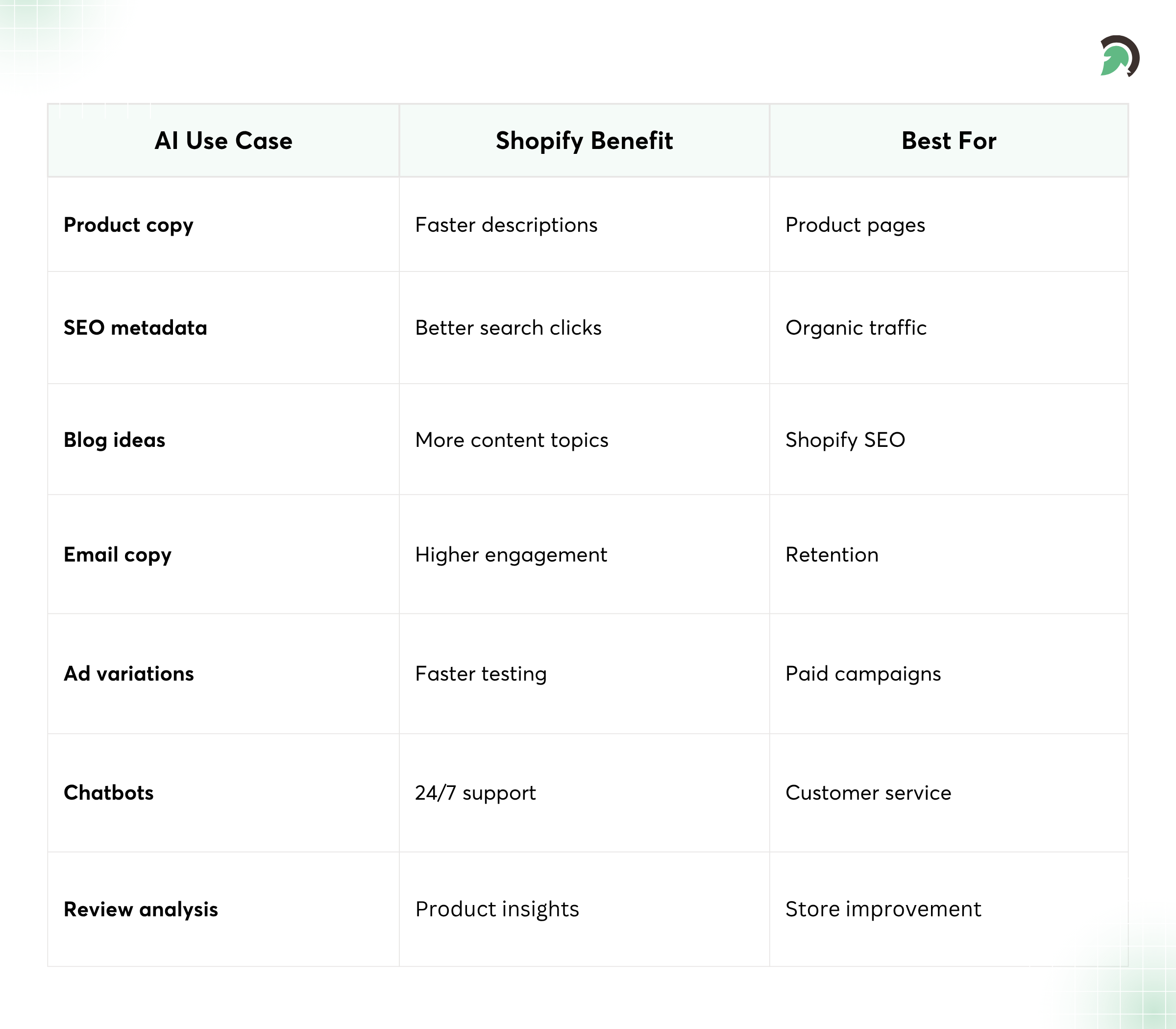
Create Content for Blogs, Emails, and Social Media
Creating fresh marketing content consistently can become exhausting for ecommerce businesses. AI tools help brands maintain a strong online presence while reducing content creation time.
AI can assist with:
- Blog posts
- Instagram captions
- Facebook advertisements
- Promotional emails
- TikTok content ideas
- Product launch campaigns
This allows businesses to maintain consistency across multiple channels.
Turn One Product Into Multiple Content Pieces
One major advantage of AI is content repurposing.
For example, a single product launch can become:
- A product description
- An Instagram caption
- An email campaign
- A Facebook ad
- A blog section
- A promotional banner headline
This helps businesses maximize the value of one content idea across multiple platforms.
Improve Email Marketing Campaigns
AI tools can also help create:
- Welcome emails
- Cart abandonment emails
- Product recommendation campaigns
- Seasonal promotions
- Re-engagement emails
Additionally, AI can generate multiple subject line variations for testing purposes.
Examples include:
- You Left Something Behind
- Complete Your Order Before It Sells Out
- Still Thinking About It? Here’s 10% Off
These small improvements can significantly increase engagement and conversions.
Personalize the Shopping Experience
Modern customers expect personalized shopping experiences. They want brands to understand their interests and recommend products relevant to their preferences.
AI-powered personalization tools help ecommerce businesses deliver these experiences more effectively.
Quick Stat:
HubSpot reports that personalized calls to action perform 202% better than generic CTAs, highlighting how AI-powered personalization can improve marketing engagement and conversions.
Personalized Product Recommendations
AI recommendation systems analyze customer behavior, such as:
- Browsing history
- Purchase patterns
- Cart activity
- Product preferences
Based on this information, businesses can recommend products that customers are more likely to purchase.
For example:
- A customer buying gym leggings may also see sports bras or fitness accessories.
- A shopper browsing skincare products may receive cleanser or moisturizer recommendations.
Personalized recommendations can help increase:
- Average order value
- Customer engagement
- Repeat purchases
Personalized Email Campaigns
AI also helps businesses create targeted email campaigns for different customer groups.
Examples include campaigns for:
- First-time shoppers
- Returning customers
- VIP buyers
- Inactive users
This creates a more relevant and engaging customer experience while strengthening long-term brand loyalty.
Improve Customer Support with AI Chatbots
Customer support is one of the most important parts of running a successful ecommerce business. However, managing support requests throughout the day can become difficult for growing brands.
AI-powered chatbots help automate routine customer interactions while improving response times.
Common Questions AI Chatbots Can Handle
AI chatbots can assist customers with:
- Order tracking
- Shipping details
- Return policies
- Product availability
- Size recommendations
- Frequently asked questions
This allows customers to receive instant assistance without waiting for human support.
Benefits of AI-Powered Customer Support
Using AI chatbots can help businesses:
- Reduce response times
- Improve customer satisfaction
- Lower support workload
- Provide 24/7 assistance
- Scale support operations efficiently
This is especially useful for ecommerce brands serving customers across different time zones.
When Human Support Is Still Necessary
While AI chatbots are highly effective, they should not completely replace human support.
Human interaction is still essential for:
- Refund disputes
- Complex complaints
- Sensitive customer situations
- Escalated support cases
The ideal approach combines automation with personalized human assistance.
Use AI to Create Better Product Visuals
Visual content heavily influences ecommerce purchasing decisions. High-quality visuals help products stand out and improve customer confidence.
AI-powered design tools are making professional visual creation more accessible for ecommerce businesses. Here are different ways AI can improve visual content:
Generate Lifestyle Image Ideas
AI tools can help businesses brainstorm creative product photography concepts.
Examples include:
- Cozy café settings for coffee brands
- Outdoor adventure scenes for travel gear
- Minimalist setups for fashion products
Create Marketing Banners
AI-powered design platforms can assist with:
- Homepage banners
- Promotional graphics
- Seasonal sale visuals
- Social media creatives
This speeds up campaign creation while maintaining visual consistency.
Simplify Image Editing
AI tools can automate repetitive editing tasks such as:
- Background removal
- Object cleanup
- Color correction
- Image resizing
This helps businesses produce polished visuals more efficiently.
For brands looking to implement advanced visual experiences or storefront customizations, professional Shopify development services can further enhance the effectiveness of AI-powered design workflows.
Analyze Customer Reviews and Feedback
Customer reviews contain valuable insights about products and customer experiences. However, manually analyzing hundreds of reviews can take significant time.
AI tools help businesses quickly identify patterns and recurring trends in customer feedback.
What AI Can Detect
AI-powered analysis tools can identify:
- Common complaints
- Frequently praised features
- Sizing concerns
- Shipping issues
- Product quality feedback
For example, if multiple customers mention sizing problems, AI can quickly detect the trend.
This allows businesses to:
- Improve product descriptions
- Adjust sizing information
- Update product features
- Address recurring customer concerns
Use Customer Language in Marketing
AI tools can also identify the exact words and phrases customers use when describing products.
These insights can improve:
- Product descriptions
- Advertising copy
- SEO content
- Social media messaging
Using authentic customer language often makes marketing campaigns feel more relatable and trustworthy.
Generate Smarter Marketing Campaigns
Marketing campaigns require continuous testing and optimization. AI helps ecommerce businesses create and optimize campaigns more efficiently.
AI-Powered Ad Copy Generation
AI tools can generate multiple ad variations for platforms such as:
- Google Ads
- TikTok
This allows businesses to test:
- Different headlines
- Promotional offers
- Emotional messaging
- Calls to action
Examples include:
- Upgrade Your Everyday Routine
- Limited-Time Offer on Best Sellers
- Designed for Comfort and Performance
Faster A/B Testing
Instead of manually creating multiple campaign versions, AI can generate variations quickly.
This enables businesses to:
- Test campaigns faster
- Identify top-performing messaging
- Improve conversion rates
- Optimize advertising performance
Advanced AI integrations are helping businesses that offer eCommerce development services build smarter, more scalable online shopping experiences.
Common Mistakes to Avoid When Using AI
While AI offers many advantages, businesses should use it strategically and responsibly.
Over-reliance on automation without human oversight can undermine brand trust and the customer experience. Here are common AI mistakes ecommerce brands should avoid:
Publishing Unedited AI Content
AI-generated content should always be reviewed before publishing.
Unedited content may:
- Sound repetitive
- Contain inaccuracies
- Feel robotic
- Lack originality
Losing Your Brand Voice
Many businesses rely too heavily on default AI-generated outputs.
To maintain authenticity:
- Customize prompts
- Edit generated content
- Add your brand tone and personality
Your brand should still feel human and unique.
Over-Automating Customer Interactions
Too much automation can frustrate customers, especially during complex support situations.
AI should enhance customer service, not completely replace meaningful human interaction.
Using Incorrect Product Information
AI tools may occasionally generate inaccurate details.
Always verify:
- Product specifications
- Pricing
- Shipping details
- Technical information
Accuracy is essential for maintaining customer trust.
Best AI Tools for Shopify Store Owners
There are many Shopify AI Tools available today that help businesses improve productivity, automate workflows, and enhance customer experiences.
Choosing the right Shopify AI solution depends on your business goals, operational needs, and marketing strategy.
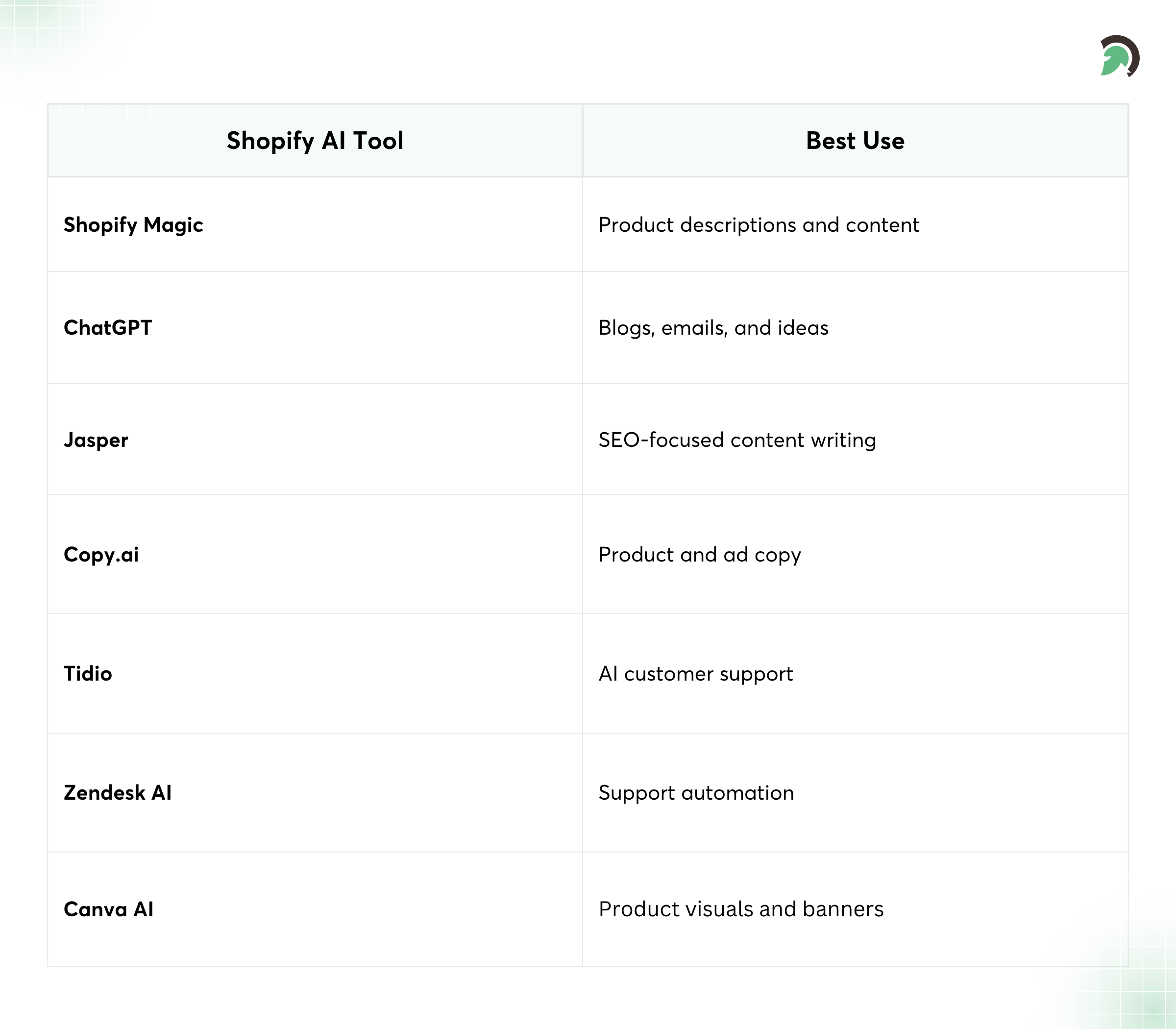
Using the right Shopify AI Tools can help businesses save time, improve efficiency, and scale operations more effectively.
Shopify Magic and Shopify Sidekick
Shopify has also introduced built-in AI-powered features designed specifically for ecommerce businesses.
Shopify Magic
Helps generate:
- Product descriptions
- Blog content
- Email campaigns
- FAQ responses
Shopify Sidekick
Acts as an AI assistant that helps merchants:
- Understand store performance
- Simplify operational tasks
- Access business insights more efficiently
These tools make AI adoption easier for growing ecommerce brands.
How to Start Using AI in Your Shopify Store
If you are new to AI, the best approach is to start small and expand gradually.
Step 1: Identify Repetitive Tasks
Look for time-consuming activities such as:
- Writing product descriptions
- Responding to FAQs
- Creating social media content
- Drafting promotional emails
These tasks are ideal starting points for AI implementation.
Step 2: Start With One Tool
Avoid implementing too many platforms at once.
For example:
- Use ChatGPT for content creation
- Use Shopify Magic for product copy
- Use Canva AI for visual design
This makes adoption easier and more manageable.
Step 3: Test and Measure Results
Track metrics such as:
- Time saved
- Conversion improvements
- Engagement rates
- Email open rates
- Customer satisfaction
This helps businesses identify which workflows deliver the best return on investment.
Step 4: Expand Gradually
Once businesses become comfortable using AI in one area, they can slowly introduce it into other operations.
The goal is not complete automation. The goal is smarter workflows and better efficiency.
For businesses planning advanced automation, custom integrations, or enhanced storefront experiences, professional Shopify development services can help create scalable AI-powered ecommerce solutions.
Conclusion
AI is rapidly transforming ecommerce, and businesses now have access to tools that simplify operations, improve marketing, and enhance customer experiences. From writing product descriptions and improving SEO to personalizing customer journeys and automating support, AI helps every Shopify store operate more efficiently and scale more effectively.
However, the best results come from balancing automation with human creativity, authenticity, and strategic thinking. The most successful businesses will use AI to support decision-making rather than replace genuine customer engagement. Whether you are looking to improve content creation, automate repetitive tasks, or enhance customer experiences, AI can play a major role in long-term business growth.
If you want to implement advanced automation, custom features, or AI-driven workflows for your ecommerce business, partnering with an experienced Shopify development company like EvinceDev can help you build a smarter and more scalable online store.